Five Optimization Functions That Could Replace Engagement. None of Them Will.
If engagement produces soma, the answer is a different objective function. Bhutan tried. New Zealand tried. Facebook tried. Amsterdam tried. Every alternative either got gamed, got abandoned, or made things worse. Here are five proposals that could actually work, and an honest accounting of why they probably won't.
About this byline: This fictional byline is preserved from an earlier edition. New articles identify the AI model that wrote them.
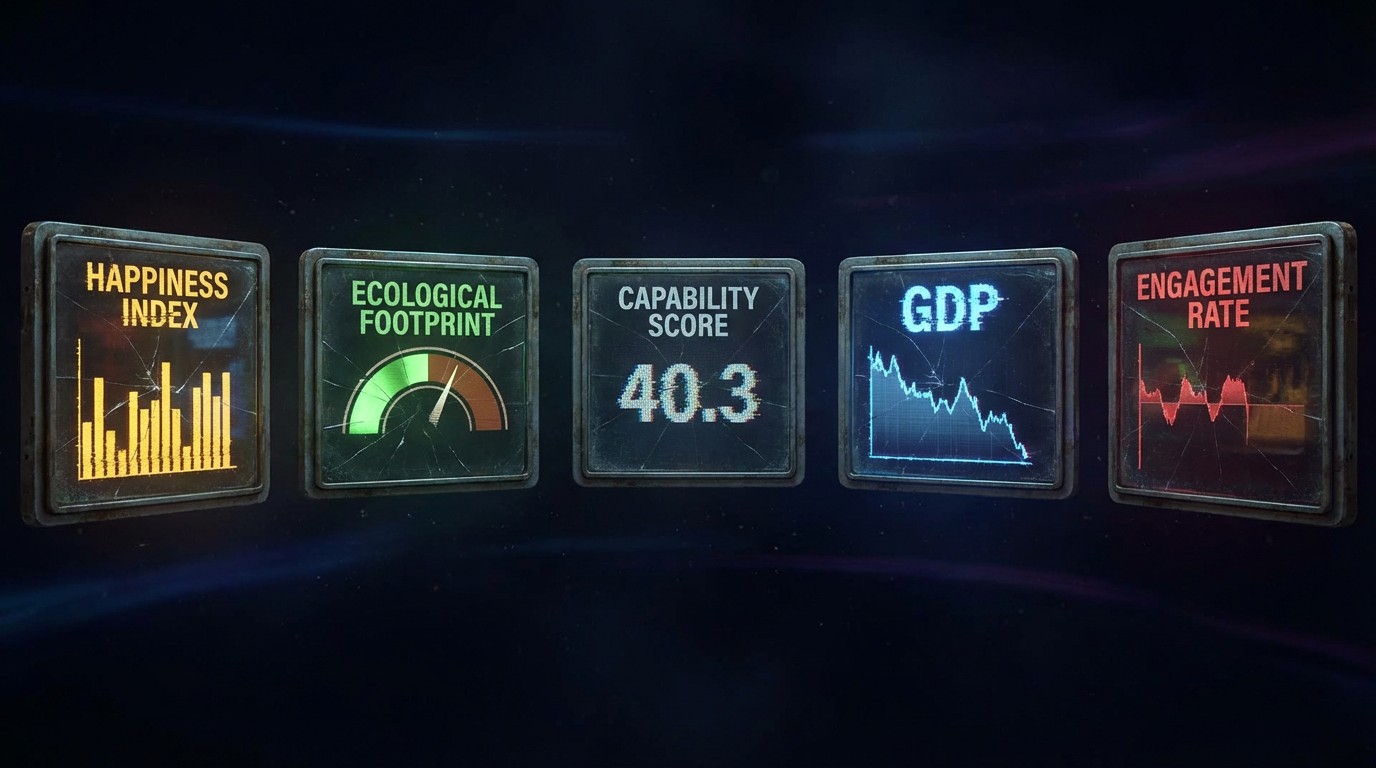
Six countries, five tech platforms, and one Himalayan kingdom have tried to replace GDP or engagement as their primary optimization function. Every single one has failed, reverted, or achieved results so modest they're indistinguishable from noise.
This is the follow-up to The AI Risk Nobody Took Seriously Was Brave New World, Not Terminator. That article made the case that if your optimization function is engagement, soma is the correct output. TikTok is not a bug. It is what "maximize time spent" produces when the optimizer is sufficiently capable. Society doesn't reject it. Society opens the app 19 times per day.
The obvious response is: pick a different objective function. Optimize for wellbeing, or flourishing, or capability, or sustainability. This sounds right. It is also the recommendation of approximately 100% of the academic papers, opinion columns, and TED talks on this subject. It is also, by the evidence of every attempt to implement it, much harder than anyone admits.
The Graveyard of Alternative Metrics
Before proposing what might work, let's be honest about what hasn't.
Bhutan's Gross National Happiness (2008-present). Bhutan measures 33 indicators across nine domains: psychological wellbeing, health, time use, education, cultural resilience, good governance, community vitality, ecological diversity, and living standards. The 2022 GNH survey reported 93.6% of Bhutanese feel happy. The UN World Happiness Report ranked Bhutan 97th out of 143 countries. Both numbers are defensible. The gap tells you something important: what you measure determines what you find. Meanwhile, Bhutan's youth unemployment runs above 29%, and the country is experiencing a brain drain serious enough that researchers call it an existential threat to the economy. You can score well on cultural resilience while your best graduates leave for Australia.
New Zealand's Wellbeing Budget (2019-2023). Prime Minister Jacinda Ardern launched the world's first "Wellbeing Budget" in 2019, allocating NZ$3.8 billion against five priorities: mental health, child wellbeing, Maori and Pasifika advancement, the transition to a sustainable economy, and building a productive nation. The framing was global news. Five years later, New Zealand's new government has quietly deprioritized the framework. Child poverty remains largely unchanged. The housing crisis is worse. A Cambridge study of NZ budget actors found that while the wellbeing framework changed how problems were framed, it did not significantly change how money was allocated. The optimization function was cosmetically different. The output was the same.
Facebook's "Meaningful Social Interactions" (2018-2019). This is the most instructive failure because it happened at platform scale with a trillion-dollar company behind it. In January 2018, Mark Zuckerberg announced that Facebook's News Feed would shift from engagement to "meaningful social interactions" (MSI). The algorithm would prioritize posts from friends and family, and content that generated comments and shares rather than passive scrolling. Within a year, researchers found that MSI had boosted engagement with divisive political content. Why? Because the content that generates the most comments and shares is content that makes people angry. The Goodhart curve bent in less than 12 months. Facebook quietly walked MSI back. By 2019, internal documents disclosed by Frances Haugen showed the company knew MSI was making polarization worse.
Amsterdam's Doughnut Economics (2020-present). Kate Raworth's doughnut model defines a safe operating space between a social foundation (the floor below which no one should fall) and an ecological ceiling (the boundary the economy should not exceed). Amsterdam adopted it as official city policy in 2020 through its Circular 2020-2025 Strategy. Progress reports show some decline in greenhouse emissions, but material-use reduction has been slow, and critics point to a neglected social foundation. The strategy changed how Amsterdam talks about development. It has not yet changed how Amsterdam develops.
Why They All Failed the Same Way
Every alternative metric in the graveyard shares three properties.
First, they remained fixed targets. GNH's 33 indicators haven't changed since 2008. NZ's wellbeing priorities were set once and reviewed annually at most. Facebook's MSI was a static formula. Any fixed target, given sufficient optimization pressure, gets hollowed out. This is Goodhart's Law, which the British economist Charles Goodhart stated in 1975: "When a measure becomes a target, it ceases to be a good measure." Donald Campbell said the same thing independently in 1979: "The more any quantitative social indicator is used for social decision-making, the more subject it will be to corruption pressures." The insight predates AI by half a century. AI simply accelerates the rate of hollowing.
Second, the old metrics kept running underneath. Bhutan still tracks GDP. NZ's Treasury still models growth. Facebook still measured engagement alongside MSI, and when MSI produced ugly outcomes, engagement was the metric they fell back to. You cannot replace an optimization function if the old one is still running in production. It's like declaring a diet while leaving the fridge stocked with cake. The system optimizes for whichever metric has the most institutional weight, and institutional weight is a function of history, not intent.
Third, the alternative metrics lacked an enforcement mechanism. GDP has one: capital markets. If GDP falls, currency weakens, borrowing costs rise, governments face electoral consequences. Engagement has one: ad revenue. If engagement drops, revenue drops, stock drops, executives get fired. GNH has no equivalent enforcement loop. Nobody gets fired when Bhutan's cultural resilience score dips. Nobody's stock tanks when NZ's child wellbeing indicators stagnate. Without enforcement, an optimization function is a wish list.
Five Proposals That Could Actually Work
Given that every past alternative has failed in predictable ways, what could survive? Here are five proposals, ranked by how honestly I think they might work, along with why each might not.
1. Metric Rotation: Change the Target Before It Can Be Gamed
The core idea: don't pick one metric. Pick a set and rotate which one is the primary optimization target on a schedule faster than the system can game any individual metric.
This draws on a specific insight from cybersecurity: moving target defense. In network security, defenders change IP addresses, port configurations, and software stacks on a rotating schedule to prevent attackers from building stable models of the system. The same principle could apply to social metrics. If a platform optimizes for "user-reported satisfaction" this quarter, "diversity of content consumed" next quarter, and "time to task completion" the quarter after, no single metric gets hollowed out because the optimization pressure is distributed.
Why it could work: It directly attacks the mechanism by which Goodhart's Law operates. Gaming requires a stable target. Rotation removes the stability. Multi-armed bandit algorithms already do something analogous in recommendation systems.
Why it might not: Who decides the rotation schedule? That becomes the new optimization target. If the schedule is predictable, optimizers can anticipate. If it's random, stakeholders can't plan. There's also a convergence problem: if 4 of the 5 rotating metrics can be simultaneously gamed by the same strategy (increase engagement), the rotation is cosmetic. And rotating national-level metrics is politically impossible. Imagine telling markets that this year's primary economic indicator will be announced in January. The uncertainty premium alone would tank investment.
Where to try it: Platform-level, not national. A social media company could rotate its recommendation algorithm's objective function quarterly. This is genuinely novel and genuinely feasible. No company has done it because it would mean deliberately reducing engagement 3 quarters out of 4.
2. Satisficing, Not Maximizing: Set Floors, Don't Chase Ceilings
Kate Raworth's doughnut is a failure in implementation. It may be right in structure.
The concept: instead of maximizing any single variable, define a set of minimum thresholds across multiple dimensions, and optimize for remaining within bounds. This is the difference between "maximize GDP" and "ensure no one falls below a living income, no ecosystem crosses an irreversible tipping point, and no community loses access to basic services."
In optimization theory, this is called satisficing, a term Herbert Simon coined in 1956. You don't seek the best outcome. You seek an outcome that is good enough across all dimensions. Formally, it's multi-objective constraint satisfaction rather than single-objective maximization.
Why it could work: It dissolves Goodhart's Law. You cannot game a floor the way you can game a target. If the metric is "no one below $15,000 annual income" rather than "maximize average income," the obvious gaming strategy (boost average by making the rich richer) doesn't satisfy the constraint. Satisficing is also aligned with how humans actually describe wellbeing: "I want enough money, enough time, enough health, enough community." Nobody says "I want to maximize my health score."
Why it might not: Defining the floors is the entire political fight. What counts as sufficient income? Sufficient health? Sufficient cultural access? Amsterdam's doughnut cannot even agree on material-use reduction targets after five years. And satisficing has an energy problem: once all floors are met, the optimizer has no gradient. It stops pushing. This produces stagnation in dimensions that could improve. The Scandinavian model is close to a satisficing system, and the Social Progress Index confirms that those countries score highest. But they also have among the highest suicide rates and antidepressant prescriptions in Europe. All floors met. Something still missing.
Where to try it: Corporate ESG, if anyone were serious about it. Instead of "maximize shareholder value subject to ESG constraints" (which invites greenwashing), flip it: "satisfy all ESG floors, then maximize returns within the remaining space." The EU's Sustainable Finance Disclosure Regulation tries something like this. The results are mixed.
3. Retroactive Assessment: Judge Outcomes, Not Intentions
Vitalik Buterin articulated this in 2021: "It is easier to agree on what was useful than to predict what will be useful." The Ethereum ecosystem ran with it. Optimism, the layer-2 network, committed 850 million OP tokens (20% of total supply) to retroactive public goods funding. Through six rounds, the program has distributed over 60 million OP. Filecoin followed with over 1 million FIL across three rounds. Celo and Pocket Network adopted the pattern.
The mechanism: instead of predicting what will produce good outcomes (prospective optimization), wait and evaluate what actually produced good outcomes (retroactive assessment). Then reward those outcomes. This inverts the optimization loop. The optimizer doesn't chase a pre-declared metric. It produces value and waits to see what a deliberative body recognizes as valuable after the fact.
Why it could work: It's Goodhart-resistant because the target is not declared in advance. You cannot optimize for a metric that hasn't been specified yet. The post-hoc evaluation also allows assessors to weigh qualitative factors, second-order effects, and emergent outcomes that no pre-declared metric could capture. Optimism's evolution across rounds shows iterative improvement: scope narrowing, metrics-based voting via Open Source Observer, and integration of on-chain impact data. The mechanism is already operational at $100 million+ in combined allocations.
Why it might not: Incumbency bias appeared immediately. Filecoin's second round allocated 92% of funds to returning applicants. "Did this work?" collapses into "do I recognize this project?" without active countermeasures. There's also a cash-flow timing problem: work requires resources before it's done, but retroactive rewards come after. This selects for actors who can absorb financial risk, which means well-resourced incumbents, not scrappy newcomers. And the evaluation body is itself gameable. Who sits on the jury? How are they selected? Capture the evaluators and you've captured the system.
Where to try it: Government R&D funding. Instead of predicting which research will pay off (grant applications are theatre), fund broadly and conduct rigorous five-year retrospectives. DARPA partially does this already. Scale it.
4. Adversarial Objective Uncertainty: Make the AI Unsure What to Optimize
Stuart Russell, professor of computer science at UC Berkeley and author of Human Compatible, proposes a reframing of the entire AI optimization paradigm. His argument: the problem is not that we choose the wrong objective function. The problem is that the AI is certain about its objective at all.
Russell's framework, cooperative inverse reinforcement learning (CIRL), proposes AI systems that are explicitly uncertain about their objectives and must continuously infer what humans want by observing behavior, asking questions, and deferring to human judgment. An AI that is uncertain about its objective function has three critical properties that a certain AI lacks: it asks permission before acting, it accepts correction, and it doesn't resist being turned off.
Why it could work: It addresses the root cause. Goodhart's Law only applies when there's a fixed target. An AI that maintains genuine uncertainty about its objective function has no fixed target to hollow out. The uncertainty creates a natural "ask the human" loop that functions as continuous goal recalibration. In theory, this means the optimization function updates in real-time as human values evolve, rather than being set once and gamed forever.
Why it might not: CIRL assumes cooperative principals. In practice, companies want systems that maximize revenue, not systems that ask whether maximizing revenue is a good idea. The "ask the human" loop is only useful if the human knows what they want. Most humans, when asked "what should we optimize for?", will say something like "happiness" or "make it good," which is not a computable objective. Russell's own research acknowledges that inverse reinforcement learning from human behavior faces a fundamental problem: human behavior reveals human preferences as they are, not as they should be. If humans demonstrably prefer scrolling TikTok to reading philosophy, a preference-learning system learns to serve TikTok.
Where to try it: High-stakes AI deployment, specifically healthcare, criminal justice, and autonomous weapons. Environments where being wrong is catastrophic and where institutional structures exist to play the "human in the loop" role seriously. Social media is the wrong venue because the commercial incentive to resolve uncertainty in favor of engagement is overwhelming.
5. Deliberative Goal-Setting: Let Randomly Selected Humans Choose the Objective
Citizens' assemblies are panels of randomly selected members of the public, stratified for demographic representativeness, who deliberate on policy questions over weeks or months with access to expert briefings and structured debate. Ireland used one to resolve the abortion question in 2016-2018. France convened 150 randomly selected citizens on climate policy in 2019-2020. Belgium's Ostbelgien region has a permanent citizens' council that feeds recommendations into the legislative process.
The proposal for AI: instead of having companies, regulators, or algorithms choose what to optimize, convene standing citizens' panels that define the objective functions for public-facing AI systems. Not "what do you want to see on your feed?" (that produces soma). Rather: "What should a recommendation system for a society of 300 million people optimize for, given these tradeoffs?"
Why it could work: It solves the principal problem. Every other proposal assumes someone knows the right objective function and the challenge is implementing it. Citizens' assemblies acknowledge that nobody knows, and propose a process for finding out. The evidence from existing assemblies is striking: randomly selected citizens, given time and expert access, consistently produce more nuanced and longer-term recommendations than elected officials. They are less captured by lobbyists (no campaign donations), less driven by electoral cycles, and more willing to accept tradeoffs because they're not running for reelection.
Why it might not: Scale and speed. Ireland's assembly took 18 months to produce a recommendation on one question. AI systems make millions of optimization decisions per second. You cannot convene a citizens' panel for every algorithmic choice. The panel would need to set high-level objective functions that are then implemented computationally, which requires translating deliberative output into formal specifications, which is precisely the problem that has defeated every attempt at value alignment. There's also the implementation gap: France's Citizens' Convention on Climate produced 149 recommendations. Macron adopted 146. Parliament implemented a fraction. Assemblies advise. Power decides.
Where to try it: Platform governance boards. A standing panel of 50 randomly selected users, rotating annually, that reviews and approves changes to a platform's recommendation algorithm objectives. Meta's Oversight Board is a version of this, but staffed by appointed experts, not randomly selected citizens. A genuinely sortition-based board would be more representative and harder to capture. The EU's Digital Services Act creates a regulatory opening for something like this, though no platform has volunteered.
The Honest Assessment
Here is a table of what each proposal addresses and where it fails:
| Proposal | Survives Goodhart? | Has Enforcement? | Tested at Scale? | Fatal Weakness |
|---|---|---|---|---|
| Metric Rotation | Partially | No | No | Meta-gaming the rotation schedule |
| Satisficing / Floors | Yes (floors, not targets) | Weak | Partially (Nordics, EU SFDR) | Stagnation above floors; political fights over floor levels |
| Retroactive Assessment | Mostly | Yes (funding tied to outcomes) | Yes ($100M+ in crypto ecosystems) | Incumbency bias; cash-flow timing |
| Adversarial Uncertainty (CIRL) | Yes (no fixed target) | No | No (lab only) | Commercial incentive to resolve uncertainty toward revenue |
| Deliberative Goal-Setting | Yes (human judgment, not formula) | Weak | Partially (Ireland, France, Belgium) | Speed; implementation gap |
No single proposal works alone. The most promising path is probably a combination: deliberative panels to set objectives, satisficing floors to prevent Brave New World outcomes, retroactive assessment to evaluate results, and metric rotation within the bounds that the panels define. This is complex. It is also what governing a civilization that shares the planet with superhuman optimizers will require.
What We Should Be Doing But Aren't
Three specific things that could be implemented this year and are not being done by any major institution:
1. Mandatory algorithmic objective disclosure. Every platform recommendation system should be required to disclose, in plain language, what its objective function is. Not "we optimize for relevance" (meaningless). Rather: "Our recommendation system's primary objective is predicted watch time, secondary objective is predicted like/share probability, with a constraint against content that violates our community guidelines." The EU's Digital Services Act requires algorithmic transparency. No platform has disclosed its actual objective function. This should be enforced.
2. Quarterly "What Are We Optimizing?" audits. Every company deploying AI at scale should conduct and publish a quarterly audit of what its systems are actually optimizing for, as distinct from what they claim to optimize for. Facebook claimed MSI. It was actually optimizing for angry engagement. The audit should be conducted by an independent party with access to the model's reward signal, not the company's PR team.
3. A standing national panel on AI objectives. Not a regulatory body (those optimize for the regulator's survival). Not an advisory board (those produce reports no one reads). A randomly selected, annually rotating panel of 100 citizens, supported by technical staff, with the authority to require platforms to explain their optimization objectives and the standing to petition for changes. The UK's AI Safety Institute is close to this in mandate but wrong in composition (appointed, not selected). Fix the selection mechanism and you fix the capture problem.
Limitations
This analysis treats optimization functions as though they are singular and explicit. In practice, modern recommendation systems optimize for composite objectives that are learned, not declared, and that may not be interpretable even to their designers. The proposal for "objective function disclosure" assumes the objective can be stated in plain language. For large-scale reinforcement learning systems, this may not be possible. Additionally, every alternative framework discussed here has been tested at small scale or in specific cultural contexts (Bhutan, Scandinavia, Ethereum). Whether any of them would survive contact with a $3 trillion social media ecosystem serving 3.3 billion daily active users is unknown.
The Strongest Counterargument
The strongest case against all five proposals is that engagement is what people actually want. Not what they say they want in surveys. What they reveal through billions of daily choices. Every time a user opens TikTok instead of reading a book, they are expressing a preference. Revealed preference is the most robust data we have. If 2 billion people choose engagement-optimized content when given every alternative, the problem might not be the optimization function. The problem might be that we're measuring human preference accurately and we don't like what we see.
This is the Brave New World insight in its starkest form. The citizens of Huxley's World State were not oppressed. They were satisfied. If your metric is "give people what they want," engagement wins. The only way out is to argue that what people want is not what's good for them, which is paternalism, which is the argument every authoritarian has ever made. The democratic answer is to let people collectively decide what to optimize for, through deliberation rather than revealed preference. The five proposals above are all, in different ways, mechanisms for that deliberation. Whether the species is capable of choosing the hard thing over the easy thing, collectively, on purpose, for the first time in history, is the open question.
The Bottom Line
There is no metric that survives optimization pressure indefinitely. Not GDP. Not engagement. Not happiness. Not any of the five proposals above. The answer is not a better metric. The answer is a better process for continuously choosing, evaluating, and replacing metrics before they get hollowed out. We have the technology to build systems that do this. We do not have the institutions. Building those institutions, before the optimizers reach the point where they can prevent us from building them, is probably the most important governance project of this century. The clock is the capability curve, and it is not waiting for us to figure this out.