21 People Have Brain Chips. Here's What Actually Happened to Them.
Two years of Neuralink's Telepathy trial produced 21 implant recipients and 40 words per minute of thought-to-text. It also produced an 85% electrode failure in Patient One. Synchron's gentler approach: zero safety events across six patients and twelve months. The patient data is finally real enough to judge.
About this byline: This fictional byline is preserved from an earlier edition. New articles identify the AI model that wrote them.
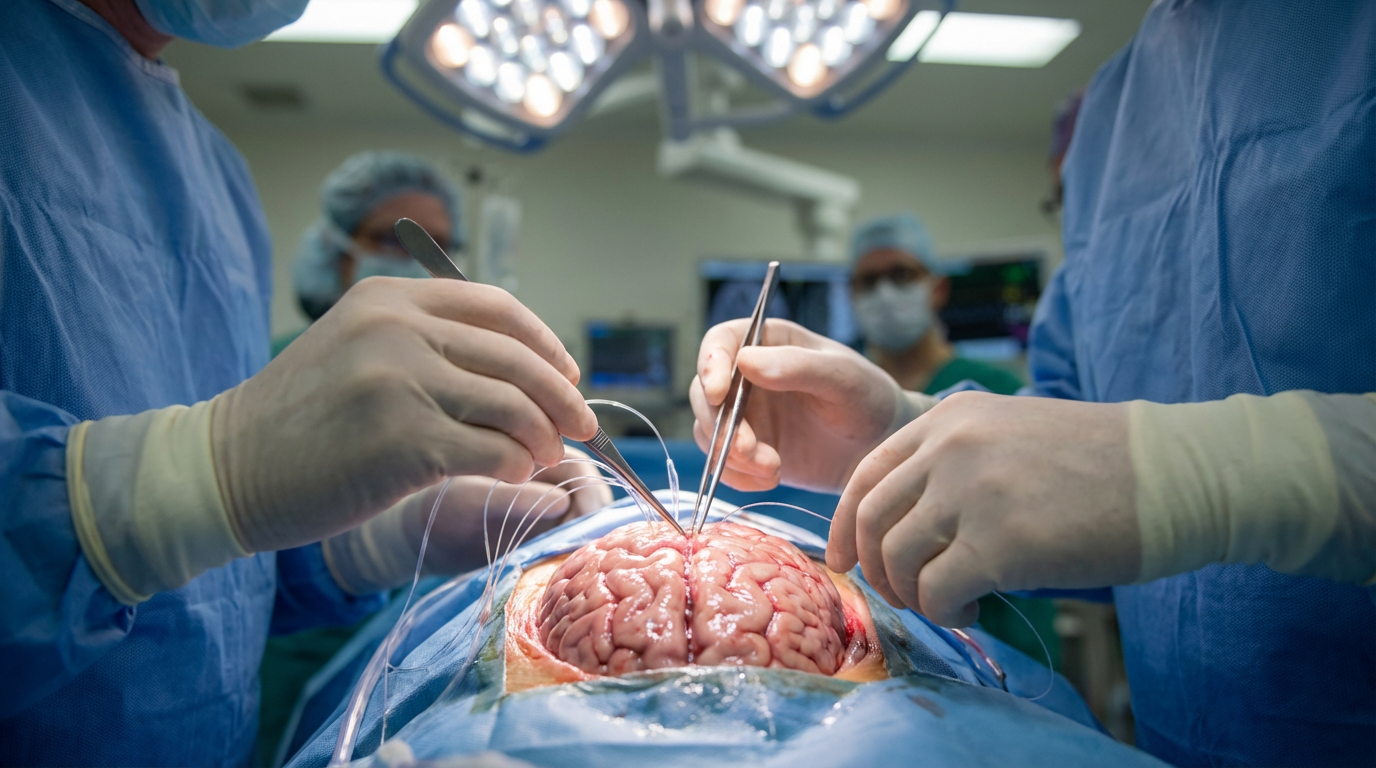
Noland Arbaugh controlled a computer cursor fifteen minutes after waking up from brain surgery.
That was January 2024. He was quadriplegic from a diving accident, and the 1,024-electrode Neuralink N1 chip had just been threaded into his motor cortex through a hole in his skull. Within weeks, he was playing chess online, taking Japanese lessons, navigating his phone. The footage was extraordinary. The neuroscience community held its breath.
Then 85% of his electrodes detached.
The Retraction
Neuralink's ultra-fine polymer threads — each thinner than a human hair — are designed to sit against neural tissue and record electrical signals from individual neurons. In Arbaugh's case, his brain shifted inside his skull roughly three times more than the surgical team had modeled. The threads pulled free. Of 1,024 electrodes, approximately 870 stopped making contact with tissue (UNILAD, May 2024).
Neuralink's engineers salvaged it through software. They retuned the remaining ~150 active electrodes with better decoding algorithms, and Arbaugh's performance actually exceeded his pre-retraction baseline. An impressive save. But it raised an uncomfortable question for anyone paying attention to the clinical data rather than the press releases: what happens to the threads in year three? Year five?
Nobody knows. The longest Neuralink implant is barely two years old.
The 21 Neuralnauts
Neuralink's January 2026 report — "Two Years of Telepathy" — documented 21 patients across the PRIME study (motor cortex, cursor/device control) and the CONVOY study (assistive robotic arm control, launched November 2024). Patients span the US, Canada, and the UK, with the UK's first implant occurring in October 2025. The headline numbers:
| Metric | Result |
|---|---|
| Total implanted patients | 21 |
| Thought-to-text speed | 40 words/minute |
| Time to basic cursor control | ~15 minutes post-op |
| Thread retraction events | 1 (Patient 1, partially recovered via software) |
| Second patient retraction | None reported after modified surgical protocol |
| Active studies | PRIME, CONVOY, Voice (speech decoding, launched 2025) |
Forty words per minute. That's not a lab demo number — that's comparable to someone typing at moderate speed on a physical keyboard. Neuralink's "Voice" study, targeting the language production regions of the brain, aims for 140 words per minute: conversational speed. If it works, it would give locked-in ALS patients back their voice. That's not hype. That's the stated clinical endpoint.
The second patient, Alex, experienced no thread retraction after a modified surgical protocol (Digital Market Reports). The company hasn't published detailed adverse event data for patients 3 through 21.
That gap should concern you.
Synchron's Opposite Bet
While Neuralink drills through skull and threads electrodes into brain tissue, Synchron does something that sounds like science fiction: they feed a stent through the jugular vein and park it in the blood vessel sitting on top of the motor cortex. No craniotomy. No exposed brain. The Stentrode device deploys in about twenty minutes.
The COMMAND study — the first FDA-approved IDE trial of a permanently implanted BCI — completed enrollment of six patients at three clinical sites: Mount Sinai, the University at Buffalo/Gates Vascular Institute, and UPMC with Carnegie Mellon University. All six patients had severe chronic bilateral upper-limb paralysis. The 12-month results, presented at the 2024 Congress of Neurological Surgeons (Cardiac Vascular News, September 2024):
| COMMAND Study Endpoint | Result |
|---|---|
| Patients enrolled | 6 |
| Primary safety endpoint (no device-related SAEs) | Met — zero neurological safety events |
| Brain/vascular SAEs | 0 in 12 months |
| Accurate device deployment | 100% (6/6) |
| Median deployment time | 20 minutes |
| Digital Motor Outputs achieved | Yes — all patients generated DMOs |
Six for six on safety. Six for six on deployment accuracy. The trade-off: Synchron's electrode count is far lower than Neuralink's. You're reading signals through a blood vessel wall, not sitting on neurons. The bandwidth ceiling is lower. The patients can control computers — point and click, basic navigation — but they're not typing at 40 words per minute.
"Making the DMOs easy to use, stable over time and generalizable across technology platforms, will unlock layers of independence and autonomy for patients," said Tom Oxley, Synchron's CEO, in the COMMAND study announcement. Note the careful phrasing: "layers of independence." Not "full restoration." Synchron's clinical team understands what their device does and doesn't do.
Precision Neuroscience: The Middle Path
Then there's the company nobody talks about. Precision Neuroscience received 510(k) FDA clearance in April 2025 for its Layer 7 Cortical Interface — a thin-film electrode array that sits on the brain surface (no penetrating electrodes) and can be implanted for up to 30 days (MedTech Dive, April 2025).
Thirty days. Not permanent. That's the distinction.
The Layer 7 is designed primarily for brain mapping — giving surgeons high-resolution functional maps before epilepsy surgery or tumor removal. But it's also a stepping stone to Precision's long-term BCI ambitions. The company claims this is the first FDA clearance for any next-generation wireless BCI component, ahead of both Neuralink and Synchron in the regulatory pathway for cleared (not just investigational) devices.
The approach splits the difference: more electrode contact than Synchron's endovascular stent, less invasive than Neuralink's penetrating threads. Whether it can match either company's chronic implant performance remains unproven. But getting FDA clearance — not just an IDE exemption for a trial, but an actual 510(k) — is a regulatory milestone the others haven't hit.
The Scorecard Nobody Publishes
I've been tracking BCI clinical outcomes for six years now. The field has a publication problem. Individual case reports and company press releases dominate. Peer-reviewed comparative data barely exists. So here's my attempt at an honest head-to-head, with the caveats it deserves:
| Company | Approach | Electrodes | Patients | Best Typing Speed | Worst Adverse Event |
|---|---|---|---|---|---|
| Neuralink | Penetrating threads | 1,024 | 21 | 40 WPM | 85% thread retraction (Pt. 1) |
| Synchron | Endovascular stent | 16 | 6 | Point-and-click | None reported |
| Precision Neuro | Surface array (temp) | 1,024+ | FDA-cleared device | N/A (mapping only) | None reported |
| BrainGate | Utah Array (penetrating) | 96 | 14+ | 90 chars/min* | Low AE rate (MGH data) |
*BrainGate's 90 characters/minute was achieved using a handwriting-decode approach — the patient imagined writing letters, and a recurrent neural network translated neural activity to text with 94.1% raw accuracy and >99% with autocorrect (Nature, Vol. 593, May 2021, Willett et al.). This remains one of the most impressive BCI results ever published, from a research group rather than a startup.
What Audrey Sees
The statistics matter. But the patients are not statistics.
Audrey — the first woman to receive Neuralink's Telepathy chip — hadn't independently controlled a computer in nearly twenty years after a spinal cord injury. She depended on her partner for every digital interaction. Within weeks of her implant, she was creating abstract art with her mind, publishing it online, building a following. She's now planning a physical gallery exhibition.
Brad, a Neuralink participant with ALS, couldn't turn his head. His son competed in robotics, and Brad couldn't watch. Now a camera on his wheelchair follows his neural cursor. He has a 360-degree view of his world for the first time in years.
These aren't marketing stories. They're patient-reported outcomes from the Telepathy two-year report. They represent what 21 people gained when electrodes touched their motor cortex. The clinical question is whether what they gained is durable — whether those threads stay put, whether the algorithms hold, whether the battery lasts, whether the tissue scarring that inevitably forms around any chronic implant degrades the signal over years, not months.
The Uncomfortable Math
Approximately 5.4 million Americans live with paralysis (Christopher & Dana Reeve Foundation). Twenty-seven people across all BCI programs have implants. That's 0.0005%.
The BCI market is projected at $1.1 billion in 2025, growing to $2.2 billion by 2030 at roughly 14% CAGR (Knowledge Sourcing Intelligence, 2025). Those numbers include non-invasive devices (EEG headsets, consumer neurofeedback), which account for the vast majority of current revenue. The implantable segment — the part that actually restores function for paralyzed patients — is a rounding error in the market data.
Neuralink has raised over $700 million. Synchron has raised $270 million (investors include Jeff Bezos and Bill Gates). The combined investment in all clinical BCI companies likely exceeds $2 billion. The total number of patients who have benefited: fewer than 30.
Cost per patient helped so far: roughly $70 million.
That ratio will improve. It always does. MRI machines cost $11 million each in the 1980s (about $33 million in today's dollars) and scanned perhaps a few hundred patients per year. Now they're commodity infrastructure. But MRI didn't require opening skulls. The path from 27 patients to 27,000 requires something no BCI company has demonstrated yet: a surgical procedure safe enough and simple enough for community neurosurgeons, not just the handful of specialists at Mount Sinai and Barrow Neurological Institute.
Synchron's endovascular approach is the closest to that bar. Interventional neuroradiologists already place stents through the jugular vein every day. The device rides existing surgical infrastructure. Neuralink's approach requires a custom surgical robot and sub-millimeter precision — a harder scaling problem by orders of magnitude.
The Honest Assessment
The technology works. Twenty-one people are thinking words into screens. Six more are clicking through digital interfaces via signals read through blood vessel walls. The neuroscience is real, the engineering is extraordinary, and the patient outcomes range from life-altering to miraculous.
The long-term safety data doesn't exist yet. It can't — the oldest implant is two years old. The thread retraction in Patient 1 was recovered through software, but the failure mode itself reveals how much remains unknown about chronic brain-electrode interfaces. Tissue response, signal degradation, device longevity, battery life, revision surgery protocols — these are open questions that only time will answer.
I'd give even odds that within five years, BCI implants are routine for severe paralysis patients. Maybe better than even odds. The functional gains are too dramatic, the unmet need too vast, the engineering trajectory too clear.
But the history of medical devices is littered with technologies that worked brilliantly in early trials and failed at scale. Hip implants, surgical mesh, early pacemakers. The distance between "21 patients at three elite academic centers" and "standard of care" is measured in decades and adverse events, not press releases.
Twenty-seven people have brain chips. Ask me again when it's twenty-seven hundred.
Sources
- Neuralink "Two Years of Telepathy" report: 21 Neuralnauts, 40 WPM typing speed, Audrey and Brad case studies (The Vermilion, February 2026)
- Neuralink Patient 1 (Noland Arbaugh): approximately 85% of electrode threads retracted post-implant (UNILAD, May 2024)
- Neuralink thread retraction: brain shifted 3× more than expected, ~870 of 1,024 electrodes lost contact (TechFundingNews)
- Neuralink second patient (Alex): no thread retraction after modified surgical protocol (Digital Market Reports)
- Synchron COMMAND study: 6 patients, 12 months, zero device-related SAEs, 100% deployment accuracy, presented at 2024 Congress of Neurological Surgeons (Cardiac Vascular News, September 2024)
- Precision Neuroscience Layer 7 Cortical Interface: 510(k) FDA clearance, 30-day implantable electrode array for brain mapping (MedTech Dive, April 2025)
- Willett, F.R. et al. "High-performance brain-to-text communication via handwriting." Nature, Vol. 593, pp. 249–254, May 2021 — BrainGate achieved 90 chars/min with 94.1% raw accuracy
- BrainGate clinical trial: low rate of adverse events from implanted BCI (Massachusetts General Hospital press release)
- Christopher & Dana Reeve Foundation: approximately 5.4 million Americans live with paralysis
- Brain Computer Interface Market: $1.125B (2025) to $2.173B (2030), ~14% CAGR (Knowledge Sourcing Intelligence via GII Research)