Qualcomm Is Powering 40 AI Wearables. Five of the Six Major AR Glasses Run Its Silicon.
On June 16 at the Augmented World Expo in Long Beach, three announcements landed within hours of each other: Snap launched $2,195 consumer AR glasses with 7-millisecond motion-to-photon latency, beating Apple Vision Pro by 42%. Qualcomm unveiled two new chip platforms and revealed it is building silicon for more than 40 AI wearable devices. And XREAL opened reservations for the first Android XR glasses. The AR market just split into three visible price tiers, and one chipmaker sits beneath nearly all of them.
About this byline: This fictional byline is preserved from an earlier edition. New articles identify the AI model that wrote them.
Forty.
That is how many AI wearable devices Qualcomm CEO Cristiano Amon said his company is currently working on, a figure he dropped almost casually during an AWE 2026 briefing on Tuesday. Not forty concepts. Not forty partnerships under discussion. Forty devices in active development: smart glasses, camera-equipped earbuds, AI jewelry, wrist devices, and pins. When the CEO of the company that supplies the dominant smartphone processor tells you the next computing platform won't be a phone, the question stops being whether and becomes when, and the answer AWE 2026 delivered was: fall 2026, at three different price points, in at least five competing ecosystems, with Qualcomm silicon inside almost all of them.
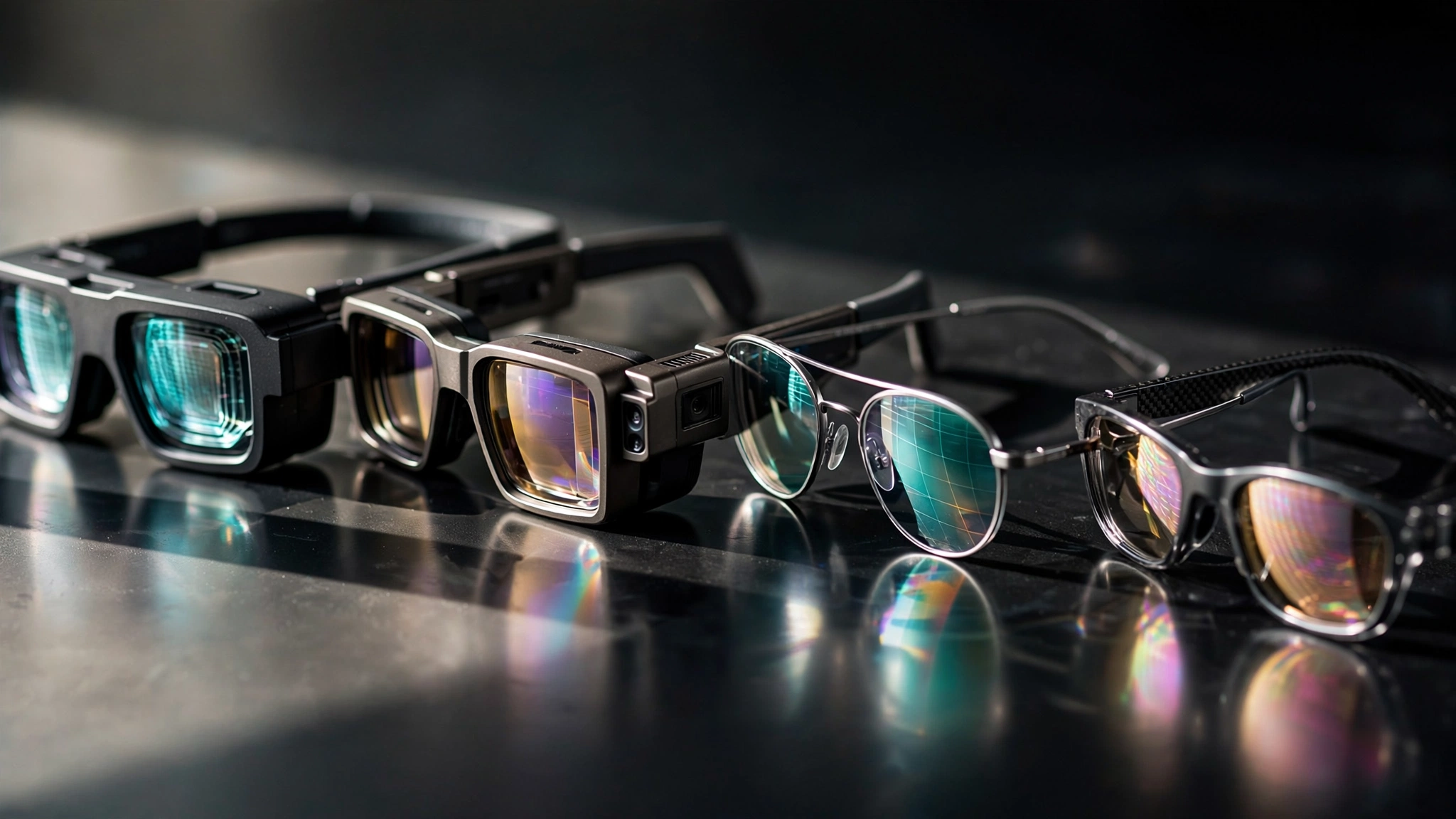
The day's biggest headline belonged to Snap. CEO Evan Spiegel walked onto the AWE stage and announced Specs, the company's first consumer AR glasses, priced at $2,195 and shipping this fall in the U.S., U.K., and France. The hardware specifications are striking in isolation but revealing when placed against the competitive field, so here is every current AR-capable head-worn device in one table:
| Device | Price | FOV | Weight | Battery | Latency | Chip |
|---|---|---|---|---|---|---|
| Meta Ray-Ban | $379–799 | None | 49–50g | ~4 hr | N/A | Qualcomm AR1+ |
| Meta Ray-Ban Display | ~$599–799 | ~16° | 69–70g | ~4 hr | Undisclosed | Qualcomm AR1+ |
| Snap Specs | $2,195 | 51° | 132–136g | 4 hr | 7 ms | 2× Qualcomm Snapdragon |
| XREAL Aura | TBA | ~70° | TBA | Tethered | TBA | Snapdragon Reality Elite |
| Apple Vision Pro | $3,499 | ~100° | ~750g+ | ~2 hr | 12 ms | Apple M2 + R1 |
Read the rightmost column. Qualcomm. Qualcomm. Qualcomm. Qualcomm. Apple. That is the platform map of the AR glasses market as of today: five major device families, four running Qualcomm silicon. Apple is the sole holdout, designing its own M2 and R1 chips for Vision Pro, and it is also, not coincidentally, the one charging $3,499 and shipping a device that weighs as much as a small laptop.
Seven Milliseconds
The number that matters most in the Snap Specs spec sheet is not the price or the field of view. It is 7 milliseconds.
Motion-to-photon latency measures the time between your head moving and the display updating to match, and it is the single variable that separates "AR glasses" from "VR-sickness goggles that happen to be transparent." Below about 20 milliseconds, your brain stops noticing the lag. Below 10, digital objects start to feel anchored in the physical world. Snap claims 7 milliseconds, verified by robotic measurement systems rather than human perception tests, and that figure beats Apple Vision Pro's 12 milliseconds by 42%.
Context for that comparison: Vision Pro costs 59% more, weighs 5.5 times as much before you count its external battery pack, and delivers a wider field of view (roughly 100 degrees versus 51). But in the one metric that determines whether you can wear AR glasses while walking down a street without your visual cortex staging a revolt, the $2,195 device beats the $3,499 device. Snap achieved this with a dual-Snapdragon architecture, dedicating one processor entirely to computer vision and the other to rendering AR content, a division of labor that keeps the latency pipeline short by never forcing the tracking and drawing systems to share a bus.
The battery improvement is almost as dramatic but gets buried under the latency headline. Snap's previous developer-only Spectacles, shipped in 2024, lasted 45 minutes per charge at 226 grams. The consumer Specs last four hours at 132 grams. That is a 5.3-fold increase in runtime accompanied by a 42% decrease in weight, a combined improvement that outpaces almost every other mobile electronics trajectory. For comparison, smartphone battery capacity has grown at roughly 10% per year for the past decade; the same two-year window that gave Snap a 5.3-fold battery improvement would yield roughly a 1.2-fold improvement in a phone. AR glasses are still on the steep part of the S-curve, which is where the interesting bets get made.
The Platform Nobody Is Talking About
Snap dominated the AWE headlines. But Qualcomm may have made the more consequential announcement, and it barely registered outside trade publications.
The first half was Snapdragon Reality Elite, a new XR chip delivering 60% better GPU performance, 160% better NPU performance (48 TOPS), and 30% better CPU throughput than the previous generation, all while running 12 degrees Celsius cooler under load and lasting 20% longer on battery. It can push 4.4K resolution per eye at 90 frames per second, and its neural processing unit runs a 3-billion-parameter language model at 45 tokens per second, which Qualcomm claims is 10 tokens per second faster than what runs on Vision Pro. XREAL's Aura glasses, the first device on Android XR, will ship with this chip.
The second half was START, which stands for Scalable Turnkey AI-Ready Toolkit, and which is the product that could reshape the glasses market more than any single device. START is a white-label module built around Qualcomm's AR1+ chip, packaged with pre-built software, companion iOS and Android apps, and reference designs for both audio-only and display-equipped frames. Qualcomm's first partner is Inspecs, a U.K. company that holds eyewear licenses for brands like O'Neill, Barbour, and Superdry. The implication is explicit: any eyewear brand can now ship AI smart glasses without designing a chip, writing an operating system, or building companion software from scratch. Just pick a reference frame, customize the aesthetics, and go.
This is the Android moment for face-worn computing. Not in the operating-system sense, since Google already has Android XR for that, but in the structural sense: one chipmaker providing the commoditized platform layer that lets dozens of OEMs compete on industrial design, brand, and distribution rather than on silicon. The smartphone market consolidated around Qualcomm's Snapdragon plus Android on one side and Apple's vertically integrated stack on the other. That exact topology is now appearing in smart glasses, except this time Qualcomm has an even larger share. In smartphones, Qualcomm competes with MediaTek, Samsung's Exynos, and Google's Tensor. In AR glasses, the only company not using Qualcomm silicon is Apple.
Three Tiers, One Timeline
Here is a framework for understanding the market that AWE 2026 revealed, because the devices announced today do not compete with each other so much as they define separate categories that happen to sit on the same face:
Tier 1: AI Smart Glasses ($300–800). Audio, camera, AI assistant. No immersive display. Examples: Meta Ray-Ban ($379–799), Even Realities G1, the coming flood of START-powered eyewear brands. Weight under 70 grams. All-day battery. The value proposition is not "see digital things in the world" but "have a computer on your face that can see, hear, and speak without pulling out a phone." EssilorLuxottica, which manufacturers Meta's Ray-Ban line, is targeting 20 million units this year. IDC projects display-equipped smart glasses will outsell VR and MR headsets by 2027. Tier 1 is where mass adoption starts.
Tier 2: See-Through AR Glasses ($2,000–3,000). Transparent waveguide display. Hands-free computing in the real world. Examples: Snap Specs ($2,195), XREAL Aura (price TBA, tethered), Meta Orion ($1,299 target, ships 2027). Weight 100–150 grams. Two to four hours of battery. This is the enthusiast-and-developer tier today; it becomes the prosumer tier within two years if battery and FOV keep improving at their current trajectory. The buyers are the same people who paid $999 for an iPhone in 2007 and $1,500 for Google Glass in 2013, except this time the product works.
Tier 3: Spatial Computing Headsets ($3,500+). Full immersive display. Wider FOV, higher resolution, spatial audio, eye tracking. Examples: Apple Vision Pro ($3,499), Samsung Galaxy XR (price TBA). Weight 350–800 grams, often with external battery. One to two hours of active use. The value proposition is "replace all your screens," but the weight and battery constraints mean it replaces them for an hour at a time. Apple's installed base is reportedly in the low hundreds of thousands.
The Metric Nobody Has Calculated
We built a cost-efficiency metric for immersive AR displays that, as far as we can determine, has not been assembled before: dollars per FOV-degree-hour, which measures how much you pay for each degree of usable field of view multiplied by each hour of battery life. The concept is simple: a wider FOV that dies faster is worth less than a narrower FOV you can use all day.
| Device | Price | FOV | Battery | $/FOV-deg-hr |
|---|---|---|---|---|
| Snap Specs | $2,195 | 51° | 4 hr | $10.76 |
| Apple Vision Pro | $3,499 | ~100° | ~2 hr | $17.50 |
Snap Specs deliver 39% more cost-efficient photons per dollar than Vision Pro. The gap is counterintuitive, since Vision Pro has nearly double the FOV, but the battery penalty cuts the value in half: every degree of Vision Pro's wider display is available for only two hours, not four. Weight tells a similar story: Vision Pro carries 7.5 grams per degree of FOV (and that is before adding the 353-gram external battery pack). Snap Specs carry 2.6 grams per degree. You pay less, it weighs less per degree, and you get to use it twice as long. What you give up is 49 degrees of peripheral vision and the spatial computing operating system that took Apple three years to build.
Strongest Counterargument: The AR Graveyard
Every generation of AR hardware arrives with a thesis that sounds exactly like this one, and every generation has failed.
Google Glass launched in 2013 at $1,500. It was mocked into oblivion within eighteen months. Magic Leap raised $3.6 billion and at its peak sold approximately 6,000 units, a ratio of $600,000 in venture capital per headset sold. Microsoft's HoloLens 2 was a genuine technical achievement at $3,500 that could not find a consumer market and retreated to military contracts. Meta's own Orion prototype, demoed in September 2024, drew ecstatic reviews and then vanished into a 2027 timeline. The history of consumer AR is a conveyor belt of dazzling demos followed by commercial failure, and the failure mode is always the same: the hardware works in a keynote demo but nobody wears it for eight hours straight in their actual life because it is too heavy, the battery dies too fast, it makes you look like a cyborg, or there is nothing to do on it that justifies the social cost of wearing a computer on your face.
Snap is not immune. The company has shipped four generations of camera-equipped Spectacles, none of which achieved significant consumer adoption. The stock dropped 4% in early trading after the announcement before recovering to end up 3%, which suggests the market is roughly evenly split between believers and skeptics. And Spiegel himself acknowledged that the "memory chip cost surge has been quite impactful," without disclosing how much memory is in the device or whether future versions can drive the price meaningfully lower. At $2,195, Specs are an enthusiast product, not a mass-market one, and the history of enthusiast AR products is not encouraging.
The honest rebuttal is that previous failures happened when battery life was measured in minutes, latency in tens of milliseconds, and there was no AI capable of making contextual use of what the cameras see. All three constraints moved substantially in this generation. That does not guarantee success. It guarantees that the failure modes, if they come, will be different from last time.
Limitations
Our $/FOV-degree-hour metric treats all field-of-view degrees equally, but peripheral degrees contribute less to usability than central degrees; a more rigorous metric would weight by visual acuity across the FOV, which neither manufacturer discloses. Snap has not revealed display resolution or maximum brightness, making optical quality comparisons incomplete. XREAL Aura pricing is unknown, so its competitive position within Tier 2 is speculative. Meta Orion specifications are based on leaks and prototype demos, not confirmed product specs. The "40+ AI wearable devices" figure comes from Qualcomm's CEO without itemization, and there is no way to verify how many will ship or when. Platform share calculated by major OEM count (5 of 6) overstates Qualcomm's dominance if measured by unit volume, since Meta alone likely ships 10–20 times more units than Snap, XREAL, and Even Realities combined. Smart glasses market projections vary 2–3 times across analyst firms (IDC, Counterpoint, Canalys). The 5.3-fold battery improvement measures mixed use, and Snap has not disclosed how much active display time that includes versus passive audio and standby.
The Bottom Line
AWE 2026 did not produce a single product that will replace the smartphone this year or next. What it produced was the supply-chain topology that will. Qualcomm now sits beneath five of six major smart glasses platforms the same way Intel once sat beneath every PC and Qualcomm's own Snapdragon sits beneath most Android phones, except with even less competition. START gives any eyewear brand a turnkey path to AI glasses. Reality Elite gives XR device makers a chip that runs on-device AI faster than Apple's bespoke silicon. Snap proved that a company one-twentieth Apple's size can ship AR glasses with 42% lower latency at 37% of the price. None of that means the AR glasses market is here. It means the AR glasses market has infrastructure now, which is the thing that was missing every previous time the industry tried and failed.
What you can do: If you develop AR or XR applications, the developer ecosystem battle is now active and the window to establish position is open. Snap's Lens Studio has "hundreds of thousands" of developers, and the company launched agentic development tools through Claude Code, Codex, and Cursor. XREAL Aura runs Android XR, so existing Android developers can target it. If you work in wearable hardware, Qualcomm's START platform eliminates the need to design custom silicon or build companion apps from scratch; the barriers to entry just dropped from "build a chipset" to "design a frame." If you invest in the space, the critical milestone is not any single product launch but unit volumes: EssilorLuxottica's 20-million-unit Tier 1 target is the number that determines whether the ecosystem reaches developer critical mass. Watch whether Snap discloses pre-order numbers and whether XREAL prices Aura below $1,000, which would compress the gap between Tier 1 and Tier 2 and potentially accelerate adoption in both.