Apple Is Paying Google $1 Billion a Year for the AI Brain It Couldn't Build. Three of Four Glasses Platforms Now Share It.
Apple's custom 1.2-trillion-parameter Gemini model inverts a 19-year financial relationship in which Google was always the one writing checks. When Samsung's Galaxy Glasses and Google's Android XR devices also run Gemini, three of four major smart glasses platforms will share one AI provider. Only Meta runs proprietary. We mapped the convergence, calculated the financial dependency, and found the historical precedent that predicts what happens next.
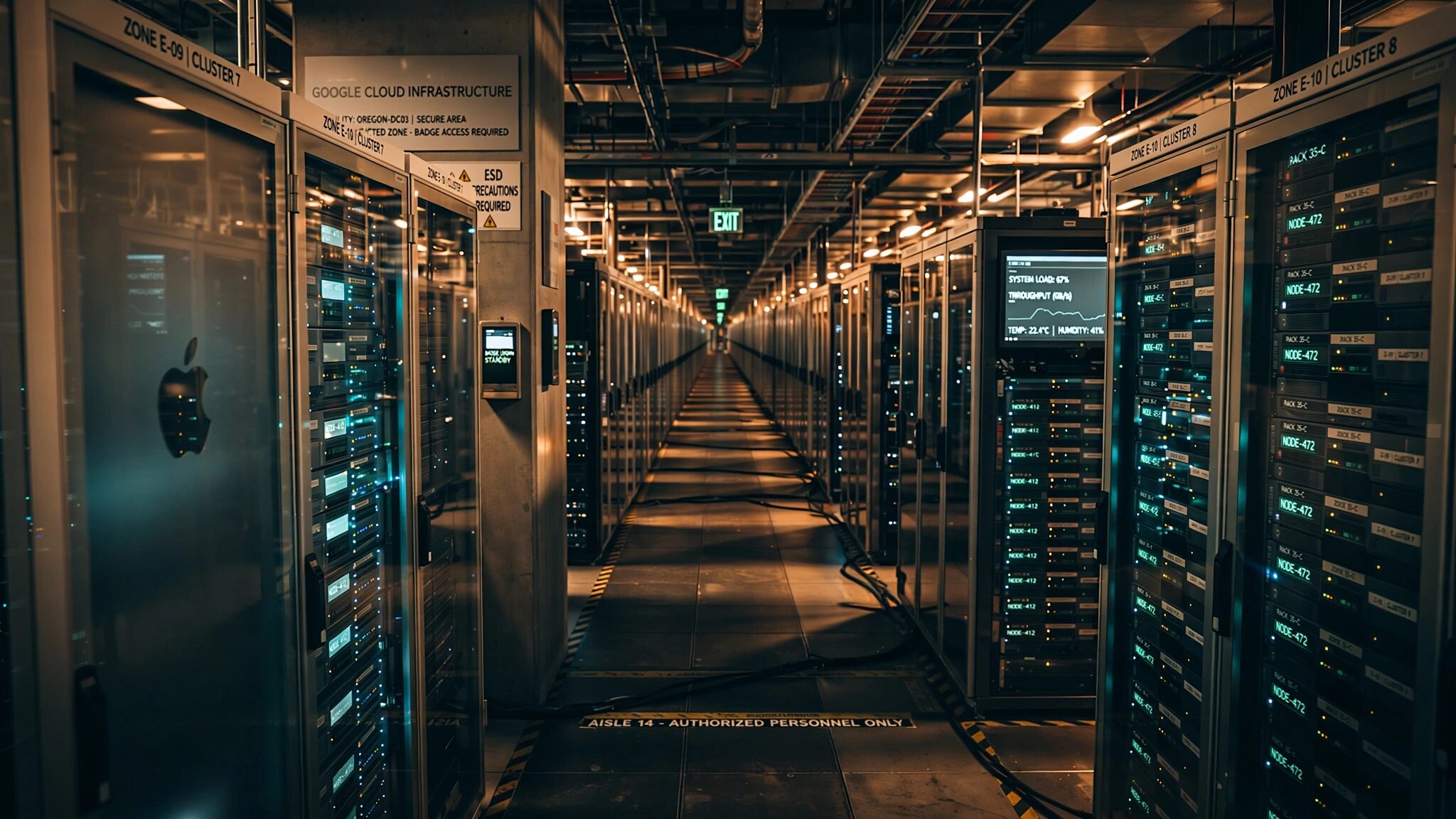
One billion dollars a year. That is what Apple will pay Google for a custom 1.2-trillion-parameter Gemini model to power Siri, according to Bloomberg's Mark Gurman. Think about that number for a moment. The most vertically integrated consumer technology company on Earth, the company that designs its own chips, writes its own operating systems, manufactures its own servers, and spent the better part of two decades systematically eliminating every external dependency in its product stack, just agreed to pay a direct competitor for the AI brain inside its most important software product.
Tomorrow at WWDC, Apple will demo the result, and Siri 2.0 ships to consumers in September.
But the deal's significance extends far beyond Cupertino, because Samsung's Galaxy Glasses, expected at Unpacked on July 22, run Google's Android XR with Gemini as the default AI. Google's own Project Aura display glasses, shown at I/O in May, run Gemini natively, and so does XREAL's Aura with its 70-degree field of view. Count the platforms and you arrive at a number the industry has not fully absorbed: three of four major smart glasses ecosystems will share the same AI brain by year's end, and the fourth, Meta, runs Muse Spark, its first fully closed model built by Alexandr Wang's Superintelligence Labs.
The Dependency Inversion
For 19 years, money has flowed in one direction between these two companies. Google pays Apple roughly $20 billion per year to remain the default search engine on iPhones, iPads, and Macs, a figure confirmed by court documents in the 2022 antitrust proceedings and reported by the Wall Street Journal as recently as June 1, 2026. Apple incurs essentially zero incremental cost for that revenue. It is free money for setting a default the company would likely set anyway.
Now the flow reverses. Apple sends Google $1 billion annually for Gemini. Net transfer? Still overwhelmingly Google-to-Apple, approximately $19 billion. But the directional shift matters more than the arithmetic, because Apple has never before paid a rival for a technology it considers core to its consumer product, and the fact that it is doing so now reveals something the company would rather not advertise about the state of its internal AI capabilities.
Why did it happen? According to The Information, Apple first attempted to run a distilled Gemini on its own Private Cloud Compute servers, the custom Apple silicon infrastructure announced with considerable fanfare at WWDC 2024, but a model with 1.2 trillion parameters demanded more compute than Apple's internal fleet could deliver at acceptable latency, and when the response times came back too slow for a consumer product, the company turned to Google Cloud, where queries now route to Nvidia's Blackwell B200 chips with hardware-level confidential compute encryption.
The irony is structural: Craig Federighi stood on a WWDC stage in 2024 and told developers that anything leaving the device had to run on Apple's own servers, for privacy. That promise lasted 18 months. Some Siri queries now travel to Google's data centers, processed on Nvidia's hardware, branded as Apple's Private Cloud Compute. TheStreet called it "quietly retiring" the Federighi commitment.
Three Brains, One Provider
Map the AI providers across every major smart glasses platform launching in 2026 and the convergence is immediate:
| Platform | AI Brain | Provider | Model Access |
|---|---|---|---|
| Apple (Siri 2.0, future glasses) | Custom Gemini 1.2T | Licensed, cloud | |
| Samsung Galaxy Glasses | Gemini via Android XR | Integrated, native | |
| Google / XREAL Aura | Gemini | First-party | |
| Meta Ray-Ban | Muse Spark | Meta (internal) | Proprietary, closed |
Three of four major platforms running one provider's model represents seventy-five percent convergence. If you include Huawei's glasses running its proprietary Pangu AI in China and the nascent OpenAI wearable effort confirmed by Qualcomm CEO Cristiano Amon in May, the broader landscape is more fragmented. But the consumer-facing Western market has consolidated hard and fast around a single AI supplier, and the speed of that consolidation has no precedent in consumer electronics.
This concentration has consequences. When three platforms share the same foundational model, their AI capabilities converge, and ask Siri a question, ask Samsung Galaxy Glasses the same question, ask XREAL Aura the same question, and you get responses drawn from the same weights, the same training data, the same reasoning architecture. Fine-tuned differently, yes, but fundamentally alike in ways that matter to the developer choosing where to invest and the consumer choosing which ecosystem to buy into. Competitive differentiation migrates away from what the AI knows and toward how users interact with it.
Where the Moat Actually Lives
Meta stands alone as the outlier, and its differentiation strategy is instructive. Muse Spark gives Meta a proprietary AI layer that no competitor can license or replicate, but Meta's deeper moat is not the model itself. It is the input method. The Neural Band, Meta's electromyography wristband, reads electrical signals from the user's forearm muscles to detect hand gestures without requiring the user to raise their hands, touch their glasses, or speak aloud, a capability that no other shipping product from any manufacturer replicates.
Pair that with EssilorLuxottica's 18,000 retail locations globally, including every LensCrafters and Sunglass Hut, and Meta has a distribution advantage of 53 to 1 over Warby Parker's 337 stores, the eyewear partner for Samsung's Android XR glasses. Italian manufacturing avoids the 27 to 65 percent tariffs that Chinese optics face under current trade policy, and the three-device system connecting glasses, Neural Band, and the forthcoming Malibu 2 watch creates cross-device experiences that cannot be replicated by a competitor shipping a single product.
In the Gemini-converged world, the question that matters for consumers and developers is not "which AI is smarter" but rather "which platform has the best input, the best distribution, and the most defensible hardware ecosystem." On those dimensions, the company without Gemini may be the one best positioned to win.
The Apple Maps Precedent
Apple has walked this road before.
In 2007, the original iPhone shipped with Google Maps as its default mapping application, and the relationship endured for five years, during which Apple grew increasingly uncomfortable with Google's access to iPhone location data and its control over a core user experience that hundreds of millions of people used daily. In September 2012, Apple launched Apple Maps as a replacement. Tim Cook published a public apology within weeks. Scott Forstall, the executive who championed the premature launch, was fired. Apple Maps became shorthand for corporate hubris, and the market punished the stock.
Then Apple spent a decade catching up, and today Apple Maps is a genuinely competitive product with 3D city views, transit routing, and offline navigation, though Google Maps retains roughly 67 percent market share. The lesson is clean and has repeated across modems, GPUs, and display controllers: Apple outsources reluctantly, builds internally with a kind of institutional obsessiveness that borders on compulsion, and replaces external dependencies within three to five years.
Apply that pattern to the Gemini deal and the forecast writes itself. Apple's machine learning teams are building proprietary foundation models during the contract period, a conclusion that requires no insider knowledge because it is simply what Apple does every single time it finds itself dependent on an external supplier for a core capability. The $1 billion annual payment buys time. Morgan Stanley analyst Erik Woodring argued this week that "a polished AI platform and clear agentic vision" could push Apple stock higher, while UBS analyst David Vogt was more measured, maintaining that WWDC won't be a major catalyst "absent a surprise." The short-term product launches tomorrow. The long-term exit strategy is already in a Cupertino lab.
The Strongest Case Against This Analysis
Apple's privacy architecture may genuinely differentiate the Gemini implementation even though the model is licensed. On-device models handle simpler queries locally. Only complex requests escalate to cloud processing, where Nvidia's confidential compute encrypts data during inference. No query data trains the model. Apple has contractual guarantees that Google cannot access user prompts, and the Blackwell B200's hardware-level encryption provides a technical enforcement mechanism beyond contractual language. Users can also choose Claude or ChatGPT for certain tasks, which fragments the Gemini dependency further. The $1 billion may buy Apple something no other Gemini licensee gets: a bespoke model that diverges meaningfully from what Samsung and Android XR receive, making the "same brain" thesis weaker than the surface convergence suggests.
What We Cannot Prove
Bloomberg's $1 billion figure and Munster's $5 billion total are estimates from sources and analysts, not disclosed contract terms. Apple and Google have not confirmed the annual payment. The ratio of on-device queries to cloud queries is unknown, and if Apple routes 90 percent of interactions to on-device models, the practical Gemini dependency is much smaller than the strategic one. Samsung's Galaxy Glasses have not shipped yet; launch-day AI capabilities may differ from pre-release specifications. Meta has not published Muse Spark's parameter count or architecture in sufficient detail to make an apples-to-apples model comparison. And the Apple Maps precedent, while historically apt, is a single data point from which to extrapolate a company's entire AI strategy.
The Bottom Line
Apple paying Google for a core AI capability is not failure; it is triage performed by a company that learned from the $250 million Siri false-advertising settlement exactly how much delay costs. WWDC tomorrow will show whether the Gemini-powered Siri can deliver what Federighi promised two years ago.
For developers choosing a smart glasses platform: if three of four options run the same AI, your development investment differentiates on input, sensors, and ecosystem, not on the intelligence layer. Build for the hardware you believe will win distribution, not the model you think will win benchmarks. For investors: watch the on-device versus cloud query ratio when Apple publishes iOS 27 usage data. A high cloud ratio means a durable Gemini dependency. A low one means Apple is already replacing Google under the hood. For Apple: the clock started in January 2026. History says you have until about 2029 before the market expects you to have built your own. You have never missed that kind of deadline before.