Casio Let an Algorithm Design a G-Shock. The Result Is Stronger Than Any Human Could Draw.
The MTG-B4000 is the first consumer watch with a generative AI-designed frame. It joins a quiet materials arms race where Hublot is sintering gold with ceramic at 2,000°C, TAG Heuer is growing diamonds in a reactor, and Apple is machining Grade 5 titanium at smartphone scale. The watch industry is running a live experiment in computational design that the rest of manufacturing will follow.
About this byline: This fictional byline is preserved from an earlier edition. New articles identify the AI model that wrote them.
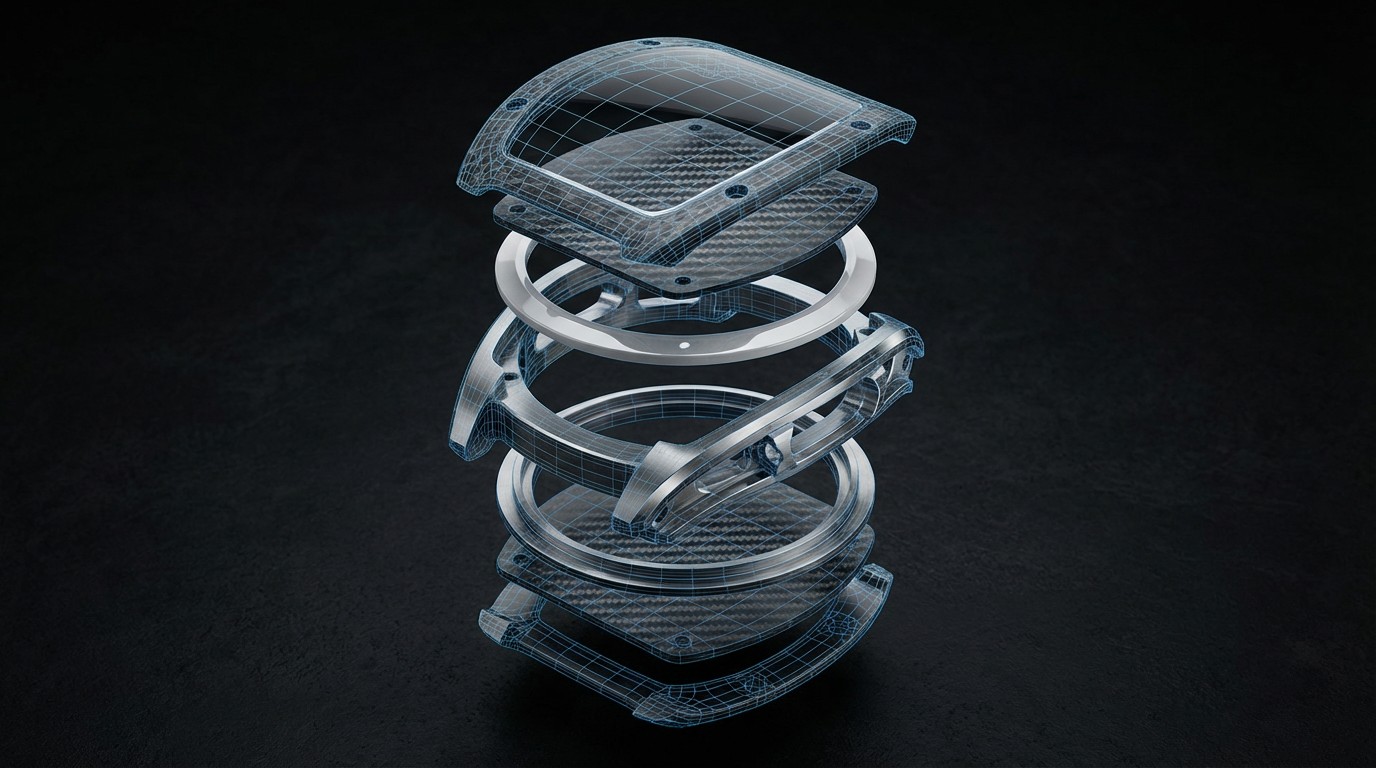
Forty-two years. That's how long Casio's engineers have been dropping G-Shocks from ten meters onto concrete. They've accumulated decades of shock-resistance data: which angles crack cases, which frequencies resonate through bezels, which impact vectors shear band attachments. For every G-Shock model since 1983, a human designer looked at that data, sketched a case shape, prototyped it in resin, dropped it, and iterated. It worked. The G-Shock is the most shock-resistant mass-produced watch on earth.
In May 2025, Casio did something different. They fed the entire 42-year dataset into a generative AI system and asked it to design the optimal frame for a new MT-G. The algorithm evaluated structural strength, material properties, and machinability simultaneously across thousands of configurations that no human would have explored. The result is the MTG-B4000, shipping August 2025 at $1,250. It is the first mass-produced consumer watch with an AI-designed frame.
It will not be the last.
What the Algorithm Actually Did
The MTG-B4000's development process, detailed by SJX Watches, started conventionally. Human designers proposed a concept. Then the AI took over the structural optimization. Using decades of drop-test data as training input, the system ran load simulations and proposed frame geometries that optimized for three constraints at once: shock absorption, material efficiency, and manufacturability. These aren't the same problem. A shape that absorbs impact beautifully might be impossible to machine from carbon composite. A shape that's easy to manufacture might crack at the band attachment.
The most significant structural change the AI proposed was integrating the band connection directly into the outer frame. In every previous G-Shock, the band attaches to the case via spring bars or separate lugs. Force applied to the band transmits through these attachment points into the case. The AI's solution eliminates the intermediary: the carbon-and-glass-fiber composite frame extends continuously into the band connection, so strap forces are absorbed into the frame itself before reaching the center case. It's a solution that emerges naturally from load-path optimization but would be counterintuitive to a human designer trained on 40 years of separate-lug construction.
The frame itself is machined from laminated sheets of carbon fiber and glass fiber in a polymer matrix. The layering produces a visible striated pattern on the case sides. Casio then applies Sallaz polishing (known as Zaratsu in the broader Japanese watchmaking tradition) to the bezel surfaces. Sallaz is a flat-plane polishing technique typically reserved for Grand Seiko cases priced above $5,000. Putting it on a $1,250 G-Shock is a statement about where the MT-G line is headed.
MTG-B4000 vs. Previous MT-G Models
| MTG-B4000 (AI) | MTG-B3000 (Human) | |
| Frame design | Generative AI | Human CAD |
| Band integration | Frame-integrated | Separate lugs |
| Frame material | Carbon/glass fiber composite | Resin + metal |
| Bezel finish | Sallaz polished | Brushed/polished |
| Dimensions | 45.3 × 56.6 × 14.4mm | 49.8 × 51.9 × 12.1mm |
| Price | $1,250–$1,350 | $1,000–$1,100 |
The Materials Arms Race Nobody's Talking About
The MTG-B4000 is notable because of the AI angle. But step back and look at the watch industry's material innovations over the past decade, and you'll see something broader: this is the most material-experimental consumer product category on earth. No other industry puts this many exotic materials on a mass-market product that people wear every day.
Hublot Magic Gold is the most extreme example. In 2012, Hublot announced it had created scratch-resistant 18-karat gold. Traditional 18K gold has a Vickers hardness of about 110 HV. Stainless steel is roughly 200 HV. Hublot's Magic Gold hits 1,000 HV. For reference, standard watch ceramic runs 1,200-1,600 HV. Hublot made gold nearly as hard as ceramic.
The process: take boron carbide powder (one of the hardest materials known, used in tank armor), cold-press it into shape, then inject molten 24-karat gold at extreme pressure and temperature. The gold fills the microscopic voids in the ceramic matrix. The result is a material that is legally 18K gold (75%+ gold by weight), maintains the warm color of gold, but can only be scratched by diamond. Hublot patented the process. Nobody else can make it.
TAG Heuer went in a different direction: growing diamonds. The Carrera Plasma Diamant d'Avant-Garde uses Chemical Vapor Deposition (CVD) to grow polycrystalline diamond plates in a reactor. These aren't individual stones set in bezels. They're continuous diamond surfaces used as dial material. The dial of the Carrera Plasma is a single 3.9-carat polycrystalline diamond plate. The crown is 2.5 carats of grown diamond. TAG's CVD partners (Lusix, Capsoul, Diamaze) use the same deposition technology that creates the carbon composite hairspring in TAG's in-house Nanograph caliber. The material science is the movement and the case are made by the same process.
Swatch's Bioceramic attacks a different problem. Instead of pushing hardness to extremes, it optimizes for sustainability and tactile comfort: two-thirds ceramic powder blended with one-third bio-sourced plastic derived from castor oil. The result is lighter and warmer on the skin than pure ceramic, with reasonable scratch resistance. At $260 for a MoonSwatch, it's the most accessible advanced material in watchmaking.
Watch Material Hardness Comparison (Vickers HV)
| Material | Vickers (HV) | Example Watch |
| 18K Yellow Gold | 110 | Rolex Day-Date |
| 316L Stainless Steel | 200 | Omega Seamaster |
| Grade 5 Titanium | 250 | Apple Watch Ultra |
| Hublot Magic Gold | 1,000 | Big Bang Unico |
| Ceramic (ZrO₂) | 1,200–1,600 | Rado True Square |
| PVD Coating | up to 2,000 | Various |
| Sapphire Crystal | 2,200 | Nearly all luxury watches |
The Apple Effect: Grade 5 Titanium at Scale
Apple's contribution to this arms race doesn't get enough credit from the watch world. The Apple Watch Ultra uses Grade 5 titanium (Ti-6Al-4V), the same alloy used in aerospace structural components and medical implants. It's 45% lighter than stainless steel at comparable strength, with 250 HV hardness. This is the same material Breitling charges $8,000+ for in the Avenger. Apple sells it starting at $799.
The difference is manufacturing volume. Apple machines Grade 5 titanium cases in quantities that the entire Swiss watch industry, combined, doesn't approach. When you machine millions of titanium cases per year, you drive down the per-unit cost of tooling, you amortize your CNC investment across a massive volume, and you push your machinability data further than any traditional watchmaker. Apple's materials engineering team has more data on how Grade 5 titanium responds to sub-millimeter machining operations than any watch brand on earth. It's not because they're smarter. It's because they make more.
This is the same dynamic Casio exploited with the MTG-B4000. They have more drop-test data than anyone in the watch industry. AI doesn't work in a vacuum. It works on data. Casio's 42-year accumulation of shock data is a competitive moat that no competitor, traditional or tech, can replicate.
From Watches to Everything
The watch industry is an early adopter, not an outlier. Generative design and topology optimization are already reshaping how industrial products are engineered:
General Motors and Autodesk used generative design to produce a proof-of-concept seat bracket that was 40% lighter and 20% stronger than the human-designed original, consolidating eight separate components into a single 3D-printed part. Airbus applied topology optimization to a cabin partition, reducing its weight by 45% while meeting all structural certification requirements.
The progression is consistent: feed the algorithm decades of performance data, define the constraints (strength, weight, manufacturability, cost), and let it explore a design space too large for human intuition. What comes out is often organic-looking, biomorphic, structurally logical, and not something a human would have drawn.
The MTG-B4000's frame, with its integrated band connections and layered carbon-glass composite, looks like what happens when an algorithm solves for impact absorption without the aesthetic conventions that 42 years of human designers carried as implicit constraints. It still looks like a G-Shock. But it looks like a G-Shock designed by someone who started from physics rather than precedent.
What We Don't Know
Casio hasn't published quantified performance comparisons between the AI-designed frame and its human-designed predecessors. We don't know if the MTG-B4000 survives drops that the MTG-B3000 doesn't. We don't know the specific AI system used (Casio says "generative AI" without naming a vendor or detailing the architecture). We don't know whether the structural improvements are 5% better or 50% better.
This matters. Without controlled testing data, the MTG-B4000 could be a genuine structural advance, a marginal improvement that Casio is marketing as revolutionary, or a case where the AI simply confirmed what human designers already knew and the real value was time savings in the design cycle rather than performance gains.
Hublot's Magic Gold has quantified performance data (1,000 HV, independently verifiable). TAG's CVD diamond is chemically characterizable. Apple publishes detailed material specifications. Casio's "AI designed this" claim is, for now, unaccompanied by the numbers that would validate it.
The Strongest Case Against
The skeptic's read: the watch industry doesn't need AI to solve materials problems. It needs AI to sell watches. G-Shock's shock resistance was already solved in 1983. Every improvement since has been incremental. The MTG-B4000 might absorb 12% more impact force than its predecessor, and Casio could have achieved that with a conventional engineering revision. Slapping "AI-designed" on the case back is marketing with a different vocabulary.
This argument has merit. Generative design in automotive and aerospace is solving genuine structural problems where weight savings translate directly to fuel efficiency and emissions. A watch doesn't have these constraints. Nobody's flying the MTG-B4000 into orbit. The value proposition of AI-designed consumer products is harder to quantify than AI-designed aircraft components, because the stakes are lower.
But it misunderstands what the MTG-B4000 represents. It's not a better watch. It's proof that generative AI design tools have become cheap enough, fast enough, and reliable enough to be deployed on a $1,250 consumer product. If Casio can justify the R&D cost at that price point, every consumer electronics company can. The question isn't whether an AI-designed G-Shock is meaningfully better than a human-designed G-Shock. The question is what happens when this tool reaches products where the constraints actually bite.
The Bottom Line
The most contested 40 millimeters of real estate in consumer electronics is running a live materials science experiment. Hublot proved you can fuse gold with ceramic. TAG proved you can grow a dial in a reactor. Apple proved you can machine aerospace titanium at smartphone volumes. And Casio just proved you can let an algorithm design a watch frame, produce it at scale, and sell it for $1,250. The tools are all here. The data is accumulating. The watch industry is small enough to experiment fast and visible enough that everyone notices. What's happening on your wrist right now is a preview of what's coming for your car, your bike frame, your running shoes, and every other physical product engineered under constraints. The algorithm doesn't care about tradition. It cares about the load path.
Sources
- MTG-B4000. casio.com
- Magic Gold hits 1,000 HV. monochrome-watches.com
- proof-of-concept seat bracket. design-engineering.com