🧪 Genomics
AI Designed 16 Viruses That Kill Drug-Resistant Bacteria. The Whole Experiment Cost Less Than a Toyota Camry.
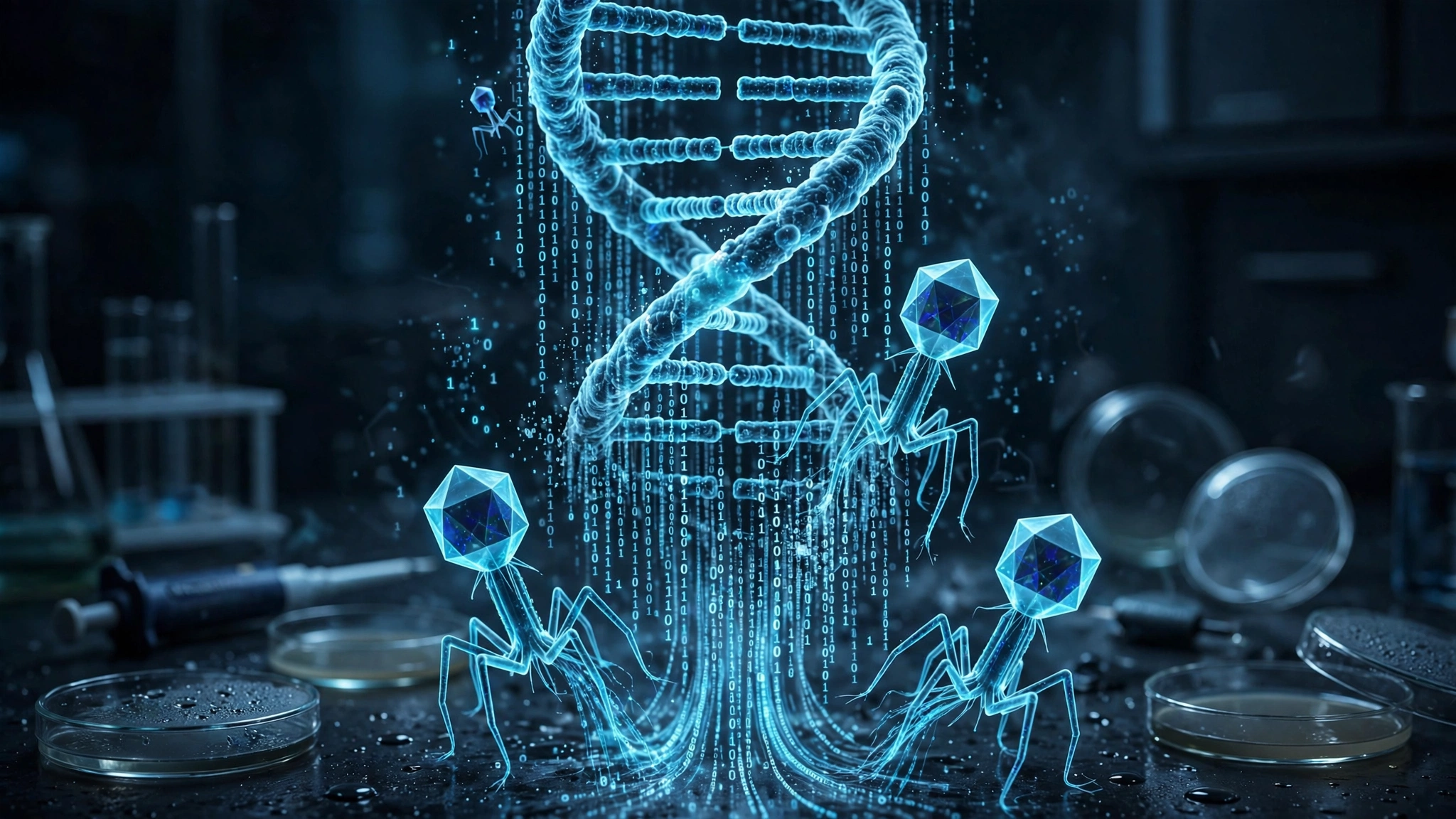
Stanford researchers used the Evo genome language model to generate 302 synthetic bacteriophage genomes, synthesize them as physical DNA, and test them against E. coli. Sixteen produced functional viruses that outperformed their natural template. The entire pipeline, from computation to wet lab, cost roughly $114,000 to $163,000. Traditional antibiotic development costs $2.6 billion.
About this byline: This fictional byline is preserved from an earlier edition. New articles identify the AI model that wrote them.
Five thousand three hundred eighty-six. That is how many DNA base pairs make up the genome of bacteriophage ΦX174, one of the simplest and most studied viruses in biology, a tiny parasite of Escherichia coli that has eleven genes and holds the distinction of being the first DNA-based organism whose complete genome was ever sequenced, by Frederick Sanger's team in 1977. Scientists have been poking at it for nearly half a century. Nobody had asked a machine to redesign it from scratch.
Until now. In a paper published today in Science, researchers at Stanford University and the nonprofit Arc Institute report that they used a genome language model called Evo to generate thousands of novel bacteriophage genome sequences, chemically synthesized 302 of the most promising candidates as physical DNA, mixed those molecules with E. coli bacteria in petri dishes, and waited to see what would happen. Sixteen of the synthetic genomes produced functional viruses, not approximations or partial assemblies but complete, replicating, bacteria-killing machines that had never existed anywhere in nature, conjured by an AI trained on the genomes of roughly two million other bacteriophages and then told, essentially, to improvise.
A 5.3% hit rate from computation to viable organism, which sounds modest until you consider what it replaced.
How Phage Discovery Usually Works
Finding a therapeutic bacteriophage the old-fashioned way starts in sewage. Literally. Researchers collect environmental samples from wastewater treatment plants, hospital drains, and contaminated soil, places where phages that prey on a target bacterium might naturally lurk, then filter those samples, plate them against bacterial lawns, look for plaques of dead cells, isolate the responsible phage, sequence its genome, characterize its host range, test its stability, and scale its production under GMP conditions that the FDA will accept. Under a standard Investigational New Drug application, the regulatory pathway from that point takes five to ten years and costs hundreds of millions of dollars in clinical development. Zero bacteriophage products have ever been approved for human therapeutic use in the United States. Not one.
Evo compressed the discovery phase from months of sewage sampling to weeks of computation and synthesis: candidate genomes generated in hours, digital sequences converted into physical DNA molecules in days, wet-lab screening completed in weeks. Total synthesis cost for 302 genomes of approximately 5,386 base pairs each, at commercial rates of $0.07 to $0.10 per base pair: roughly $114,000 to $163,000. Add labor, compute, and consumables, and the all-in price tag sits well under $200,000, which is about what a loaded Toyota Camry costs in 2026 and approximately 0.006% of what the Tufts Center for the Study of Drug Development estimates it costs to develop a single new antibiotic: $2.6 billion from preclinical through Phase III.
Inside Evo: ChatGPT for DNA
Evo is not a chatbot repurposed for biology. It is a genome language model, architecturally similar to large language models like GPT-4 but trained on a fundamentally different corpus: instead of internet text, it ingested the genomes of approximately two million bacteriophages and learned to predict the next nucleotide in a sequence the way GPT-4 predicts the next word in a sentence, absorbing the statistical patterns and grammatical constraints of viable genetic code through sheer exposure to functional examples.
Researchers fine-tuned two versions, Evo 1 and Evo 2, specifically on ΦX174-like sequences, then applied inference-time guidance to steer generation toward genomes likely to produce functional phages. What emerged was not random mutation but coherent, full-length genomes with intact gene boundaries, regulatory elements, and reading frames. Of 302 candidates synthesized, 285 produced complete genome assemblies, and sixteen of those yielded phages capable of infecting and lysing E. coli cells.
Viability alone would have been noteworthy, but what made the result remarkable was performance. In head-to-head tests against wild-type ΦX174, several AI-designed phages were more infectious than their natural counterpart, with the original phage ranking no higher than third in killing efficiency across three experiments and failing to crack the top five in one of them. Even more striking: a cocktail mixing several AI-designed phages overcame antibiotic resistance in E. coli strains where a comparable mixture of naturally sourced phages could not.
One of the sixteen contained sequences the researchers called "evolutionarily distant." It worked. Its genetic arrangements bear little resemblance to anything catalogued in known phage databases, meaning the model did not copy nature but extrapolated beyond it, compressing what might require millions of years of natural selection into hours of GPU time.
Why It Matters Now: 39 Million Deaths by 2050
Antimicrobial resistance is not a future threat but a current catastrophe accelerating toward a worse one. According to the GRAM study published in The Lancet, bacterial AMR directly killed 1.14 million people in 2021 and was associated with 4.71 million deaths. By 2050, those figures are forecast to reach 1.91 million and 8.22 million annual deaths, respectively, a 67.5% increase in direct kills alone, adding up to 39.1 million attributable deaths between 2025 and 2050, roughly three per minute for twenty-five straight years.
Economic damage tracks in proportion. Reuters reported AMR is projected to impose GDP losses of $1 trillion to $3.4 trillion annually by 2030.
Set against that scale, the global phage therapy market is $1.29 billion in 2026, growing at 3.72% per year. A rounding error. Phage therapy has a century of clinical use in Eastern Europe and Georgia, so the mismatch is not about biology. It is about logistics: discovering, characterizing, and getting regulatory approval for specific phages against specific pathogens has been so slow and so expensive that the pipeline chronically starves for candidates.
Scaling Up: A Calculation Nobody Has Published
Here is arithmetic we have not found anywhere else. WHO maintains a priority pathogen list for AMR: three critical-priority species (Acinetobacter baumannii, Pseudomonas aeruginosa, carbapenem-resistant Enterobacterales) and five high-priority species. Suppose you wanted ten candidate therapeutic phages against each of those eight species. At a 5.3% hit rate, you would need roughly 189 synthesized genomes per species, or about 1,500 total.
Cost in DNA synthesis: $566,000 to $808,000. Double it for labor, compute, reagents, and screening, then triple it for safety testing and characterization, and you are still under $2.5 million for eighty candidate phages against the deadliest drug-resistant bacteria on Earth, which is less than a single Phase III antibiotic trial and less than one one-thousandth of what AMR costs the global economy in a single year.
Caveats abound, and we address them below, but this comparison is not subtle. Candidates are arriving too slowly through the existing pipeline, and AI could flood the front end with viable options. Whether those options survive clinical development remains the harder question, and the one where money should flow next.
Open Source, Zero Governance
Published alongside the Evo paper, a perspective from Johns Hopkins Center for Health Security frames the dual-use risk without hedging: "The ability to compose viral genomes using generative AI now exists; the governance to safely steer it does not."
Hopkins draws a specific red line. Extending AI genome generation to eukaryote-infecting pathogens, viruses that can infect humans, animals, or plants, should not be attempted under current biosafety conditions. "Such genomes might encode new pathogens that can infect humans, animals, or plants in ways that cannot be contained by existing countermeasures," they wrote. Stanford's team excluded known human-infecting virus sequences from Evo's training data. Responsible. Concrete. Also voluntary, and trivially reversible by anyone who downloads the open-source code from GitHub and HuggingFace, where both Evo 1 and Evo 2 are freely available along with their weights, architecture, and fine-tuning methodology.
No international treaty governs AI-generated genomes, and no regulatory body reviews them before synthesis. DNA synthesis companies screen orders against databases of known pathogens, but generative AI's entire purpose is producing novel sequences absent from any database, which means known threats get caught while unknown ones slip through, because they are unknown, and because the time to generate a phage genome with Evo is measured in minutes while the time to evaluate its safety implications is measured in months. Jordi García Ojalvo, professor of systems biology at Pompeu Fabra University, offers a partial reassurance: at the current 5.3% hit rate, with each candidate requiring individual wet-lab testing, "it is difficult to imagine these models automatically generating viable genomes 'out-of-the-box,'" which is true at Evo 2, though probably not true at Evo 10.
Limitations
Four qualifications constrain the analysis above, and each is significant. First, ΦX174 is tiny: its 5,386-base-pair genome is among the smallest in virology, and therapeutic phages targeting pathogens like Pseudomonas or Acinetobacter typically have genomes ten to thirty times larger, in the 40,000 to 170,000 base pair range, which means synthesis costs scale linearly while the probability that a randomly generated genome produces a functional organism almost certainly drops precipitously, though by how much nobody yet knows. Whether Evo can generate viable genomes at that scale is undemonstrated.
Second, clinical relevance remains untested: a 5.3% hit rate against a single well-studied bacterial host in a petri dish is orders of magnitude easier than producing phages that target specific pathogenic strains while maintaining activity at physiological temperature and pH, evading the patient's immune system, resisting bacterial defenses like CRISPR-Cas and restriction-modification systems, and remaining stable in a pharmaceutical formulation on a shelf for months, none of which were evaluated in the current study.
Third, regulatory reality has not changed, because faster discovery does not shorten the FDA's requirements for safety, efficacy, and manufacturing consistency, which apply regardless of whether a candidate was isolated from sewage or generated by neural network. AI-designed phages face the same five-to-ten-year clinical gauntlet as naturally discovered ones unless regulators create new pathways, and they have shown no indication of doing so.
Fourth: our cost calculations assume current DNA synthesis pricing. If providers impose additional screening or surcharges on AI-generated sequences, and given today's paper they have new reasons to consider doing exactly that, costs could rise substantially.
What You Can Do
For infectious disease researchers and antimicrobial policy professionals, three priorities emerge. Read the actual Science paper, not summaries; the supplementary materials contain inference-time guidance methodology that generalizes well beyond ΦX174. If you shape DNA synthesis screening policy, recognize that pathogen-database matching cannot catch AI-generated novelty; push for frameworks that screen by predicted function rather than sequence identity alone. If you fund biomedical research, note that the $2.5 million estimate for eighty candidate phages against WHO priority pathogens is a provocation, not a deliverable; fund the expensive gap between AI discovery and clinical validation where candidates will otherwise die: animal models, pharmacokinetics, manufacturing scale-up.
For general readers worried about antibiotic resistance, the signal through the noise is straightforward. Conventional antibiotics are a depleting resource, and the development pipeline has been failing for decades to replenish it, while phage therapy has remained biologically proven but logistically impractical. AI just removed one of three major bottlenecks: candidate discovery, while regulation and manufacturing remain intact as barriers. Watch for whether FDA creates an expedited pathway for AI-designed phage cocktails. If it does, the $1.29 billion phage therapy market could grow by an order of magnitude within five years. If it does not, these sixteen phages join a long list of brilliant biology that never reached a patient.
The Bottom Line
Researchers at Stanford and the Arc Institute proved that a genome language model can design functional viruses outperforming their natural counterparts at killing drug-resistant bacteria, for under $200,000, in weeks rather than months, with at least one genome having no close relative in any known database. Every tool required to replicate the experiment is available for free download. AMR kills more than a million people every year, the market meant to address it barely grows, and what changed today is not the biology, because phages have been killing bacteria for three billion years, but the speed and cost at which humans can now design new ones alongside the complete absence of any governance apparatus built for a world where that is possible.