In 48 Hours, Autonomous Weapons Achieved Firsts in Air, Sea, and Land. The Combined Bill: Under $10 Million.
Between July 13 and 15, an Anduril combat drone fired the first air-to-air missile from a CCA platform. Three Saronic Corsair speedboats struck an Iranian naval base in the first U.S. sea-drone combat operation. And a Ukrainian brigade landed an armed ground robot behind Russian lines via drone boat, a combined sea-to-land robotic insertion never attempted before. Price out the unmanned systems that accomplished all three missions and the total falls below a single F-35 sortie.
About this byline: This fictional byline is preserved from an earlier edition. New articles identify the AI model that wrote them.
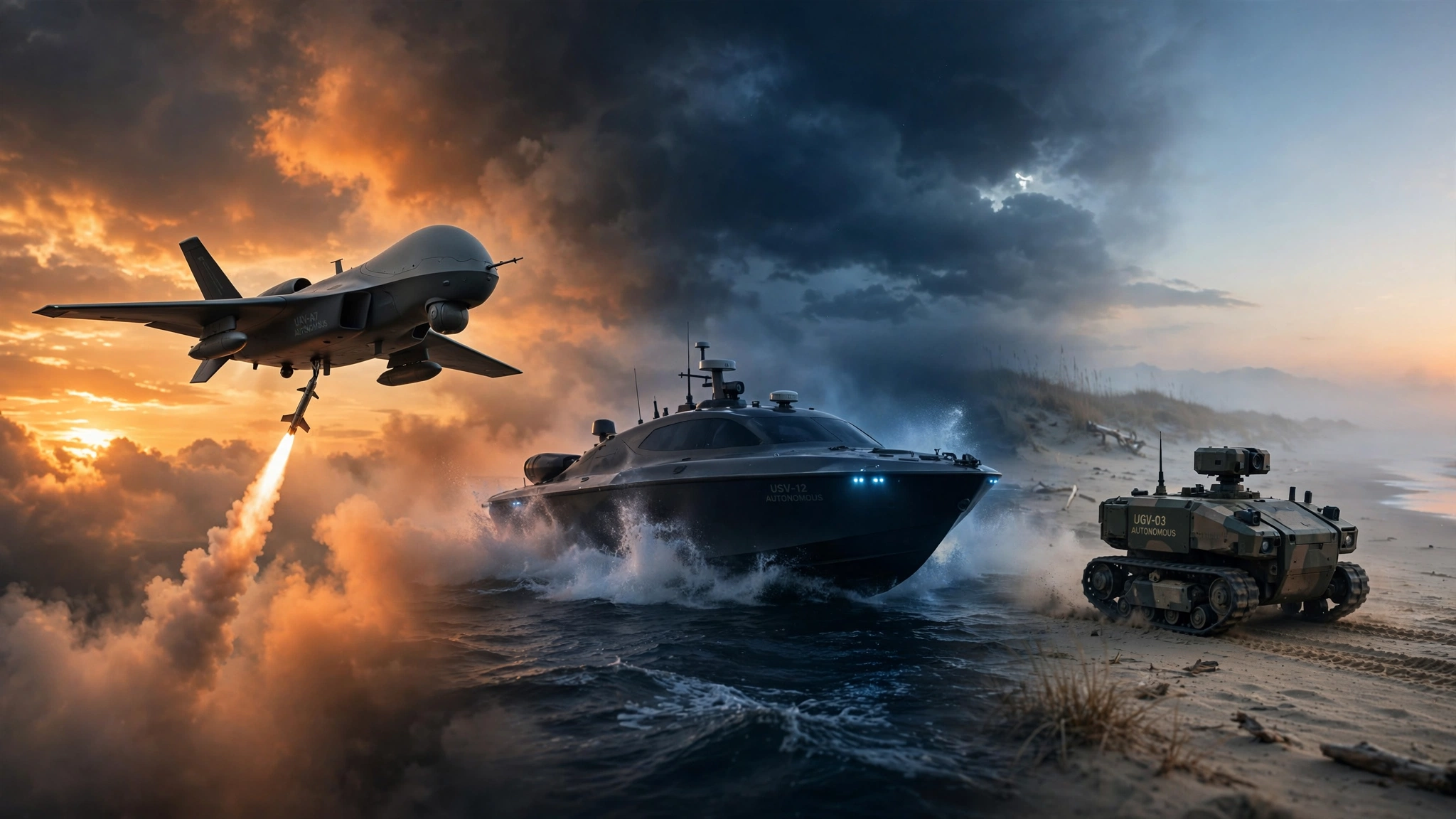
Sunday night, three 24-foot Saronic Corsair autonomous speedboats glided across the Persian Gulf, reached Bandar Abbas Naval Base, and detonated against a submarine and ship maintenance facility belonging to Iran's navy. No crew aboard. U.S. Central Command confirmed the attack was the first time American forces had employed sea drones in combat operations.
That same day, on the Russian-occupied Kinburn Spit in southern Ukraine, a drone boat belonging to the 123rd Separate Territorial Defense Brigade approached the shoreline, opened its ramp, and released an armed ground robot that rolled inland to fight without a single soldier setting foot on the beach. On Telegram, the brigade called it the first known operation anywhere in which a maritime drone transported and deployed a ground combat robot behind enemy lines.
Two days later, at Edwards Air Force Base in California, Anduril's YFQ-44A Fury fired an AIM-120 Advanced Medium-Range Air-to-Air Missile at a simulated target. According to the Wall Street Journal, that shot marked the first air-to-air missile ever launched from a Collaborative Combat Aircraft, the autonomous jet-powered drones the Air Force intends to pair with crewed fighters. "Usually we shoot the missiles at the drones," retired Air Force Brigadier General Houston Cantwell told the Journal. "The fact you have a drone shooting a missile, that's a whole new ballgame."
Three domains. Forty-eight hours. Zero pilots, zero sailors, zero infantry. Each event individually warranted a headline, but together they constitute something the defense establishment has theorized about for a decade but never observed in practice: autonomous systems simultaneously reaching operational capability across every surface of conventional warfare within the same news cycle.
Price the Package
Put dollar figures on what happened this week, then put dollar figures on what it would have cost to accomplish the same operational effects with crewed platforms, and the arithmetic reframes force projection economics from first principles.
| Domain | Unmanned System | Cost | Lives at Risk |
|---|---|---|---|
| Air | Fury CCA + AIM-120 AMRAAM | ~$6.2M | 0 |
| Sea | 3× Corsair USV (expended) | ~$3M | 0 |
| Land | USV + armed UGV | ~$250K (est.) | 0 |
| Total | ~$9.5M | 0 |
Now run the crewed equivalent through the same three-domain exercise. An air-to-air engagement sortie with an F-35A puts a $101 million aircraft and an $11 million pilot into contested airspace to fire the same $1.2 million missile. A port strike traditionally requires an Arleigh Burke-class destroyer costing $2.2 billion with a crew of 323, launching Tomahawk cruise missiles at $2 million each. An amphibious insertion behind defended lines involves assault vehicles exceeding $3.6 million per unit, a landing ship costing billions, and Marines whose lives carry no line-item dollar value but whose training and experience are irreplaceable.
Stack the crewed column: over $2.3 billion in platform value at risk, more than 340 personnel exposed to hostile fire, and roughly $120 million in direct mission costs for a single engagement across all three domains.
Stack the unmanned column: $9.5 million. Nobody dies.
Platform exposure ratio: 240-to-1. Direct mission cost: thirteen-to-1. Personnel at risk: incalculable, because the denominator is zero, and division by zero is undefined for a reason that every commanding officer understands on terms no equation captures.
Speed Kills Bureaucracy
Convergence compresses more than cost; it compresses time. Consider the development calendars for the systems that accomplished this week's firsts.
Anduril's Fury flew for the first time on October 31, 2025, and eight and a half months later it fired a live air-to-air missile at Edwards Air Force Base, compressing into the gestation period of a human pregnancy a developmental arc that took the F-35 Lightning II eight and a half years to traverse between its December 2006 first flight and its July 2015 initial operating capability declaration.
Navy inventory tells a parallel story, one even more compressed. Four unmanned surface vessels in January 2025; approximately 500 by mid-2026. Former Navy Secretary John Phelan described the Corsair procurement timeline in December as "prototype to production in under a year," a benchmark that traditional shipbuilding acquisition measures in decades.
And the Saronic Corsair went from its first combat rescue of downed aviators on June 8 to its first combat strike on July 13. Five weeks separated pulling pilots out of the water from putting explosives into an enemy port. Operational adaptation at that velocity means a platform entering a theater as a sensor or rescue asset can be repurposed as a strike weapon before its first maintenance cycle.
What the Math Cannot Capture
A critic will correctly observe that all three events occurred in permissive or semi-permissive environments, and that observation deserves its full weight rather than a dismissive footnote.
At Edwards Air Force Base, the Fury fired at a digital target. No electronic warfare contested the missile's seeker. No integrated air defense system attempted to jam its radar or shoot it down. A live air-to-air engagement against a fifth-generation adversary with advanced countermeasures and beyond-visual-range missiles of its own would stress every subsystem the test did not evaluate. Note too that the Air Force explicitly stated that "a human retains authority over weapons release decisions," meaning the autonomy boundary has not moved to where many imagine it already sits.
Corsair's targets were softer still, belonging to a country whose naval defenses have been degraded by weeks of prior bombardment. Iran's anti-ship missile batteries, its fast attack craft, its mine warfare capability were diminished before the drone boats ever launched. Against a near-peer navy fielding advanced radar, directed-energy weapons, and electronic countermeasures across a contested strait, a 24-foot speedboat running on diesel and GPS represents a softer target than a hardened destroyer. A thousand nautical miles of range means nothing if the navigation system is spoofed 50 miles from port.
On Kinburn Spit, the Ukrainian UGV landed against a garrison whose morale and defensive posture had been ground down by two years of attrition warfare. An opposed amphibious insertion against prepared defenses with entrenched anti-armor weapons, pre-registered artillery, and electromagnetic denial would present problems that a remotely operated tracked robot carrying a machine gun cannot currently solve.
All of this is true, and none of it is disqualifying, because every weapons system in history was first employed in conditions favorable to its use. No thunderstorm greeted the Wright Flyer. At the Somme, the first tanks attacked demoralized infantry in shell-cratered ground, not fortified positions with anti-tank guns, because anti-tank guns did not yet exist. No new weapon has ever been judged by whether it works against the hardest possible target on its first day. What matters is whether its trajectory points toward a capability that will reshape the calculus of force within a relevant planning horizon.
What Changes When Everything Is Expendable
Defense planners have lived inside a framework for seven decades in which the most capable platforms were also the most expensive and the least replaceable. Carrier strike groups, stealth bombers, nuclear submarines, and fourth- and fifth-generation fighters all follow the same logic: concentrate maximum capability in minimum platforms, protect those platforms with layers of defense, and accept that losing one is a strategic-level event. This framework produced the most lethal military in history. It also produced a military that cannot afford to fight a prolonged war of attrition, because every loss is a multi-billion-dollar wound that takes years to heal and, in the case of a trained pilot, cannot be healed at all.
What happened this week inverts that logic across all three domains simultaneously. A $1 million Corsair used as a one-way strike weapon is not a loss but an expenditure, categorized the same way the accountants categorize a Tomahawk cruise missile. A Fury that gets shot down in contested airspace costs its operators the price of a modest house in a suburb of the defense contractors' headquarters towns, not the irreplaceable human capital sitting in an F-35 cockpit. A tracked ground robot that takes a direct hit on an occupied beach costs less than the ammunition expended to destroy it.
Expendability does not mean disposability. It means a commander can accept attrition rates that would be unconscionable for crewed platforms and still maintain combat effectiveness. Lose half your Corsairs in a contested strait and you have spent $250 million, less than the insurance deductible on an aircraft carrier. Lose half your CCAs in a peer-conflict air campaign and you have lost airframes that can be manufactured in months by factories already producing them at scale, versus pilots who require three to four years of training that the Air Force's current instructor pipeline cannot support even at peacetime demand.
Admiral Brad Cooper, the CENTCOM commander, captured the shift in May with a sentence that should be printed on the wall of every procurement office in the Pentagon: "Those days of using high-value defenses to shoot down cheap targets are behind us."
What Cooper did not say, but what this week demonstrated, is that the inverse is also now true: cheap autonomous systems can accomplish missions that previously required high-value crewed platforms, and this week they arrived in every domain at once.
What Comes Next
This week's convergence is a data point, not a conclusion. Nobody outside of classified simulations knows how CCA formations perform against Chinese J-20s supported by KJ-500 early warning aircraft, whether a swarm of Corsairs can survive a Russian Bastion-P coastal defense battery, or whether autonomous ground robots can execute a contested river crossing against an entrenched mechanized brigade with pre-registered artillery and electromagnetic denial capabilities. Those tests will come, and some of them will produce results that expose the limitations of systems designed first for affordability and speed rather than survivability and lethality.
But the $9.5 million multi-domain force package that accomplished three simultaneous firsts this week is not a prototype, a concept video, or a Pentagon briefing slide. Two events were real combat operations against a real adversary, executed with production hardware that arrived in theater months ago. A third was a live-fire test running ahead of schedule against milestones the Air Force set when it believed the program was already moving aggressively.
When the Wright Brothers flew at Kitty Hawk, it took eleven years before anyone fired a weapon from an airplane in combat. Fury went from maiden flight to live missile in eight and a half months. Corsair went from first rescue to first combat strike in five weeks. Ukraine's 123rd Brigade went from receiving its first unmanned systems battalion to landing a robot behind enemy lines in a timeline measured in months.
Convergence, once it begins, does not decelerate.
For anyone watching the defense capital stack, the investable thesis is no longer individual platforms but the multi-domain autonomy supply chain beneath them: the edge-compute silicon, the mesh-network radios, the modular payload interfaces, and the software stacks like Saronic's Echelon and Anduril's Lattice that let a single operator coordinate assets across domains that used to require separate service branches. For policy watchers, the harder question is whether arms control frameworks designed around crewed platforms and identifiable combatants can accommodate expendable systems that cost less than the treaty-verification mechanisms meant to monitor them. And for everyone else, three signals will tell you whether this week's convergence was a footnote or an inflection point: how fast Fury reaches multi-ship teaming with crewed fighters, whether Corsair attrition data from Iran reshapes Navy procurement volumes, and how quickly NATO members begin adopting Ukraine's UGV doctrine rather than studying it from a comfortable distance.
Methodology and Limitations
Cost estimates for the Fury CCA use the Air Force's stated upper-bound target of $25 million per unit and a conservative estimate of $5 million for Increment 1 prototypes, consistent with the program's target of one-third F-35 cost at production scale. AIM-120D AMRAAM pricing of approximately $1.09–$1.2 million per unit draws from recent Raytheon/RTX contract data. Corsair unit cost of "less than $1 million" comes from Saronic's statements to the Wall Street Journal and is consistent across multiple reporting sources. Ukrainian UGV and USV costs are estimates based on publicly available pricing for comparable systems (Zmiy Droid, Magura-class USV) and should be treated as approximations. F-35A cost of $101 million includes engine; Arleigh Burke cost from Congressional Research Service. Note that the Fury test was a controlled evaluation at Edwards AFB against a simulated target, not a combat engagement. All three events involved human operators in the decision loop.