Truckers Lose 56 Minutes a Day to Parking Search. The Reservation That Reads the HOS Clock.
American truckers burn an average of 56 minutes every day hunting for a place to sleep, and the federal hours-of-service clock gives them no slack: 11 hours of driving inside a 14-hour window that never pauses, then 10 hours off. When the clock dies at 9 p.m. and every lot within 40 miles is full, the options are an illegal ramp, a violation gamble, or quitting the industry. The reservation that reads the driver's ELD clock and guarantees the spot is the most obvious missing infrastructure in American freight.
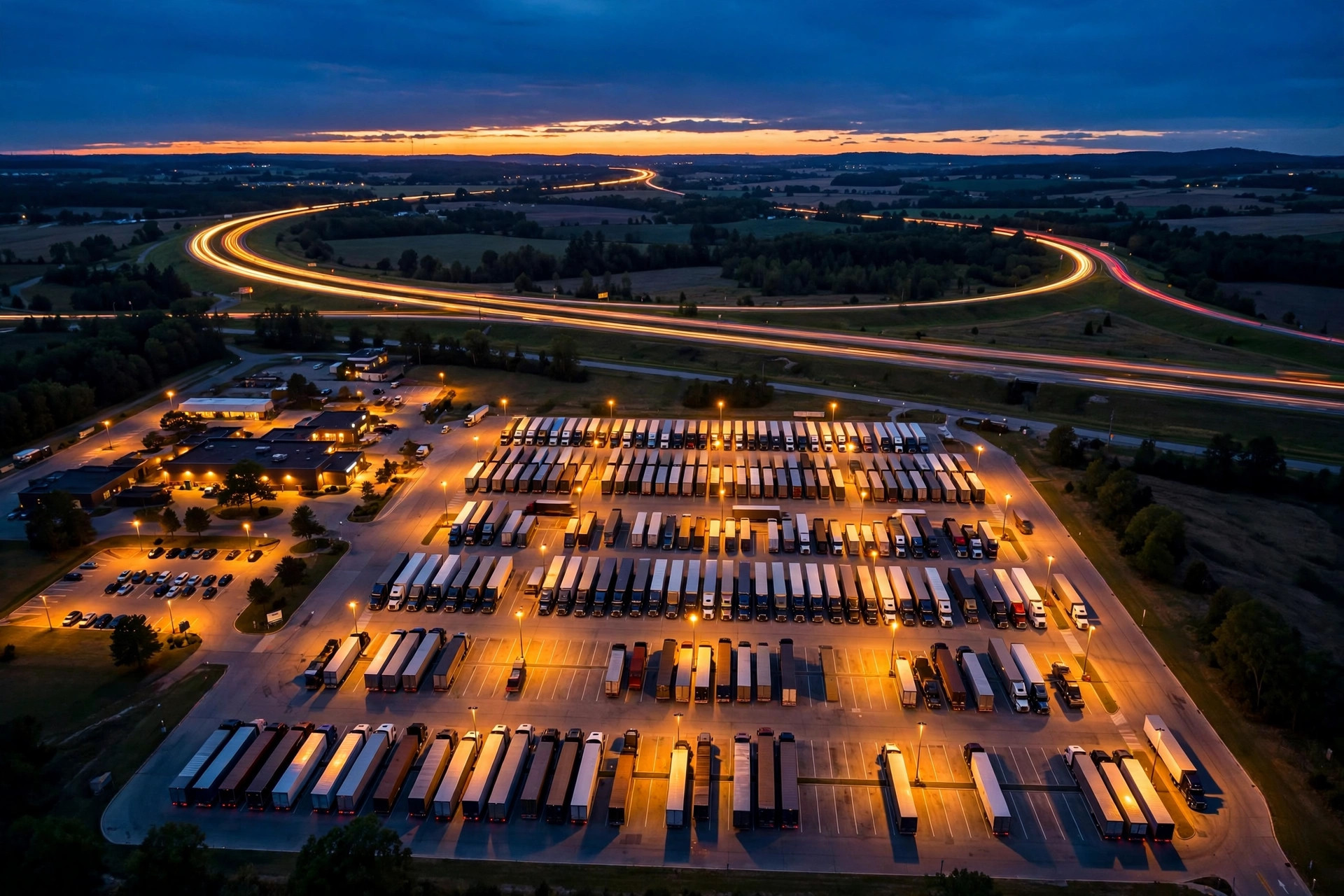
The Problem
Start with the number that runs the whole industry. Researchers at the American Transportation Research Institute put diaries in drivers' hands and asked them to log every parking search for 14 days, documenting 4,700 stops in granular detail. On average, a driver dedicates 56 minutes of available drive time per day to finding parking, time spent parking early to guarantee a spot rather than risking the alternative. ATRI converts that to 9,300 revenue miles a year, worth $4,600 in lost wages per driver. Citing newer USDOT research, the American Trucking Associations puts the annual wage loss at $6,813, which means either way the parking search is a second unpaid job.
What makes the search so punishing is the clock. Federal hours-of-service rules give a property-carrying driver 11 hours of driving inside a 14-hour on-duty window, followed by 10 consecutive hours off duty, with a 30-minute break after 8 cumulative hours of driving and a 60- or 70-hour weekly cap that only a 34-hour restart resets. Cruelest of all is the 14-hour window: it starts the moment the driver comes on duty and it never pauses. Loading docks, fuel islands, traffic, the shipper who keeps a truck waiting four hours for a door, every minute burns the window whether the wheels turn or not, which is why a single bad detention at a grocery distribution center can erase a third of a driver's legal day before dinner. When the window closes, the truck stops where it is. No provision in the law asks whether a parking space exists within the next 40 miles, and the arithmetic that follows is brutal: no slack, no mercy, just math.
ATRI's diaries found the cruelest hours are 7 p.m. to 5 a.m. on weeknights, when lots fill and stay full. Drivers adapt by parking early and surrendering productive drive time to guarantee a bed, or they gamble by pushing toward the next lot and praying, and the diaries show both strategies failing on the same corridors week after week. The gamble fails constantly. Law enforcement across the country reports rising unauthorized parking on shoulders and ramps, exactly the behavior the hours-of-service rules were written to prevent.
Then people die. On July 12, 2023, a Greyhound bus drifted onto the shoulder of an I-70 rest area ramp in Highland, Illinois, and struck three tractor-trailers parked there illegally, killing three bus passengers, and the Board's investigators found the trucks were there because the rest area's legal spaces were full, a fact the report states plainly rather than burying. In May 2025 the National Transportation Safety Board published its report and named the parking shortage as a contributing factor, with Chair Jennifer Homendy calling it a painful lesson: until the safety issue is addressed, lives are at risk on the nation's roads. Those trucks were parked illegally. They were also parked there because there was nowhere else: the Board explicitly recognized the recurring lack of available truck parking. Louisiana State Police investigated 430 crashes involving parked commercial vehicles between 2023 and 2025, killing eighteen people.
Nobody in the industry disputes any of this. NATSO's own CEO told the truck stop trade group's convention: "I can guarantee you, the truck parking issue would be gone if people were willing to pay for it." That sentence is the whole business plan and the whole objection in nineteen words. Drivers spend an hour a day on a problem they could buy their way out of for the price of a fast-food meal, and most of them would rather burn the hour, which tells you the product cannot be sold as convenience to drivers but must be sold as recovered capacity to the people who pay for the trucks. Any startup here has to survive that sentence.
The 56-Minute Tax: An Original Calculation
Nobody in the parking business publishes the payback math. So here it is.
ATRI's figures imply a value for every minute of the search: $4,600 a year divided by 56 minutes a day over roughly 250 driving days works out to about 33 cents per minute, a number that turns every evening's search into a meter running against the driver's own paycheck. A $15 reservation therefore breaks even if it saves 46 minutes of hunting. The problem is 56 minutes. Buy the $15 spot and the driver keeps 10 minutes of the evening, free, on top of a guaranteed bed. Do the division. That is the entire consumer pitch in one division problem.
The fleet math is where it gets violent. A 100-truck fleet sacrifices 100 times 9,300 revenue miles a year, or 930,000 miles, and with ATRI's 2026 analysis putting the all-in operating cost at a record $2.336 per mile, the parking search represents $2.17 million in annual operating-cost exposure for that fleet. A dispatch platform priced at $25 per truck per month costs the same fleet $30,000 a year. Even if the platform recovers only half the lost time, that is 36 dollars of recovered capacity per dollar of software. Name another line item in a fleet P&L with a 36-to-1 return.
Now the underwriting math behind the guarantee, because a reservation nobody trusts is a map with a price tag. At a 15 percent take rate on a $15 booking, the platform earns $2.25; model a 2 percent miss rate, meaning two arrivals in a hundred find no spot, with an average payout of $75 for the verified alternative plus credit, which works out to an expected cost of $1.50 per booking, leaving a margin after the guarantee of 75 cents per booking before any SaaS revenue. Priced this way, the guarantee pays for itself as long as the miss rate stays under 3 percent. That "as long as" is modeled, not measured, and it is exactly what the pilot has to prove.
Where the Search Breaks Down
Consider a driver who starts at 6 a.m. in Columbus with a delivery in Harrisburg, knowing that 14-hour window closes at 8 p.m. no matter what. At 2 p.m. the shipper keeps the truck at the dock for three hours, and those hours are gone forever because the window does not extend. By 7:30 p.m. the driver is on the I-70 corridor with 30 minutes of legal driving left, and every lot within range is deep in the dead zone. This is the detention double-tax: the shipper steals the afternoon, and the parking shortage steals the evening. ATRI's diaries show how drivers actually solve this: they quit early, parking at 4 p.m. with hours left on the clock, because a guaranteed spot at 4 beats a gamble at 8, a rational response to irrational scarcity that nonetheless surrenders the most productive hours of the driving day. So the industry pays for the same parking shortage twice, once in detention and once in surrendered drive time, while the ELD records both without comment.
Notice what the driver never had at any point in that evening: information about where the clock would die, delivered early enough to act on instead of react to. Every parking product on the market sits passively waiting for the driver to open an app and type a search, which means every one of them starts working at exactly the moment the driver has the least time to use it. By the time a driver with 30 minutes left is scrolling a map, the negotiation is over. The product that matters is the one that did the math at noon.
The Gap in the Market
Parking software exists. It splits between driver-side discovery apps and booking marketplaces, and none of it touches the clock.
| Company | What They Do | What's Missing |
|---|---|---|
| Trucker Path | Free app with crowdsourced availability; Reserved Parking Network of 70,000+ spots as of September 2026, averaging $20 per reservation. Predictive analytics from historical utilization. | Crowdsourced accuracy varies by corridor. No ELD or HOS-clock integration. No availability guarantee. Built for the driver's phone; invisible to dispatch. |
| TruckPark | Reservation platform founded 2017 in Chicago; 2,500+ partner spaces, about $15 a night, bookings up to 12 months out in roughly 30 seconds. | Footprint concentrated in the Midwest and Southeast. No clock-aware booking. No miss guarantee. The driver pays out of pocket. |
| ParkMyTruck | Realtime availability, some of it pulled directly from truck-stop point-of-sale systems rather than driver reports. | Thin reservation layer. No fleet product. Availability is not a booking. |
| Truck Parking Club | Booking marketplace at roughly 6,000+ reservable locations, typically $10 to $20 a night. | Booking only. No prediction, no HOS awareness, no compliance layer for fleets. |
| Pilot / Love's / TA Reserve-It | The big chains sell reserved spots directly through their own programs. | Chain-captive. A driver running multiple corridors juggles separate programs with separate balances. No cross-chain view. |
| State TPAS (FL, MN, OH) | Free realtime rest-area availability from state DOTs; genuinely good on their corridors. | Rest areas only. No reservations, no private supply, three states. Free is not the same as guaranteed. |
The structural gap is the buyer. Every product sells to the driver's phone, which means every product fights the nineteen-word objection: the driver would rather burn the hour than spend the $15, a cultural fact about owner-operators and company drivers alike that no onboarding flow has ever changed. Nobody sells to the fleet's dispatch desk, where the buyer is a carrier absorbing $2.17 million in operating-cost exposure per hundred trucks and $5,500 to $15,000 every time a driver quits, which reframes the $15 reservation from a driver expense into a fleet-level capacity decision with a measurable return. Nobody reads the HOS clock that actually creates the deadline. And nobody underwrites the reservation, which is why drivers who have been burned once at midnight never trust a booking again.
The Solution
A fleet-bought, ELD-integrated reservation platform that predicts where each driver's 14-hour window dies and pre-books a guaranteed spot there, before the driver has to think about it:
1. Fleet dispatch SaaS ($25/truck/month): ELD integrations (Motive, Samsara, Geotab, ISAAC) stream remaining drive time continuously. A projection engine combines the route, current speed, and historical detention at the destination to predict where the 14-hour window will expire, then auto-books a guaranteed spot at that point hours before the driver needs it, turning dispatch from reactive pleading into planned logistics. Dispatch sees every truck's booked rest stop on one screen instead of a radio full of drivers asking where to sleep. As a bonus, the audit trail of compliant rest doubles as FMCSA and insurance documentation, which is proof the fleet plans rest rather than hoping for it.
2. Driver app (free): The booking lands as a one-tap accept with gate codes, amenities, and one-tap rebooking when the plan changes. No separate account, no separate payment, no nineteen-word objection. Here the fleet pays, because the fleet is the one capturing the recovered miles.
3. Private lot network: Warehouses, churches, and distribution centers with empty asphalt from 7 p.m. to 5 a.m. get onboarded to a lighting, security, and amenity standard, then listed as reservable supply with an 85/15 revenue split in the owner's favor. This is the net-new supply lane: in corridors where every truck stop is full by 6 p.m., a lit warehouse lot ten minutes off the interstate is a parking space that did not exist yesterday.
4. The miss guarantee, reimagined: if the reserved spot is not available on arrival, the platform pays for the verified alternative (up to $50) plus a $25 credit, automatically, with no claim form. This is the feature that turns a booking app into infrastructure. A reservation that fails at midnight is worse than no reservation at all, because it spent the driver's last legal minutes driving to a lie. Priced into the take rate and backstopped by a reserve fund, the guarantee is what lets a dispatcher promise a driver a bed and mean it. That is the product.
Revenue Model
| Revenue Stream | Amount | Notes |
|---|---|---|
| Marketplace take rate | 12-15% of reservation | $15-20 average nightly rate yields roughly $2.25 per booking. Scales with nights booked, not trucks. |
| Fleet SaaS (per truck/month) | $25 | Dispatch dashboard, HOS projection, auto-booking, compliance audit trail. Annual contract. |
| Private-lot revenue share | 15% of lot revenue | Owner keeps 85%. Platform handles listing, booking, payment, and guarantee coverage. |
| Guarantee premium tier | $4/truck/month | Optional add-on: priority rebooking, higher payout caps, dedicated support line for stranded drivers. |
| Chain API licensing | Custom | White-label booking widget for fuel networks and independents that lack reservation tech. |
Unit economics on a 100-truck fleet: SaaS revenue at $25 per truck per month: $30,000 a year. Marketplace take: 100 trucks times 150 reserved nights times $15 times a 13 percent blended take rate: $29,250 a year. Combined: roughly $59,250 a year per 100-truck fleet. Customer acquisition through fleet pilots, fuel-card partnerships, MATS presence, and inside sales runs an estimated $8,000 per fleet, with payback on SaaS gross margin alone landing inside two months, while marketplace revenue compounds underneath: every recovered night is a booked night.
Market Size
TAM: Roughly 1.2 million American drivers sleep away from home on a regular schedule: an estimate, about one-third of the 3 million-plus drivers the FHWA counts on the road, and the single largest assumption in this piece, one that skews toward the irregular-route truckload carriers where parking pain concentrates. At 200 reserved nights a year and $15 a night, that is $3.6 billion in annual reservation GMV. A 12 percent platform take rate yields $432 million in marketplace revenue; fleet SaaS at full penetration (1.2 million trucks times $300 a year) adds $360 million. Combined platform-revenue TAM: approximately $800 million a year.
The 1.2 million figure deserves its flag. Nobody counts long-haul drivers cleanly; the BLS, ATA, and FMCSA each slice the workforce differently, and the sleep-away-from-home subset is inferred, not measured. If the true number is 800,000, the TAM is $530 million. If it is 1.6 million, it is $1.06 billion. Every step of that build is linear, and the uncertainty is stated plainly.
SAM: The integration-ready segment: fleets already running Motive, Samsara, Geotab, or ISAAC ELDs with API access, where the clock data flows without new hardware. Estimated at 350,000 trucks, roughly 30 percent of the long-haul base, the segment represents $1.05 billion in reservation GMV yielding $126 million in take-rate revenue, with SaaS adding another $105 million. Serviceable market: approximately $230 million a year.
SOM (year 3): 8,000 trucks on the dispatch platform at $25 a month: $2.4 million in SaaS. The marketplace layer adds 8,000 trucks times 150 nights times $15 times 12 percent, or $2.16 million, bringing the total to approximately $4.6 million ARR, about 2 percent of the SAM. That is 80 fleets of 100 trucks, or one mid-size carrier's worth of proof that the guarantee holds.
Why Now
Federal money just moved. On October 14, 2026, six days before this writing, USDOT awarded $200 million for 14 truck parking expansion projects across 12 states through the INFRA program, from a 137-space rest area in Arkansas to a 260-space facility on I-91 in Connecticut. New capacity needs a demand router, and the grants legitimize paid parking as federal policy rather than driver exploitation.
The clock is digital now. Full enforcement of the ELD mandate began in December 2017. Every covered truck's hours-of-service data is electronic, timestamped, and API-accessible through the big telematics platforms. A live feed of every driver's remaining legal drive time is the prediction input this product needs, nonexistent at scale nine years ago because paper logs could not stream, and available today.
The liability pattern is documented. In May 2025 the NTSB's report on the Highland crash gave plaintiff attorneys a federal document tying parking scarcity to fatalities, complete with recommendations aimed at USDOT and FMCSA. Fleets whose drivers park on ramps are no longer facing a hypothetical risk; they are facing a documented one, and their insurers read NTSB reports.
The legislative pipeline is full. One bill, the Truck Parking Safety Improvement Act, would authorize $755 million in competitive funding, while another, the BUILD America 250 Act, would add $750 million over five years. Congress already approved $200 million for parking in the fiscal 2026 appropriations package, and the House is advancing another $200 million for fiscal 2027, which means the supply is coming while the coordination layer still does not exist, and whoever routes drivers to the new spaces first inherits the demand.
With cargo theft still rising, freight is increasingly targeted during unsecured dwell times, which makes a secured, reserved, well-lit lot worth a premium over a dark ramp, and gives shippers a reason to care about where their loads sleep. Chain-of-custody is becoming a shipper requirement, and a booked spot is a documented one.
Startup Costs
| Category | Cost | Notes |
|---|---|---|
| Platform engineering (12 months) | $320K | 2 backend + 1 frontend + 1 mobile. ELD integrations (Motive, Samsara, Geotab, ISAAC APIs), HOS projection engine, dispatch dashboard, driver app, lot-owner portal. |
| Miss-guarantee reserve fund | $150K | The underwriting float. Sized for a modeled 2 percent miss rate across pilot volume; the pilot either validates the model or reprices the product. |
| Supply onboarding (5 corridors) | $90K | Lot acquisition team for private industrial and institutional lots in parking deserts. Lighting and security audits per site. |
| Insurance and legal | $60K | Guarantee terms, lot contracts, state-by-state paid-parking rules, carrier service agreements. |
| Sales and marketing (year 1) | $80K | Fleet pilots, MATS and NATSO presence, fuel-card partnership development, driver-community marketing. |
| Data and operations | $40K | State TPAS feeds, mapping and routing APIs, cloud hosting, customer support tooling. |
| Operating buffer | $60K | Twelve months of contingency against slower fleet sales cycles. |
| Total | $800K |
Limitations
Start with the biggest caveat: the 1.2 million long-haul driver figure is an estimate, not a count, and the TAM scales linearly with it. ATRI's $4,600 in lost wages comes from a 14-day diary study with self-selected participants; it may not generalize to the full driver population, and the ATA's $6,813 figure is a research estimate, not a measured benefit of any intervention. Behind the guarantee math sits a 2 percent miss rate modeled from nothing, since real-world miss rates on aggregated inventory are unknown until the pilot runs, and a 5 percent miss rate would erase the per-booking margin entirely, which is why the reserve fund gets sized before the marketing budget does. Driver willingness to pay remains the existential unknown; the entire fleet-buyer thesis assumes carriers will pay for what drivers will not, and fleet pilots have to validate that instead of asserting it. Finally, state TPAS systems are free and expanding, and if FMCSA ever funds a national free reservation layer, the consumer marketplace compresses even if the fleet compliance product survives.
That 36-to-1 fleet return also assumes recovered miles convert to revenue at full operating cost, which overstates the case for fleets that cannot fill the recovered capacity with paying freight. In a soft freight market, recovered drive time is worth less than the math suggests. Stated plainly, the return peaks exactly when freight is tight and capacity is the constraint, which is also when drivers are hardest to retain.
Strongest Counterargument
Trucker Path already won. Seventy thousand reservable spots, millions of drivers with the app installed, predictive analytics from years of utilization data, and a September 2026 deal adding Safe Truck Parking's 5,750 spaces across 25 locations, an inventory lead that compounds every quarter the startup spends building instead of booking. Building a second parking app against that inventory is suicide; drivers will not install two parking apps and they will not pay twice. And the deeper objection holds that parking is a supply problem rather than a software problem: three hundred thousand spaces against more than three million trucks. No code creates asphalt, and the celebrated $200 million federal buildout adds hundreds of spaces, a rounding error against the deficit. Reservations just reallocate scarcity to whoever pays, which a driver culture that believes parking should be free actively resents. Stripped of politeness, this objection says the ceiling is a premium niche rather than infrastructure, and the fleet SaaS is a feature Trucker Path could ship in a quarter.
Take it seriously, because most of it is true. The counter-move is to avoid the driver's home screen entirely. Trucker Path optimized for bookings from drivers; this product optimizes for compliance spend from carriers, where the buyer absorbs $2.17 million in operating-cost exposure per hundred trucks and five figures per quit driver, a different buyer with a different budget and a different definition of what the product is for. Trucker Path has not shipped HOS-clock projection, and the miss guarantee is a balance-sheet product rather than a software feature, because underwriting availability requires a reserve fund plus the willingness to pay when you are wrong, which is a business-model decision that booking-optimized incumbents have not made. If Trucker Path ships ELD integration tomorrow, the wedge narrows to the guarantee alone. That is a genuine risk, and it is why the private-lot supply lane matters most: net-new spaces in parking deserts are the one asset no incumbent can replicate with an API call.
What You Can Do
If you run fleet operations: Pull last quarter's ELD data and count two things: HOS violations tied to parking, and early-parking events where drivers quit with drive time left, pricing both at ATRI's $2.336 per mile, then pilot clock-aware booking on 20 trucks for 60 days and measure recovered drive time against the 56-minute baseline the industry already accepts. Then pilot clock-aware booking on 20 trucks for 60 days and measure recovered drive time against the 56-minute baseline. If the pilot does not beat 30 recovered minutes a day, kill it.
If you drive: Run the $15 math on your worst corridor. One guaranteed spot on the lane where you always gamble pays for itself at 46 saved minutes, and the spot that saves you from a ramp at midnight is not a $15 decision. It is a career decision.
If you own a lit lot that sits empty at night: Warehouses, churches, distribution centers: your asphalt is dead from 7 p.m. to 5 a.m. Striping, lighting, and a gate code turn it into $15 per space per night with an 85 percent revenue share. The truck stop ten minutes away is full by 6 p.m. You are the supply.
If you are building this: The moat is the ELD integration plus the guarantee reserve, in that order. Sign one telematics partnership before writing the projection engine, because without live clock data you are another map with pins. Fund the reserve before the first booking, because the first midnight failure without a payout is the last booking that driver ever makes. Whoever underwrites the miss owns the trust, and trust is the only inventory that matters.
The Bottom Line
American freight runs on a clock that never pauses and a parking supply that never grew. For decades the industry's answer has been to make the driver absorb the difference: 56 minutes a day, $4,600 a year, and occasionally a life on a ramp shoulder. The ELD mandate digitized the clock. The reservation platforms digitized the map. Nobody connected the two and nobody stood behind the result. A platform that reads the 14-hour window, books the spot before the driver has to think, and pays when it is wrong is not another parking app; it is the compliance layer the hours-of-service rules always assumed would exist. At $25 a truck per month against $2.17 million in annual operating-cost exposure per hundred trucks, the only hard part is the part no spreadsheet captures: convincing an industry that has always treated parking as free that the hour is worth buying back.