Silica Dust Compliance SaaS for Stone Countertop Fabrication Shops
A joint federal-state research effort has mapped 19,316 stone countertop fabrication businesses across the United States. In California, where state health officials have been tracking cases longest, they have documented 219 confirmed silicosis diagnoses and 14 deaths among workers who cut and polished engineered quartz. The median age at diagnosis was 45, and Australia looked at the same data, looked at its own workers dying, and banned engineered stone entirely on July 1, 2024. OSHA responded with a focused inspection initiative targeting every shop in the country that falls under NAICS codes 327991 and 423320. Cal/OSHA finalized a permanent respirable crystalline silica regulation effective February 2025. And the 19,316 shops on the receiving end of this enforcement wave? They track air monitoring results in filing cabinets, schedule medical exams on sticky notes, and document employee training by asking a supervisor to initial a clipboard.
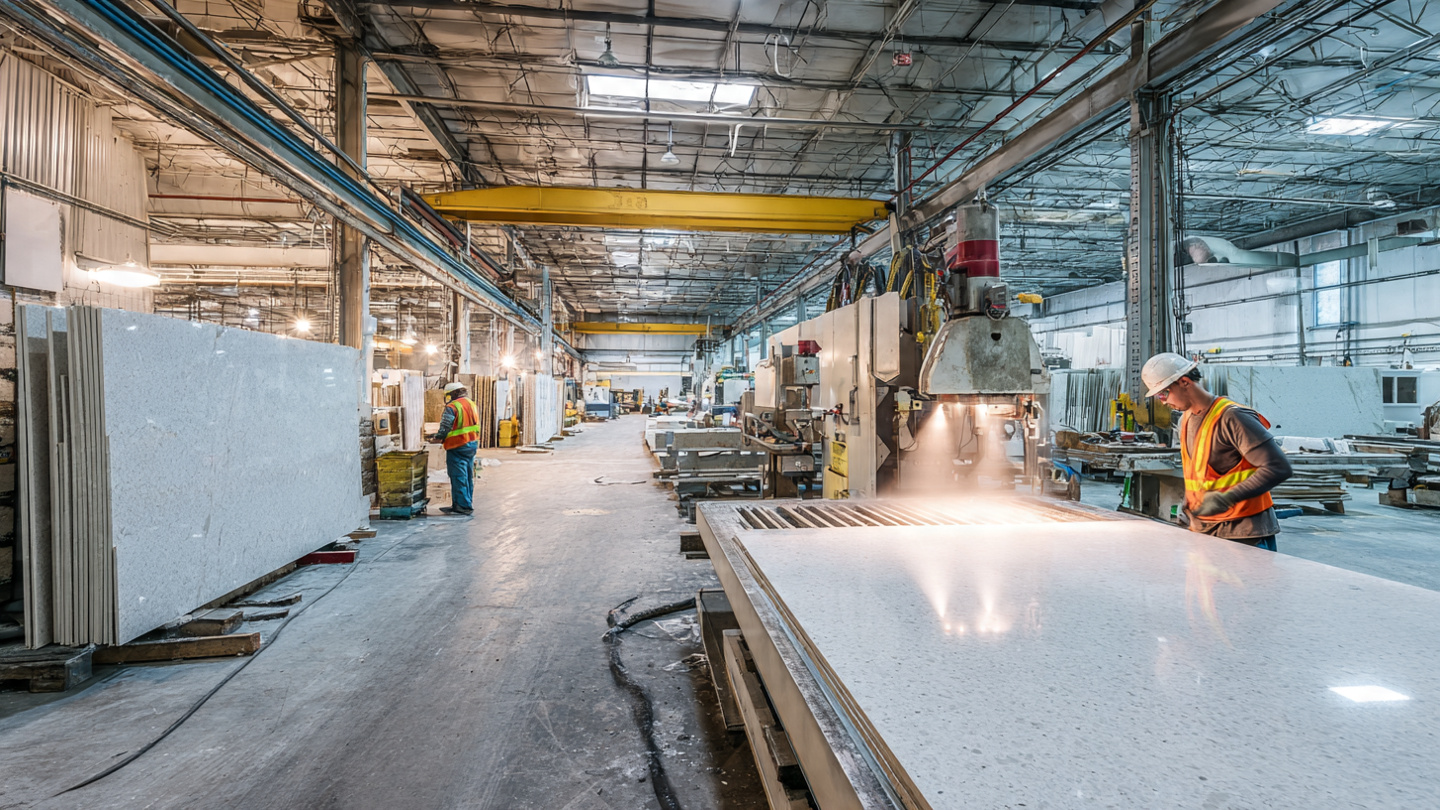
The Problem
Engineered stone killed a worker in California who was 37 years old. He had spent 11 years cutting quartz countertops, and when industrial hygienists finally measured the air in his workspace, the silica exposure levels came back at 22 times the permissible exposure limit set by the federal government to protect workers from exactly the kind of death he was about to experience. According to a 2019 CDC Morbidity and Mortality Weekly Report, his case was one of 18 severe silicosis diagnoses identified across California, Colorado, Texas, and Washington between 2017 and 2019, including two fatalities, and that was only the first wave. By 2024, California alone had recorded 219 confirmed cases and 14 deaths, and the Los Angeles County Department of Public Health reported that over 60% of the state's cases clustered in the San Fernando Valley, where hundreds of small fabrication shops operate within a few square miles of each other.
Engineered quartz contains up to 93% crystalline silica, compared with 25-40% for natural granite, which means every cut produces a dust cloud with roughly double the silica concentration. When a worker dry-cuts a quartz slab with a handheld grinder, the resulting dust cloud contains respirable crystalline silica (RCS) particles at concentrations that a 2023 Georgia study published in the Journal of Occupational and Environmental Hygiene measured at levels exceeding OSHA's permissible exposure limit in 53% of all worker samples collected across multiple fabrication shops between 2017 and 2023. The permissible exposure limit is 50 micrograms per cubic meter of air, averaged over an eight-hour shift. Some of the Georgia samples exceeded that by a factor of 20. Twenty times the legal limit.
The regulatory response has arrived in layers, each one adding new compliance obligations:
Federal: OSHA's Respirable Crystalline Silica Focused Inspection Initiative specifically targets stone fabrication shops under NAICS codes 327991 (Cut Stone and Stone Product Manufacturing) and 423320 (Brick, Stone, and Related Construction Material Merchant Wholesalers). The initiative has produced 371 inspections, 574 air samples analyzed, and found 117 samples exceeding the PEL. Fifty-nine establishments were cited for excessive silica exposure. Maximum penalty for a serious violation runs $16,131, and willful or repeated violations carry a $161,323 ceiling per occurrence.
California: Cal/OSHA adopted an emergency temporary standard in December 2023 and finalized a permanent regulation effective February 2025. The rule requires employers working with engineered stone to presume silica exposure exceeds the action level (25 µg/m³) unless air monitoring proves otherwise. This shifts the burden of proof: shops must demonstrate compliance rather than waiting for OSHA to prove a violation. Medical surveillance, written exposure control plans, and employee training records are now mandatory. The California Occupational Safety and Health Standards Board is separately considering a potential outright ban on engineered stone fabrication, following public testimony documenting 542 cases and 29 deaths.
Australia: Safe Work Australia prohibited the manufacture, supply, processing, and installation of engineered stone containing 1% or more crystalline silica, effective July 1, 2024, becoming the first country to ban the material outright. Others are watching. The UK's British Safety Council has since called for a similar prohibition across Britain.
Each of these regulatory actions creates compliance requirements that fall on shop owners, the requirements are not optional, the penalties are not trivial, the enforcement is not theoretical, and yet the shops themselves have essentially no infrastructure for meeting any of it.
The Gap in the Market
NIOSH's national mapping project identified 19,316 stone countertop fabrication companies in the United States, and the vast majority are small: a typical shop employs 5 to 15 workers, generates $1M to $4M in annual revenue, and operates from a single location with one or two CNC bridge saws and several handheld tools, and many are family-owned. In California and Texas, a disproportionate number serve predominantly Spanish-speaking immigrant communities, which adds language barriers to the compliance challenge.
| Company/Product | What They Offer | What's Missing for Stone Shops |
|---|---|---|
| Cority | Enterprise EHS platform used by Fortune 500 companies. Incident management, industrial hygiene, compliance tracking, and audit management across more than 1,400 enterprise customers globally. | Priced for large organizations at $50K-$200K+ per year with implementation timelines of 6-12 months, the platform requires dedicated EHS staff to configure and maintain. A 10-person stone shop with no EHS department cannot use this product, and Cority has no interest in selling to them. |
| Intelex (Fortune Brands) | Cloud-based EHS and quality management platform with strong industrial hygiene modules, exposure tracking, and medical surveillance scheduling capabilities, used by manufacturers, energy companies, and construction firms. | Same enterprise pricing and complexity barrier, with minimum contract values typically exceeding $15K/year. The platform assumes the customer has an EHS professional who understands industrial hygiene terminology, sampling protocols, and regulatory frameworks. Stone fabrication shop owners are artisans who know how to cut stone, not compliance professionals. |
| HSI (formerly Vivid Learning) | Safety training content library and learning management system. Over 900 course titles including silica awareness modules, with particular strength in construction and general industry training delivery. | Training is one component of silica compliance rather than the whole picture, and while HSI delivers training content but does not manage air monitoring schedules, track exposure assessment results, generate written exposure control plans, coordinate medical surveillance appointments, or produce OSHA-ready documentation packages. A shop can train every worker and still fail an OSHA inspection on five other requirements. |
| iAuditor / SafetyCulture | Mobile inspection and checklist platform. Used across many industries for safety audits, quality checks, and compliance inspections. Customizable templates. | The platform is generic: a shop owner could build a silica inspection checklist, but would need to know what questions to ask, what regulatory thresholds apply, how often to schedule monitoring, and how to interpret results. The platform does not understand 29 CFR 1926.1153, does not know what Table 1 compliance means, and cannot auto-generate an exposure control plan. It is a blank form builder, not a compliance solution. |
| Industrial hygiene consulting firms | Certified Industrial Hygienists (CIHs) conduct air monitoring, write exposure control plans, recommend engineering controls, and help shops through OSHA inspections, representing the hands-on expert approach to compliance. | Expensive and episodic: a single site assessment with air monitoring runs $2,000-$5,000. Ongoing quarterly monitoring for an 8-person shop: $8,000-$12,000/year. Most small shops cannot afford this, and the consulting model does not scale. There are approximately 7,000 active CIHs in the entire United States, per the American Board of Industrial Hygiene, and those 7,000 professionals serve every industry from pharmaceutical manufacturing to oil refining to construction, not just the 19,316 stone shops that just became a regulatory enforcement priority. |
The gap is not that compliance tools do not exist. The gap is that nothing exists at the price point, complexity level, and domain specificity that a 10-person stone fabrication shop in the San Fernando Valley needs. The shop owner speaks Spanish, has no EHS training, just received an OSHA inspection letter referencing 29 CFR 1926.1153, and has 15 days to respond. His options today: hire a $200/hour CIH he cannot afford, buy enterprise software he cannot operate, or download a blank checklist that does not tell him what to do. Nothing fits. That is the gap.
The Solution
A vertical SaaS platform purpose-built for stone countertop fabrication shops, covering the five compliance pillars that OSHA's silica standard requires.
1. Exposure Assessment Manager ($149/month per shop): Guided workflow for conducting and documenting exposure assessments. The platform pre-populates assessment templates based on the shop's equipment inventory (CNC bridge saw, handheld grinder, edge polisher, etc.) and maps each tool to the applicable Table 1 control method or alternative exposure assessment protocol. For shops using Table 1 compliance, the system generates the required documentation showing which specified control method applies to each task and confirms that the shop follows it. For shops choosing the alternative performance option (actual air monitoring), the platform schedules sampling events, records results, flags exceedances, and generates the written exposure assessment required by 29 CFR 1926.1153(d). Spanish and English throughout. The shop owner does not need to read the regulation. The software reads it for him. That is the entire value proposition distilled into two sentences.
2. Written Exposure Control Plan Generator ($49/month add-on): OSHA requires every employer with workers exposed above the action level to establish and implement a written exposure control plan that identifies tasks involving silica exposure, describes engineering and work practice controls, describes procedures to restrict access to high-exposure areas, and includes a schedule for reviewing the plan's effectiveness. The platform auto-generates this document based on the shop's specific equipment, layout, ventilation configuration, and work practices, then prompts the owner to review and sign it annually. When the shop changes equipment or processes, the plan updates automatically. This document is the first thing an OSHA inspector asks for.
3. Medical Surveillance Coordinator ($39/month add-on): The silica standard requires initial and periodic medical exams for workers exposed above the action level for 30 or more days per year. Exams include chest X-rays, pulmonary function tests, and a medical questionnaire. The platform maintains a dashboard of every worker's surveillance status (initial exam completed, next exam due date, referral needed, physician's written medical opinion received), sends automated reminders to both the employer and employee, and generates the records OSHA requires showing that exams were offered and either completed or declined. The platform connects to a curated network of occupational medicine clinics in major fabrication markets (Los Angeles, Houston, Dallas, Miami, Atlanta) that offer silica surveillance exams at negotiated group rates.
4. Training and Competency Tracker ($29/month add-on): The standard requires employers to ensure each worker can demonstrate knowledge of health hazards associated with silica exposure, specific tasks that involve exposure, engineering controls and work practices in use, the purpose and proper use of respiratory protection, and the contents of the silica standard. The platform delivers training modules (video, 15-20 minutes, available in Spanish and English), administers competency quizzes, records completion with timestamps and scores, and alerts the shop owner when annual refresher training is due. Training content covers the specific tools and processes used in stone fabrication, not generic "dust is bad" material.
5. Inspection Response Kit ($199 one-time purchase): When OSHA sends an inspection notification letter, most shop owners panic. The platform includes a step-by-step inspection preparation guide, an automated document compilation tool that assembles every required record into a single inspection-ready package (exposure assessments, exposure control plan, medical surveillance records, training records, respiratory protection program documentation), and a checklist of the 15 most commonly cited violations in stone fabrication inspections with instructions for correcting each one before the inspector arrives. The kit does not replace legal counsel for contested citations, but it prevents the most common failures: missing documentation, expired training records, and incomplete exposure control plans.
The Math: What an OSHA Citation Actually Costs a Small Shop
Consider a fabrication shop in Houston with 10 workers, two CNC saws, three handheld grinders, and $2.5M in annual revenue. The owner has never conducted air monitoring, has no written exposure control plan, does not offer medical exams, and has a training binder from 2019 that three current employees have never seen.
OSHA inspects, and under the focused enforcement initiative, the inspector samples air in the cutting area. Results come back at 180 µg/m³ for the grinder operator. That is 3.6 times the PEL.
Scenario: Typical citation package for a first-time inspection with overexposure
Violation 1: Failure to assess employee exposure (29 CFR 1926.1153(d)(2)), classified as serious with a proposed penalty of $12,000.
Violation 2: Failure to implement Table 1 engineering controls or conduct alternative exposure assessment (29 CFR 1926.1153(c)), classified as serious with a proposed penalty of $14,000.
Violation 3: No written exposure control plan (29 CFR 1926.1153(g)), classified as serious with a proposed penalty of $10,000.
Violation 4: Failure to offer medical surveillance (29 CFR 1926.1153(h)), classified as serious with a proposed penalty of $10,000.
Violation 5: Failure to provide information and training (29 CFR 1926.1153(i)), classified as serious with a proposed penalty of $8,000.
Violation 6: No respiratory protection program (29 CFR 1910.134), classified as serious with a proposed penalty of $12,000.
Total proposed penalties: $66,000. For a shop grossing $2.5M with typical 8-12% margins, that is $200,000-$300,000 in revenue the owner must generate to cover the fines after taxes and overhead. The citation also triggers abatement requirements with deadlines, follow-up inspections, and potential escalation to willful classification ($161,323 per violation) if the shop fails to correct the hazards.
Now add the liability exposure that the citation creates. A worker diagnosed with silicosis after the shop received citations for overexposure has a straightforward workers' compensation claim and a potential third-party lawsuit against the shop for willful disregard of known hazards. Average workers' compensation cost for an occupational disease claim involving permanent disability: $150,000-$400,000 depending on the state. A wrongful death settlement for a silicosis fatality in a shop with documented OSHA violations: seven figures.
Platform cost for the same shop: $149/month (exposure assessment) + $49 (exposure control plan) + $39 (medical surveillance) + $29 (training) + $199 one-time (inspection kit) = $266/month ongoing, $3,391 first year, $3,192 annually thereafter. That is 4.8% of the first OSHA citation this shop would receive, and a mere 0.8% of the estimated workers' comp claim if one of those 10 workers develops silicosis. The math is not subtle.
Revenue Model
| Revenue Stream | Amount | Notes |
|---|---|---|
| Exposure Assessment Manager (per shop/month) | $149 | Core product. Assessment workflows, Table 1 mapping, sampling records, exceedance alerts. Required by 29 CFR 1926.1153(d). |
| Written Exposure Control Plan (per shop/month) | $49 | Auto-generated, equipment-specific ECP. Annual review prompts. Required by 29 CFR 1926.1153(g). |
| Medical Surveillance Coordinator (per shop/month) | $39 | Exam scheduling, status tracking, physician opinion records, clinic network rates. Required by 29 CFR 1926.1153(h). |
| Training and Competency (per shop/month) | $29 | Video modules (EN/ES), quizzes, completion records, annual refresher scheduling. Required by 29 CFR 1926.1153(i). |
| Full compliance bundle (per shop/month) | $229 | All four modules at 14% discount. Expected take rate: 60%+ of subscribers. |
| Inspection Response Kit (one-time) | $199 | Document compilation, preparation guide, citation response checklist. |
| Air monitoring hardware referral (per unit) | $50-$75 commission | Affiliate revenue from personal air sampling pumps ($800-$1,500 retail). SKC, Sensidyne, Casella partnerships. |
| IH consulting referral (per engagement) | 15% referral fee | For shops that need a CIH on-site. Curated network of bilingual industrial hygienists in major fabrication markets. |
Unit economics on the full compliance bundle: Monthly revenue per shop: $229. Annual: $2,748. Add one inspection kit ($199) and one monitoring hardware referral ($62.50 average commission) in year one: $3,009.50. Customer acquisition through OSHA inspection letter response (shops searching "OSHA silica citation help" after receiving a letter) and industry association partnerships (Natural Stone Institute, Marble Institute of America, Stone Fabricators Alliance) costs an estimated $400-$600 per subscriber. At 3-year average retention: LTV $8,443 / CAC $500 = LTV:CAC 16.9x.
Market Size
TAM: NIOSH's mapping project identified 19,316 stone countertop fabrication companies in the United States. Not all of those shops work with engineered stone, since some are granite-only operations and others specialize in marble, but the OSHA silica standard applies to natural stone fabrication as well because granite and marble both generate respirable crystalline silica during cutting, polishing, and grinding operations, which means the compliance obligation extends far beyond the engineered quartz shops that have drawn the most public attention. Conservatively, 14,000 of these shops face silica compliance obligations that require air monitoring, exposure control plans, and medical surveillance. At the full compliance bundle rate of $229/month: 14,000 × $229 × 12 = $38.5M/year in recurring SaaS revenue. Adding hardware referrals, IH consulting referrals, and inspection kits: approximately $52M total addressable.
SAM: Focus on the six states with the highest enforcement activity and silicosis case counts: California, Texas, Florida, Georgia, New York, and Illinois. These states contain an estimated 7,200 fabrication shops (based on NIOSH data showing California alone with 1,564 and Texas as the second-largest market). At blended revenue of $250/month per shop including add-ons: $21.6M/year.
SOM (year 3): 600 shops on the platform, averaging $229/month in recurring revenue plus $400/year in one-time and referral revenue. $1.89M ARR. 8.3% penetration of the California/Texas addressable market (3,200 shops in those two states). Achievable through a combination of OSHA inspection response marketing (shops actively searching for help), Natural Stone Institute partnership, and direct outreach to shops in high-enforcement zip codes where OSHA has already conducted inspections.
Why Now
OSHA's focused enforcement initiative changed the probability of inspection from theoretical to real. Before the initiative, a stone fabrication shop's chance of receiving an OSHA inspection in any given year was roughly 1 in 200, based on OSHA's total inspection capacity divided across all industries. The focused inspection initiative specifically targets NAICS codes 327991 and 423320, concentrating inspector attention on this industry. With 371 inspections completed as of the latest reported data and OSHA's stated intent to continue the initiative, the probability of inspection for any individual shop has increased by an order of magnitude. Shop owners who previously dismissed silica compliance as a theoretical concern now have neighbors and competitors who have been inspected, cited, and fined, and the word travels fast through an industry where shops in the same metro area compete for the same builders and use the same equipment suppliers.
California's permanent regulation created the strictest compliance requirements in the country, and other states will follow. The February 2025 Cal/OSHA permanent silica regulation for engineered stone imposes requirements beyond federal OSHA: presumed overexposure unless monitoring proves otherwise, mandatory engineering controls for all engineered stone work, and state-specific documentation requirements. The Standards Board's ongoing consideration of a full ban means California shops face existential regulatory uncertainty. Washington and Colorado, the other states with the highest case counts, are developing their own enhanced regulations. A platform built for multi-jurisdiction compliance has a structural advantage over state-specific solutions.
Australia's ban made this a global story, and the demand-side of the countertop market is shifting. When Australia prohibited engineered stone on July 1, 2024, it validated the public health argument with a policy decision that no amount of industry lobbying could reverse. Architects and designers are reconsidering engineered stone specifications, and homeowners are asking questions they never asked before. The fabrication shops that survive this transition will be the ones that can document, prove, and certify that their workers are protected. Compliance software is not just a regulatory cost avoidance tool. It is increasingly a market access requirement.
The workforce most affected has the least access to compliance resources. A 2023 qualitative study of Los Angeles countertop workers found that 90% of workers surveyed reported respiratory symptoms from dust exposure. Many described working without proper ventilation, cutting dry without water suppression, and receiving no training about silica hazards. The language barrier is not incidental: most shop-floor workers in the San Fernando Valley speak Spanish as their primary language, and compliance materials from OSHA are written in regulatory English at a reading level that assumes familiarity with industrial hygiene concepts. A bilingual, simplified platform designed for non-expert users is not a nice feature. It is the product.
Startup Costs
| Category | Cost | Notes |
|---|---|---|
| Web platform + mobile app (6 months) | $180K | 2 full-stack engineers + 1 designer. Assessment workflows, ECP generator, medical surveillance tracker, training LMS, document compilation engine. React + React Native for bilingual mobile experience. |
| Regulatory content engine | $45K | Legal review of compliance templates against 29 CFR 1926.1153, 29 CFR 1910.134, Cal/OSHA Title 8 §5204, and state-specific equivalents. Template generation for exposure control plans, assessment documentation, and training curricula. Occupational health attorney engagement for initial regulatory mapping. |
| Training video production (EN/ES) | $35K | 8-10 training modules, 15-20 minutes each, filmed in actual fabrication shop settings showing real equipment and techniques. Professional Spanish translation and voice-over. Competency quiz development. Annual refresh cycle budget. |
| IH consultant and clinic network | $20K | Business development to establish referral partnerships with bilingual CIHs and occupational medicine clinics in LA, Houston, Dallas, Miami, Atlanta, and New York. Negotiated group rates for medical surveillance exams. |
| Pilot program (25 shops, CA + TX) | $30K | Free 6-month pilot with 25 fabrication shops across Los Angeles and Houston, including subsidized onboarding, dedicated bilingual support, on-site visits to each participating shop during the pilot period, and contractual rights to publish case studies and testimonials from shops that achieve documented compliance improvements. |
| Industry association partnerships + trade shows | $25K | Natural Stone Institute sponsorship, StonExpo/Marmomac Americas attendance, OSHA consultation program partnerships. Booth, demos, travel, collateral (EN/ES). |
| Operating buffer (12 months) | $40K | Cloud infrastructure, customer support (bilingual), regulatory update monitoring, insurance. |
| Total | $375K |
Limitations
The 19,316 company figure from NIOSH's mapping project was compiled from business databases using NAICS and SIC codes, not from verified on-the-ground surveys. Some of those companies may have closed, some may not actually fabricate stone (distributors and installers can share the same codes), and some active fabrication shops may be missing if they registered under a different classification. The actual addressable count could be 30% lower or 20% higher.
The citation penalty amounts used in the ROI calculation are based on OSHA's 2024 maximum penalty schedule and typical first-inspection citation groupings reported in enforcement data. Actual penalties vary significantly based on employer size, good faith, history of violations, and gravity of the hazard. Small employers (under 25 employees) typically receive 40-60% penalty reductions. A 10-person shop's first citation for the same violations described above might total $28,000-$40,000 rather than $66,000. The economic argument for the platform still holds at the reduced figure, but the headline numbers are top-end estimates.
The platform's regulatory content covers federal OSHA and California's Cal/OSHA regulations as its initial scope. Compliance requirements in other states (Washington, Colorado, New York, New Jersey) may include additional or different provisions that the platform would need to address as it expands geographically. Building and maintaining multi-state regulatory content is an ongoing cost that will scale roughly linearly with the number of states covered.
Medical surveillance coordination assumes that occupational medicine clinics exist within reasonable distance of fabrication shops. In rural areas and smaller metro markets, the nearest clinic offering silica surveillance exams with chest X-ray and spirometry may be 50+ miles away. The platform can schedule the appointment, but it cannot solve geographic access gaps in occupational healthcare infrastructure.
Strongest Counterargument
OSHA itself gives away compliance assistance for free. The OSHA On-Site Consultation Program, funded by OSHA but operated by state agencies, provides free and confidential workplace assessments to small and medium-sized businesses. Consultants help employers identify hazards, suggest corrective actions, and assist with compliance obligations. Georgia's on-site consultation program has already specifically targeted stone fabrication shops with silica training and resources. If OSHA is willing to help shops comply for free, why would they pay $229/month for software?
The counterargument to the counterargument: the consultation program is massively oversubscribed and structurally episodic. There are approximately 1,200 OSHA on-site consultants covering all industries in all 50 states. They cannot provide ongoing compliance management for 14,000 stone fabrication shops. A consultant visits once, writes a report, and moves on. The shop owner is left with a paper report and no system for maintaining compliance between visits. Air monitoring needs to happen on a regular schedule. Medical exams need tracking. Training records need updating. The consultation program identifies what you need to do. It does not do it for you, and it does not come back next quarter to make sure you are still doing it. Software does both.
Additionally, shops that receive an on-site consultation are temporarily exempt from programmed OSHA inspections, but only while they are correcting identified hazards within the consultant's recommended timeline. The exemption does not protect against complaint-driven inspections or inspections triggered by a worker injury or fatality. The protection is conditional and temporary. Ongoing compliance management through software provides continuous protection that an annual consultation visit cannot match.
What You Can Do
If you own a stone fabrication shop: Start with Table 1. OSHA's silica standard for construction (29 CFR 1926.1153, Table 1) lists specific tasks, equipment, and the engineering and work practice controls that, if followed, are deemed sufficient without requiring air monitoring. For stone countertop work, the relevant entries cover stationary masonry saws (use integrated water delivery system, operate and maintain per manufacturer instructions), handheld grinders (use tool with integrated water delivery system that supplies continuous stream at point of impact), and handheld power saws (same water requirement). If every tool in your shop has a functioning water delivery system and you actually use it on every cut, you are following Table 1 and your documentation burden drops significantly. Document which Table 1 entry applies to each tool. Take dated photos of your water delivery systems. Keep the documentation in a binder at the shop. That binder alone will change the trajectory of an OSHA inspection from "hostile" to "cooperative."
If you're a CIH or occupational health professional: The 19,316 shops on NIOSH's map represent the largest concentrated demand for industrial hygiene services in a single industry segment since the asbestos remediation wave of the 1980s and 1990s. Most of these shops have never hired an industrial hygienist. Most do not know what one does. If you speak Spanish and can explain silica hazards in plain language, you can build a practice serving this market segment alone. Partner with a technology platform that handles the ongoing compliance management so you can focus on the high-value work: initial assessments, complex exposure scenarios, and expert witness services for workers' compensation cases.
If you're building this: Start in the San Fernando Valley. The highest concentration of fabrication shops in the country, the most active enforcement environment, the most documented silicosis cases, and a community that communicates through word of mouth. Sign up 15 shops for a free pilot. Your MVP is the exposure assessment manager and the written exposure control plan generator. Skip medical surveillance coordination and training content for v1. Prove that shops using the platform can produce OSHA-ready documentation in 30 minutes that previously required a $3,000 consulting engagement. That time-and-money savings is your entire pitch. Build the onboarding so a shop owner with a high school education and a smartphone can complete it in Spanish without ever reading a federal regulation.
The Bottom Line
Stone countertop fabrication is a $22 billion industry in the United States that is experiencing its asbestos moment. Workers are dying from a preventable disease, the federal government is actively enforcing regulations that most of the 19,316 affected shops are not equipped to meet. One country has already banned the material. The most populous US state is considering it. The compliance requirements are specific, well-defined, and mandatory, which makes them perfect for software automation. The shops that need this software the most are the ones least likely to have heard of Cority or Intelex, least likely to be able to afford a consulting industrial hygienist, and most likely to respond to a product that speaks their language, understands their tools, and costs less per month than one hour of a CIH's time. That is $375,000 to build and $229/month to sell, targeting a market where non-compliance costs $66,000 per citation and the alternative is a filing cabinet full of yellowing paper that protects nobody.