130,000 Schools Must Prove Their Air Is Safe. The Software Doesn't Exist.
ASHRAE Standard 241, the first infectious aerosol control standard in building engineering history, requires zone-by-zone clean airflow documentation for every occupied room. California mandates CO2 monitors in every new classroom. Boston deployed 4,000 sensors and published the data. Nobody sells the compliance platform that turns sensor readings into the Building Readiness Plan a school district actually needs.
The Problem
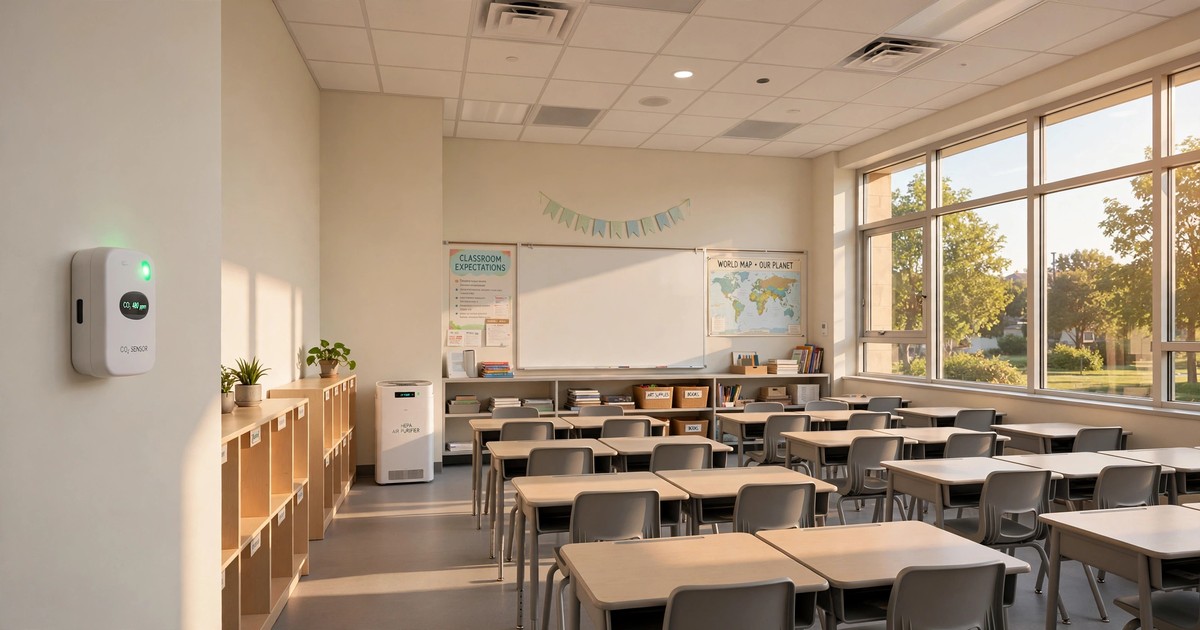
Walk into most American classrooms and the air is worse than you think. A UC Davis study testing ventilation rates in California classrooms found that the majority failed to meet the state's own minimum ventilation standards set in Title 24. CO2 concentrations regularly exceeded 1,200 ppm during occupied hours in rooms where the HVAC system was technically operational but hadn't been properly commissioned, maintained, or tested since installation. Researchers recommended periodic HVAC testing and continuous real-time CO2 monitoring. The state legislature responded with Assembly Bill 2232, which requires covered schools to ensure HVAC systems meet minimum ventilation rates, install MERV 13 or higher filtration, and directed the Building Standards Commission and Division of the State Architect to propose mandatory CO2 monitoring standards for classrooms. Since January 2023, California's CALGreen code requires CO2 monitors in all new K-12 classroom construction.
Then came the pandemic, and with it, a reckoning. Schools that had ignored ventilation for decades suddenly needed to prove their buildings were safe for children to occupy. Most faked it. Portable HEPA filters wheeled into corners. Windows propped open in January. CO2 monitors purchased in bulk and mounted on walls with no system for reading, recording, or acting on the data they produced. When the emergency receded, most schools returned to baseline neglect. But the rules had permanently changed.
ASHRAE Standard 241-2023, published in June 2023, is the inflection point. ASHRAE itself describes it as the first standard in building engineering history to set specific equivalent clean airflow requirements for controlling infectious aerosol transmission indoors. Previous standards addressed ventilation for comfort and odor; Standard 241 addresses ventilation for disease prevention. Here is what it requires: every occupied zone in a building must achieve a minimum equivalent clean airflow rate (ECAi) calculated per occupant, met through any combination of outdoor air ventilation, filtered recirculated air (MERV-A 11 minimum), and air cleaning devices. For a typical classroom with 25 occupants, that means 500 liters per second of equivalent clean air. And critically, the standard mandates a Building Readiness Plan: a documented assessment, planning, and commissioning protocol that proves each zone meets the target. Not optional. Not aspirational. Required.
Consider a school district with 50 buildings and 2,000 classrooms. It must produce a Building Readiness Plan covering every occupied zone. Each zone requires an ECAi calculation incorporating outdoor air volume, filter efficiency, recirculated airflow fraction, air cleaner CADR, and occupant count. Each zone must independently meet its target; over-ventilating the hallway does not compensate for an under-ventilated classroom. Documentation must survive regulatory scrutiny, parental inquiry, and potential litigation. Right now, districts attempting this work are doing it in spreadsheets. One building at a time. Consulting engineers billing $150-250 per hour.
Why the Current Tools Miss the Mark
Hardware for measuring indoor air quality exists. Software for documenting regulatory compliance with ASHRAE 241's Building Readiness Plan requirements does not. That distinction matters. It is the difference between having a thermometer and filing a health department report.
| Company | What They Do | What's Missing |
|---|---|---|
| Awair (Omni) | Enterprise-grade IAQ sensor: CO2, PM2.5, temperature, humidity, VOCs. Cloud dashboard with historical data and alerts. | Monitors conditions but cannot calculate ASHRAE 241 equivalent clean airflow, generate Building Readiness Plans, or classify zones as compliant. A sensor, not a compliance engine. |
| Kaiterra (Sensedge) | Commercial IAQ sensors for BMS integration. Used in WELL-certified buildings. Enterprise dashboard with multi-site aggregation. | Built for commercial real estate and WELL certification, not K-12. Pricing ($1,000+/sensor) prohibitive for district-wide deployment. No ECAi calculation. No Building Readiness Plan workflow. No school-specific reporting formats. |
| RESET Air | Certification platform requiring continuous IAQ monitoring with accredited sensors. Data integrity verification for WELL v2 and RESET compliance. | Certifies that monitoring hardware meets data quality standards. Does not calculate whether monitored conditions meet ASHRAE 241 equivalent clean airflow targets. Wrong layer of the stack. |
| Johnson Controls (OpenBlue) / Honeywell Forge | Enterprise building automation and analytics with IAQ monitoring. AI-driven HVAC optimization. | Requires existing BMS infrastructure most schools lack. A district running 50 buildings with 30-year-old rooftop units cannot deploy OpenBlue. Even with BMS, these platforms optimize performance, not regulatory compliance documentation. |
| Brightly (SchoolDude / Siemens) | Facility management platform used by 12,000+ school districts. Maintenance scheduling, asset tracking, capital planning. | Tracks when a filter was changed. Cannot calculate whether that filter's MERV rating, combined with outdoor air fraction and recirculated airflow, achieves the ECAi target for that zone's occupancy. Maintenance-centric, not compliance-centric. |
Sensor manufacturers sell hardware that generates data. BMS vendors sell platforms that optimize operations. Facility management tools track maintenance. Nobody sells the compliance layer that sits between the sensor readings and the regulatory requirement. That gap is the product.
What Gets Built
A compliance-layer SaaS purpose-built for K-12 school districts, bridging the gap between IAQ sensor hardware and ASHRAE 241 regulatory documentation. Six components:
1. District building and zone inventory: Import or manually create the district's complete building inventory: every school, every wing, every classroom, every gymnasium, every cafeteria. Each zone gets an occupancy count (from fire code or scheduling data), a room volume, and HVAC system specifications including outdoor air intake rate, recirculated air volume, filter MERV rating, and any supplemental air cleaning devices (portable HEPA units with documented CADR). This is the data layer that no existing product maintains in a structured, queryable format for school districts.
2. ASHRAE 241 ECAi calculator: For every zone, calculate the equivalent clean airflow rate using the standard's formula: ECAi = Σ(zf × Vot) + Σ(Vmvs) + Σ(Vacs) + Vnv, where Vot is the outdoor air contribution (weighted by zone fraction), Vmvs is the filtered recirculated air contribution (airflow × filter infectious aerosol reduction efficiency), Vacs is supplemental air cleaning (CADR), and Vnv is natural ventilation. Compare against the standard's minimum ECAi per person for the space type (20 L/s per person for classrooms). Red/yellow/green status per zone. Dashboard showing district-wide compliance percentage with drill-down to individual rooms.
3. CO2-based ventilation verification: Integrate with deployed CO2 sensors (Awair, Kaiterra, or any sensor with an API or CSV export) to validate calculated outdoor air rates against measured conditions. Steady-state CO2 concentration and per-person outdoor air ventilation rate have a well-established mathematical relationship (the CO2 mass balance equation). If a zone's HVAC specification claims 7 L/s per person outdoor air but CO2 readings consistently exceed 1,200 ppm at full occupancy, the system flags a discrepancy. That is exactly what the UC Davis study found happening across California classrooms. This verification layer transforms CO2 sensors from standalone monitors into compliance evidence.
4. Building Readiness Plan generator: ASHRAE 241 requires a Building Readiness Plan covering assessment, planning, and commissioning. This is the deliverable. The platform generates it from the district's zone inventory and compliance calculations: which zones meet the standard, which require remediation, what remediation options exist (upgrade filters, add portable air cleaners, increase outdoor air intake, reduce occupancy), estimated costs per path, and a prioritized implementation timeline. School boards, state regulators, and parents are beginning to demand this document. Right now it requires a consulting engineer at $150-250/hour to produce manually.
5. Compliance monitoring and drift detection: IAQ compliance is not a one-time calculation. Filters degrade. Dampers stick. Economizers fail. Occupancy changes. The platform continuously compares sensor data against each zone's ECAi target and alerts facilities staff when a room drifts out of compliance. Seasonal patterns (winter with closed windows vs. summer with natural ventilation) are tracked over time. Filter replacement schedules tie to compliance degradation curves. Facilities directors see a real-time compliance dashboard; maintenance teams see work orders triggered by compliance drift rather than arbitrary schedules.
6. State reporting and parent transparency portal: California's AB 2232 and CALGreen requirements have specific reporting formats. Other states are following with their own IAQ legislation. The platform generates state-specific compliance reports from the same underlying data. For districts that want to follow Boston's lead in public transparency, a parent-facing portal (similar to what Boston Public Schools built for its 4,000-sensor deployment) shows real-time air quality by school and classroom without exposing the underlying compliance calculations or remediation priorities.
What Bad Air Actually Costs a School District
Advocates have argued the financial case for school IAQ qualitatively for years. Here it is quantitatively.
In Average Daily Attendance (ADA) states like California, school districts receive state funding based on the number of students who actually show up each day, not the number enrolled. SchoolStatus data from 172 districts shows that a 5,000-student district loses $75,000 to $150,000 annually for each percentage point increase in chronic absenteeism. Oakland Unified lost approximately $55 million to student absences in 2023-24 at a 90% attendance rate, roughly $90 in ADA funding per absent student per day.
Respiratory illness is the leading cause of school absence, a finding consistently reported in the CDC's National Health Interview Survey (NHIS) across multiple survey years. A 2024 report by ACHR News on Boston's Otis Elementary, the first school in the country to meet ASHRAE 241 benchmarks, found that proper ventilation and filtration reduced COVID-19 infection risk by over 80% and also cut transmission of flu, RSV, and other respiratory infections.
Run the numbers for a district of 10,000 students across 20 schools. Chronic absenteeism nationally sits at approximately 23.5%, per Department of Education data reported by District Administration. Respiratory illness accounts for roughly 40% of illness-related absences. If ASHRAE 241-compliant ventilation and filtration reduces respiratory illness transmission by even 30% (conservative given the 80%+ reduction seen in controlled settings), the expected reduction in chronic absenteeism is approximately 2.8 percentage points (23.5% × 40% × 30%). At $75,000-$150,000 in lost ADA funding per percentage point for a district of this size, that translates to $210,000-$420,000 in recovered annual revenue.
A compliance SaaS at $100/school/month across 20 schools costs $24,000/year. The ROI on recovered ADA funding alone: 8.75x to 17.5x. That ignores the health benefits and litigation risk reduction entirely. Even halving the respiratory illness reduction assumption to 15%, recovered revenue ($105,000-$210,000) still delivers a 4.4x to 8.75x return on a $24,000 annual software subscription. The math works.
This calculation does not account for the consulting engineer fees the platform replaces. One Building Readiness Plan assessment for a single school building runs $5,000-$15,000 when performed by an outside consultant. For a 20-school district: $100,000-$300,000 in one-time consulting fees, largely eliminated. First-year ROI becomes even more lopsided.
Revenue Model
| Revenue Stream | Amount | Notes |
|---|---|---|
| Per-school subscription (monthly) | $79-149 | Includes zone inventory, ECAi calculations, compliance dashboard, Building Readiness Plan generation, and CO2 sensor integration for up to 50 zones per school. Tiered by school size (elementary vs. large high school). |
| District tier (monthly) | $499-1,999 | For districts with 10+ schools. Portfolio compliance dashboard, cross-school analytics, automated state reporting, parent transparency portal, and dedicated onboarding support. Volume pricing brings per-school cost to $50-80/month at scale. |
| State program management tier (annual) | $25,000-75,000 | For state education departments or grant-administering organizations managing IAQ compliance across hundreds of districts. Aggregated compliance reporting, grant fund tracking, statewide benchmarking. Sold through state RFP processes. |
| Sensor partnership referral fees | 5-10% of hardware | Referral agreements with CO2 sensor manufacturers (Awair, Senseware, or lower-cost options) for districts that need to purchase monitoring hardware alongside the compliance platform. Not a primary revenue stream but reduces customer acquisition friction. |
| Consulting engineer marketplace (per assessment) | $500-1,000 | For districts that need professional engineer sign-off on Building Readiness Plans. The platform pre-fills the assessment; the PE reviews and certifies. Platform takes 15-20% of the consulting fee as a marketplace commission. |
Unit economics on a 20-school district: 20 schools at $99/month average = $23,760/year. Customer acquisition cost: $2,000-4,000 (facilities directors attend ASBO International and state facilities conferences; that is the sales channel). School districts are notoriously sticky with compliance software. At 48-month average retention, LTV reaches $95,040, yielding an LTV:CAC ratio between 24x and 48x.
Market Size
TAM: Approximately 130,930 K-12 schools across roughly 13,500 school districts in the United States, with approximately 99,400 public and 29,700 private. At a blended average of $100/school/month, the school IAQ compliance platform market is worth approximately $157M/year for K-12 alone. Add higher education institutions (5,500+ Title IV schools with similar compliance needs), commercial buildings in jurisdictions adopting ASHRAE 241 by reference, and international schools following ASHRAE standards: $250-350M/year total addressable market for IAQ compliance-layer SaaS.
SAM: Immediate serviceable market: schools in states with active IAQ legislation or funding programs. California (10,500+ schools, AB 2232 mandate), New York (4,700+, post-pandemic IAQ investments), Massachusetts (1,800+, Boston's public transparency precedent), Colorado, Connecticut, Illinois, New Jersey, Oregon, and Washington have all introduced IAQ-related legislation or funding. Collectively about 45,000 K-12 schools. At $100/month: $54M/year.
SOM (year 3): 500 school subscriptions at $99/month average = $594,000. Fifteen district-tier customers at $999/month = $179,820. Two state program contracts at $50,000/year = $100,000. Consulting marketplace commissions: $50,000. Total: approximately $924,000 ARR. Roughly 1% penetration of schools in states with active IAQ mandates. Conservative given the concentrated buyer base and compliance urgency driving adoption.
Why Now
ASHRAE 241 is moving from voluntary standard to adopted code. When ASHRAE published Standard 241 in June 2023, it was voluntary. Three years later, jurisdictions are adopting it by reference. D.C.'s State Board of Education held public hearings on ASHRAE 241 adoption for schools in 2024. California's Division of the State Architect is incorporating CO2 monitoring into CALGreen mandatory standards for all K-12 construction and major renovation. Industry analysis from early 2026 identifies ASHRAE 241 as a primary compliance driver alongside NYC Local Law 97 and WELL Building Standard v2. As the standard shifts from aspirational to required, the gap between what districts must document and what tools exist to help them widens.
Federal funding has created sensor deployments with no compliance layer. EPA's $34 million in IRA Section 60106 grants, awarded in August 2024, funded five organizations to help schools develop IAQ management plans. California's CALShape program allocated $20 million from the Greenhouse Gas Reduction Fund for school ventilation. These programs purchased sensors and produced assessments. They did not build sustainable compliance infrastructure. When the grant period ends, schools are left with hardware on walls and PDF reports in filing cabinets. Ongoing compliance documentation doesn't exist.
Boston proved that public IAQ transparency is survivable and popular. Boston Public Schools deployed 4,000 IAQ sensors across more than 120 buildings and made the data public. Rather than creating a crisis, transparency built trust. Otis Elementary became the first school in the country to officially meet and exceed ASHRAE 241 benchmarks. Other districts are watching. Whether more districts publish IAQ data is no longer the question. Whether they do it proactively or in response to parent lawsuits is.
Chronic absenteeism is a financial crisis driving urgent action. National chronic absenteeism sits at 23.5%, a post-pandemic level that has not recovered to pre-2020 baselines. District Administration reports that districts with 10,000 students typically recover around $529,760 annually from even modest 3-5 percentage point improvements. School boards have exhausted behavioral interventions. Environmental factors are next. IAQ improvement is one of the few interventions with both a health evidence base and a measurable financial return through ADA funding recovery.
Litigation risk is rising. Pre-pandemic, suing a school district over air quality required proving specific harm from specific conditions. Post-pandemic, with published standards (ASHRAE 241) and available monitoring technology (sub-$500 CO2 sensors), the legal bar for demonstrating that a district knew or should have known about inadequate ventilation has dropped materially. A parent whose child has repeated respiratory infections in a classroom with documented CO2 levels above 1,500 ppm has a stronger claim than parents had five years ago. Compliance documentation is increasingly defensive necessity.
Startup Costs
| Category | Cost | Notes |
|---|---|---|
| Platform engineering (12 months) | $320K | 2 backend + 1 frontend + 0.5 data engineer. Zone inventory data model, ECAi calculation engine implementing the ASHRAE 241 formula, CO2 sensor integration layer (API connectors for major sensor brands + CSV import fallback), Building Readiness Plan document generator, compliance dashboard. The ECAi calculation engine is straightforward engineering (the formula is published); the hard part is the zone inventory data model that accommodates the messy reality of school buildings with mixed HVAC systems, partial renovations, and incomplete as-built documentation. |
| Sensor integration and validation | $30K | Purchase 10-15 CO2 sensors from different manufacturers (Awair Omni, Aranet4, Senseware, lower-cost options) to validate API integration and data quality. Test the CO2-to-ventilation-rate derivation against known outdoor air volumes in a controlled classroom environment. This is the credibility foundation: if the platform's calculated ventilation rate from CO2 data matches the engineer's measured rate within 10%, the product has validated its approach. |
| ASHRAE 241 expert advisory (6 months) | $40K | Contract with an ASHRAE member engineer to validate the ECAi calculation engine, review the Building Readiness Plan template against the standard's requirements, and provide ongoing advisory during development. ASHRAE's own training course for Standard 241 costs $369 per participant; the contract goes deeper into implementation-level detail. |
| Pilot program (5 schools, 6 months) | $20K | Free platform access for pilot schools. Dedicated onboarding including on-site zone inventory with facilities staff. Goal: validate the zone inventory workflow, ECAi calculation accuracy, and Building Readiness Plan output quality in real school environments with real HVAC systems. Target at least 3 different building vintages (pre-1970, 1970-2000, post-2000) to test across the range of HVAC systems schools actually operate. |
| Sales, conferences, and content (year 1) | $35K | ASBO International (school business officials), CoSN (school technology), state-level school facilities conferences. Targeted webinars for facilities directors. White paper on ASHRAE 241 compliance for K-12 districts. The buyer attends these events and reads these publications; this is a market where conference presence and educational content drive pipeline. |
| Compliance and legal review | $15K | Legal review of Building Readiness Plan templates for liability exposure. Privacy review for student occupancy data handling (FERPA considerations if zone data is linked to class schedules). Terms of service establishing that the platform provides compliance documentation tools, not engineering certification. |
| Cloud infrastructure and operating buffer (12 months) | $25K | AWS or GCP. Time-series database for sensor data (InfluxDB or TimescaleDB). Document generation pipeline. Customer support. Insurance. |
| Total | $485K |
Limitations
The ADA funding recovery calculation above relies on several assumptions that introduce meaningful uncertainty. Attributing 40% of chronic absenteeism to respiratory illness draws from CDC survey data on illness-related absences, but chronic absenteeism includes non-illness factors (transportation, housing instability, disengagement) that vary dramatically by district demographics. A 30% reduction in respiratory illness from ASHRAE 241-compliant ventilation draws on controlled studies that may not translate directly to the operational reality of school buildings with aging infrastructure. More conservative assumptions (20% respiratory illness attribution and 15% transmission reduction) yield annual ADA recovery of approximately $52,500-$105,000 for a 10,000-student district. Still exceeds the $24,000 platform cost, but with a narrower margin.
Boston is an outlier. BPS committed significant capital expenditure to sensor deployment and HVAC upgrades, driven by strong district leadership and political will. Most school districts, particularly smaller ones in rural areas, lack both the funding and organizational capacity to replicate Boston's approach. A compliance platform reduces the documentation burden but does not solve the underlying infrastructure problem: a school running a 40-year-old rooftop unit with no outdoor air economizer cannot achieve ASHRAE 241 compliance through software alone. Software identifies the gap. Closing it requires capital investment many districts cannot afford.
ASHRAE 241 adoption as mandatory code is proceeding unevenly. California, D.C., and several other jurisdictions are moving toward adoption, but the standard remains voluntary in most of the country. Without regulatory mandates, the primary market driver shifts from compliance (must-have) to risk management (nice-to-have), which changes the sales cycle, price sensitivity, and urgency. Market size projections above assume continued regulatory momentum; a stall in state-level adoption would compress the addressable market and extend the timeline to SOM targets.
Monitor cost matters. The $500 per-monitor figure cited by the California Building Standards Commission for CO2 sensors has compressed since 2023, with basic monitors now available under $200. However, monitors meeting the accuracy and calibration requirements suitable for compliance documentation (NDIR sensors with ±50 ppm accuracy) remain $300-500 for commercial-grade units. Consumer-grade sensors with ±100+ ppm accuracy may not produce data reliable enough for regulatory compliance determinations, creating a quality threshold that affects the platform's utility in districts choosing lower-cost hardware.
Strongest Counterargument
Brightly (formerly SchoolDude, now Siemens) is the dominant facility management platform in K-12 education, serving over 12,000 school districts. If ASHRAE 241 compliance becomes a meaningful requirement, Brightly will add an IAQ compliance module within one to two product cycles. It already has the customer relationships, school building inventory data, maintenance workflow integration, and sales channel into facilities directors. A startup building a standalone IAQ compliance platform would face Brightly's distribution advantage, switching costs, and bundling economics. Brightly could offer IAQ compliance as a $20-30/school/month add-on, undercutting a standalone competitor while cross-selling its full suite.
Here is why that may not happen cleanly. Brightly's data model is maintenance-centric: work orders, asset lifecycles, repair histories. Building an ASHRAE 241 compliance engine requires a fundamentally different data architecture centered on zone-level environmental specifications, airflow calculations, and continuous sensor integration. Retrofitting a maintenance platform to perform zone-by-zone equivalent clean airflow calculations is not a feature addition; it is a data model migration. The ECAi formula itself is simple, but the zone inventory feeding it (HVAC system specifications per zone, filter ratings, outdoor air fractions, occupancy schedules, supplemental air cleaner CADR values) requires structured data Brightly's current schema does not capture. Furthermore, a facility management vendor calculating compliance status faces a structural self-grading problem: the platform that schedules filter changes has an incentive to report that those filters are working. An independent compliance layer that ingests both maintenance records and sensor data can identify the gap between "the filter was installed" and "the filter is actually producing the specified aerosol reduction efficiency." That gap is where compliance failures live.
What You Can Do
If you're a school facilities director: Start with the cheapest diagnostic available. Buy five NDIR CO2 sensors ($200-400 each) and deploy them in classrooms you suspect have poor ventilation: interior rooms without windows, older wings with aging HVAC, portable classrooms. Log peak CO2 concentrations during full-occupancy periods. Any classroom consistently exceeding 1,100 ppm CO2 is almost certainly below ASHRAE 62.1 minimum ventilation rates and well below ASHRAE 241 equivalent clean airflow targets. This $1,000-2,000 investment in sensors produces the data that justifies a larger conversation about compliance investment with your superintendent and school board.
If you're a school board member or superintendent: Request that your facilities department produce a Building Readiness Plan for your largest or newest school. Not a vendor pitch, not a consultant proposal: an actual zone-by-zone assessment of equivalent clean airflow against ASHRAE 241 targets. If your team cannot produce this document, that is the gap. The question for your next board meeting: "Do we know, for each classroom, whether the air our students are breathing meets the national standard for infectious aerosol control?" If the answer is "we don't know," the follow-up is straightforward.
If you're a builder evaluating this space: Your beachhead is California. AB 2232 creates a legislative mandate, CALGreen creates a building code requirement, and the state's ADA-based funding model creates a direct financial ROI calculation for every district CFO. Start with three to five California school districts spanning different sizes and building vintages. The pilot should validate two things: first, that the ECAi calculation engine produces results consistent with an engineer's manual assessment (hire an ASHRAE-member engineer to perform parallel assessments); second, that facilities directors can populate the zone inventory from existing records (HVAC schedules, commissioning reports, filter purchase records) without requiring an on-site engineering survey for every room. If both hold, you have a product. If the zone inventory requires on-site engineering for every room, your product is a workflow tool for engineering firms, not a self-service platform for districts, and the go-to-market changes accordingly.
Bottom Line
American schools spend approximately $800 billion per year educating 50 million students. For most of those schools, the air students breathe while learning has been unmeasured, undocumented, and unmanaged. ASHRAE 241 changed the standard. California changed the law. Boston changed the expectation. Sensor hardware exists at commodity prices. What does not exist is the compliance documentation layer that helps a district with 50 buildings and 2,000 classrooms answer the question every parent, board member, and regulator will increasingly ask: does this classroom meet the standard? At $100 per school per month, the platform costs less than a single day of consulting engineer time and pays for itself through recovered ADA funding. The regulatory wave is building. The infrastructure gap is documented. The financial case is clear. Someone will build the ASHRAE 241 compliance platform for schools. The only question is whether it gets built proactively, as a product, or reactively, after the lawsuits arrive.