854 Buses Late, 140 Never Delivered: Fleet-Readiness Software for Electric School Buses
The EPA's $5 billion Clean School Bus Program has awarded funding for about 8,500 buses across three rounds, about 90 percent of them battery electric. Agency figures released in September 2026 put deliveries at roughly 1,100 buses out of about 2,600 ordered, with 854 delayed and 140 that will never be delivered, while the program itself is frozen pending a rewrite. In Gouverneur, New York, a rural district waited three years for its first pair of electric buses; after one day of service the high-voltage chargers began malfunctioning, sidelining both buses for weeks, and when they returned in November the heating systems failed, knocking one out for four months. School districts are buying $500,000 buses and $1.4 million charging installations with spreadsheet-level planning. The route modeling, right-sized charging design, and grant-compliance platform for this rollout does not exist as a product.
The Problem
America runs the largest mass transit system in the country and barely thinks of it as one. More than 490,000 school buses shuttle children back and forth every school day, a fleet more than twice the size of all other mass transit vehicles combined, driving 3.45 billion miles in a single school year at a cost of $24.3 billion in transportation spending, with about 94 percent of those buses burning diesel. The federal government decided to change that with $5 billion, and the result, four years in, is the most expensive fleet-planning failure nobody is selling software against.
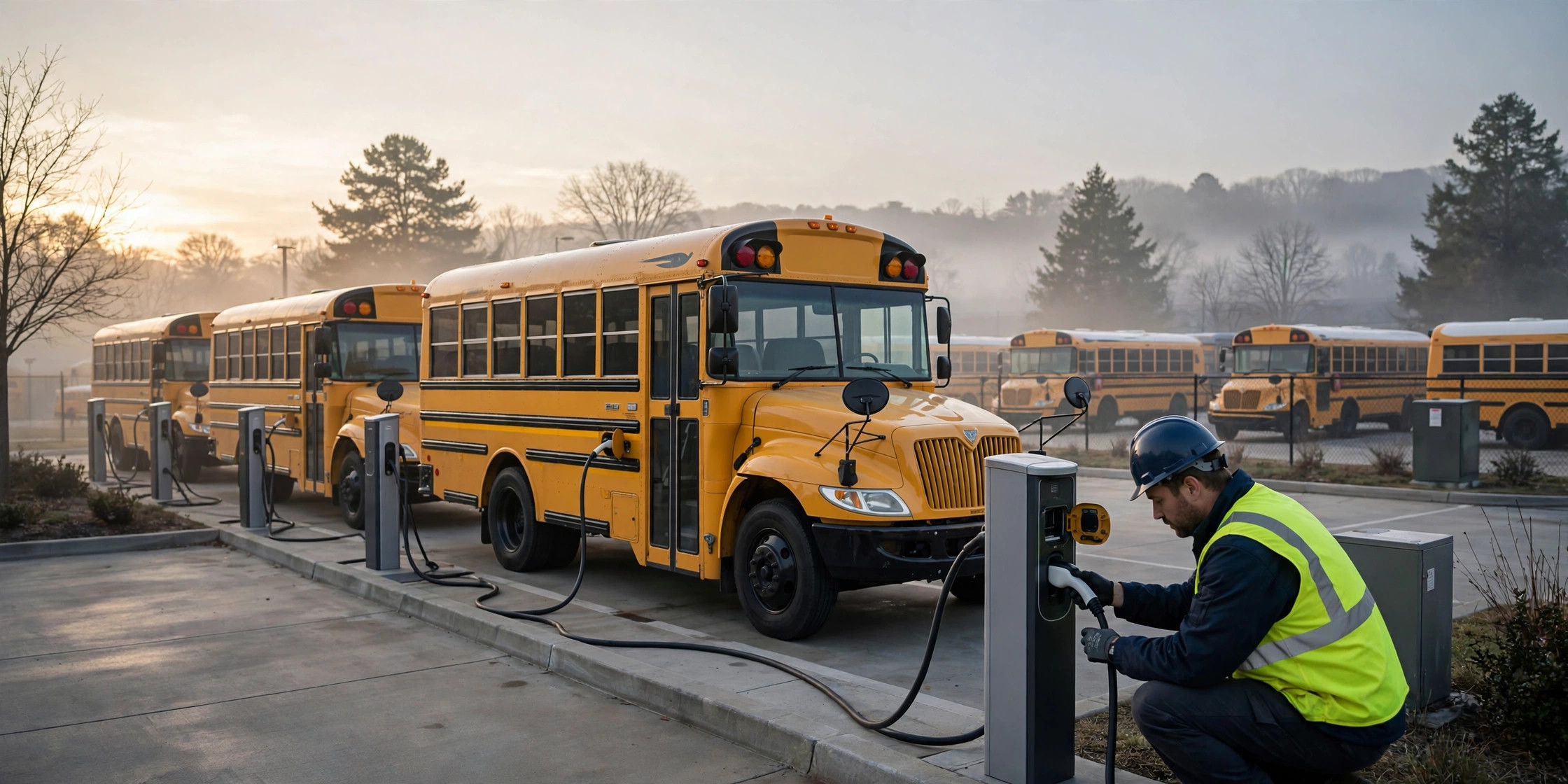
The failure has a shape, and it starts with the price: an electric school bus costs nearly $500,000, two to three times a diesel bus (the EPA's all-in program cost per bus, infrastructure included, runs over $1 million), and the buses are only the down payment. Queensbury, New York told state lawmakers that complying with the state's electric bus mandate would push annual bus expenditures from $1.3 million to nearly $4 million, with charging infrastructure alone estimated at $1.4 million. During a stretch of 19-below-zero weather, all four of the district's electric buses entered a reduced-power "turtle mode" and became inoperable. In Gouverneur, a town near the Canadian border, the district's first two electric buses arrived after a three-year wait and lasted one day before the chargers failed. These are not edge cases from the technology's infancy, as the New York Times reported on September 23, 2026, two days before this writing, under the headline "Why Some Schools Are Hitting the Brakes on Electric Buses."
Behind every one of these failures sits the same missing layer. Somebody had to decide which routes could run on batteries, how much charger power the depot actually needed, when to start the utility interconnection process, and how to file the EPA's semi-annual reports, while in nearly every district that somebody was a transportation director with a spreadsheet and a bus dealer whose incentive was to sell buses, not to right-size infrastructure. The World Resources Institute, which runs the country's most serious school-bus electrification research program, warned in an October 2025 working paper that school districts are "largely responsible for procuring charging infrastructure, which requires understanding timelines, pricing, long-term maintenance, and delineation of roles and responsibilities," that "delays in service upgrades and switchgear delivery are common sources of project slowdowns," and that a frequent pitfall is operators selecting more powerful charging equipment than needed, adding cost for nothing. Every sentence of that warning describes software waiting to be built.
The $5 Billion Program Is Being Rewritten Mid-Flight
In 2021, the Infrastructure Investment and Jobs Act created the EPA's Clean School Bus Program: $5 billion over five fiscal years to replace diesel buses with clean models. The Biden administration ran three funding rounds announcing nearly $3 billion for about 8,500 buses, roughly 90 percent battery electric, with roughly $2.7 billion ultimately awarded. A fourth round, $965 million in rebates covering up to 50 electric buses per application, opened in September 2024 and closed in January 2025.
Then the wheels came off the program itself, and EPA figures released in September 2026, reported by the New York Post, show that of roughly 2,600 buses ordered under the program, only about 1,100 have been delivered, with 854 delayed and 140 that will never be delivered, against about $2.7 billion awarded. Administrator Lee Zeldin froze outgoing money. He accused the prior administration of rushing funds out without planning or oversight. Then he cancelled the 2024 rebate round outright. In February 2026 the agency announced a full restructuring, opened a request for information on alternative fuels, and said a revamped program with new compliance requirements would arrive ahead of a new funding opportunity planned for November 2026, with about $2 billion still unspent.
Underneath, the compliance burden is real and growing: grant recipients file quarterly progress reports; rebate recipients file semi-annual project reports plus eligibility and scrappage forms for every bus replaced, with a detailed final report due within 120 days of project completion and all records retained for three years. If a replacement bus fails to meet program requirements, the EPA may seek recovery of disbursed funds. The agency's own inspector general found the program's verification mechanisms so weak that third-party contractors had applied for grants on behalf of districts that did not know they were applicants, forcing the EPA to redirect $38 million. Tighter verification is the certain outcome. The paperwork burden will grow.
State mandates add a second forcing function, starting with New York's 2022 law, which required all new school bus purchases to be zero-emission, with a full fleet transition to follow. Facing district revolts over cost, the state delayed the mandate by five years in 2026 but kept it alive, which converted an impossible deadline into a planning window. California, New Jersey, Connecticut, and Maryland run their own mandates or incentive programs. The buyers are not going away. They are buying later, with more scrutiny. That is when planning software earns its keep.
The Gap in the Market
Money and attention are flooding this space, but none of it is selling the district a planning product.
| Company | What They Do | What's Missing |
|---|---|---|
| Highland Electric Fleets | Electrification-as-a-service: $150 million in preferred equity from Aiga Capital Partners, and the official electric school bus provider for the LA28 Olympics, deploying 500 zero-emission buses. They finance, build, procure, and maintain the whole fleet under long-term contracts. | A fleet-takeover model, not a software product: districts hand Highland the keys under a 10-15 year service agreement. The districts that operate their own buses and want to keep them cannot buy Highland's planning as software. And EaaS economics only work at scale, which leaves small and mid-size districts unserved. |
| First Student | North America's largest school transportation operator: $401 million in EPA awards across three rounds for 1,200+ electric buses, 350+ already deployed. They apply for the grants with districts, then operate the buses. | Operator-only. If your district runs its own transportation department, First Student is a competitor for the contract, not a vendor for your planning, and their grant expertise stays inside their operations. |
| Zum | Tech-enabled school transportation operator with a parent app and routing platform, electrifying contracted fleets. | Same operator-model limitation: Zum's software serves Zum's contracts, and a district transportation director cannot license it. |
| WRI Electric School Bus Initiative | The field's best research and free technical assistance: a national dashboard tracking 13,759 committed electric buses across 1,572 districts, step-by-step electrification guides, equity planning resources, funded by the Bezos Earth Fund. | A nonprofit advisory program, not a product: it publishes guides and answers questions but does not run your route model, track your EPA reports, or manage your utility interconnection. Free help is episodic by nature, and the districts that need continuous tooling still need to buy it. |
| Blue Bird / Thomas Built / IC Bus | The OEMs building the buses: Blue Bird's electric Vision, Thomas Built's new-generation Jouley, IC Bus electrics. Combined with dealers, they are the default "planning" source for most districts. | They sell buses, and dealer planning is how districts ended up with oversized chargers and undersized utility service. The WRI paper names this failure mode explicitly: an OEM has no incentive to tell a district to buy fewer buses or a smaller charger. |
| Lion Electric | Was North America's top-selling electric school bus maker; filed for creditor protection, and Quebec pulled 1,200 Lion buses from roads after a fire, the third Lion fire in a year. | A cautionary tale, not a competitor, but the strongest possible sales asset for independent planning software: districts just watched vendor lock-in become a stranded fleet, which makes vendor-neutral readiness planning the hedge. |
| Optibus | SaaS planning and scheduling for public transit agencies, with EV fleet modules. | Built for city transit, not school districts: no school-bus duty cycles, no EPA Clean School Bus reporting, no depot-charging design for bus barns, no state mandate compliance packs. Adapting it is a services project, not a product. |
| Grant consultants (CTE and others) | Nonprofit and for-hire consultants who write EPA applications and shepherd districts through awards. | Episodic hours, the pickleball-consultant problem transposed: a $50,000 engagement produces a plan that is obsolete the day the utility quotes an 18-month interconnection timeline. No continuous platform, no data network effects across districts. |
The pattern: the market sells turnkey fleets (Highland, First Student, Zum), hardware (OEMs), free advice (WRI), or hours (consultants). Nobody sells the district that runs its own buses a software platform that answers the four questions every electrification project hinges on: which routes fit batteries, what charging the depot actually needs, when to start the utility paperwork, and how to stay inside the EPA's reporting rules.
The Solution
A fleet-readiness and grant-compliance platform sold to the transportation directors of districts that operate their own buses. Five components, each one mapped to a documented failure:
1. Route-fit engine: The district uploads 30 days of GPS or telematics data, or just route sheets. The engine scores every route against every major electric bus model with winter-derated range for the district's climate zone, and returns a per-route verdict: electrify now, electrify with midday charging, or keep diesel. This is the product's core because it converts the industry's best-known fact, that a National Renewable Energy Laboratory study found the average school bus route is 32 miles with 80 percent under 40 miles against nameplate ranges of 100 to 300 miles, into a district-specific answer. The fact is public. The per-route answer is what districts pay for.
2. Right-size charging designer: Given the electrifiable routes and their schedules, the tool designs the depot: charger count, power levels, and phasing across years, explicitly avoiding the oversizing pitfall WRI flagged. It generates the utility interconnection application packet with load profiles, which matters because utility service upgrades are the most common source of project slowdowns and the paperwork currently starts months late.
3. EPA compliance dashboard: Tracks every award's reporting calendar: quarterly or semi-annual reports, eligibility and scrappage forms per bus, the 120-day final report, the three-year record retention clock. Flags clawback risk when a bus misses deployment milestones. This is the module that sells itself during the program rewrite: whatever the revamped November 2026 round requires, it will require more documentation than the last one.
4. Bid intelligence: Anonymized bus and charger bid data pooled across the customer base. A district in Ohio sees what comparable districts actually paid for 10 Blue Bird electrics and 6 depot chargers, instead of taking the dealer's first quote. The network effect is the moat: every customer makes the pricing data better.
5. Cold-weather ops planner: Schedules preconditioning, midday charging windows, and route assignments that keep buses out of turtle mode. Built from the failure record: Queensbury's 19-below-zero shutdown, the 20-mile winter range penalty New York drivers report, the Dorchester County lesson that DC fast charging (three hours) versus Level 2 (eight hours) determines whether a bus can run both morning and afternoon routes.
The Original Calculation: The Stranded-Asset Ledger
Nobody has published the unit economics of an electric school bus failure. Start with the EPA's own delivery ledger: 854 ordered buses delayed, 140 never to be delivered. Take a representative district project from the public record. Ten electric buses at roughly $450,000 each is $4.5 million in vehicles, and Queensbury's charging infrastructure estimate was $1.4 million. Total committed capital: about $5.9 million, planned by a transportation director with a spreadsheet and a dealer quote, with the utility interconnection timeline discovered rather than scheduled.
Now the failure cost: Gouverneur's two buses cost on the order of $1 million delivered and ran for one day before charger failures sidelined them for weeks, followed by a four-month heating-system outage on one bus. Queensbury's four buses went inoperable simultaneously in extreme cold. Every month a $450,000 bus sits dead, the district pays diesel-bus replacement costs on top of the electric bus it already bought, burns staff time on warranty fights, and hands ammunition to the voters being asked to approve the next bond. Call the all-in cost of one Gouverneur-style failure $150,000 in replacement transport, staff time, and political capital. That is a conservative number next to the bond measures it jeopardizes.
Here is the prevention math. The readiness platform costs $12,000 a year. That is 0.2 percent of a $5.9 million project. One avoided four-month outage pays for roughly twelve years of subscription. One avoided charger-oversizing mistake, the exact pitfall WRI documented, saves more than the platform costs over its entire lifetime at a typical district. The industry's planning spend rounds to zero today, which is why the failure rate rounds to the EPA's ledger.
The route math underneath is what makes the product tractable: with 80 percent of routes under 40 miles and nameplate ranges starting at 100, the typical district's electrification question is not a research project. It is an afternoon of modeling per depot. The reason districts do not do it is not difficulty. It is that nobody packaged the model, the climate derating, and the charger sizing into one place, so each of the country's roughly 14,000 school districts faces the problem as if it were the first.
Revenue Model
| Revenue Stream | Amount | Notes |
|---|---|---|
| Fleet-readiness platform (annual) | $9,600-14,400 | Per district, tiered by fleet size (under 50 buses, 50-150, 150+). Includes route-fit engine, charging designer, cold-weather planner, and bid intelligence, with annual contracts aligned to district budget cycles. |
| EPA compliance module (annual, add-on) | $6,000 | Per active award. Reporting calendar, scrappage documentation, clawback-risk flags, record vault. Priced against the cost of a single missed filing, which can trigger a full-award clawback. |
| Route-fit study (one-time) | $4,500-9,000 | Per depot. The land-and-expand wedge: a district buys the study before the bond vote, converts to the platform after. Delivered in two weeks, priced at half a consultant engagement. |
| Charger bid marketplace (per project) | 1.5% transaction fee | Matched installer bids through the platform's charging designer output. On a typical $800,000 depot charging project, $12,000. High margin once the installed base generates project flow. |
| State mandate reporting packs (annual) | $3,000 | New York, New Jersey, California, Connecticut filings: prefilled forms, deadline tracking, audit trail. Sells into the mandate states where compliance is non-optional. |
| Enterprise / contractor (annual) | $60,000 | Large districts and private contractors managing 500+ buses: portfolio view across depots, standardized procurement, board-ready electrification plans. Priced above the per-district tiers so it never undercuts them. |
Unit economics on a 60-bus district: platform at $12,000 a year plus one active EPA award at $6,000 = $18,000 ARR. CAC runs $8,000 to $15,000: district sales move on annual budget cycles, the transportation director does not always hold the budget, and pilots need a board vote. Retention is the compensating virtue: districts do not churn compliance software mid-award, and the bid data gets more valuable every year. At five-year average retention, LTV is $90,000 against a $12,000 midpoint CAC, roughly a 7.5x ratio. The risk is the sales cycle, not the churn.
Market Size
TAM: Start with the committed base: WRI's dashboard counted 13,759 electric buses committed by 1,572 districts through 2024, and the EPA's revamped round plus state mandates will add thousands more. The realistic ten-year software-buying base is about 3,500 districts: current committers, EPA award recipients, and mandate-state districts. At $12,000 average platform pricing, that is $42M a year. Add the compliance module at 2,500 active-award districts times $8,000 blended (award module plus mandate packs): $20M a year. Add the charger bid marketplace at 800 depot projects a year, $800,000 average project value, 1.5 percent: $9.6M a year, for a total of approximately $70M a year.
SAM: The serviceable market is districts with money already in motion: EPA award recipients (well over a thousand districts among the roughly $2.7 billion in EPA awards) plus mandate states where compliance spending is non-optional. Roughly 2,000 districts: platform $24M plus compliance $12M plus a thinner project flow $2M = $38M a year. The SAM expands mechanically with each EPA round and each state mandate.
SOM (year 3): 300 readiness subscriptions at $12,000 = $3.6M. Compliance module on 150 awards at $8,000 blended = $1.2M. Marketplace on 60 projects at $12,000 average fee = $720,000, for a total of approximately $5.5M ARR. That is under 15 percent of the SAM, reachable through the two national transportation conferences and state school-board association channels without a field sales team.
Why Now
The program is being rewritten and $2 billion is still on the table. The EPA cancelled the 2024 rebate round, froze the program, and promised a revamped version with new compliance requirements ahead of a funding opportunity planned for November 2026. Every district applying to the new round will need exactly the documentation infrastructure this platform produces, and nobody knows the new rules yet, which is the best possible moment to sell the tool that tracks them.
The failures just went public: the EPA's delivery ledger (about 1,100 delivered of roughly 2,600 ordered, 854 delayed, 140 never) and the Times' September 23, 2026 coverage of Gouverneur ended the era when a transportation director could propose a $6 million electrification with a dealer quote and a prayer. School boards now ask about the infrastructure plan. "What is your infrastructure plan" is a software-shaped question.
Delayed mandates are planning windows: New York's five-year delay did not kill its mandate. It converted an impossible deadline into a funded planning period. Districts that use the window to model routes and size charging will buy buses in 2029. Districts that wait will repeat Gouverneur. The delay is the sales cycle.
Vendor lock-in just became radioactive, because Lion Electric's creditor protection and Quebec's decision to pull 1,200 Lion buses after a fire taught every transportation director the same lesson: the bus vendor is not a planning partner. Independent, vendor-neutral readiness software is the hedge against the next Lion, and districts are buying hedges right now.
Verification is about to get teeth: the inspector general's finding that contractors applied for grants behind districts' backs, forcing a $38 million redirect, guarantees the revamped program verifies harder. Harder verification means more forms, more deadlines, more records. Compliance workload is the one certain growth curve in this market.
Startup Costs
| Category | Cost | Notes |
|---|---|---|
| Route-fit modeling engine (9 months) | $280K | 2 backend engineers, equity-heavy comp. Ingests GPS/telematics and route sheets, scores routes against bus models with climate-derated range, outputs per-route verdicts. No custom hardware; the moat is the model plus the bid data network. |
| EPA compliance module | $90K | Reporting calendar engine, scrappage documentation workflow, clawback-risk flags, record vault. Built against the current program guides with a rules architecture that absorbs the November 2026 rewrite. |
| Charging designer + utility packet generator | $70K | Depot layout optimization, load-profile modeling, interconnection application packets for major utilities. Assumes standard utility tariff structures; custom utility integrations come later. |
| Model validation | $50K | Partner with a university transportation lab to validate route-fit predictions against real deployment data. The validation report is the sales asset: "our model predicted Gouverneur's charger failure mode." |
| Pilot program (15 districts, 6 months) | $45K | Free platform for 15 districts across 5 states, weighted toward mandate states and EPA awardees. Goal: route-fit case studies and measured before/after infrastructure cost data no competitor has. |
| Go-to-market (year 1) | $40K | National Association for Pupil Transportation and School Transportation News conferences, state school-board association channels. Content: the annual State of School Bus Electrification report built from pilot data. No field sales team; one costs ~$150K fully loaded. |
| Legal and insurance | $25K | Student transportation data handling review, E&O insurance for a product whose reports support bond votes and federal filings. |
| Cloud infrastructure and operating buffer (12 months) | $30K | Route modeling is batch compute, not real-time; the load is trivial, and the buffer covers support and legal. |
| Total | $630K |
Post-launch burn runs roughly $40,000 a month on a lean team of five. Against the year-3 SOM of $5.5M ARR, break-even lands around month 30, assuming district budget cycles cooperate and the EPA's November 2026 round lands on schedule.
Limitations
The EPA delivery figures (roughly 1,100 delivered of about 2,600 ordered, 854 delayed, 140 never) come from agency data released in September 2026 and reported by the New York Post, in a politically charged context, so treat them as directional rather than audited. The firmer baseline is the trade press accounting: nearly $3 billion announced for about 8,500 buses across three rounds.
The route statistics come from a National Renewable Energy Laboratory study of three states (Washington, New York, Colorado): average route 32 miles, 80 percent under 40 miles, longest observed 127. Rural districts differ sharply: Dorchester County, South Carolina runs routes of 90 to 175 miles a day, far outside the ideal use case. The product's value concentrates in suburban and small-city districts; the rural long-route segment may never electrify, which caps the SAM.
The TAM build assumes districts buy software, and most school districts have never bought fleet-planning software: procurement runs through annual budget cycles and sometimes board votes, and the transportation director often does not control the budget. The 6-to-12-month sales cycle in the unit economics is a real number with real failure modes.
Electric bus pricing and availability move fast, and Lion Electric's collapse shows vendor risk cuts both ways: it sells the independence pitch, but it also shrinks the bus supply the platform models. If the EPA's revamp redirects the remaining $2 billion toward propane and natural gas, the electric-specific SAM contracts and the company becomes a mandate-state niche.
The bid-intelligence network effect requires a critical mass of customers before the pricing data is useful, which means the first 50 districts buy on the strength of the route-fit engine and compliance module alone, so price the early product accordingly.
Strongest Counterargument
This business rides a federal program that could die, and the districts know it. Administrator Zeldin froze the money, cancelled a $965 million round, and openly mused about redirecting the remaining $2 billion to propane and natural gas. Congress rescinded unobligated Clean Heavy-Duty vehicle funds in the reconciliation law. A company whose compliance module exists to file EPA reports is building on a foundation the current administration is actively jackhammering. If the November 2026 round never materializes or goes to alt fuels, the compliance revenue thesis collapses to the mandate states, which is a much smaller business.
Against all of that, the customer objection is just as strong, because school districts do not buy software; they buy buses from dealers, and the dealer throws in "free" planning. The transportation director's budget covers diesel and drivers, not SaaS. The rational district move in 2026 is to wait: let the EPA rewrite settle, let bus prices fall, let the early adopters absorb the failures. Waiting is free, and the last four years suggest waiting was the correct call.
And the operator-model competitors already bundle planning into their service. Highland will plan your depot, finance your buses, and guarantee uptime. A district comparing Highland's turnkey contract against a $12,000 software subscription plus self-managed procurement is comparing certainty against homework, and most boards pick certainty.
The honest rebuttal starts by conceding the federal risk is real and sizing the business for the downside, because the mandate states alone, New York, New Jersey, California, Connecticut, Maryland, are a $20M-plus SAM that does not depend on the EPA. The dealer-planning objection is answered by the failure ledger: free planning produced Gouverneur, the 854 delayed buses, and the oversized chargers WRI documented, which makes free the most expensive option. As for waiting, the districts with mandates cannot wait, and the EPA awardees holding money cannot wait either: their multi-year project periods are already running, and the clock is ticking. The honest version of this company is a compliance-infrastructure business for a federally funded transition that might slow but cannot unspend the $2.7 billion already awarded. Price the downside in, sell the certainty the dealers failed to deliver.
What You Can Do
If you run district transportation: Pull 30 days of GPS or telematics data and compute your route-length distribution before the next bus purchase. Any route under 80 miles round-trip is a candidate for current-generation buses even with winter derating. You do not need a consultant for that first cut. You need it before the dealer sizes your chargers, because the dealer's incentive is to sell you more power than the routes require.
If you sit on a school board: Require an infrastructure readiness plan, with a utility interconnection timeline, before approving any electric bus purchase. Ask who owns the interconnection application and when it was filed. Gouverneur's three-year wait started as a procurement nobody scheduled.
If you're a builder evaluating this space: The entry wedge is the route-fit engine plus the EPA reporting templates, sold as a $4,500 study ahead of bond votes. Pilot in New York: the mandate delay created a funded planning window, and every district in the state needs the same answer. The builders who feel the pain first are the districts holding EPA awards with multi-year project periods already running.
The Bottom Line
America is spending $5 billion to electrify the largest transit fleet in the country, and the planning layer for that spend is a spreadsheet and a bus dealer's quote. The ledger so far: of the roughly 2,600 buses ordered under the program, 854 are delayed and 140 will never be delivered, a $500,000 bus sidelined for four months by a heating system, four more frozen into turtle mode at 19 below, and a federal program being rewritten mid-flight with $2 billion still unspent and a new funding round planned for November 2026. Every one of those failures was a planning failure first. Hardware second. Each was preventable by software costing 0.2 percent of the project it protects. The turnkey operators will not sell it, the OEMs cannot sell it honestly, and the free advisory programs cannot sell it continuously. The districts are about to buy a lot of buses under new rules with harder verification. Somebody should sell them the readiness layer first.