The 'Free Roof' Is a $9,609 Lie. A Fixed-Price Marketplace Could Clean Up America's $19B Residential Roofing Market.
America's residential roofing market is worth roughly $19 billion a year, and the dominant sales channel is a knock on the door after a hailstorm. In 2025, a record 21 severe thunderstorm systems each caused more than $1 billion in damage. The contractors who chase those storms have turned the insurance claim into a sales funnel: manufactured damage, inflated estimates, and the "free roof" pitch that is a misdemeanor in Texas and built on a banned practice in Florida. Private equity did 134 roofing acquisitions in 2024 betting the unit economics are excellent. The unit economics are excellent. The trust is nonexistent. A marketplace with published fixed prices, aerial-measured quotes, verified contractors, and a platform-backed warranty would sell the one thing tens of thousands of roofers cannot: a price you see before anyone climbs a ladder.
The Problem
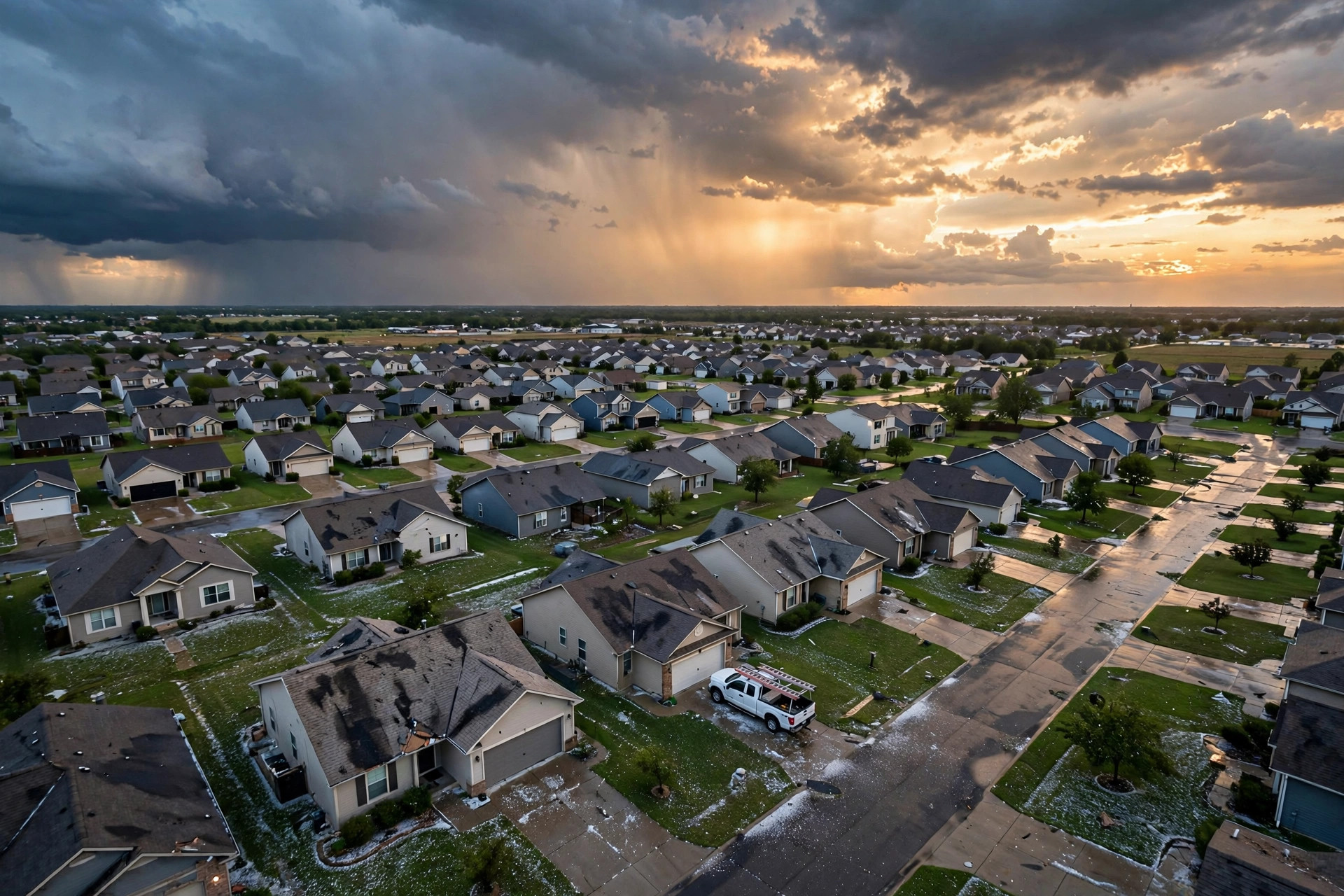
Hail the size of golf balls hits your suburb on a Tuesday. By Thursday, the door-knockers arrive. Their pitch is polished: "We work with your insurance company all the time. Sign here, we'll handle the whole claim, and it won't cost you a dime out of pocket." The clipboard comes out before the ladder does. What the homeowner does not know is that almost every clause of that pitch is either illegal or a lie. In Texas, a contractor who waives, absorbs, or rebates your deductible commits a Class B misdemeanor punishable by up to 180 days in jail and a $2,000 fine under House Bill 2102 (2019). In June 2024, the Texas Supreme Court ruled in Texas Department of Insurance v. Stonewater Roofing that a contractor cannot act as your insurance adjuster on a claim it also repairs. And the "we'll cover your deductible" offer works the way fraud always works: the contractor inflates the invoice sent to the insurer to cover the difference, which is insurance fraud that can implicate the homeowner too.
This is not a fringe scam. It is the industry's dominant post-storm acquisition funnel. The National Insurance Crime Bureau warned in May 2026 that contractor fraud keeps rising nationwide, and its investigators say the most common schemes center on manufactured roof damage, inflated water mitigation claims, abuse of assignment-of-benefits agreements, and falsified documentation. NICB describes roof claims hitting a new high and a crisis point for the insurance industry, with some claims, in the words of one investigator, "fraud-based because contractors are pushing them." After a disaster, storm-chasing contractors solicit damaged neighborhoods offering quick fixes; the dishonest ones pressure for large upfront payments and then disappear, substitute inferior materials, or perform work that does not meet code. The playbook documented by insurers and consumer groups includes showing homeowners photos of damage that is not their roof, claiming to have been "sent by your insurance company," creating damage during the "free inspection" to inflate the claim, and pressuring signatures before the adjuster arrives.
Homeowners cannot price-check any of it. A roof replacement averages $9,609 nationally in 2026, per Angi, with a range of $5,903 to $46,000 depending on size, pitch, and material. Repairs run $395 to $1,967. Almost nobody buys more than two roofs in a lifetime, the product is 30 feet overhead where you cannot inspect it, and the failure that triggers the purchase is urgent: water is coming in, or the adjuster gave you a deadline. Information asymmetry does not get more complete than this. The homeowner's only defenses are reviews, which the industry games, and the insurance adjuster, who works for the carrier.
The Gap in the Market
Every incumbent in this market sells something adjacent to trust, and none of them sells trust itself. Angi, Thumbtack, and HomeAdvisor sell leads to contractors: the contractor pays per lead, the homeowner gets matched, and the price is negotiated on the driveway with all the leverage on the side holding the ladder. GAF's Master Elite and Owens Corning's Platinum Preferred programs certify installers, but they certify them to sell shingles, and a manufacturer will never publish prices that put its own contractor network in a bidding war. EagleView and Hover built genuinely good aerial measurement technology, validated at 95 to 99 percent accuracy for square footage, but they sell $50 to $75 reports to contractors and carriers, not quotes to homeowners. ServiceTitan's June 2025 EagleView integration made contractor estimating faster. Nothing made homeowner pricing clearer.
Meanwhile the money has noticed. Private equity platforms in roofing grew from 17 at the start of 2023 to 56 by the end of 2024, with 134 reported acquisitions in 2024 alone, per CT Acquisitions' tracker citing trade-press analysis. QXO paid $11 billion for Beacon Roofing Supply in April 2025. Platform-quality residential roofing companies change hands at 6 to 10 times EBITDA. Consolidation proves the margins are real, and it does nothing for the homeowner, because a roll-up with 40 brands under one roof has the same incentive as every other contractor: win the click auction after the storm, price the job on site. Scale does not fix trust here. It just gives the mistrust a bigger logo.
The enforcement wave is the tell that the market failure is structural. Florida's legislature passed SB 2-A in December 2022, banning assignment of benefits on property policies issued or renewed after January 1, 2023, and killing the one-way attorney-fee rule that had let contractors and lawyers take over claims and litigate them for profit. State officials had said Florida held 9 percent of the country's homeowners claims and 79 percent of its lawsuits. Lawsuits collapsed by roughly two-thirds from the 2021 peak, and an industry actuarial review found Florida policyholders paid nearly $3 billion less for coverage in 2025 than the year before. When the legal system has to amputate an entire business model to stabilize a market, the business model was the problem. Nobody has built the honest version of it.
The Solution
A fixed-price residential roofing marketplace. The product is a published price book, not a quote tool. The homeowner types an address. Aerial measurement returns the roof's square footage, pitch, facets, and complexity. The price book returns a fixed number for each material tier: 3-tab, architectural shingle, designer shingle, standing-seam metal. The price is locked before dispatch, itemized down to tear-off, underlayment, flashing, and permit. The contractor cannot re-price on site. If the aerial measurement was wrong, the platform absorbs the difference up to a per-job cap and publishes the contractor's misquote rate as a quality metric.
The trust engine is the honest inspection. After a hail event, the platform flies a drone over the subscriber's roof within 48 hours and delivers a damage report with a plain-English verdict, including the verdict the industry never delivers: you do not need a roof. The inspection costs the homeowner $149, credited in full against any job booked within 90 days, and costs the platform about $85 to deliver through a contracted pilot network. The $64 spread on converting inspections funds the reports that say "no damage found," which are the entire marketing strategy. Every honest no-sale is a five-star review and a referral source in a neighborhood full of door-knockers. Storm chasers cannot copy this because their business model requires every inspection to find damage.
Every certified contractor is licensed, insured, background-checked, and manufacturer-certified, with license numbers published on their profile. The platform backs each job with a warranty funded by a $25 per-job pool: 10 years on workmanship for full replacements, matching the material warranty the manufacturer already provides. The actuarial math is published, not hidden: at a 3 percent claim rate and $600 average claim cost, expected cost is $18 per job against $25 collected, and the surplus compounds into the reserve. Version one is the price book, the verification pipeline, and the discipline to turn away contractors who will not honor the quote. The drone network is the scaling mechanism, not the wedge.
The Math: What a Job Actually Costs
Take the standard job: a 22-square architectural shingle roof (2,200 square feet of roof surface) at a fixed platform price of $10,200, near Angi's $9,609 national average adjusted for 2026. Contractor cost, built explicitly and labeled as modeled:
| Line item | Cost | Notes |
|---|---|---|
| Architectural shingles, wholesale | $2,530 | 22 squares at $115/square |
| Underlayment, ice/water shield, flashing, vents, drip edge | $950 | Code-required accessories |
| Tear-off and disposal | $1,100 | Dumpster, dump fees, tear-off labor |
| Crew labor | $2,400 | 5-person crew, 1.5 days, $320/person-day loaded |
| Permit and miscellaneous | $320 | Varies by jurisdiction |
| Total contractor cost | $7,300 | |
| Contractor gross margin | $2,900 (28.4%) | Before platform fees |
Now the platform fee, structured so it replaces the contractor's customer acquisition cost instead of stacking on it. Certified partners pay $349 a month, which includes the first 15 platform jobs each month at zero transaction fee; jobs beyond 15 carry a 6 percent fee; $25 per job goes into the warranty pool. At 120 platform jobs a year, the subscription amortizes to $34.90 per job, plus $25 warranty, for a total platform cost of $59.90 per job. The contractor keeps $2,840 per job, a 27.8 percent margin.
Compare that to the lead platforms, using an illustrative example rather than a surveyed average: a $45 shared lead that closes one time in four costs $180 per booked job, and the contractor still negotiates the price on the driveway. The platform's $59.90 is roughly a third of that, and it arrives with the price already accepted. That comparison is the sentence that closes the contractor sale, and it is also the reason the fee cannot be a percentage of every job from dollar one. A marketplace that taxes the transaction it claims to make transparent will not keep honest contractors.
Path to roughly $38 million in year-five revenue: 4,000 certified contractors at $349 a month ($16.8M), overage fees from the top decile that exceed 15 jobs a month ($5M), 120,000 annual roof-health plans at $79 a year covering the post-storm drone inspection plus an annual condition report ($9.5M), and financing attach plus manufacturer co-op marketing on premium material upgrades ($6.5M). Four thousand contractors is a small fraction of the country's roofing companies, which is the point: the platform does not need national density on day one. It needs density in the hail belt.
Revenue Model
| Stream | Price | Notes |
|---|---|---|
| Certified partner subscription | $349/mo per contractor | Includes license/insurance verification, price-book access, dispatch priority, warranty badge, and the first 15 platform jobs each month at 0% transaction fee. Replaces lead-gen spend rather than stacking on it. |
| Overage transaction fee | 6% of job value | Only on jobs beyond the 15 included each month. Small by design. |
| Warranty pool | $25/job from contractor | Funds the 10-year workmanship warranty. Expected cost at 3% claims and $600 average claim is $18 per job; the surplus compounds into the reserve. Pass-through, not platform revenue. |
| Homeowner inspection | $149, credited against job | Drone damage report within 48 hours of a hail event, or on demand. Costs ~$85 to deliver; the spread funds the honest "no damage" reports. |
| Roof-health plan | $79/yr | Annual condition report, post-storm priority inspection, maintenance reminders. Converts one-time buyers into a recurring relationship. |
| Financing and manufacturer co-op | Varies | Referral fees on roof financing and co-op marketing funds from manufacturers on premium material upgrades sold through the platform. |
Market Size
Start with the total: the US roofing market was $32.66 billion in 2025, growing to $34.66 billion in 2026 at a 6.01% CAGR, per Mordor Intelligence via ResearchAndMarkets (October 2026). Residential roofing is 58% of that, which puts the US residential TAM at roughly $18.9 billion. Reroofing and replacement, as opposed to new construction, is 63.5% of revenue. Apply that to residential and the replacement TAM is about $12 billion.
The SAM narrows to single-family reroofing in the 30 US metros with the highest hail and wind exposure, roughly 55% of national replacement volume: about $6.5 billion a year. The SOM at year five is roughly $38 million in platform revenue against that SAM, or about 0.6%. For a marketplace that never picks up a hammer, that is a reasonable capture rate, and it leaves room to be wrong about the metro share by half and still have a large business.
Why Now
Five things converged. First, storm volume hit a record: 2025 saw 21 separate billion-dollar severe thunderstorm events, the most ever recorded, driving about $51 billion in severe-storm damages, per Climate Central's continuation of the federal billion-dollar disaster database. Every one of those events is a door-knocking season. Second, carriers are forcing the replacement wave: insurers now request roof inspections at renewal for homes older than 15 years and are shortening acceptable roof ages to 15 to 20 years, per the Mordor analysis, which turns aging roofs from a maintenance question into an insurability question. The median US roof is already past 17 years old.
Third, enforcement is doing the marketing. Texas made the "free roof" a misdemeanor, its supreme court barred contractors from moonlighting as adjusters, and Florida amputated the assignment-of-benefits model entirely. Each enforcement wave teaches homeowners that the knock on the door is a sales funnel, and each one is a free advertising campaign for a trust-first brand. Fourth, consolidation proved the money and concentrated the supply side: 134 PE acquisitions in 2024 and an $11 billion distributor buyout mean the independent shops the platform recruits are the ones currently losing to both storm chasers and roll-ups. A platform handing them pre-measured, price-accepted jobs is the only scale they can access without selling the company.
Fifth, the measurement technology finally supports remote binding quotes. Aerial roof measurement validates at 95 to 99 percent accuracy for square footage, and the contractor software stack already treats those reports as ground truth. What the technology has never been pointed at is the homeowner. The first company to aim EagleView-grade measurement at the demand side, instead of selling it to the supply side, gets to set the price both sides transact at.
What to watch: whether other hail-belt states copy Texas's deductible-waiver criminalization, whether Florida's post-reform litigation drop holds through the next major hurricane season, and whether the PE platforms start publishing prices, which would signal they see transparency as a tactic rather than a threat.
Startup Costs
| Category | Cost | Notes |
|---|---|---|
| Aerial quote engine + platform (9 months) | $260K | 2 engineers + 1 full-stack. Address-to-measurement pipeline, published price book, booking and dispatch, contractor profiles with license verification. Aerial measurement APIs exist; the build is the price book and the quote lock. |
| Drone inspection network (launch) | $110K | Contracted Part 107 pilot network in 3 launch metros, scheduling and report tooling, damage-classification review. The 48-hour post-storm response is the product. |
| Contractor verification and ops (year 1) | $90K | License and insurance verification across launch states, background checks, onboarding audits. 1 ops lead plus vendor costs. |
| Price-book research | $70K | Contractor cost surveys in 10 hail-belt metros, wholesale material pricing from distributors, labor rate mapping. The data that makes fixed quotes defensible. |
| Warranty reserve | $150K | Seed capital for the 10-year workmanship warranty pool until per-job contributions make it self-funding. Actuarial support for claim-rate modeling. |
| Launch marketing (3 metros) | $150K | Dallas-Fort Worth, Denver, Minneapolis: hail alley, high claim volume, dense contractor base. Local SEO, Nextdoor, and direct comparison ads against "free roof" operators. |
| Legal | $60K | State contractor-law review, warranty terms, insurance-adjacent regulatory analysis. The warranty must not accidentally become a regulated insurance product. |
| Operating buffer (12 months) | $60K | Cloud, insurance, customer support. |
| Total | $950K |
Limitations
The research firms disagree on scope: Mordor's $32.66 billion is one firm's proprietary estimate, and the 58% residential share and 63.5% reroofing share come from the same report family, so the $18.9 billion TAM and $6.5 billion SAM chain assumptions from a single source. If Mordor's scope is off by a third, every downstream number moves with it. The "top 30 hail metros are 55% of replacement volume" is a modeled approximation, not a measured share.
The contractor cost build is modeled, not observed: wholesale shingle prices, crew day-rates, and tear-off costs vary widely by metro, and the $7,300 all-in cost could easily be $6,000 in one market and $9,000 in another, which is exactly why the price book has to be metro-specific before the first quote goes out. The $349 subscription, 6% overage fee, $25 warranty contribution, $149 inspection, and $79 plan are all modeled willingness-to-pay, untested against real contractors. The $45-lead, one-in-four-close customer acquisition comparison is an illustrative example, not a surveyed average. The warranty math assumes a 3% claim rate at $600 average cost; a hail season that exposes systematic installation defects across a contractor cohort would blow through the reserve faster than per-job contributions replenish it, and a 10-year workmanship warranty is a long-tail liability for a young company.
The 95 to 99 percent aerial measurement accuracy figure is a vendor-adjacent claim, repeated in contractor marketing materials citing EagleView and Hover validation, not an independent study. Steep pitches, complex geometries, and tree cover all degrade it, which is why the platform absorbs misquotes up to a cap rather than pretending the measurement is perfect. The NICB and FTC complaint statistics are industry- and agency-reported; the "record 21 billion-dollar severe storms" comes from Climate Central's nonprofit continuation of the discontinued federal database, using the same methodology as NOAA's, but it is no longer a government series. Treat every number in this piece as directionally right and precisely wrong.
Strongest Counterargument
The strongest objection is that the insurance adjuster sets the price, not the marketplace. Most full roof replacements flow through insurance, and carriers price them in Xactimate: line items for tear-off, squares, flashing, with the deductible fixed by the policy and by law. If the carrier's number is the ceiling, a "fixed-price marketplace" is just a contractor directory with better branding. The price was never the mystery; the carrier published it.
That objection is half right, and the half that is right defines the real product. Xactimate is a starting bid, not a final price. The money in a roofing claim is in the supplements: code upgrades, decking replacement, flashing details, ventilation corrections that the adjuster's first scope missed. Documenting supplements is skilled, adversarial work, and it is exactly where honest contractors earn their margin and storm chasers manufacture theirs. A marketplace that standardizes supplement documentation, photographs everything, and submits it in the carrier's own format is not restating the adjuster's number. It is doing the part of the job most contractors do badly and most homeowners cannot do at all.
The other half of the objection is timing. The retail share of roofing is growing: percentage deductibles turn a $400,000 home into a $4,000 to $8,000 out-of-pocket check, carriers are settling aging roofs at actual cash value instead of replacement cost, and non-renewals are pushing homeowners to pay cash for roofs that keep them insurable. Every homeowner in those categories is buying a roof the way they buy a car: with their own money, no adjuster involved, and no idea what it should cost. That buyer is the customer. The insurance job is the wedge that gets the contractor on the platform; the retail buyer is the market that pays for it.
Next: storm chasers will not join, and density is the whole game. True, and the platform should not want them. The recruiting pool is the established local shops that PE has not bought yet, the ones currently losing jobs to door-knockers with no overhead and no warranty. Those shops are pre-sold on the thesis that the knock on the door is poison. The honest inspection is the demand engine that makes density achievable: a drone report that says "you do not need a roof" earns the review, the referral, and the roof-health plan, and it does it in the exact neighborhoods where the chasers are knocking.
Next: GAF or Owens Corning could build this. They have the contractor networks, the brand, and the balance sheet. They will not, for the same reason Angi will not: the manufacturers sell shingles to contractors, and a price-transparency platform declares war on its own distribution channel. Every published price is a contractor complaining to its distributor rep. The incumbents' incentives point away from transparency, which is the same structural reason nobody in the trade publishes prices today. A startup with no shingle revenue to protect is the only actor whose incentives align with the homeowner.
What You Can Do
If hail just hit your neighborhood: Do not sign anything at the door. Photograph your roof, gutters, and any hail dents on vents or flashing from the ground, then call your insurance carrier before you call a contractor. Get your deductible in writing and remember that anyone offering to waive, absorb, or rebate it is either breaking the law or planning to inflate the claim to cover it. Get three written estimates that separate tear-off, materials, accessories, and labor. Angi's 2026 band is $5,900 to $12,900 for a typical replacement; a quote far outside that band in either direction deserves scrutiny, not excitement.
If you run an honest roofing company: Publish your prices. The storm chasers have poisoned the well you drink from, and every "free roof" pitch makes the next homeowner distrust you before you arrive. A shop with a public price book, published license numbers, and a real workmanship warranty is already 80% of this startup's value proposition. The platform just gives you distribution.
If you are building this: Start in Dallas-Fort Worth. It is the densest hail market in the country, the contractor base is deep, Texas law already criminalized your competitors' pitch, and the enforcement headlines are free marketing. Your first 50 contractors should be the shops already publishing prices on their own websites; they are pre-sold on the thesis. Arm yourself with the one sentence that closes the contractor sale: the $349 subscription replaces their lead-gen spend instead of stacking on it, and at 120 platform jobs a year they keep a 27.8% margin on a $10,200 ticket while paying a third of the per-job acquisition cost. The drone network can wait for version two. Version one is a price book, a phone number, and the discipline to turn away contractors who will not honor the quote.
The Bottom Line
Residential roofing is a $19 billion American market where the customer cannot know the price before the work starts and the dominant sales channel is a stranger knocking after a storm. The fraud got so structural that two states rewrote their insurance laws to amputate it, private equity is paying up to 10 times EBITDA for the companies that survive it, and 2025 set the record for billion-dollar severe storms at 21. Everything about this market says the money is real and the trust is broken. The company that measures the roof from the air, publishes the price book, verifies the contractor, warranties the work, and tells the homeowner when they do not need a roof does not need to invent demand. It needs to show up in Dallas-Fort Worth with a fixed quote the week after the hail, and let the honest shops do what they have always wanted to do: charge a fair price and get the job.