Radon Mitigation System Monitoring SaaS for Contractors and Property Managers
Over 2 million American homes have radon mitigation systems protecting occupants from a radioactive gas that kills an estimated 21,100 people per year. Every one of those systems relies on a fan with a 5-to-10-year lifespan. When it fails, nothing beeps. Nothing alerts. The U-tube manometer on the pipe reads zero, but nobody checks it. EPA recommends retesting every two years, but compliance is voluntary and unmeasured. An estimated 200,000 fans reach end-of-life annually. Most homeowners won't know until they sell the house or develop lung cancer.
The Problem
Radon is a radioactive gas produced by the natural decay of uranium in soil and rock. It seeps through foundation cracks, construction joints, and gaps around pipes into buildings above. You can't see it, smell it, or taste it. According to EPA's 2003 risk assessment, radon causes an estimated 21,100 lung cancer deaths in the United States each year, making it the leading cause of lung cancer among non-smokers and the second leading cause overall after cigarette smoking. An estimated 13.4% of all US lung cancer deaths are radon-related.
EPA's Report on the Environment indicator shows that approximately 1 in 15 US homes have radon levels at or above the recommended action level of 4 picocuries per liter (pCi/L). As of 2013, the agency estimated 7.1 million homes exceeded this threshold without a mitigation system installed. In the same year, 1.244 million homes had operating mitigation systems, a 611% increase from 175,000 in 1990. Fan manufacturers have continued shipping at similar or higher volumes since, putting the current installed base well above 2 million systems.
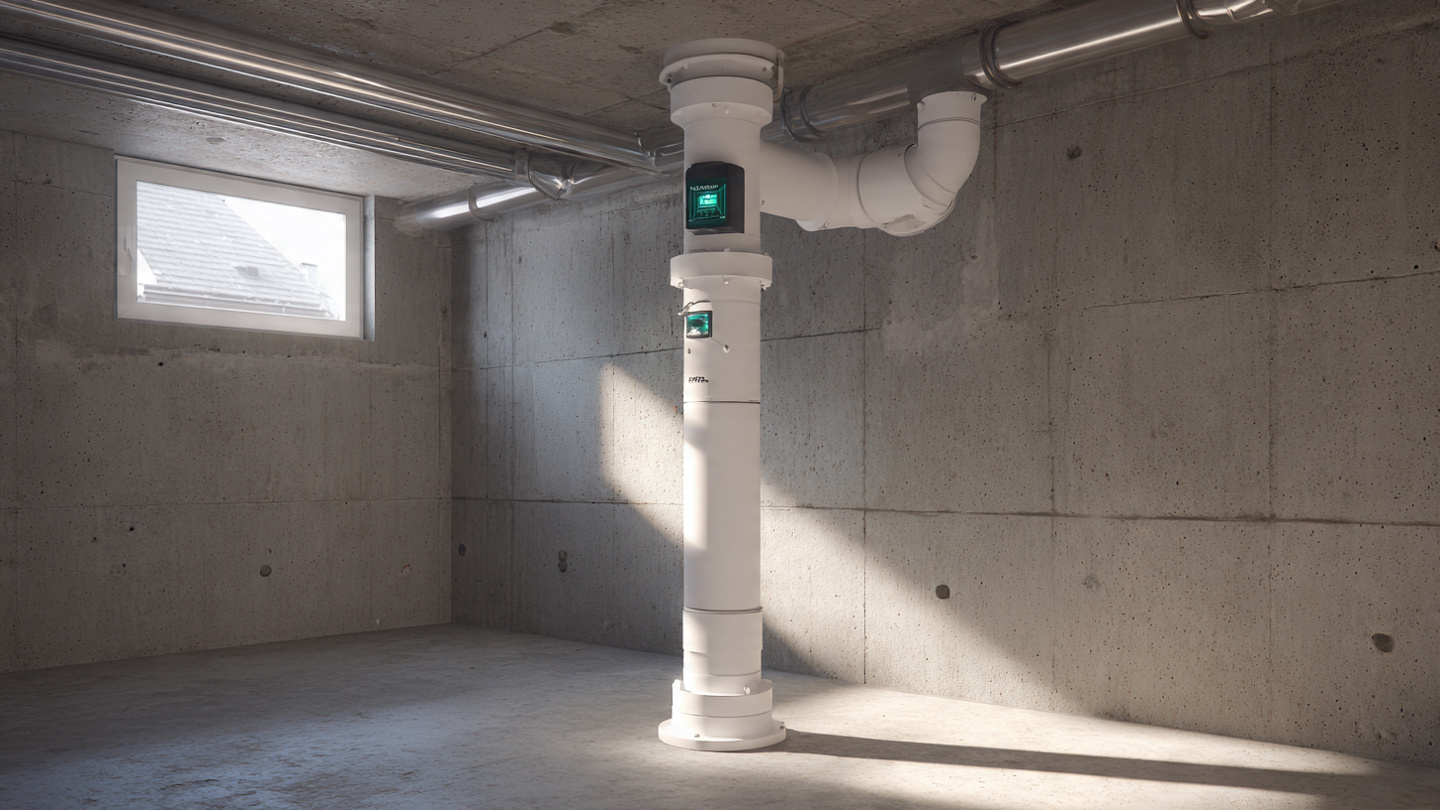
A standard residential radon mitigation system is elegantly simple: a PVC pipe drilled through the basement slab, connected to a fan that creates negative pressure beneath the foundation, pulling radon-laden soil gas up and venting it above the roofline before it enters the living space. It works. Sub-slab depressurization systems typically reduce indoor radon levels by 80-99%.
But the fan is a mechanical device. It runs 24 hours a day, 365 days a year, in a harsh environment (temperature extremes, moisture, dust). According to EPA guidance, radon vent fans last five or more years, with replacement costs of $200-350. Industry sources report typical lifespans of 5-10 years, with degradation patterns including bearing wear, motor winding deterioration, and impeller imbalance that gradually reduce airflow before eventual failure.
When the fan fails, the monitoring infrastructure protecting most homeowners consists of a single device: a U-tube manometer filled with oil, mounted on the pipe in the basement. If the liquid levels equalize, the system has lost suction. But homeowners rarely check it. Many don't know what it is. EPA recommends retesting the home for radon every two years after mitigation, but this is voluntary guidance with no enforcement mechanism and no tracking of compliance rates. Minnesota's Department of Health, one of the few states that publishes radon testing data, reported that home radon testing dropped 39% in 2022 compared to 2020, and that was for transactions where financial incentives (home sales) existed to test.
The Exposure Gap: An Original Calculation
If the installed base of radon mitigation systems in the US is approximately 2 million (a conservative extrapolation from EPA's 2013 figure of 1.244 million, plus 12 years of continued fan sales at 80,000-120,000 units annually based on manufacturer data), and the average fan lifespan is 7.5 years (midpoint of the 5-10 year industry estimate), then approximately 267,000 fans reach end-of-life each year.
What happens after failure? Consider two scenarios:
Compliant homeowner (retests every 2 years): If a fan fails at a random point in the 2-year retest cycle, the average time until detection is 12 months. For a home that originally tested at 8 pCi/L before mitigation (reduced to 0.5-1.5 pCi/L with the system running), the occupants experience 12 months at 8 pCi/L before discovering the problem. EPA's risk tables indicate that at 8 pCi/L, a non-smoker has approximately a 1.5% lifetime risk of radon-related lung cancer death. Each month of elevated exposure contributes marginally to that cumulative risk.
Typical homeowner (does not retest on schedule): No national data tracks retest compliance rates, but the Minnesota testing data and industry anecdotes suggest most homeowners do not retest on the EPA-recommended 2-year cycle. For homeowners who don't retest until a home sale (average US homeownership tenure: approximately 12 years as of 2024 per Redfin), a fan failing at year 5 of its life could go undetected for 7 or more years. At 8 pCi/L for 7 years, the cumulative radon dose is equivalent to what a uranium miner received over several working years in unventilated conditions.
The aggregate math: If 267,000 fans fail annually and 70% of homeowners don't retest within 2 years (a directional estimate; no rigorous survey data exists), roughly 187,000 homes per year join a growing pool of residences with non-functioning mitigation systems and undetected elevated radon. Over a decade, that pool could reach 1 million or more homes. At an average pre-mitigation level of 6 pCi/L (between the 4 pCi/L action level and the 8+ pCi/L that many mitigated homes originally tested at), the excess lung cancer risk across this population is not negligible. This is the monitoring gap: a public health problem hiding in plain sight because no infrastructure exists to detect it.
The Gap in the Market
| Company | What They Do | What's Missing |
|---|---|---|
| Airthings | Norwegian company (Oslo, publicly traded). Makes consumer radon monitors including Wave Radon ($100-180) and View Plus ($299). Continuous readings via BLE/WiFi to mobile app. Founded 2008, ~$30M revenue (2024 estimate). | Monitors radon levels in the living space, not the mitigation system. By the time Airthings detects elevated radon, the fan has already failed and occupants have been exposed. No integration with mitigation contractors. No compliance documentation for real estate. |
| Ecosense (RadonEye) | US-based. RadonEye RD200 (~$163) uses pulsed ion chamber for continuous measurement. Higher accuracy than consumer competitors. Sold through Amazon, Best Buy. | Same gap as Airthings: measures the symptom (elevated radon), not the cause (system failure). A RadonEye won't tell you why radon is high, whether it's a fan failure, a new foundation crack, or seasonal fluctuation. No contractor-facing tools. |
| RadonAway | Dominant US radon fan manufacturer (Massachusetts). Makes the RP and XP series fans that are the industry standard. Also sells the RadonAway Fan Alert ($39), a simple current-sensing device that beeps when the fan stops. | The Fan Alert exists but only triggers on complete fan stoppage (binary: fan on or off). Doesn't detect gradual degradation (reduced airflow, bearing wear). No connectivity, no remote alerting, no dashboard. The contractor installs it and never interacts with it again. |
| Fantech | Canadian manufacturer of radon fans and ventilation equipment. Sells HP and Rn series fans. No monitoring products. | Pure hardware manufacturer with no IoT or SaaS offerings. Sells through distribution to contractors. |
The pattern: consumer monitor companies (Airthings, Ecosense) sell directly to homeowners but don't solve the mitigation system monitoring problem. Fan manufacturers (RadonAway, Fantech) sell hardware to contractors but have no recurring revenue model and no connected platform. Nobody occupies the intersection: a system-level monitor that alerts both the homeowner and the installing contractor when the mitigation system degrades, with compliance documentation for real estate transactions and property management portfolios.
The Solution
A wireless mitigation system monitor paired with a contractor-facing SaaS platform that transforms the radon mitigation business from one-time installation to ongoing managed service:
1. Pipe-mounted wireless sensor ($79 base, $149 with radon sensor): A clamp-on device that attaches to the mitigation pipe between the fan and the roof vent. Measures: (a) differential pressure across the suction point via a pressure transducer, confirming adequate sub-slab depressurization; (b) fan motor vibration via accelerometer, detecting bearing wear and impeller imbalance months before failure; (c) pipe airflow velocity via thermal anemometer; (d) optional integrated radon sensor for the $149 tier. Battery-powered (2-3 year lithium cell) with WiFi or BLE-to-gateway connectivity. Installs in 5 minutes with a pipe clamp.
2. Contractor SaaS dashboard ($8/system/month): Fleet view of every system the contractor has installed and monitors. Color-coded status: green (normal), yellow (degradation detected), red (system failure). Automated work order generation when a system enters yellow or red status. Inventory management for fan replacements. Annual compliance reports auto-generated and emailed to homeowners. Revenue tracking for monitoring subscriptions. This is the key unlock: radon mitigation contractors currently have zero recurring revenue. They install a system for $1,500-3,000 and never hear from the homeowner again unless something breaks. Monitoring subscriptions create a predictable revenue stream and a reason to maintain the customer relationship.
3. Homeowner mobile app ($5/month or bundled into contractor subscription): Real-time system status with push notifications for any anomaly. Historical pressure and performance data. Compliance documentation vault with timestamped records exportable for home sales. EPA retest reminders with one-tap booking through the installing contractor. Fan replacement scheduling with contractor-provided quotes.
4. Property management integration ($12/unit/month for portfolio pricing): Multi-property dashboard for property managers and landlords. Particularly valuable in states with radon disclosure requirements. Colorado's SB23-206 (2023) now requires landlords to provide tenants with radon risk information, testing history, and mitigation status. Illinois, New Jersey, and Florida have disclosure requirements of varying stringency. A property manager with 200 rental units in a high-radon state needs centralized compliance documentation. This product doesn't exist today.
Revenue Model
| Revenue Stream | Amount | Notes |
|---|---|---|
| Pipe sensor (base model) | $79 | Pressure + vibration + airflow. 65% gross margin at scale. 2-3 year battery. |
| Pipe sensor (with radon) | $149 | Adds pulsed ion chamber radon sensor. 55% gross margin. Premium tier. |
| Contractor SaaS | $8/system/month | Fleet dashboard, alerts, work orders, compliance reports. 90%+ software margin. |
| Homeowner app | $5/month (or $49/year) | Can be bundled into contractor subscription or sold direct-to-consumer. |
| Property management tier | $12/unit/month | Multi-property dashboard, portfolio compliance, lease disclosure generation. |
| Fan replacement marketplace | 10-15% commission | Marketplace connecting homeowners to contractors for fan replacement. Average ticket: $200-350. |
| Annual compliance reports | $25/report | Timestamped system performance summary for real estate transactions. |
Unit economics for a contractor with 100 monitored systems: Hardware revenue at install: 100 × $79 = $7,900 at ~65% gross margin ($5,135). Monthly recurring SaaS: 100 × $8 = $800/month = $9,600/year at 90%+ margin ($8,640). Homeowner subscriptions (assuming 40% attach rate): 40 × $49/year = $1,960/year. Year 1 gross revenue per contractor: $19,460. Customer acquisition cost via trade shows, NRPP/NRSB conferences, and contractor referrals: ~$1,200. LTV at 5-year contractor retention: ~$65,000+. LTV:CAC ratio: 54x.
Market Size
TAM: The US installed base of radon mitigation systems exceeds 2 million (EPA tracked 1.244 million through 2013; continued fan sales at 80,000-120,000 units/year through 2026 add another 800,000-1,200,000, offset by ~10% annual retirement of oldest systems). At a blended $8/system/month for contractor SaaS: 2 million × $96/year = $192M/year in contractor SaaS alone. Adding homeowner subscriptions ($49/year at 40% attach) and property management tiers: total TAM reaches approximately $280M/year in recurring revenue, plus ~$160M-300M in one-time hardware sales over the conversion period.
SAM: Focus on the 10 highest-radon states (Iowa, Pennsylvania, Ohio, Illinois, Colorado, Minnesota, Nebraska, Indiana, Missouri, New York), which account for an estimated 55-60% of installed mitigation systems. Approximately 1.1 million systems. At blended $8/system/month: $106M/year.
SOM (year 3): 5,000 monitored systems across 200 contractors at blended $140/system/year (contractor SaaS + partial homeowner attach + annual reports) = $700K ARR, plus ~$400K in cumulative hardware sales. 0.45% penetration of SAM.
Why Now
The first-generation mitigation wave is hitting end-of-life. Radon mitigation installations accelerated sharply in the 2000s and 2010s. Systems installed between 2005 and 2015 are now entering the 10-20 year window where fan failure becomes likely. The number of systems with aging fans is higher right now than at any point in history, and it grows every year. The monitoring problem wasn't urgent when 175,000 systems existed in 1990. At 2 million+, with 200,000+ fans aging out annually, the scale demands an automated solution.
State radon disclosure laws are expanding. Colorado's SB23-206 (2023) is the most comprehensive recent example, requiring landlords to provide tenants with radon risk warnings, testing history, and mitigation status. Illinois requires radon disclosure in residential property transfers. New Jersey mandates testing in certain school buildings. The regulatory trend is toward more disclosure, not less. Property managers and landlords in these states need documented proof that mitigation systems are functioning. Paper records and biennial test kits don't scale across a portfolio.
Consumer IoT hardware costs have collapsed. A MEMS pressure sensor costs under $1 in volume. A Bosch BMI270 accelerometer for vibration monitoring: $2. An ESP32-C3 WiFi microcontroller: $1.50. A lithium thionyl chloride battery good for 2-3 years of intermittent sensing: $3. The total BOM for a viable pipe monitor is under $20 at scale. Five years ago, achieving adequate sensor accuracy at this price point for a battery-powered device wasn't practical. Today it is.
ANSI/AARST standards were updated in December 2023. The updated voluntary consensus standards for soil gas mitigation, radon measurement, and new construction radon control create a clearer compliance framework. As standards tighten and more jurisdictions adopt them, the paper trail documenting system performance becomes more valuable.
Startup Costs
| Category | Cost | Notes |
|---|---|---|
| Hardware engineering (sensor module, 6 months) | $180K | 1 embedded systems engineer + 1 mechanical engineer (enclosure, pipe clamp). MEMS pressure sensor, accelerometer, thermal anemometer, WiFi radio, battery management. FCC Part 15 certification. |
| Software platform (dashboard + mobile app, 5 months) | $150K | 1 backend + 1 frontend + 1 mobile developer. Contractor dashboard, homeowner app, alerting engine, compliance report generator. |
| Initial manufacturing run (1,000 sensor units) | $35K | Contract manufacturing. BOM ~$20/unit at initial volumes; tooling and NRE for pipe clamp mold. |
| Pilot program (50 contractors, 500 systems) | $25K | Subsidized hardware for first 50 contractors. Each installs sensors on 10 existing systems for field validation. |
| Industry conferences and trade shows (year 1) | $20K | AARST International Radon Symposium, state radon conferences, home inspector association events. Booth, travel, demo units. |
| Regulatory and certifications | $15K | FCC Part 15 for WiFi radio, UL/ETL listing. Radon measurement device certification through NRPP if including radon sensor tier. |
| Operating buffer (12 months) | $25K | Cloud hosting (AWS IoT Core), cellular fallback data plans, customer support. |
| Total | $450K |
Limitations
The 2 million+ installed base estimate is a directional extrapolation, not a census. EPA's most recent published figure (1.244 million) is from 2013, derived from voluntary fan manufacturer sales data. Fan sales data doesn't account for systems where the fan was replaced (one system, two fan sales counted) or systems decommissioned when homes were demolished or renovated. The actual number of currently operating mitigation systems could be 20-30% lower than the extrapolation suggests.
The 267,000 annual fan failures figure assumes a 7.5-year average lifespan uniformly distributed across the installed base. Actual failure rates depend on fan quality, installation location (attic vs. exterior vs. basement), climate, and maintenance. RadonAway's Pro Series fans carry a 5-year warranty and may last 12-15 years in favorable conditions. Cheap fans installed by low-bid contractors may fail in 3-4 years. The average masks significant variance.
No survey data exists on homeowner retest compliance rates. The 70% non-compliance estimate used in the exposure gap calculation is an assumption based on Minnesota's testing decline data and industry anecdotes, not a measured statistic. If actual retest compliance is higher (say, 50%), the exposure gap shrinks proportionally but remains significant.
The radon sensor tier ($149 model) faces a technical challenge: pulsed ion chamber sensors accurate enough for regulatory-grade measurements cost $30-50 in volume, pushing the BOM toward the retail price. Semiconductor-based radon sensors are cheaper but less accurate. The base model (pressure + vibration only) is the more defensible hardware product; the radon sensor tier may need to be positioned as premium from launch.
Strongest Counterargument
A $99 Airthings Wave Radon monitor already solves this problem for homeowners who care. Place it in the basement, and if radon levels spike because the fan failed, you get a push notification on your phone. The Airthings approach monitors the outcome (radon level in the living space) rather than the cause (fan performance), but the outcome is what actually matters for health. A homeowner with an Airthings device and a failed fan gets alerted within 48-72 hours as radon levels climb. The exposure gap effectively disappears. Why buy a $79-149 pipe sensor and pay $5-8/month for a SaaS subscription when a one-time $99 consumer device provides earlier and more health-relevant alerting?
The response comes in two parts. First, consumer radon monitors have a well-known placement sensitivity problem. Radon concentrations vary significantly by room, by floor level, and by season. An Airthings device in the living room may not detect a basement-level radon increase for days or weeks, depending on air circulation patterns. A study using 6 million indoor measurements across the US demonstrated high spatial variability in radon concentrations even within single structures. The pipe sensor, by contrast, detects system degradation at the point of failure, before radon levels increase anywhere in the home.
Second, and more importantly, consumer radon monitors don't solve the contractor's business problem. Airthings sells to homeowners; this platform sells to radon mitigation contractors. The contractor's pain point isn't "does the homeowner have a radon monitor?" It's "I installed 400 systems last year and have zero recurring revenue from any of them. I don't know which systems are still running. I can't proactively schedule fan replacements. I have no reason to contact past customers until they call me with a problem." The SaaS platform transforms the contractor's business model from project-based to service-based, an economic shift worth pursuing even if every homeowner simultaneously bought an Airthings device.
What You Can Do
If you have a radon mitigation system in your home: Go check your U-tube manometer right now. It's the small plastic device on the mitigation pipe in your basement or utility room, usually filled with red or blue oil. If both sides are level, your fan may not be running. Listen for the fan hum. If you hear nothing and the manometer reads zero, contact your original installer for a fan replacement ($200-350). Then order a continuous radon monitor ($99-163 for Airthings or Ecosense) and place it in the lowest livable level of your home. EPA recommends retesting every two years regardless; set a calendar reminder.
If you're a radon mitigation contractor: Calculate your repeat customer rate. How many of the systems you installed 5+ years ago have you heard from? For most contractors, the answer is close to zero, which means you're leaving thousands of dollars in fan replacement revenue and service calls on the table. Even without a purpose-built monitoring platform, you can start a preventive maintenance program today: contact every customer with a system older than 5 years, offer an annual inspection package ($75-100/visit), and upsell a RadonAway Fan Alert ($39) as a basic failure detector. The monitoring SaaS described here is the automated, scalable version of this manual program.
If you're building this product: Start with the contractor dashboard, not the homeowner app. The contractor is the buyer, the installer, and the ongoing service provider. Recruit 20 contractors in Pennsylvania (the highest-radon state by mitigation volume) for a 90-day pilot. Give them 10 sensors each at cost. Prove that predictive maintenance alerts generate enough fan replacement revenue to justify the subscription. The homeowner app is a phase 2 product that rides on the contractor's customer base. NRPP/NRSB conferences and the annual AARST International Radon Symposium are your highest-ROI marketing channels.
The Bottom Line
Radon mitigation is a solved problem with an unsolved maintenance gap. America spent billions installing 2 million+ depressurization systems in homes where radioactive gas seeps from the earth. Then it asked homeowners to monitor those systems by periodically glancing at a plastic tube filled with oil in their basement. Fan manufacturers build devices with a 5-10 year lifespan, EPA recommends retesting every 2 years, and nobody tracks whether either thing actually happens. A $20 sensor module clipped to a PVC pipe can detect system degradation months before failure, alert the homeowner and the installer simultaneously, and generate compliance documentation that state regulators are increasingly demanding. For the contractor, the value proposition is even simpler: stop walking away from $8/month in perpetuity every time you finish a $2,000 install. The fans will fail. The question is whether anyone is watching when they do.