Commercial Pool Chemical Compliance SaaS for Multi-Facility Aquatic Operators
The United States has approximately 309,000 public and semi-public swimming pools, hot tubs, and water playgrounds. Between 2015 and 2019, the CDC documented 208 outbreaks linked to these treated recreational water venues, resulting in 3,646 illnesses, 286 hospitalizations, and 13 deaths. One in eight routine inspections triggers immediate closure for serious health violations. Chemical automation hardware exists. What doesn't exist is the compliance documentation layer that connects those sensors to the health department clipboard. The entire regulatory workflow for a $950 million automation market still runs on paper logs and manual test kits.
The Problem
Every state in the US requires operators of public and semi-public swimming pools to maintain daily chemical logs. Free chlorine, combined chlorine, pH, water temperature, alkalinity, cyanuric acid levels. Some jurisdictions require readings every two hours during operating hours. Others require readings at opening and closing. The specifics vary, but the core obligation is universal: if your pool is open to anyone other than a single-family homeowner, you must document water chemistry and produce those records on demand for health inspectors.
The Pool & Hot Tub Alliance (formerly the Association of Pool & Spa Professionals) estimates there are approximately 309,000 public and semi-public aquatic venues in the United States. This includes hotel pools, municipal recreation centers, apartment and condominium complexes, fitness clubs, water parks, HOA pools, and university natatoriums. Each one has a chemical log that, in the vast majority of cases, looks identical to what it looked like in 1985: a laminated sheet on a clipboard, hanging from a hook on the pump room wall, filled out with a ballpoint pen by whichever employee drew the short straw that morning.
Getting it wrong is not a paperwork problem. A 2021 CDC Morbidity and Mortality Weekly Report analyzing data from 2015 through 2019 found 208 outbreaks associated with treated recreational water. These outbreaks caused at least 3,646 cases of illness, 286 hospitalizations, and 13 deaths. Cryptosporidium accounted for 49% of outbreaks with confirmed etiology and 84% of cases. Legionella caused 42% of confirmed outbreaks and all 13 deaths. Nearly all of these outbreaks (96%) occurred at public venues, not backyard pools. Hotels and resorts accounted for 34% of all outbreaks.
An earlier CDC study analyzing 121,020 routine pool inspections across 13 states in 2008 found that 12.1% of inspections identified violations serious enough to warrant immediate closure. Over three-quarters of all inspections found at least one code violation. Childcare facility pools had the highest immediate closure rate (17.2%), followed by hotel/motel pools (15.3%). The most common violations involved inadequate disinfectant levels and improper pH, the two parameters most directly linked to disease transmission.
The Gap in the Market
Pool chemical monitoring hardware has improved dramatically. Controllers from companies like Pentair, Hayward, BLU-SENTINEL (Neptune-Benson/Evoqua), and IPS Controllers can continuously measure ORP (oxidation-reduction potential), pH, temperature, and flow rate, then automatically adjust chemical feed pumps to maintain target levels. The swimming pool automation system market was valued at approximately $950 million in 2026 and is growing at 8.7% annually.
But here's the gap: chemical controllers control chemicals. They do not manage compliance.
| Company | What They Do | What's Missing |
|---|---|---|
| Pentair IntelliChem / IntelliConnect | Market leader in pool automation. Measures and adjusts chlorine and pH. Mobile app for single-pool monitoring. Residential and light commercial. | No compliance log generation. No multi-site dashboards. No health department report formatting. No integration with inspection workflows. App designed for homeowners checking their backyard pool, not operations managers overseeing 150 hotel pools. |
| BLU-SENTINEL (Evoqua/Xylem) | High-end commercial controller with HRR sensors, shock chlorination, and economic mode. Enterprise-grade hardware. | On-premise system. Data stays at the pool. No cloud aggregation across facilities. No regulatory report templates. No alert escalation to off-site management. If the health department asks for 90 days of logs, someone is still printing Excel spreadsheets. |
| IPS Controllers | American-made ORP/pH controllers with WiFi and web-based monitoring. Multiple price points from basic to advanced. | Web monitoring is per-controller. No fleet view. No compliance documentation engine. No automated variance detection ("Pool 7 has been 0.3 ppm below target for 4 hours"). Monitoring is reactive, not proactive. |
| iopool / Sutro / pHin | Consumer-grade smart water monitors. Floating sensors with app-based recommendations. $149-299 hardware. | Designed for residential pool owners. Cannot scale to commercial operations. No compliance features. No chemical feed integration. No multi-site management. Sensor accuracy insufficient for regulatory reporting. |
| PoolStar / Pool Shark H2O | Software for manual pool chemical logging. Digital forms replace paper clipboards. | Solves only the digitization problem, not the monitoring problem. Staff still tests manually. No IoT sensor integration. No automated alerts. The clipboard moved to a tablet, but the workflow didn't change. |
Hardware vendors build excellent chemical controllers that talk to pumps. Software vendors build digital log forms that replace paper. Nobody connects the two into an integrated system where sensors continuously feed a compliance-grade documentation platform that a 200-property hotel chain can manage from a single dashboard.
The Solution
A vertically integrated IoT sensor + cloud SaaS platform built for multi-facility commercial pool compliance:
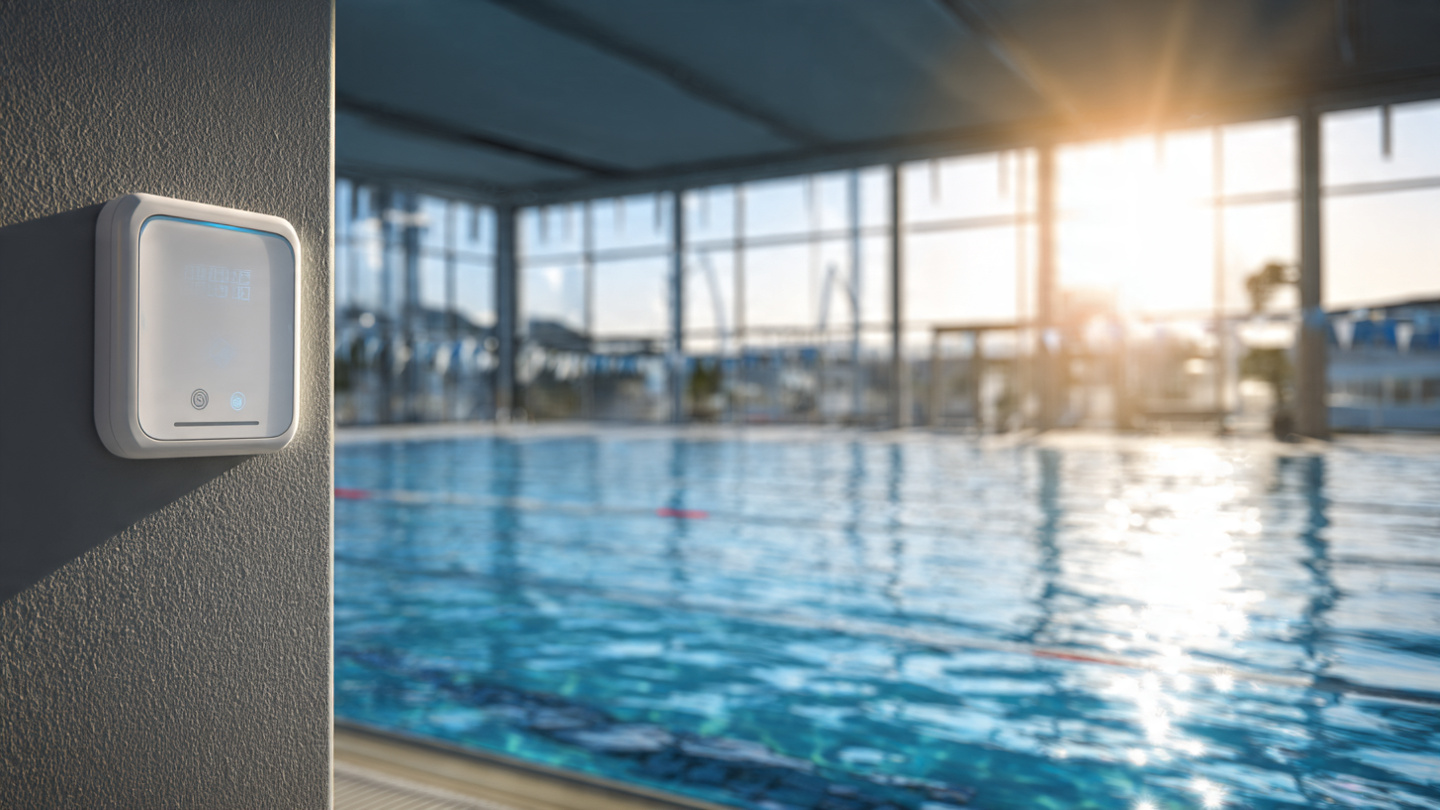
1. Commercial-grade wireless sensor module ($349 per pool): Inline probe assembly measuring free chlorine (amperometric, not ORP proxy), pH, water temperature, and flow rate. Installed in the existing plumbing return line after the filter. Cellular + WiFi dual connectivity. Readings every 5 minutes, logged to the cloud. No manual test kits required for routine monitoring. The critical technical distinction: free chlorine measurement, not ORP. Health departments require free chlorine readings in parts per million. ORP (millivolt readings) correlates with disinfection effectiveness but is not accepted as a direct substitute for free chlorine measurement in most state codes. Every competing controller that relies on ORP still requires manual DPD testing to satisfy inspectors. An inline amperometric chlorine sensor eliminates that manual step.
2. Chemical feed integration module ($149 add-on): Relay interface that connects to existing peristaltic or diaphragm chemical feed pumps. Closed-loop control: sensor reads, platform computes, feed pump adjusts. Compatible with chlorine (liquid sodium hypochlorite or cal-hypo), muriatic acid, and CO2 pH adjustment systems. Not a replacement for the operator's existing pumps. An integration layer that makes dumb pumps smart.
3. Compliance dashboard ($99/pool/month): The core product. Multi-site dashboard showing real-time chemical status across all facilities. Color-coded: green (in range), yellow (approaching limits), red (out of compliance). Every reading timestamped and stored for the state-required retention period (typically 3-5 years). Automated daily compliance report generation matching the specific format required by the operator's jurisdiction. When the health inspector arrives and asks for 90 days of pool chemical logs, the manager prints a report in 30 seconds instead of digging through filing cabinets.
4. Alert and escalation engine: Configurable alerts when any parameter exceeds thresholds. Not just "chlorine is low" but a tiered escalation: first alert to the on-site pool operator, second alert to the property manager if no response in 30 minutes, third alert to the regional operations director if no response in 60 minutes. This is critical for hotel chains where no single person is watching all pools at all times. The system also detects anomalies: "Pool 12 chlorine consumption doubled in the last 24 hours without a corresponding increase in bather load. Possible chemical feed malfunction or contamination event."
5. Inspection readiness module: Automated pre-inspection checklists generated from the CDC's Model Aquatic Health Code (MAHC) and the operator's specific state/local code requirements. The platform knows when the pool was last inspected, what violations were cited, and what corrective actions were taken. It tracks upcoming inspection windows and ensures documentation is complete before the inspector arrives.
The Math: What a Closure Costs
Take a mid-range hotel. 150 rooms, average daily rate of $189 (the 2025 US hotel industry average per STR). The pool is listed as an amenity on every booking platform. The hotel markets it in listing photos.
Scenario A: Failed inspection, pool closed for 3 days
Inspector finds free chlorine below minimum (1.0 ppm in most states) and cites a serious violation. The pool is closed until corrections are verified. Direct revenue impact is hard to isolate, but hotel operators consistently report that pools drive 15-25% of booking decisions for leisure travelers. If the closure coincides with a weekend and 10% of booked guests request refunds or leave negative reviews, the immediate cost is substantial: 10% of $189 × 150 rooms × 3 nights = $8,505 in direct refunds. The long-term cost from negative reviews and reduced future bookings is harder to quantify but consistently cited by revenue management teams as a multiple of the direct loss.
Scenario B: Outbreak linked to the hotel pool
A Pseudomonas outbreak. 23 guests sick, as occurred at a Maine hotel pool in March 2023. The pool is closed for weeks during investigation. News coverage names the hotel. Litigation costs for a multi-plaintiff case range from $50,000 to $500,000+ depending on severity. One wrongful death claim from a Legionella case can exceed $5 million. Insurance premiums increase. The hotel's rating drops.
Annual cost of the monitoring platform for one hotel pool:
Sensor hardware: $349 + $149 feed integration = $498 (one-time, amortized over 4 years = $125/year). Monthly SaaS: $99/month × 12 = $1,188/year. Total annual cost: $1,313.
One prevented closure saves $8,505+. One prevented outbreak saves $50,000-$5,000,000. The $1,313 annual subscription is a rounding error on a hotel's liability insurance premium.
Revenue Model
| Revenue Stream | Amount | Notes |
|---|---|---|
| Sensor hardware (per pool) | $349 | Inline amperometric chlorine + pH + temp + flow. 70% gross margin at scale. 4-year sensor life with annual calibration. |
| Chemical feed integration | $149 | Relay module compatible with standard peristaltic/diaphragm pumps. Optional add-on. |
| Monthly compliance SaaS | $99/pool/month | Dashboard, automated logging, compliance reports, alert engine, inspection tracking. 12-month contracts standard. |
| Enterprise tier | $79/pool/month (50+ pools) | Volume pricing for hotel chains, municipal parks departments, fitness chains. Includes API access, custom report templates, SSO. |
| Annual sensor calibration | $89/pool/year | Mail-in or field-swap calibration kit. Required annually for compliance-grade accuracy. High-margin recurring revenue. |
Unit economics on a 10-pool hotel management company: Hardware revenue: 10 × $498 = $4,980 at ~65% gross margin. Annual recurring SaaS: 10 × $99 × 12 = $11,880 at 85% margin. Calibration: 10 × $89 = $890 at 70% margin. Customer acquisition cost via hospitality trade shows, health department referrals, and insurance broker partnerships: ~$2,000. First-year revenue: $17,750. LTV at 5-year retention: $63,850 SaaS + $4,450 calibration + $3,237 hardware margin = $71,537. LTV:CAC ratio: 35.8x.
Market Size
TAM: 309,000 public and semi-public aquatic venues in the US. At a blended average of $99/pool/month ($1,188/year in SaaS alone): $367M/year recurring. Including hardware sales and calibration services, total addressable approaches $450M.
SAM: Focus on multi-facility operators where the compliance management pain is acute. Hotels (54,000+ properties with pools, per STR), fitness chains (15,000+ locations), municipal parks departments (10,000+ public pool systems), apartment/condo complexes with 3+ pools managed by a property management company (estimated 40,000+ pools). Total SAM: approximately 120,000 pools. At blended $89/pool/month (enterprise discount): $128M/year.
SOM (year 3): 2,400 pools across 300 multi-facility customers at blended $89/pool/month = $2.56M ARR, plus ~$1.0M in cumulative hardware and calibration revenue. 2% penetration of SAM.
Why Now
The CDC's Model Aquatic Health Code is gaining regulatory teeth. The MAHC, first published in 2014 and updated through its 4th edition, provides a comprehensive model code for aquatic facility design and operation. While adoption is voluntary at the federal level, states and localities are increasingly incorporating MAHC provisions into their own codes. As of 2024, 27 states and numerous local jurisdictions have adopted or adapted at least portions of the MAHC. This standardization is creating, for the first time, a consistent compliance framework that a software product can be built against. Before the MAHC, each jurisdiction had unique requirements, making a national product impractical. The MAHC is converging those requirements.
Legionella outbreaks are forcing building-level water management plans. Legionella caused all 13 deaths in the 2015-2019 CDC outbreak data. CMS (Centers for Medicare & Medicaid Services) now requires healthcare facilities to have water management programs. ASHRAE Standard 188 mandates Legionella risk management for buildings with complex water systems, including those with pools and hot tubs. These standards are pushing commercial building operators, who already manage HVAC water systems for Legionella, to extend that monitoring to their aquatic facilities. The compliance workflow is converging.
Amperometric chlorine sensors have gotten cheap enough. Five years ago, an inline amperometric free chlorine sensor suitable for continuous monitoring cost $2,000-3,000 for the sensor element alone. Advances in electrode manufacturing, primarily from suppliers serving the municipal water treatment market, have driven that cost below $150 at volume. For the first time, continuous free chlorine measurement (not ORP proxy) is economically viable at scale for commercial pool operators. This is the hardware cost inflection point that makes the unit economics work.
Insurance carriers are starting to ask questions. After several high-profile Legionella settlements exceeding $10M (including a $6.8M verdict in a New York hotel case), commercial property insurers are requesting documentation of water management practices during underwriting. Operators who can demonstrate continuous monitoring and automated compliance logging are beginning to see premium reductions. This creates a direct financial incentive, beyond regulatory compliance, to adopt monitoring technology.
Startup Costs
| Category | Cost | Notes |
|---|---|---|
| Hardware engineering (sensor + integration module, 10 months) | $320K | 2 embedded/firmware engineers + 1 sensor/electrochemistry specialist. Inline probe design, amperometric sensor integration, cellular+WiFi comms, weatherproof enclosure, NSF/UL certification. |
| Software platform (dashboard + mobile + API, 8 months) | $240K | 2 backend + 1 frontend + 1 mobile developer. Multi-tenant SaaS, compliance report engine, alert system, jurisdiction-specific code library. |
| Regulatory code library (50-state research) | $45K | Contractor or paralegal to catalog pool chemical requirements across all 50 states and major local jurisdictions. This is the compliance moat: nobody else has done this systematically. |
| Initial manufacturing run (500 sensor units + 300 integration modules) | $90K | Contract manufacturing. Prototype tooling and first production run. |
| Pilot program (20 facilities, subsidized hardware) | $25K | Free sensors for pilot customers in exchange for feedback, case studies, and health department introductions. |
| Trade show presence (year 1) | $30K | World Aquatic Health Conference (CDC-sponsored), PHTA International Pool Spa Patio Expo, ALIS (Americas Lodging Investment Summit). Booth, demos, travel. |
| Certifications | $35K | NSF/ANSI 50 (equipment for swimming pools), UL listing, FCC certification for wireless communications. |
| Operating buffer (12 months) | $45K | Cloud hosting, cellular data plans, customer support, insurance. |
| Total | $830K |
Limitations
PHTA's 309,000-venue figure encompasses all public and semi-public aquatic venues, including hot tubs, splash pads, and water playgrounds. Not all of these are traditional swimming pools requiring the same chemical monitoring regimen. Hot tubs have different chemistry requirements (higher temperatures, smaller volumes, faster chemical depletion). Splash pads often use flow-through treated water systems rather than recirculating pools. The actual number of traditional pools and hot tubs suitable for the proposed sensor system may be closer to 250,000-275,000.
Amperometric free chlorine sensors at sub-$150 volume pricing reflects pricing from municipal water treatment sensor suppliers (e.g., Hach, Prominent, Sensorex) for OEM-grade sensor elements. A complete probe assembly including housing, signal conditioning, and integration electronics will cost more. The $349 per-pool price target for the complete sensor module assumes ~40% of BOM cost in the sensor element itself, with the balance in electronics, enclosure, and connectivity. If sensor element costs are higher than projected, retail pricing may need to increase to $449-549, which changes the unit economics but doesn't break them.
MAHC adoption data is self-reported by jurisdictions to the CDC. "Adopted or adapted at least portions" covers a wide range, from states that have fully incorporated the MAHC into their code to those that have adopted only specific provisions (such as the cyanuric acid cap). Full MAHC adoption that would allow a single standardized compliance template remains years away. In practice, the platform will need to support jurisdiction-specific variations, which increases the regulatory code library cost and ongoing maintenance burden.
Continuous inline chlorine measurement is not universally accepted by all jurisdictions as a substitute for manual DPD testing. Some health departments explicitly require grab samples tested with a colorimetric method, regardless of what the inline sensor reports. The platform should be designed to complement, not replace, manual testing in jurisdictions that require it, which reduces the labor-savings value proposition for those customers.
Strongest Counterargument
Pentair could build this in six months. They already have the largest installed base of commercial pool automation equipment in the US. Their IntelliChem controllers are in tens of thousands of facilities. They own the sensor technology, the chemical feed integration, and the brand trust with pool operators. If continuous compliance monitoring becomes a meaningful market, Pentair adds a cloud dashboard to IntelliChem, charges a monthly subscription, and instantly reaches more customers than any startup could acquire in five years. Their acquisition of Pelican Water Systems in 2019 and ongoing investment in connected products shows they understand the IoT-to-subscription model. They have the engineering resources, the distribution network, and the customer relationships.
The counterpoint: Pentair is a $7 billion industrial equipment company. Pool automation is one product line within their Water Treatment segment, which itself is one of three business segments. Their core business model is selling hardware through a dealer distribution network. Subscription software requires a fundamentally different organizational structure: a product team shipping features biweekly, a customer success function managing renewals, and a compliance team tracking regulatory changes across 50 states. Pentair's dealer network, which sells controllers alongside filters, heaters, and pumps, is not incentivized to push $99/month subscriptions that generate minimal dealer margin. The 50-state regulatory code library is specialized legal/regulatory work that has no analog in Pentair's hardware-first organization. And Pentair's customers are individual pool builders and service companies, not the multi-facility operators (hotel chains, municipal parks departments) who are the primary target for a compliance management platform. The customer relationship that matters here is with the VP of Risk Management at a hotel chain, not the pool equipment dealer in Scottsdale. If a startup proves the compliance management category, Pentair is more likely to acquire the platform than to build it, and that's a viable exit at 6-10x revenue.
What You Can Do
If you operate a hotel pool or manage multiple aquatic facilities: Start with an audit. How many of your pools have chemical logs that are complete and accurate for the past 90 days? If you're honest, the answer at most properties is "not many." The immediate, zero-cost step is to photograph every daily chemical log with a timestamp. Store them in a shared drive. This creates a searchable backup that survives the clipboard being lost, damaged, or "accidentally" falling behind the chemical storage cabinet before an inspection. It also reveals patterns: which properties are actually testing on schedule, and which are filling in yesterday's blanks this morning.
If you're a pool service company or aquatic consultant: The compliance management layer is your opportunity to move from hourly service billing to recurring subscription revenue. You already visit these pools. You already know which operators are struggling with compliance. Become the integration point: install monitoring hardware, configure alerts, manage the compliance dashboard on behalf of your clients. This is the same business model transformation that HVAC contractors made when they shifted from break-fix to managed service agreements, and it's driven by the same dynamic: the customer doesn't want to operate the equipment, they want to buy the outcome.
If you're building this: The 50-state regulatory code library is the moat, not the sensor. Hardware can be commoditized. Cloud dashboards can be replicated. But systematically cataloging the chemical testing frequency, parameter ranges, record retention periods, reporting formats, and inspector contact information for every state and major local jurisdiction is tedious, unglamorous work that creates enormous switching costs. Once a hotel chain has configured their compliance templates for all their properties, they are not switching to a competitor to save $10/month. Start with the five states that have the most public pools (California, Florida, Texas, New York, Arizona) and build outward. The regulatory library is your product. The sensor is just the data source.
The Bottom Line
The US pool industry has a peculiar split personality. Below the waterline, it runs on $950 million of increasingly sophisticated automation hardware that measures chemical parameters with millivolt precision and adjusts feed pumps in real time. Above the waterline, the regulatory compliance system that proves all that automation is working still depends on a human with a DPD test kit, a laminated log sheet, and the discipline to fill it out honestly three times a day, every day, for the entire operating season. That gap between automated measurement and manual documentation is where illness outbreaks, facility closures, and multimillion-dollar lawsuits live. The CDC counted 208 outbreaks in five years. A health inspector finds closure-grade violations at one in eight pools they walk into. Every one of those incidents involves a facility that either wasn't monitoring properly or couldn't prove that it was. The technology to close that gap exists. The regulation requiring it is converging. The insurance industry is starting to price it in. What's missing is the company that stitches the sensor data to the compliance document and sells it as a managed service to operators who would rather pay $99/month than explain to a jury why their chemical logs have gaps.