Pickleball Noise Monitoring and Compliance SaaS for Court Operators
Pickleball is the fastest-growing sport in America for the fifth year running: 24.3 million Americans played in 2025, up 171.8% in three years, across 82,613 known courts at 18,258 locations, with more than 2,300 new locations added in 2025, about 190 a month. The sport's signature sound, a hard plastic ball striking a hard paddle, measures around 70 dBA at 100 feet, roughly eight times as loud as tennis, concentrated in the 1,000-2,000 Hz band where human hearing is most sensitive. A Barnstable Superior Court judge ordered Falmouth's pickleball play enjoined. Mashpee closed its courts on Sundays. At Crescent Lakes near Boca Raton, a resident-led recall drive forced targeted board members to resign in August 2026, and the HOA abandoned the conversion. The continuous acoustic monitoring, pre-construction noise modeling, and compliance-evidence platform that lets operators keep courts open does not exist as a pickleball-specific product.
The Problem
Stand 100 feet from a pickleball court and you will hear a sharp, percussive pop, over and over, several hundred times an hour. The sound of a perforated plastic ball striking a rigid paddle is an impulsive noise, acoustically closer to a hand clap or a knock on a door than to the dull thud of a tennis rally. It registers around 70 dBA at 100 feet, compared to roughly 40 dBA for tennis at the same distance. Worse, the energy concentrates in the 1,000 to 2,000 Hz band, exactly where human hearing is most sensitive, which is why neighbors describe the sound as piercing.
The arithmetic of annoyance is brutal. Sound drops about 6 dB each time distance doubles, so a court producing 70 dBA at 100 feet still produces roughly 58 dBA at 400 feet, which may exceed residential daytime limits depending on the jurisdiction's metric and measurement rules. Complaints are common from residents within 250 feet and rare beyond 500 feet. Four pickleball courts fit on a single tennis court footprint, so every tennis-to-pickleball conversion, and conversions are the dominant source of new courts, with a New York Times aerial analysis finding 8,000 converted tennis courts, multiplies the number of simultaneous noise sources by four while moving play closer to homes, because the converted courts were often sited for tennis's far quieter profile.
Do the daily math for one busy 8-court municipal facility: roughly 900 paddle strikes per court per hour (about 15 a minute during normal play), 10 hours of play a day, 8 courts. That is 72,000 impulsive pops per day, every day, at 65-70 dBA, within earshot of whichever homes happen to be inside a 500-foot radius. Retiree-heavy player demographics mean play starts at 7 or 8 AM. Evening leagues run to 9 or 10 PM. The conflict is structural, baked into the physics of the game, and it scales with the sport's growth: a July 2026 Bounce industry analysis estimated the U.S. needs approximately 25,000 additional dedicated courts, most of which will be built in the same suburban parks and HOA common areas generating today's complaints.
The Current Playbook Is Expensive and One-Shot
Court operators facing noise complaints today have a short menu of bad options, and every one of them is a single purchase with no ongoing measurement.
Option one: hire an acoustics consultant. A qualified noise study costs $5,000 to $15,000, produces a PDF, and is obsolete the moment play patterns change. Falmouth's neighbors hired Arizona-based Spendiarian & Willis Acoustics to build their case. East Grand Rapids retained Soundscape Engineering before buying curtains. The study proves what happened on the days the consultant measured; it says nothing about the other 360 days.
Option two: buy barriers. Public records show mitigation proposals ranging from a $24,600 not-to-exceed authorization for two fence lines of Pickle Block in East Grand Rapids, to $60,000 to $76,000 in materials for SoundSeal exterior panels, to a $114,000 Pickleglass replacement-fence option considered in Camas. Barriers knock off roughly 10-15 dBA. But nobody measures the before and after with calibrated equipment, so the purchase is faith-based: Carmel-by-the-Sea's council debated $30,000 to $60,000 in fencing while openly questioning whether it would work for elevated homes nearby.
Option three: mandate quiet equipment. USA Pickleball's Quiet Category certification is the sport's official answer, and the first certified paddle, the Owl CXE, retails for $169. A casual player can buy two standard paddles, a bag, and balls for under $60 on Amazon. Adoption is voluntary, unenforceable at public parks, and unmeasured: no facility knows what percentage of play uses quiet equipment on any given day.
Option four: restrict or close. Lake Elmo, Minnesota limited play to 8 AM to 7 PM and banned court lights. Mashpee closed Sundays. Falmouth got a court order. At Crescent Lakes near Boca Raton, a resident-led recall drive prompted the targeted board members to resign in August 2026, after which the HOA abandoned the conversion. Restrictions cost nothing and satisfy nobody: players lose access, neighbors get partial relief, and the underlying conflict recurs at the next facility.
The common thread: every intervention is deployed blind. Nobody continuously measures the noise, nobody can show a neighbor or a judge a timestamped record of actual levels, and nobody can prove a $60,000 barrier worked. The entire market runs on anecdote, which is why the disputes keep ending in courtrooms.
The Gap in the Market
Acoustic products for pickleball exist. Acoustic consultants for pickleball exist. Continuous, pickleball-specific noise monitoring with compliance reporting does not.
| Company | What They Do | What's Missing |
|---|---|---|
| Acoustifence | Sells patented noise-reduction fence curtains ($520-$924 per 6-foot panel); claims up to 20 dB reduction; installed at hundreds of HOAs and municipalities including Newport Beach and Scarsdale. | A materials vendor: they sell the curtain, leave, and never measure whether it worked at your facility. No sensors, no software, no ongoing data, no compliance documentation. |
| Pickle Block | Recyclable sound curtains for court fencing; won the East Grand Rapids municipal bid at $24,600 with a 15-year claimed lifespan. | Same one-shot hardware model. No measurement before or after installation, no integration with facility operations, no evidence trail for the next complaint. |
| SoundSeal | Industrial exterior acoustic panels and curtains ($60,000-$76,000 in materials for a typical court enclosure); serves stadiums and industrial sites. | An industrial acoustics company that now markets a pickleball-specific curtain page but still sells one-shot hardware: repackaged industrial curtains with pickleball marketing. No continuous monitoring, pricing aimed at capital projects rather than ongoing operations. |
| Spendiarian & Willis / Soundscape Engineering | Qualified acoustic consultants who perform the noise studies that win or lose pickleball lawsuits; the Falmouth plaintiffs' case rested on their work. | Consulting is episodic by design: a $5,000-$15,000 study covers a few measurement days. They have no product for the 360 days they are not on site, and no incentive to productize, since studies are the business. |
| USA Pickleball (Quiet Category) | The sport's governing body certifies quieter paddles and balls; sets the equipment standard. | A standards body: they certify equipment in a lab, but cannot tell a parks director whether Tuesday's open play exceeded the city ordinance, and cannot enforce anything at a public park. Meanwhile USA Pickleball is expanding facility acoustic-evaluation services (site design review, remote and on-site evaluations, mitigation vendor referrals) inside its Facilities Development Program, which overlaps the pre-construction study pillar directly. That makes the governing body the most credible distribution partner and the most dangerous potential competitor. |
| Pulsar / NoiseMeters (generic SLM vendors) | Sell calibrated sound level meters and generic environmental noise loggers to industry. | Hardware without domain logic. A parks department can buy a $2,000 meter and get a spreadsheet of decibels; it still needs someone to interpret pickleball's impulsive signature, map it to the local ordinance, and turn it into a report a council will accept. |
| NoiseAware | Sells weatherproof outdoor noise sensors plus a subscription monitoring service with real-time threshold alerts, a multi-property dashboard, and timestamped incident reports; built for outdoor neighbor-noise compliance with no audio recording. | The nearest existing continuous-monitoring product, and the one a parks department could deploy today. But their "Noise Score" smooths spikes rather than counting pickleball's impulsive signature, there is no municipal-ordinance mapping, and no evidentiary chain-of-custody built for litigation. This is the competitor the product must beat, and the fight happens in domain logic, where sensor hardware gives nobody an edge. |
One more competitor belongs in the picture: Pickleball Sound Mitigation LLC, Dale Van Scoyk's pickleball-dedicated acoustics consultancy, which performs pre-construction sound assessments with on-site measurement, paddle lists, and ball noise data. It sells studies, which leaves the continuous-monitoring gap intact, but the product's third pillar (pre-construction modeling) competes directly with firms like it.
The pattern: the market sells either hardware (curtains, panels, meters) or hours (consultants). Nobody sells the ongoing truth: what the courts actually sound like, day after day, measured against the specific ordinance that governs them, in a format that settles disputes. That is the layer a SaaS company can own.
The Solution
A pickleball-specific acoustic monitoring and compliance platform, sold to the operators caught in the middle: municipal parks departments, HOAs, and private clubs. Six components:
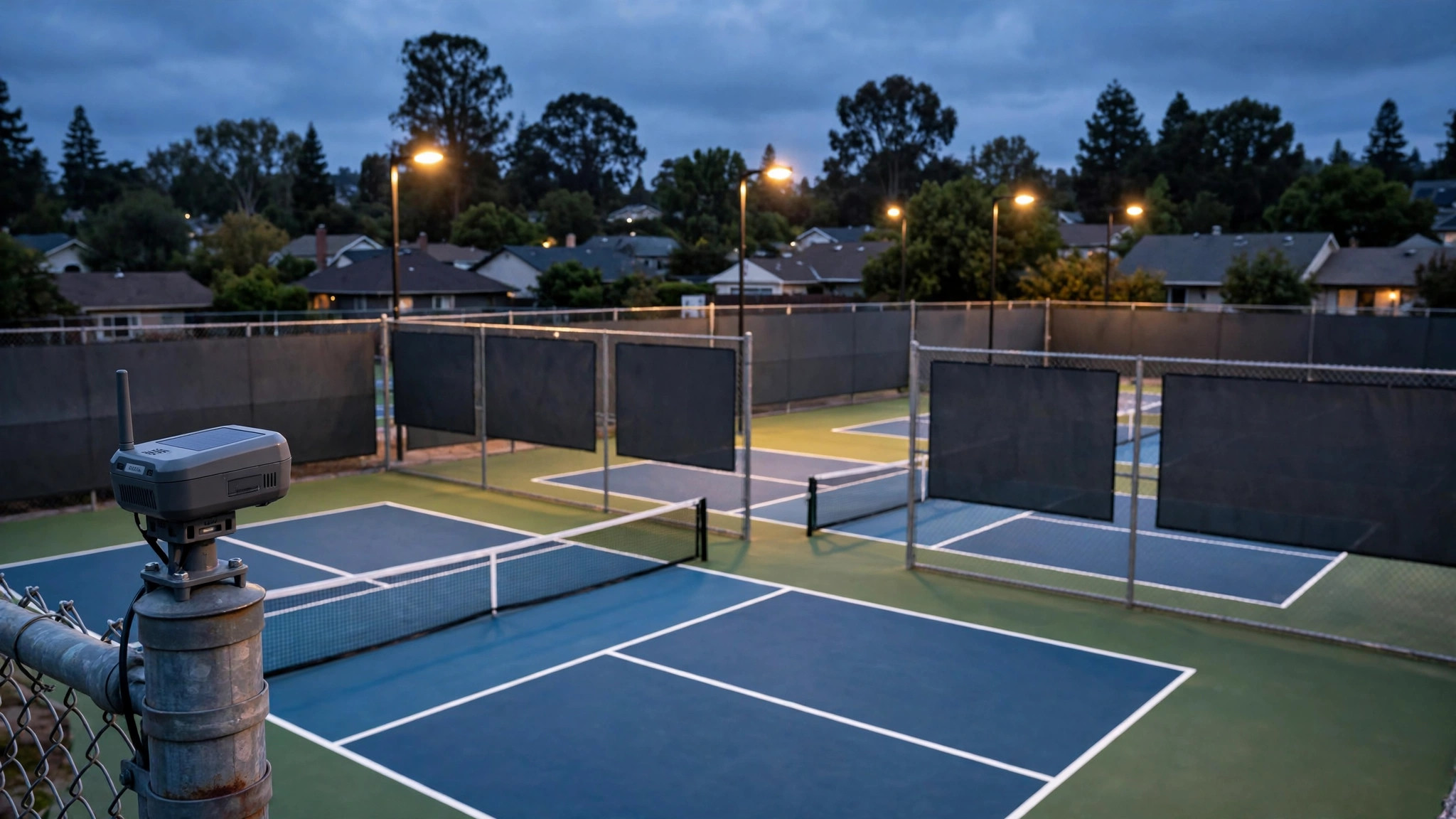
1. Continuous monitoring sensors: Pole-mounted, solar-powered acoustic sensors at each facility, streaming 1-minute Leq (equivalent continuous level) plus peak impulse counts to a cloud dashboard. Calibrated to Type 2 standards so the data survives scrutiny. The sensor distinguishes pickleball's impulsive signature from lawnmowers, traffic, and leaf blowers, so the facility's record reflects court noise specifically, not ambient suburbia.
2. Ordinance-aware alerting: Every facility gets its local noise ordinance encoded: daytime and nighttime limits, impulsive-noise penalties (many ordinances subtract 5 dB for impulsive sources, which makes pickleball's effective limit stricter than the headline number), and quiet hours. When a 15-minute rolling average threatens the limit, the facility manager gets a push alert with the option to dispatch staff, pause open play, or switch to quiet-equipment-only hours. The alert tells the facility manager when to act, before the complaint turns into a lawsuit.
3. Pre-construction noise modeling: Before a single court is poured, the operator inputs the site plan: court count, orientation, distances to the nearest residential lot lines, terrain, and proposed barrier options. The model outputs predicted dBA contours at every neighboring property line, the setback distance required to meet the local ordinance, and a permit-ready noise study document. Park City, Utah and Centennial, Colorado already require qualified noise studies for courts near homes (150-600 feet in Park City, 250-600 feet in Centennial); this product makes the study a $2,500 software output instead of a $10,000 consultant engagement, and it is reproducible, which matters when the study gets challenged at a zoning hearing.
4. Dispute-evidence logbook: Every complaint gets a case file. The neighbor says Tuesday at 7:40 AM was unbearable; the logbook shows the timestamped 1-minute levels, the equipment in use, and whether play was within posted hours. Timestamped, tamper-evident, exportable. This is the feature that ends lawsuits: Falmouth's case turned on dueling expert studies because neither side had continuous data. A year of calibrated readings could provide stronger evidence than isolated measurements, subject to admissibility, calibration, siting, and the ordinance's prescribed metric.
5. Quiet-equipment program management: Facilities that go the quiet-equipment route get the operational tooling to make it real: paddle checkout tracking (which certified quiet paddles are in circulation), quiet-hours scheduling (loud equipment before 10 AM, quiet after), and measured before/after comparisons showing the actual dBA reduction the equipment delivered. It converts USA Pickleball's lab certification into facility-level proof.
6. Mitigation ROI calculator: When levels exceed limits, the platform models the fix options against the facility's own measured data: barrier vendor A's curtains (rated 10-15 dBA reduction) versus quiet equipment (measured 4-8 dBA at this facility) versus hour restrictions (free, but costs evening league revenue). Each option shows predicted post-mitigation levels at the nearest lot line and payback math. Barrier vendors pay a referral fee for qualified leads, which turns the industry's $25,000-$114,000 hardware spend into a revenue stream instead of a competitive threat.
The Original Calculation: What Getting Noise Wrong Actually Costs
Nobody in this market has published the full cost accounting of a pickleball noise failure. So here it is, using Falmouth as the template.
Falmouth appropriated $310,000 for the combined Lawrence School tennis/pickleball/basketball court project, per the town's recreation-project document, then a Barnstable Superior Court judge enjoined pickleball play after neighbors documented the noise. The town's costs break into a labeled scenario: the $310,000 appropriation, largely stranded as pickleball play was enjoined; legal fees across the injunction fight (assumed $40,000 to $80,000); two years of staff and hearing time; and replacement-court construction at Trotting Park (assumed $150,000 to $360,000). Scenario total: roughly $500,000 to $750,000 for a single facility, before counting the political cost to the elected officials involved.
Now the prevention math. Continuous monitoring for an 8-court facility: four sensors at $450 each ($1,800 one-time) plus $240/month SaaS ($2,880/year). A pre-construction noise study through the platform: $2,500, versus $5,000-$15,000 for a consultant. Total year-one cost: roughly $7,200. That is 1.0% to 1.4% of the cost of one Falmouth-style failure, and it buys the two things Falmouth lacked: a defensible siting decision before construction, and continuous evidence after.
The setback math shows why so many facilities are in trouble. Take a court producing 70 dBA at 100 feet as an illustrative free-field calculation (70 dBA is a single impact event; ordinance limits are typically Leq-style averages, so treat this as a physics illustration). Closing a 15 dB gap to a 55 dB limit at 6 dB per distance doubling requires 2.5 doublings: 100 to 200 to 400 to about 566 feet of setback with no barrier. Most converted tennis courts sit 100-300 feet from the nearest home. Park City and Centennial answered with 600-foot setbacks unless a qualified noise study proves mitigation works. A 12 dBA barrier (mid-range of the 10-15 dBA vendors claim) cuts the required setback to about 141 feet, a quarter of the unmitigated distance. That single calculation, run before the concrete is poured, is the difference between a permitted facility and a lawsuit.
And the complaint-volume math explains why the problem only grows: 72,000 paddle strikes a day at one busy facility, each one an impulsive event in the most sensitive band of human hearing. Acoustic annoyance research consistently finds impulsive, unpredictable noise far more disturbing than steady noise at the same level. The customer buys a timestamped record of what actually happened, so disputes end in facts instead of expert testimony.
Revenue Model
| Revenue Stream | Amount | Notes |
|---|---|---|
| Facility monitoring subscription (monthly) | $149-349 | Per facility, tiered by court count (1-4, 5-8, 9+ courts). Includes sensors' data pipeline, ordinance alerting, dashboard, and complaint logbook. Annual prepay discount. |
| Acoustic sensors (one-time or leased) | $450/unit or $25/mo | Pole-mounted, solar, cellular. Typical facility needs 2-4. Leased option lowers adoption friction for municipal procurement. |
| Pre-construction noise study (per project) | $2,500-7,500 | Software-generated, permit-ready. Priced at half the consultant rate with 10x the turnaround. Required upsell for every new facility in an ordinance zone. |
| Mitigation marketplace referral (per project) | 8-12% of hardware | On barrier projects the platform's ROI calculator recommends (public records show authorizations and option quotes from $24,600 to $114,000). High-margin, scales with the installed base's mitigation spend. Disclosed conflict: referral payments never influence monitoring data or certification decisions, and the tamper-evident chain of custody exists precisely so a vendor payment cannot taint the evidence. |
| Annual acoustic certification (per facility) | $1,200 | "Quiet Facility" certification for HOAs and clubs to show residents and insurers: twelve months of compliant readings, equipment program in place, complaint log clean. Renewal is nearly pure margin. |
| Enterprise / municipal portfolio (annual) | $40,000-60,000 | City-wide dashboard for parks departments managing 10+ facilities: cross-site compliance view, council-ready quarterly reports, standardized complaint handling. Priced above the per-facility floor so it never undercuts the standard tiers. |
Unit economics on a 20-facility parks department: 20 facilities at $249/month average = $59,760/year in SaaS, plus 60 sensors at $450 ($27,000 one-time), plus 3 pre-construction studies a year ($15,000), plus 2 barrier referrals ($7,000 total, 2 x $3,500). Year-one revenue from one municipal customer: roughly $109,000. CAC: $12,000-$20,000, because sensor purchases at this level trip formal RFP and bid thresholds, the parks director does not hold the budget, and buying happens on annual budget cycles, so a March pitch can wait a year for the next fiscal year. Sales cycles run 9-18 months. LTV at 36-month retention (a realistic municipal SaaS lifetime, given budget cuts and director turnover): 20 x $249 x 36 = $179,280, for an LTV:CAC ratio of roughly 9-15x. Forty-eight months of zero churn is an upside case; the plan assumes 36 months.
Market Size
TAM: Start with the installed base: 82,613 known courts across 18,258 locations, with more than 2,300 new locations added in 2025 (about 190 a month). The monitorable base is facilities with meaningful residential exposure: municipal parks, HOAs, and clubs within 500 feet of homes. At 5,000 such facilities paying $240/month average ($2,880/year), monitoring alone is $14.4M/year. Add pre-construction studies: 2,300 new locations a year, roughly two-thirds needing noise documentation for permits or neighbor relations, at $5,000 average = $7.7M/year. Add mitigation referral margin: 700 barrier projects a year at $35,000 average hardware spend and 10% referral = $2.45M/year. Add certification and quiet-equipment program management (a blended $1,000/year for certification plus equipment-program tooling, below the $1,200 standalone certification price) at 3,000 facilities = $3M/year. Total: approximately $28M/year.
SAM: The serviceable market is facilities in jurisdictions where noise is already regulated or litigated: states and metros with enacted pickleball noise ordinances, active lawsuits, or 600-foot setback rules, plus the new-build pipeline in those zones. Roughly 1,500 facilities and 400 new studies a year: monitoring $4.3M + studies $2M + referrals and certification $0.7M = $7M/year.
SOM (year 3): 280 monitoring subscriptions at $230/month average = $772,800. Sixty pre-construction studies at $5,000 = $300,000. Barrier referrals on 40 projects at $3,500 average = $140,000. Certifications: 80 facilities at $1,200 = $96,000. Total: approximately $1.3M ARR. That is under 6% of the high-risk installed base, achievable through parks-and-rec conference sales and barrier-vendor partnerships.
Why Now
Rules and dispute outcomes are accumulating fast. Falmouth's injunction, Mashpee's Sunday closure, the August 2026 Crescent Lakes recall drive that forced board resignations, and the Polo Trace and Parkside lawsuits in Palm Beach County are raising the cost of operating without documentation. Every ruling raises the expected cost of operating without documentation, and every recalled board member is a cautionary tale that parks directors forward to each other.
Ordinances are proliferating. Park City wrote pickleball-specific zoning with 600-foot setbacks and a 47 dBA residential lot-line limit during play; Centennial adopted its own 600-foot setback regime. Carmel-by-the-Sea passed an urgency ordinance. Lake Elmo rewrote hours and lighting rules. Each new ordinance creates a defined compliance obligation, and compliance obligations are what SaaS companies sell against. The regulatory surface is expanding from zero to a patchwork. That expanding patchwork of obligations is the opening a compliance product needs.
Construction is accelerating into the risk zone. The roughly 25,000 additional courts a July 2026 Bounce analysis estimated the country needs will overwhelmingly be built in suburban parks and HOA common areas, the exact settings generating today's complaints, because that is where the players live. More than 2,300 new locations came online in 2025, about 190 a month, each making a permanent siting decision, most without any acoustic analysis.
The equipment answer is not working fast enough. USA Pickleball's Quiet Category is the right long-term fix, but a $169 paddle competing against $60 Amazon bundles means voluntary adoption will take years, and public parks cannot enforce equipment mandates. Monitoring is the bridge: it lets facilities stay open during the decade-long equipment transition by proving actual levels instead of arguing about potential ones.
The hardware got cheap. MEMS microphones, solar trickle charging, and LTE-M connectivity have pushed a calibrated outdoor acoustic sensor's bill of materials under $150. Five years ago this product required a $2,000 sound level meter and a consultant to read it. Now the sensor is a commodity and the software is the product, which is the correct cost structure for a SaaS business.
Startup Costs
| Category | Cost | Notes |
|---|---|---|
| Sensor hardware design + first 200 units | $90K | Off-the-shelf MEMS mic capsule, solar + LTE-M board, IP67 enclosure, pole mount. No custom silicon; the moat lives in the software. First production run covers 50 pilot facilities. Assumes a pre-certified LTE-M module and no tooling surprises; a certification or tooling miss pushes this line up. |
| Platform engineering (9 months) | $270K | 2 backend + 1 frontend engineer. Ingestion pipeline for 1-minute Leq streams, pickleball impulse-signature classifier, ordinance rules engine (50-state ordinance database), alerting, complaint logbook, modeling engine for pre-construction studies. Assumes founding engineers on equity-heavy compensation; market-rate hires push this toward $350K-$400K. |
| Acoustic model validation | $45K | Partner with a university acoustics lab or licensed consultant to field-validate the propagation model at 10 sites against calibrated reference measurements. The validation report is a sales asset: "our model agrees with reference gear within 2 dB." |
| Pilot program (25 facilities, 6 months) | $40K | Free sensors and platform for 25 parks/HOAs across 5 states. Goal: 12 months of complaint-resolution case studies and measured barrier/equipment before-and-after data that no competitor possesses. |
| Go-to-market (year 1) | $35K | NRPA annual conference, state parks-and-recreation association shows, pickleball facility builder partnerships (court builders bundle the pre-construction study). Content: the annual "State of Pickleball Noise" report, built from pilot data. Conference presence only, no field sales team; one field sales hire adds roughly $150K/year fully loaded. |
| Legal and insurance | $20K | Ordinance database licensing review, sensor privacy review (audio is processed on-device; only dB levels leave the sensor), E&O insurance for a product whose reports get used in legal proceedings. |
| Cloud infrastructure and operating buffer (12 months) | $30K | Time-series ingestion for ~1,000 sensors at 1-minute resolution is trivial load. Cellular data plans for pilot sensors. Support and legal. |
| Total | $530K |
Post-launch burn runs roughly $35,000-$45,000 a month (a lean team of four, cellular plans for the installed sensor base, cloud and support). Against the year-3 SOM of $1.3M ARR, break-even lands around month 34, assuming the municipal sales cycle cooperates.
Limitations
The 82,613 court count comes from USA Pickleball and the Pickleheads database and includes temporary and shared-use courts; a 2023 infrastructure report estimated more than 70% of courts at the time were temporary in nature. The monitorable base of permanent, outdoor, residentially exposed facilities is smaller than the headline number, which is why the TAM build uses 5,000 facilities rather than 18,258 locations. Treat the installed-base figures as directional.
The 70 dBA at 100 feet figure is widely cited but varies with paddle and ball type, player skill (harder hits are louder), temperature, and measurement methodology. Some sources report 65 dBA, others 78 dB at closer range. The setback arithmetic in this piece uses 70 dBA as a representative value; a real deployment would calibrate per facility, which is precisely the product's job.
Noise complaints are geographically concentrated: Florida, Massachusetts, California, Colorado, and Minnesota dominate the complaint and litigation records, and much of the country's 82,613 courts generate no complaints at all. The SAM deliberately restricts to ordinance and litigation zones, but expansion beyond them depends on the problem spreading, which is likely but not guaranteed.
The 6 dB per doubling attenuation rule is a free-field simplification. Real propagation includes ground absorption, wind, temperature inversions, and barrier diffraction, which is why the product's modeling engine needs the field validation budgeted above rather than relying on textbook math.
The evidence logbook cuts both ways. Compliance data is also violation data, and neighbors' lawyers can subpoena it. That selects for already-compliant or near-compliant facilities as the early market, which is a smaller slice of the 5,000-facility TAM build than the raw count suggests.
Municipal buyers have a free alternative, and barrier vendors can bundle a commodity logger with every curtain to collapse the proof-of-mitigation wedge at cost. The durable moat is the ordinance database plus multi-vendor neutrality: a vendor's logger only ever proves its own curtain worked. And if quiet equipment eventually wins, the terminal state is a cash-flow business of pre-construction studies and third-party certification over a 10-15 year bridge, one whose cash flows arrive long before any exit.
Strongest Counterargument
Quieter equipment will make this product unnecessary. USA Pickleball has done the hard institutional work: the Quiet Category exists, manufacturers are certifying paddles, and the price premium will compress as volume grows. Within five to ten years, the default recreational paddle will be meaningfully quieter, new courts will be sited with noise in mind because the Falmouth injunction and the accumulating local ordinances demand it, and the monitoring layer will be a solution to a solved problem. Meanwhile, the customers who feel the most pain, municipal parks departments, have a free alternative that elected officials prefer: restrict the hours, ban the loudest equipment, or close the courts. Monitoring at $240 a month does not outcompete free when the decision-maker is a city council managing a budget shortfall. And the product's own proof-of-mitigation wedge is available to the hardware vendors: Acoustifence or Pickle Block can ship a $50 commodity logger with every curtain to prove it worked, collapsing that wedge at cost.
There is real force in this, and the strongest version of the objection is the one the business feels least comfortable naming. The evidence logbook is symmetric: at a facility already generating complaints, which is the entire target customer base, continuous readings will frequently confirm exceedances, and that data is discoverable by the plaintiff's side. The product asks operators to pay $240 a month to manufacture the plaintiff's exhibit A. The current "operate blind" equilibrium looks less like an information gap and more like rational self-protection.
The honest rebuttal starts by conceding where monitoring loses. A city council choosing between free hour restrictions, which satisfy complainants at zero cost, and a subscription that measures the problem without reducing noise, will pick the free option most of the time, and the parks director is not the budget holder. Monitoring wins where restriction carries a real cost: evening leagues and tournaments that generate fee revenue, clubs whose members paid for access, operators facing insurer or bond-counsel documentation demands, and facilities fighting a restriction already proposed. It also wins on credibility, but only if the data survives an adversarial challenge: tamper-evident chain of custody, independent calibration audits, and third-party data hosting are what let a judge weight the readings. That is why the $1,200-a-year third-party "Quiet Facility" certification is the load-bearing product, not the raw dashboard.
The Falmouth lesson, read honestly, is that the side with data won and operators currently always arrive with no data. The neighbors hired Spendiarian & Willis; the town had nothing. Monitoring is defensive parity: the first facility that can answer a complaint with twelve months of calibrated, third-party-hosted readings negotiates from evidence instead of anecdote. As for the equipment trajectory, the bridge is long. Eighty-two thousand courts turn over slowly, and a $169 paddle competes against $60 Amazon bundles. A 10-15 year bridge monetized as a cash-flow business, with pre-construction studies and third-party certification as the terminal-state revenue: the honest version of this company is one whose cash flows arrive long before any exit.
What You Can Do
If you run pickleball facilities: Before the next complaint arrives, establish a baseline. Rent a calibrated Type 2 sound level meter for a weekend ($200-$300 from most equipment rental firms), measure 1-minute Leq at the nearest property line during peak play, and compare it to your city's daytime limit, remembering that many ordinances apply a 5 dB penalty for impulsive noise. If you are within 3 dB of the limit, you are one new housing development away from a violation. Document everything; the facility with records wins the dispute.
If you sit on a parks board or HOA: Require a noise study as part of every court conversion or construction proposal, and require post-construction verification that the mitigation performed as promised. The East Grand Rapids approach, consultant study first, then a $24,600 curtain purchase tied to the study's specifications, is the template. What is missing is the ongoing verification, which is currently nobody's job.
If you're a builder evaluating this space: The entry point is the ordinance database plus the propagation model. Fifty states, thousands of municipalities, each with its own noise ordinance, impulsive-noise provisions, and setback rules: that database, kept current, is a moat no barrier vendor will build. Pilot in Florida (highest complaint density, year-round play, HOA-heavy market) with five facilities, and sell the first pre-construction studies to court builders who need a permit package. The builders feel the permitting pain before the operators feel the complaint pain.
The Bottom Line
Pickleball added 4.5 million new players in a single year and a July 2026 Bounce analysis estimated the U.S. needs approximately 25,000 more courts, and most of those courts produce on the order of 70 decibels of impulsive noise in the most sensitive band of human hearing, hundreds of times an hour, often within a few hundred feet of someone's home. The sport's growth is now colliding with the country's noise ordinances, and the collision is producing injunctions, Sunday closures, forced board resignations, and barrier proposals running from a $24,600 authorization to a $114,000 option quote, made on faith. The operators in the middle have two choices: operate blind and hope the next complaint goes away, or measure continuously and prove compliance. A $240-a-month monitoring subscription against a $500,000 Falmouth-style failure is not a difficult purchase to justify; the arithmetic favors measuring first. The barriers, the consultants, and the quiet paddles all exist. What keeps courts open is proof of what they actually sound like. Nobody sells that proof yet.