2,586 Garages in Queens, the Bronx, and Staten Island Have 14 Months to File. The Tracking Software Does Not Exist.
On April 18, 2023, a parking garage at 57 Ann Street in lower Manhattan collapsed, killing one person and injuring five. The building sat in the first filing sub-cycle of a law New York had passed two years earlier, and no inspection report had been filed for it. Local Law 126, enacted in November 2021 and effective January 1, 2022, requires every parking structure in New York City to be inspected by a Qualified Parking Structure Inspector and reported to the Department of Buildings, on a borough-by-borough schedule. Manhattan's first two sub-cycles are already closed. The final first-cycle window, covering the Bronx, Queens, and Staten Island, runs from January 1, 2026 to December 31, 2027. An analysis of Department of Buildings records counts more than 4,800 structures citywide with no filed report, including about 2,586 in the three boroughs now on the clock. The late filing penalty is $1,000 a month, failure to file costs $5,000 a year, and an unsafe rating forces repairs on a 90-day fuse. The workflow that should connect owners, licensed inspectors, repair contractors, lenders, and the Department of Buildings runs on engineering PDFs, a city filing portal built for data entry rather than workflow, and the memory of whichever property manager was on duty when the last inspection happened.
The Problem
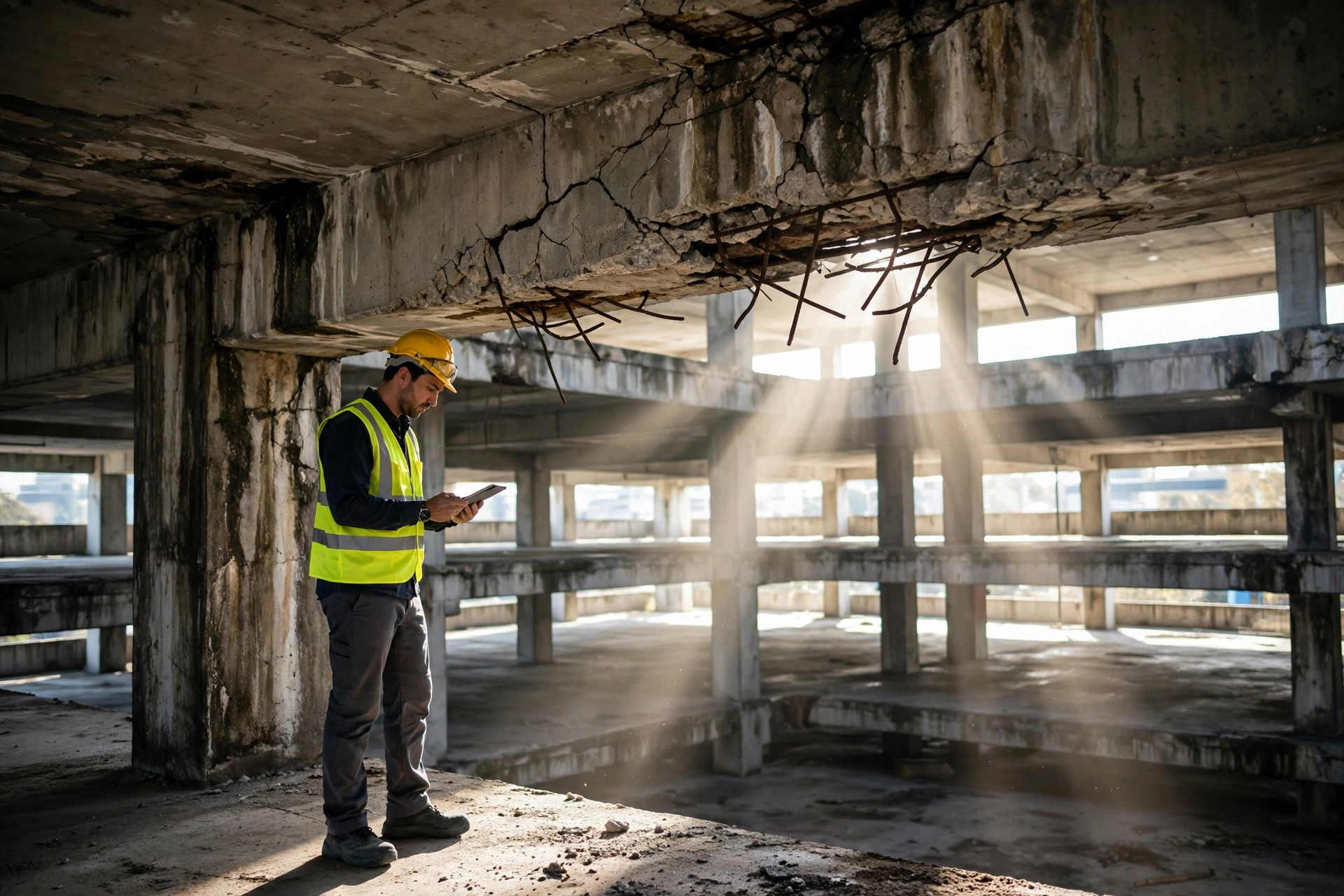
Parking structures fail differently from other buildings. They carry heavy moving loads, they sit open to weather and road salt, and their concrete decks crack, take in water, and corrode their own reinforcing steel from the inside. A garage can look fine from the ticket booth while its post-tensioning tendons, deck joints, and column bases are deteriorating. Before Local Law 126, New York had no rule forcing any owner to look. As one engineer told Gothamist after the Ann Street collapse, many owners did not even know the inspection program had started in January 2022.
The law, codified as Article 323 of the Administrative Code, is specific. A condition assessment must be performed by an approved agency, the report filed with the Department of Buildings, and an annual observation checklist, created during the initial assessment, completed every year between assessments by or on behalf of the owner. Inspectors classify each structure as Safe, Safe with Repair and Engineering Monitoring (SREM), or Unsafe. Unsafe conditions require immediate protective measures and fast repairs. The Department of Buildings charges $305 for an on-time initial report, $1,000 per month for a late one, $5,000 per year for failure to file, $1,000 per month for failure to repair an unsafe condition, and a $2,000 one-time fee for unaddressed SREM conditions, according to the fee schedule published by Walker Consultants.
Complying is a multi-year workflow, not a form. It runs: determine whether the structure is covered and which sub-cycle applies, hire a Qualified Parking Structure Inspector (a New York licensed professional engineer with parking-structure experience), complete the assessment, file the report within the window, complete the annual observation checklist every year, execute SREM or unsafe repairs on their clocks, file amended reports after repairs, and keep the whole record intact until the next cycle. Every handoff is a different party, and the record rarely survives all of them.
The Compliance Math: An Original Calculation
No official total counts every structure covered by Local Law 126, so build the number from the Department of Buildings data that analysts have already tallied. An analysis of DOB records cited by the New York Real Estate Journal and Structural Workshop counts more than 4,800 structures without a filed report, broken down as approximately 1,890 in Queens, 1,600 in Manhattan, 1,500 in Brooklyn, 644 in the Bronx, and 52 in Staten Island. Those borough figures sum to 5,686 unfiled structures. Note the definitional point: Gothamist in 2023 described "more than 1,200 parking garages" in the city, a count of standalone facilities, while the DOB inventory is larger because the law also reaches parking levels inside and beneath residential and commercial buildings. The 5,686 figure is the working inventory for a compliance business, not the standalone-garage count.
Now the spend. No firm publishes a Local Law 126 price list, so estimate from adjacent published rates and show the work. Commercial building inspections in Southern California run $0.10 to $0.30 per square foot, per a 2026 price guide from US Building Inspections. A structured garage of 80,000 square feet at the midpoint of that range, $0.15, prices at $12,000. Apply that average across the backlog: 5,686 unfiled structures at $12,000 equals $68.2 million in inspection spend that the law already requires and owners have not yet bought. The three boroughs on the clock right now, Queens plus the Bronx plus Staten Island, hold 2,586 of those structures, which is $31.0 million in inspection spend inside a window that closes December 31, 2027.
Repairs dwarf inspections. WGI's 2026 Parking Structure Cost Outlook puts the national median cost of building a new structure at $33,300 per space, or $98.75 per square foot, up 6 percent from 2025. A garage that needs deck rehabilitation, joint replacement, and corrosion repair routinely bills in the hundreds of thousands of dollars. If one quarter of the 2,586 structures in the current window need SREM or unsafe repairs averaging $150,000, that is another $97 million in repair spend in three boroughs in one cycle, before counting the Manhattan and Brooklyn structures already through their windows. The inspection is the wedge. The repair workflow is the market.
Market Size: TAM, SAM, and SOM
TAM, the inspection and repair spend the platform coordinates: $68.2 million in backlog inspection spend citywide, recurring on the Department of Buildings cycle, plus repair spend that runs several multiples of inspection spend. Counting only inspections plus the conservative repair estimate above, the New York coordination market exceeds $250 million per cycle, and the national version grows as other states adopt the same model.
SAM, the software revenue available in New York: about 7,000 covered structures (the 5,686 unfiled plus structures that have already filed) at $600 per structure per year for the owner tier equals $4.2 million in annual recurring revenue, plus roughly 100 to 200 Qualified Parking Structure Inspector firms at $249 per month, another $300,000 to $600,000 per year, plus per-filing fees. Call the New York software SAM roughly $5 million per year.
SOM, the obtainable share in three years: 800 structures on the owner tier ($480,000), 60 inspector firms ($179,000), filing fees on roughly 400 reports a year ($80,000), and repair-marketplace referral fees on mediated work ($150,000), totaling just under $900,000 in annual recurring revenue. That is about 12 percent of the New York software SAM and a credible base for expansion into New Jersey, where bill S-3636 would require professional-engineer inspections of parking structures at least once every five years, with reports submitted to the Department of Community Affairs.
Where the Paper Trail Breaks Down
Consider a 400-space garage under a Queens apartment building, managed by a firm that also manages forty other properties. The building's sub-cycle opened January 1, 2026. The manager, who handles Local Law 11 facade filings and Local Law 97 energy reports for the same building, has never filed a parking structure report. The garage's owner, a family LLC, does not know whether the below-grade levels count as a covered structure. They do.
The manager solicits bids in mid-2027. Qualified inspectors are booked solid, because every garage in three boroughs shares the same December 31 deadline. The assessment, when it happens, rates the garage SREM: deck joints and drainage need repair, with engineering monitoring. The report arrives as a PDF. The repair contractor is hired from a prior relationship, not a bid. The amended report after repairs is filed late, or filed by the engineering firm under its own account, so the owner never holds a copy. The annual observation checklist, which the law requires every year between assessments, is performed by a garage attendant with no system reminding anyone it exists, and the checklist itself lives in a binder in the garage office.
When the next cycle arrives, the engineering firm has merged, the manager has changed, and the binder is gone. The new inspector re-inventories the structure at full price, and the owner pays again for knowledge that already existed. Worse, a buyer doing due diligence on the building cannot verify the garage's status without calling the Department of Buildings and parsing filing records that were never designed for a buyer to read.
The Gap in the Market
Software for this workflow exists in pieces, but every piece serves only one side of it.
| Company | What They Do | What's Missing |
|---|---|---|
| Walker Consultants, Thornton Tomasetti, SGH, Falcon Group | Engineering firms that perform Local Law 126 assessments and publish compliance guides. | They sell labor, not software. The report is a PDF delivered to the owner. No portfolio dashboard for multi-garage owners, no annual observation checklist workflow, no cross-firm record vault, no buyer verification endpoint. Their incentive is billable assessments, not durable compliance infrastructure. |
| DOB NOW and the Department of Buildings portal | The official filing destination for inspection reports. | It accepts filings. It does not remind owners of sub-cycle deadlines, manage the annual observation checklist, track repair clocks, assemble bids, or present a building's filing history in a form a buyer or lender can use. Filing is the last step of the workflow, not the workflow. |
| AppFolio, Buildium, Yardi | Property management suites holding the owner relationship. | A parking structure inspection is a custom date field and a file attachment. No sub-cycle logic by community district, no Qualified Parking Structure Inspector marketplace, no SREM repair clock, no amended-report tracking. Compliance is a reminder, not a module. |
| Procore, PlanGrid, SafetyCulture | Construction and generic inspection checklists. | Built for projects and generic forms. No Department of Buildings filing schema, no community-district sub-cycle engine, no annual observation checklist tied to a specific structure's initial assessment, no condition-rating workflow of Safe, SREM, and Unsafe. |
| Excel, email, and the garage office binder | The actual current system of record for most small owners. | Personnel turnover destroys continuity. No lender accepts a binder as proof. No buyer can verify it. The annual observation checklist dies the first time the attendant who kept it leaves. |
The critical gap is the multi-sided one. The owner needs the inspector's report, the inspector needs the structure's history and the prior cycle's checklist, the contractor needs the defect list with its repair clock, the buyer needs a verifiable filing record, and the Department of Buildings needs a correctly formatted filing. Each side currently talks to the others through ad hoc channels, and the data never survives a handoff.
The Proposed Solution
A vendor-neutral compliance platform built around the structure, not the vendor. The core object is a digital structure registry: every parking structure an owner holds, mapped to its community district, its sub-cycle, its filing history, its condition rating, and its annual observation checklist, with the full record preserved across cycles and across inspector firms.
The platform computes the deadline automatically from the community district, counts down to it, and assembles the bid package: structure type, levels, square footage, prior ratings, and prior defects, so inspectors bid against facts instead of a phone description. Field documentation is photo-verified through a mobile app, with each photo bound to a specific structural element rather than dumped into a folder. When the assessment returns SREM or Unsafe, the defect list converts directly into a repair workflow with its own clocks: immediate protection for unsafe conditions, amended reports after repairs, engineering monitoring for SREM items. The completed cycle produces a transferable compliance record, a signed, inspectable history that the building was assessed, by whom, with what rating, and with what repairs, which a buyer, lender, or insurer can verify at transaction time instead of calling a retired property manager.
The annual observation checklist is the retention engine. Because the law requires an observation every year between assessments, the platform has a reason to touch the customer twelve times between cycles, not once. Each annual observation refreshes the structure's condition picture, catches deterioration early, and keeps the record warm for the next assessment, which is exactly the data the next inspector needs and the current system throws away.
Revenue Model
Four revenue lines, each tied to a different side of the workflow.
Owner tier: $600 per structure per year for the registry, sub-cycle countdown, annual observation workflow, record vault, and transferable compliance record. At 800 structures, that is $480,000 in annual recurring revenue, and the price is anchored to the alternative: a $12,000 assessment plus $1,000-a-month late fees makes $600 a year for never missing a deadline a trivial line item.
Inspector tier: $249 per month per firm for the bidding marketplace, report generation in a Department of Buildings-ready format, the annual observation checklist builder, and a client portfolio dashboard. Sixty firms at $249 per month is $179,000 per year, with expansion as the platform becomes the place owners go to find qualified inspectors in a deadline crunch.
Filing fees: $199 per filed or amended report, paid by the owner or split through the engineering firm. Four hundred filings a year is roughly $80,000, and every filing is also a data acquisition event that strengthens the registry.
Repair marketplace: a 5 percent referral fee on contractor repair work sourced through the platform's defect workflow. Repair bills commonly run 10 to 30 times the assessment cost, so even a small share of mediated work adds meaningful margin, and the contractor side gets pre-qualified, defect-scoped jobs instead of cold bids.
Combined three-year target: just under $900,000 in annual recurring revenue in New York, with expansion into New Jersey and other adopting jurisdictions as the second growth leg.
Why Now
The timing is the whole thesis. The final first-cycle window is open right now and closes December 31, 2027, which is 14 months from this article's publication. The first two sub-cycles are closed, which means the pattern is established: owners in Manhattan and Brooklyn have already been through it, the inspector market exists, and the Department of Buildings has a filing system that works. The remaining question is not whether the law is real. It is whether 2,586 structures in three boroughs will file on time, and the borough breakdown says most have not started.
The one-time initial observation deadline of August 1, 2024 has already passed, which means structures that never filed it are already in violation and need a remediation path, not just a calendar reminder. The penalty structure now bites monthly rather than hypothetically. And the regulatory pattern is exportable: New Jersey's S-3636 would impose five-year professional-engineer inspections statewide, and the post-Surfside wave of structural inspection laws in Florida and elsewhere shows legislators reach for the same tool after every collapse. The Ann Street collapse is the reason New York's law exists in its current form. The next collapse in another state is the reason the New York product becomes the national product with localization rather than reinvention.
Finally, the transaction channel does not depend on the enforcement calendar. Buyers, lenders, and insurers are beginning to ask for structural filing records at sale and refinance, because a garage rated Unsafe is a liability that transfers with the building. A verifiable compliance record has value even for an owner who is willing to risk a fine, because the buyer is not willing to risk the building.
Risks and Challenges
Enforcement has been slow. Thousands of structures missed the first two sub-cycle deadlines without a visible wave of mass enforcement, and the penalties, while real, are modest next to repair bills. If the Department of Buildings continues to under-enforce, many owners will rationally defer, and the platform's urgency pitch weakens. The counterweight is the transaction channel and the hard December 2027 date, neither of which depends on fines, but slow enforcement is the number-one demand risk and any honest pitch must name it.
Inspector supply bottleneck. Only licensed professional engineers with parking-structure experience can sign these assessments. The pool is thin, and it will be booked solid through the 2027 deadline across three boroughs at once. A platform that cannot staff its marketplace cannot deliver. Launch borough by borough, starting in Queens where the unfiled count is highest, and seed the supply side with firms before opening owner signups widely.
Geographic concentration. Today this market is New York City plus a New Jersey proposal. If other states fail to adopt parking-structure inspection mandates, the national expansion thesis stalls and the company is a regional compliance tool with a $5 million software ceiling. The counterweight is that structural-collapse liability is a powerful legislator motivator, but "other states will follow" is a projection, not a fact.
Rule changes. The Department of Buildings amended the governing article in 2024, and filing rules, report formats, and cycle intervals can change by rule. A platform that hard-codes today's filing schema will break on the next amendment. Build the filing layer as configuration, not code, and keep a licensed engineer on retainer to review every rule change before it ships.
The strongest counterargument: the Department of Buildings could build this, or an engineering giant like Thornton Tomasetti could productize its own compliance practice and bundle the software with the assessment. The counterpoint has two parts. First, the Department of Buildings builds filing portals, not multi-sided workflow products, and its portal is the destination, not the workflow. Second, an engineering firm's software serves that firm's clients; the platform's value compounds across firms, because a buyer's lender wants to verify a record regardless of which firm performed the assessment. The network effect lives at the transaction layer, which belongs to no single firm. A vertical entrant that owns the registry standard has a moat that a feature inside an engineering practice cannot easily replicate.
Startup Costs
Roughly $850,000 for a 12-month path to revenue. Two full-stack engineers ($340,000 fully loaded), one founder handling sales and partnerships ($180,000), legal review of the filing workflow and engineer-retainer review ($70,000), design and mobile app polish ($90,000), owner outreach built from the public Department of Buildings structure list ($100,000), and operating overhead including cloud infrastructure, which is modest for a document-and-workflow product ($70,000).
The go-to-market is cheap because the customer list is public. The Department of Buildings publishes the structure inventory and filing status by community district, which means the outreach list can be built from municipal records rather than bought. Break-even at roughly 18 months on 800 structure subscriptions plus the inspector tier, filing fees, and repair referral revenue.
What You Can Do
If you own a parking structure in the Bronx, Queens, or Staten Island: your filing window closes December 31, 2027. Confirm your community district, confirm whether your structure is covered, and get bids from Qualified Parking Structure Inspectors now, before the deadline crush books every firm in the borough. A late report costs $1,000 a month. An unsafe rating found late costs far more.
If you own a structure in Manhattan or Brooklyn and never filed: your sub-cycle has closed and you are already late. File now and stop the monthly penalty from compounding, and confirm whether your one-time initial observation from August 2024 was ever completed.
If you are a Qualified Parking Structure Inspector: standardize your report format. The firms whose reports are machine-readable, element-by-element, and photo-verified will win the marketplace when owners start comparing. The firms whose reports are bespoke PDFs will compete on price alone.
If you're building this: start with the deadline engine, not the marketplace. The community-district countdown is the feature that gets an owner to sign up this week, and the annual observation checklist is the feature that keeps them next year. The inspector marketplace and repair workflow follow. Launch in Queens, where the unfiled count is highest, and partner with three or four inspector firms to seed supply before opening owner signups.
Limitations
This analysis relies on a secondary analysis of Department of Buildings records, not a total published by the Department itself, so the 5,686 unfiled figure inherits that analysis's definitions and any errors in the underlying records. The $12,000 average assessment fee is an estimate derived from general commercial inspection rates, not a published Local Law 126 price list; actual fees vary with structure size, condition, and borough, and if the true average is $8,000 rather than $12,000, the backlog inspection figure falls from $68.2 million to $45.5 million. Repair cost assumptions are illustrative, not quoted from contractor bids. New Jersey's S-3636 is a proposal, not an enacted law, and its final form may differ. The governing code article was amended in 2024, so builders should confirm the current Department of Buildings rule text, including subsequent-cycle intervals, before encoding filing logic.
The Bottom Line
One person died at 57 Ann Street because a concrete garage was deteriorating invisibly and nobody was required to look. New York's answer, a licensed inspection, a filed report, an annual checklist, and a repair clock, was the right regulatory shape for the problem. But the compliance infrastructure was never built. The assessments happened, or didn't, and the records scattered into PDFs and filing portals while the final first-cycle deadline started ticking. An estimated $68.2 million in inspection spend is still unbought across 5,686 unfiled structures, $31 million of it in three boroughs with 14 months left on the clock, and the system of record for all of it is a binder in a garage office. Whoever builds the registry, the deadline engine, the annual checklist workflow, and the transferable compliance record owns the workflow that determines whether those garages are actually safe or merely once-inspected. At $600 per structure per year, the revenue model is modest. The garages it keeps standing are not.