Syracuse Replaced 700 Lead Pipes Last Year. The EPA Requires 1,400. Nobody Sells the Software for the Other 700.
Every water utility now knows its lead-pipe number, and the federal clock starts in thirteen months. The funded companies built the maps; nobody built the software that treats every replacement as a consent transaction: 1,400 signatures, 1,400 jobs, 1,400 trenches, and the pace reported to the state.
The Problem
Start in Syracuse. Its published numbers put most utilities to shame, and they are bleak: about 700 lead service lines replaced in 2025 against a reported target of 3,000, according to local reporting from August 2026. Roughly 14,000 known lead lines remain in the ground, plus an unknown number of unverified ones. Under the federal rule's ten-year clock and 10-percent-a-year average pace, Syracuse needs about 1,400 lines a year. Double last year's pace. Every year. For a decade. Syracuse's water commissioner blamed "logistical challenges, such as coordinating with road construction and gaining access to private properties." Read that sentence twice: the sequencing problem and the consent problem, quoted in one breath by the person living them. It is an orchestration problem wearing a funding problem's clothes, and orchestration is the product nobody has built.
At the center sits the EPA's Lead and Copper Rule Improvements, issued October 8, 2024. It ordered a finding phase, and that phase is finished: service-line inventories were due October 16, 2024, so every utility now holds a spreadsheet with its number on it, and the utilities that treated the inventory as the finish line are about to discover it was the starting gun. What the rule demands next is the digging phase, full replacement of every lead and galvanized-requiring-replacement service line in the country on a ten-year clock, and that clock started ticking against inventories that were only finished last October, which means the first construction seasons are already behind schedule before they begin. In February 2026 the EPA told a federal appeals court it will defend the ten-year requirement outright: utilities have sufficient control to replace lines on private property, and the old regime of corrosion treatment and monitoring "failed to prevent system-wide lead contamination." That filing drained the political risk. It was not a court victory. AWWA's challenge is pending in the D.C. Circuit, where judges at September 30, 2026 oral arguments wrestled with the definition of "control" over pipes on private property, and whatever definition survives will set the consent rules, and therefore the consent workload, for every utility in the country for the rest of the decade. Under either ruling, the consent problem survives. With the political risk drained, the digging happens whether the software exists or not.
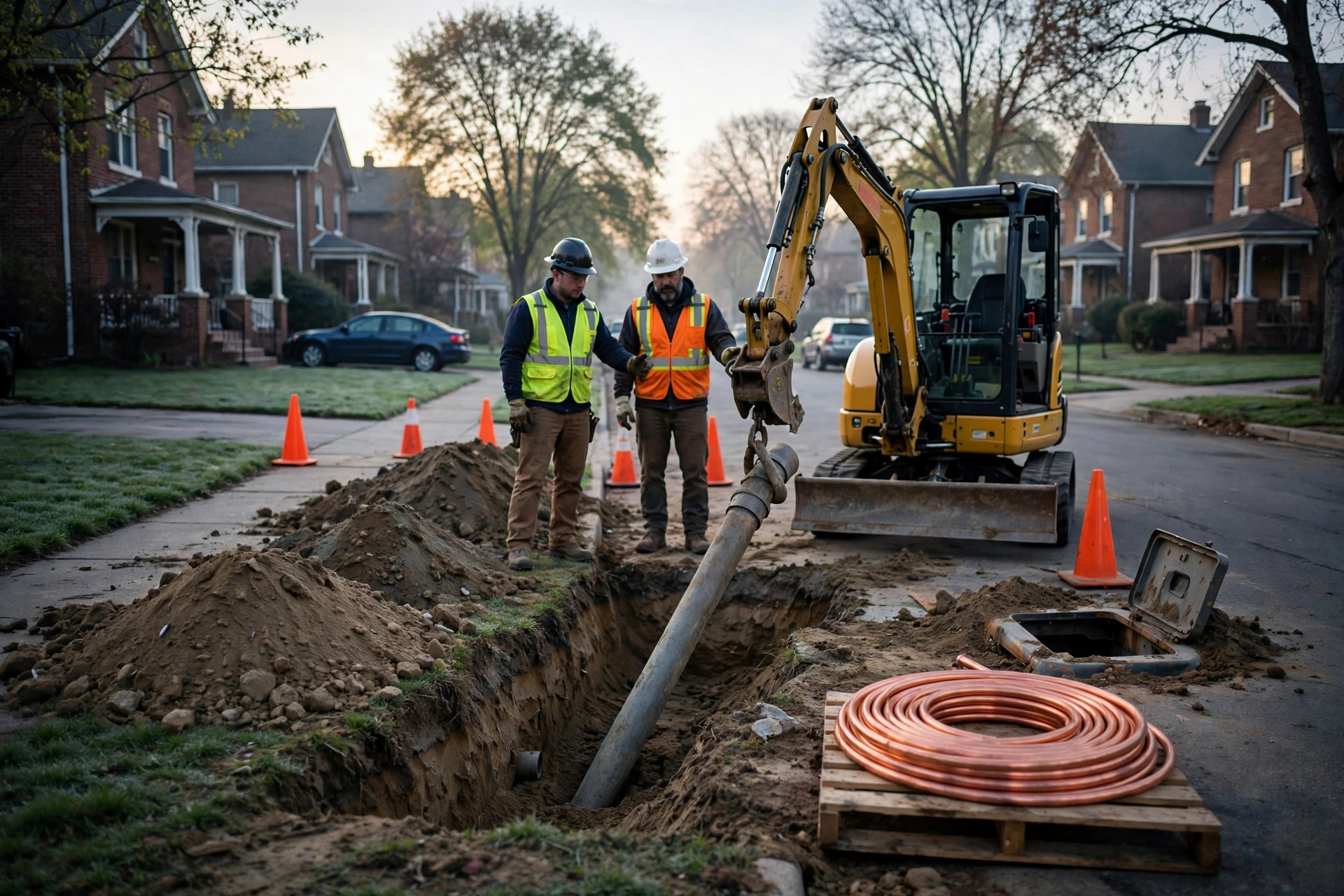
Digging is hard in ways that have nothing to do with shovels. Shovels are the easy part. A service line runs from the water main to the house, which means half of every replacement happens on land the utility does not own, yet the EPA's position is that the utility owns the obligation for the whole line anyway, private side included. Every replacement is therefore a consent transaction. Find the owner, not the tenant. Explain in their language why strangers need to excavate their lawn. Get a signature. Schedule around their life, then repeat 1,400 times a year. Partial replacements, where the utility does its half and the homeowner's half stays lead, are worse than doing nothing: Brookings notes they can actually increase lead levels, because disturbing the line shakes particulate loose. Consent is the critical path. The paperwork is the easy part. Few utilities have a system for 1,400 consent transactions a year. Most have a spreadsheet.
Then the money, which exists and still is not enough. Washington put $15 billion for lead service line replacement through the Drinking Water State Revolving Fund over five years, with 49 percent as principal forgiveness or grants for disadvantaged communities: real money, untouched by the FY2026 rescission fights, and states have strong incentive to commit it promptly rather than let it sit. It covers somewhere between a quarter and three-fifths of the job, depending on which national count you believe.
Costs run hotter than the estimates. By the EPA's own reckoning the average replacement is $4,700 a line, ranging from $1,200 to $12,300, while real utility data runs far hotter: Newark, Denver, and DC Water land between $6,400 and $21,000 a line, and the American Water Works Association puts the realistic all-in average at $8,247 to $12,000 once mobilization, street restoration, and contingency are counted. Chicago holds the national extreme: more than 400,000 lead lines, the largest inventory in the country, at about $31,000 per line, more than six times the EPA estimate, toward a bill north of $12 billion. When every dollar is grant money or ratepayer money, the gap between a $6,000 replacement and a $12,000 replacement is not a rounding error but the program itself, and the difference between those two numbers is usually decided by sequencing and density, which is to say by software, not by the price of copper.
The $140 Million Program With $23 Million in Hand: An Original Calculation
Run Syracuse's numbers, because they are public and the pattern repeats in every city with old housing stock. Fourteen thousand known lead lines remain, and at the AWWA's realistic midpoint of $10,000 a line, finishing the known inventory costs $140 million against roughly $22 million in state support and $1.1 million in federal aid currently in hand, which means the mandate is funded at one-sixth of its cost: before the unknowns, before restoration overruns, before Chicago-style cost disease.
Scale it, with a caveat the EPA itself introduced this year. The original estimate was 9.2 million lead service lines nationally; the Trump EPA revised it to roughly 4 million, under a methodology that assumes communities which never filed inventories have no lead at all. The filed inventories are the ground truth. The honest range is wide. At a conservatively blended $6,000 a line, weighting toward the agency's $4,700 while acknowledging the utilities' hotter lived experience, the country's total replacement bill runs $24 to $55 billion over ten years, or $2.4 to $5.5 billion a year in digging at steady-state pace. Federal money covers $15 billion of it over five years; the rest comes from water rates, municipal bonds, and state programs: the most politically painful sources available, which is why the utilities that move first get grants and the utilities that wait get rate cases, and why the grant paperwork is a product feature rather than an afterthought. Pace compounds the pain, because 10 percent a year means 400,000 to 920,000 replacements a year, every year, for a decade, a rate the country has never approached, in a construction labor market that was already short of qualified excavation crews before the rule existed, which is why contractor capacity rather than funding is the binding constraint in half the states. Syracuse did 700 against a 1,400 requirement; multiply that gap by every city with pre-1986 housing.
Here is the calculation that matters for the business. Nobody gets paid per shovelful of dirt; the software opportunity is the coordination layer: the consent, the sequencing, the documentation, the reporting, and the coordination layer is where programs live or die, because the digging itself is a solved trade and the signature chase is not. Take 2 to 3 percent of that annual replacement spend as the software and orchestration take rate, conservative against what program-management consultants already charge, and the addressable software revenue at steady-state pace is $48 million on the low-end count and $165 million on the high-end one. Call the working TAM on the order of $100 million a year, recurring for a decade and mandated by federal rule. Inventory software got funded first because the inventory deadline came first, and that deadline has passed. Whoever owns the work orders owns the next ten years.
The Gap in the Market
| Company / Channel | What They Do | What's Missing for the Replacement Program |
|---|---|---|
| 120Water | Cloud compliance platform: service-line inventory, sampling programs, resident notices. $43M growth round led by Edison Partners (Jan 2024), 153 employees. Their own materials put the "immediate testing and compliance market" above $2 billion. | They own the FIND layer: maps, inventories, notices. No dedicated contractor-scheduling module, no multi-touch consent-campaign tooling, no street-by-street sequencing, no grant drawdown management, as of 2026. A Dublin, Georgia council just renewed its 120Water contract at $20,280 a year to track 1,200 unknown lines: that is the inventory business, and the invoice is public record, which is how precisely the incumbent's economics can be read by anyone pricing the replacement layer. The digging business is unbuilt, and the software TAM for it, on the order of $100 million a year, is a market the inventory layer never reached on an annual basis. |
| BlueConduit | Machine-learning prediction of unknown service-line materials from partial records. | Prediction tells you where to dig first, but it does not get the signature, book the crew, photograph the trench, or file the state report, which makes BlueConduit a genuinely complementary integration partner rather than a competitor; the two companies announced a strategic partnership pairing prediction with 120Water's platform. |
| Engineering consultants + bespoke ArcGIS | The Trenton model: a multi-year engineering-services contract to run the replacement program on ArcGIS Enterprise, train contractors, build regulator dashboards. Trenton's Phase 5 RFP reads like a wedding planner for pipes. | It works, at consulting prices, one city at a time, with nothing productized and nothing reusable across utilities: the utility rents the expertise instead of owning the system. The firms billing seven figures to run a replacement program are the reason a $24K-a-year SaaS product has room to exist, because every utility that has seen the consulting invoice is already asking whether configured software could do the same job at a tenth of the price, and the answer is yes for everything except the snowflake parts. |
| ServiceTitan, HouseCall Pro, Jobber | Field-service management for plumbing and HVAC contractors: dispatch, invoicing, GPS tracking, payments. | Built for the contractor's truck, not the utility's mandate. No thousand-parcel consent workflows, no grant compliance, no EPA or state reporting exports, no ten-year pace tracking against a federal clock. The contractor is one actor in a five-actor play. |
| Spreadsheets and paper door hangers | What most small and mid-size utilities actually run today. | The real competitor for the first three years, and it fails at exactly the mandate's pressure points: consent status across thousands of parcels, photo documentation per line for the auditors, defensible pace reporting when the state asks why the utility is at 4 percent instead of 10. Paper does not scale to 1,400 signatures a year. |
Every regulated vertical that digitizes under a mandate repeats the pattern. The funded incumbents built for the first deadline, which was the inventory. Enterprise consultants sell bespoke programs at bespoke prices, the generic tools solve an adjacent job, and the thousands of utilities staring at the ten-year clock have no system of record for the work itself: the signatures, the sequencing, the photos, the grants, the pace. Their inventory told them the size of the hole, but nobody sold them the ladder.
The inventory told them the size of the hole. Nobody sold them the ladder.
The Solution
Leadline: the replacement-ops platform for the ten-year dig. Not a map, not a prediction model, not a consultant's ArcGIS dashboard. A system of record that takes a utility's completed inventory in and produces verified replacements out. Five modules, priced for public works departments instead of tech companies.
1. Consent engine (core SaaS): the critical path, productized. Multilingual mail, SMS, and door-knock scripts generated per parcel from the inventory record, plus e-signature capture for right-of-entry agreements. A landlord-tenant resolution queue, because the owner signs but the tenant lives there, and a renter-occupied duplex is where consent goes to die. Automated follow-up sequences with response tracking, so the utility knows exactly which 340 of its 1,400 target parcels are still unsigned and why. This module is the moat: once 5,000 consent records live in your system, the utility is not migrating.
2. Street-by-street sequencer (core SaaS): replacement work has to coordinate with road construction schedules, weather windows, school calendars, and contractor availability, which is the "logistical challenges" half of the Syracuse quote. It ingests the city's paving plan, clusters replacements by block to minimize mobilization cost, the single biggest lever on per-line cost, and produces a crew schedule contractors can actually bid against. Block clustering is also the cost story, because Chicago's $31,000-a-line number is what happens when every replacement is a bespoke event. Density is the discount.
3. Funding-stack navigator ($8K/year add-on): the money comes in fifty state flavors: DWSRF principal forgiveness for disadvantaged communities, state grants, WIFIA loans, municipal bonds. It screens parcels for disadvantaged-community eligibility, tracks application windows and drawdown deadlines, and maintains the audit file the grant requires. Miss a drawdown deadline and the money evaporates, and nobody's spreadsheet is watching the calendar.
4. Field documentation (contractor mobile app, $25/seat/month): every completed replacement needs GPS coordinates, timestamped before-and-after photos, material verification, and restoration sign-off, because the state primacy agency will audit the count and the EPA's pace requirement is only as real as its paperwork. It works offline in a trench, which is where the work happens. Verification events trigger the per-line orchestration fee, which keeps the revenue model honest. Revenue arrives when pipes get replaced.
5. Pace dashboard (core SaaS): the 10-percent-a-year requirement, rendered as a trajectory a utility board can read: lines completed versus the pace line, consent pipeline coverage for next quarter's target, cost per line trending against budget, grant burn-down. When the state asks why the utility sits at 4 percent instead of 10, the answer is a dashboard rather than a shrug. Syracuse's commissioner gave reporters a quote. The dashboard is for utilities that would rather give the state a number.
Revenue Model
| Revenue Stream | Price | Notes |
|---|---|---|
| Platform SaaS, small systems | $12K/year | Under 10,000 service connections. Consent engine, sequencer, pace dashboard, reporting. ~90% margin. |
| Platform SaaS, mid-size systems | $24K/year | 10,000 to 50,000 connections. The sweet spot: big enough to feel the mandate, small enough to have no program staff. |
| Platform SaaS, large systems | $48K/year | 50,000+ connections. Multi-district support, custom state reporting formats. |
| Per-line orchestration fee | $120 per verified replacement | Triggered by GPS plus photo verification in the field app. Grant-eligible as program delivery cost: the volume line. |
| Funding-stack navigator (add-on) | $8K/year | Eligibility screening, application tracking, drawdown calendar, grant audit file. |
| Contractor mobile seats | $25/seat/month | Field documentation app. Mostly a wedge onto the contractor side of the marketplace. |
Unit economics for a mid-size utility: 5,000 lead lines in inventory, 500 replacements a year to hold the 10 percent pace. Platform cost: $24K SaaS plus $8K navigator plus 500 verified replacements at $120, which is $60K, for $92K a year all in. Compare the Trenton alternative: a bespoke engineering-services contract to run the program, priced in the mid six figures annually. Or the in-house alternative: three program staff at loaded cost, roughly $300K a year before they build anything. Less than one junior engineer, and unlike the junior engineer it has seen how forty other utilities solved the consent problem. Acquisition runs through state rural-water associations, AWWA section conferences, and the engineering firms themselves as referral partners, at roughly $8K per logo. With a ten-year mandate, retention is structural: nobody rips out the system of record in year four of a federal compliance program. At five-year retention the LTV is about $460K against an $8K CAC. The ratio survives even deep skepticism about the per-line fee.
Market Size
TAM: start with the digging. The national line count is contested, 4 million on the revised EPA methodology versus 9.2 million on the original, which at a blended $6,000 replacement cost is $24 to $55 billion over ten years, or $2.4 to $5.5 billion a year in construction spend at steady-state pace. Program software plus orchestration at 2 to 3 percent of construction spend, conservative against what program-management consultants already charge, is $48M to $165M a year. The working TAM is on the order of $100M a year, recurring for a decade and mandated by federal rule.
SAM: not all of the national spend moves through software-mediated programs. The sharpest near-term pain sits where the money already is: that federal flow moving through state revolving funds at $3 billion a year, earmarked for exactly this work and already being drawn down. Program software at 2 to 3 percent of that flow is $60M to $90M a year, and it is the portion of the market where the buyer holds cash in hand rather than a rate case to file.
SOM (year 3): 60 utilities on the platform, each orchestrating an average 750 replacements a year: 45,000 verified lines at $120 is $5.4M in transaction revenue, plus $1.44M in SaaS at the $24K tier. Year-3 revenue: ~$6.8M at roughly 80% blended gross margin, roughly a tenth of the SAM, reachable through two state association partnerships and one anchor engineering-firm referral deal. Its wedge is the mid-size utility with 3,000 to 10,000 lead lines, no program staff, and a board meeting where someone just asked about the 2027 clock.
Why Now
The clock starts in thirteen months. November 1, 2027 is the compliance date, and the ten-year, 10-percent-a-year replacement requirement runs from there, which means utilities that start building replacement programs now get a running start while utilities that start in 2028 open already behind the pace line. Procurement cycles in public water run 12 to 18 months, so the buying decisions for the 2028 construction season get made in the next two quarters. This is the quarter.
The inventory phase is over, and it changed the buyer. Before the October 2024 inventory deadline forced every utility to file its count, the problem was abstract and the buyer was hypothetical, which is why nobody built replacement software in 2023: the market's founding document, the inventory itself, did not exist yet, and the next such founding document will be the first state enforcement action, which is coming. After the count, the water superintendent holds a spreadsheet that says 5,000 and a federal rule that says 10 percent a year, and the gap between those two numbers is now somebody's job performance. Software sells to people with a number. And a deadline. Both arrived in the last two years.
February cleared the political risk. The strongest objection to building on this mandate was always that a future EPA might weaken it. Drained, at least, the political version: in February the agency went to court to defend the ten-year requirement outright, arguing utilities can and must replace full lines including private-side portions, the clearest possible signal the administration won't kill it. Litigation risk is a different animal. AWWA's challenge is pending in the D.C. Circuit, and at September 30, 2026 oral arguments the judges wrestled with exactly the question this business is built on: what "control" over private-yard pipes means. Here is the heads-I-win part. If the court narrows utility authority over the private side, consent gets harder, not easier, and the consent engine becomes more valuable, not less, which is the rare regulatory hedge that pays out whether the mandate tightens or frays, since either outcome leaves the utility holding the harder version of the same job. Building on a defended mandate with a live case is a different risk profile than building on a proposed one, and the defense posture is what de-risks the build decision.
The money is moving and it is protected. $15 billion in BIL appropriations flows through state revolving funds explicitly untouched by the FY2026 rescissions, with states under pressure to commit the money promptly, and 49 percent of it is principal forgiveness or grants for disadvantaged communities, which means the utilities with the worst lead problems and the thinnest budgets are the ones holding grant checks. Grant-funded buyers are the best buyers: the money is earmarked, the spending is audited, and the paperwork the grant requires is exactly what the platform produces, which turns the platform's audit trail from a compliance feature into the reason the purchase order gets signed, since nobody loses their job for buying the thing the grant requires.
The pace gap is visible in public data right now. Syracuse at 700 against 1,400 is not a projection; it is last year's actuals, reported in August, and every utility manager in the country can run the same division on their own numbers, with the honest ones getting the same answer. Between "the gap is visible" and "everyone has a vendor" lies the window when category winners get built. That window is open this quarter, while the search results are still full of engineering-firm white papers instead of products, and the first vendor with real pace numbers from two pilots will own the category narrative the way 120Water owned the inventory narrative after the 2024 deadline.
Startup Costs
| Category | Cost | Notes |
|---|---|---|
| Water-industry co-founder / regulatory counsel | $50K | Someone who has sat across from a state primacy agency. Non-negotiable: you are selling compliance, and the buyer can smell a tourist. |
| Engineering (2 full-stack + 1 mobile, 9 months) | $315K | Consent engine, sequencer, pace dashboard, offline-first field app, state reporting exports. Boring stack; the offline trench app is the hard part. Assumes equity-heavy compensation against coastal loaded cost. |
| SOC 2 Type I + security review | $30K | Utilities put software through procurement security review, where the rule is simple, no SOC 2 means no contract, so budget it on day one. |
| Pilot program (2 utilities, 6 months subsidized) | $45K | One mid-size city, one small system. You need a full construction season of real consent transactions and verified replacements before you can sell the pace dashboard with a straight face. |
| Comms and GIS infrastructure | $25K | Multilingual SMS and mail pipelines, mapping, translation services. The consent engine is only as good as its deliverability. |
| E&O insurance + operating buffer | $55K | Errors-and-omissions coverage is table stakes when your product touches a federal mandate, plus twelve months of hosting and support. |
| Total | $520K |
Break-even lands around month 22: 25 utilities at a blended $70K a year in SaaS and per-line fees is $1.75M in ARR at roughly 80% gross margin, against a ~$1.1M annual burn for a team of ten. That ramp assumes 8 utilities by end of year one from the pilots converting, then state association partnerships and engineering-firm referrals compounding, and both channels scale without headcount, because the associations bring the rooms, the firms bring the trust, and the pilots bring the pace numbers that close the room. Year two is the business: once the consent records and the verification history live in your system, the utility's auditors, its board, and its state regulator all read from your dashboard, and at that point the switching cost is not the software license but the ten-year evidentiary record, which no procurement officer will vote to retype. Nobody migrates the compliance backbone in year four of a ten-year federal program.
Limitations
The national line count moved this year. The EPA's original 9.2 million estimate, built partly on modeling, was revised to roughly 4 million under a methodology that assumes communities which never filed inventories have none, which likely undercounts in the other direction. The TAM above uses the full range, and Chicago-scale surprises remain possible in either direction. Cost figures vary violently by city: the EPA's $4,700 average and Chicago's $31,000 are both real, so any single national TAM is a blend across a wide distribution; read the $100M as directional.
A 10-percent-a-year pace is an average over the ten-year window, not a hard annual target with a penalty attached to each individual year, which gives utilities room to back-load: a system planning 4 percent early and 16 percent late sits technically inside the rule's averaging, and that utility buys software later. High-count systems may also hold deferred deadlines beyond the ten-year window. The pace dashboard should model the back-loading honestly instead of pretending every year is 10 percent.
That $2 billion "immediate testing and compliance market" figure comes from 120Water's own funding announcement, which is to say from a vendor with an interest in the market looking large. Inventory spend was directionally enormous, though the exact figure should be read as a company's TAM slide, from a vendor with an interest in a large market, rather than a census.
A per-line orchestration fee assumes utilities can pay it from grant funds as a program delivery cost. That matches how engineering program-management fees are treated and it is the industry's working assumption, but individual state SRF programs set their own eligible-cost rules and some will push back. Validate eligibility state by state during the pilots.
Syracuse's numbers come from local reporting in August 2026. The 700-replacement figure is the city's self-reported actual and the 14,000 remaining covers known lines only. Unknowns could shift the denominator materially, in either direction.
Strongest Counterargument
This is a services business wearing a SaaS costume, and 120Water will eat it for breakfast. Every utility's replacement program is a snowflake of local politics, state rules, union contracts, and soil conditions; the "platform" will collapse into custom implementation work for each customer, margins will compress to consulting levels, and meanwhile 120Water, holding the utility relationships, the $43 million, and the trust, will simply extend downward into execution and bundle it for free. Utilities buy from vendors they know, and you are nobody.
This is the right objection, and it deserves a straight answer in four parts. First, the snowflake argument confuses the work with the workflow: soil conditions differ, but the consent transaction does not, because every utility needs the signature, the schedule, the photo, the grant report, and the pace number, and those five artifacts are identical in Syracuse and Sacramento. Consultants charge snowflake prices for identical workflows, which is exactly the inefficiency a product company arbitrages.
Second, 120Water's incentives point the other way, toward recurring compliance software sold to utility managers at high margin and low field risk. Replacement orchestration means contractor marketplaces, trench photos, and angry homeowners, which is operationally a different company, and incumbents rarely walk downhill into field ops voluntarily. Partnership logic runs the other direction: 120Water's inventory becomes your top-of-funnel, and the utility that already trusts their map arrives pre-sold on your machine.
Third, utilities do buy from nobodies when the nobody brings the reference customer. Water is a conference industry: AWWA sections and rural water associations, the same three hundred people at every event, and two successful pilots presented with real pace numbers at one state conference reach every buyer in the state by spring. Distribution here is narrow and deep, which favors the focused startup over the generalist incumbent.
Fourth, the "services collapse" risk is real and the defense is product discipline, not denial. It must refuse custom implementation work, ship the five modules as configured software, and let the engineering firms handle the snowflake parts as referral partners, because every hour of custom work is an hour not spent making the consent engine smarter. The moment the startup starts billing time and materials, the thesis is dead. That is a management problem, solvable only if the founders decide on day one that they are a product company.
What You Can Do
If you run a water utility with lead lines: divide your known inventory by ten and compare it against last year's actual replacements, because that division is the number your state regulator is already running. If the answer is uncomfortable, start the consent problem now: the signature pipeline has a longer lead time than the construction schedule, and every month of outreach delay is a month of verified-replacement delay. Pilot consent tracking on one neighborhood this construction season, multilingual from day one, and measure your signature rate before committing to a citywide pace.
If you are a civil contractor: the next decade holds 400,000 to 920,000 replacements a year and the utilities cannot find enough qualified crews. Get on your state's SRF project lists now: contractors in active SRF states report being booked two seasons out. Learn the photo-documentation and GPS verification requirements before you bid: the utilities running tight programs are starting to require them, and the contractors who already do them win the bids.
If you live in a pre-1986 house: check your utility's service-line inventory map, public since the October 2024 deadline, and learn what your line is made of. If it is lead or unknown, ask the utility when your block is scheduled, and say yes fast when the consent letter arrives, because consent bottlenecks are why programs miss their pace, and a fast yes keeps your block on schedule. The research consistently shows that disturbing a line for a partial replacement spikes lead levels in the short term, which is why full replacement is the standard utilities are held to. Ask whether the utility covers the private-side cost under its grant funding. In disadvantaged-community zones, the answer is increasingly yes.
If you are building this: start with the consent engine, not the dashboard, because the signature is the critical path, the daily-use wedge, and the switching-cost engine. Hire the water-industry co-founder before the second engineer: in this market credibility is a feature and procurement is the go-to-market. Run the pilots through a full construction season, because a consent workflow tested in winter dies in July. Decide on day one that you are a product company, because the first customer who asks for custom work will test whether the thesis survives contact with revenue.
The Bottom Line
America's lead pipe problem spent a decade being counted. The counting is done. The digging decade starts in November 2027 under a federal rule the EPA chose to defend in court this February, with the industry's challenge still pending in the D.C. Circuit. Funded incumbents built the maps and the predictions. Engineering firms sell the program by the hour. Nobody sells the system that collects 1,400 signatures, sequences 1,400 jobs, documents 1,400 trenches, and reports the pace to the state. That system is worth on the order of $100 million a year at full replacement pace. It sells to buyers holding $15 billion in earmarked federal money. Buying decisions for the 2028 construction season get made in the next two quarters. Inventories told everyone the size of the hole. Somebody has to sell the ladder.
The ladder has never been worth more than it is right now.