IRA Clean Energy Labor Compliance SaaS for Mid-Market Solar and Wind Contractors
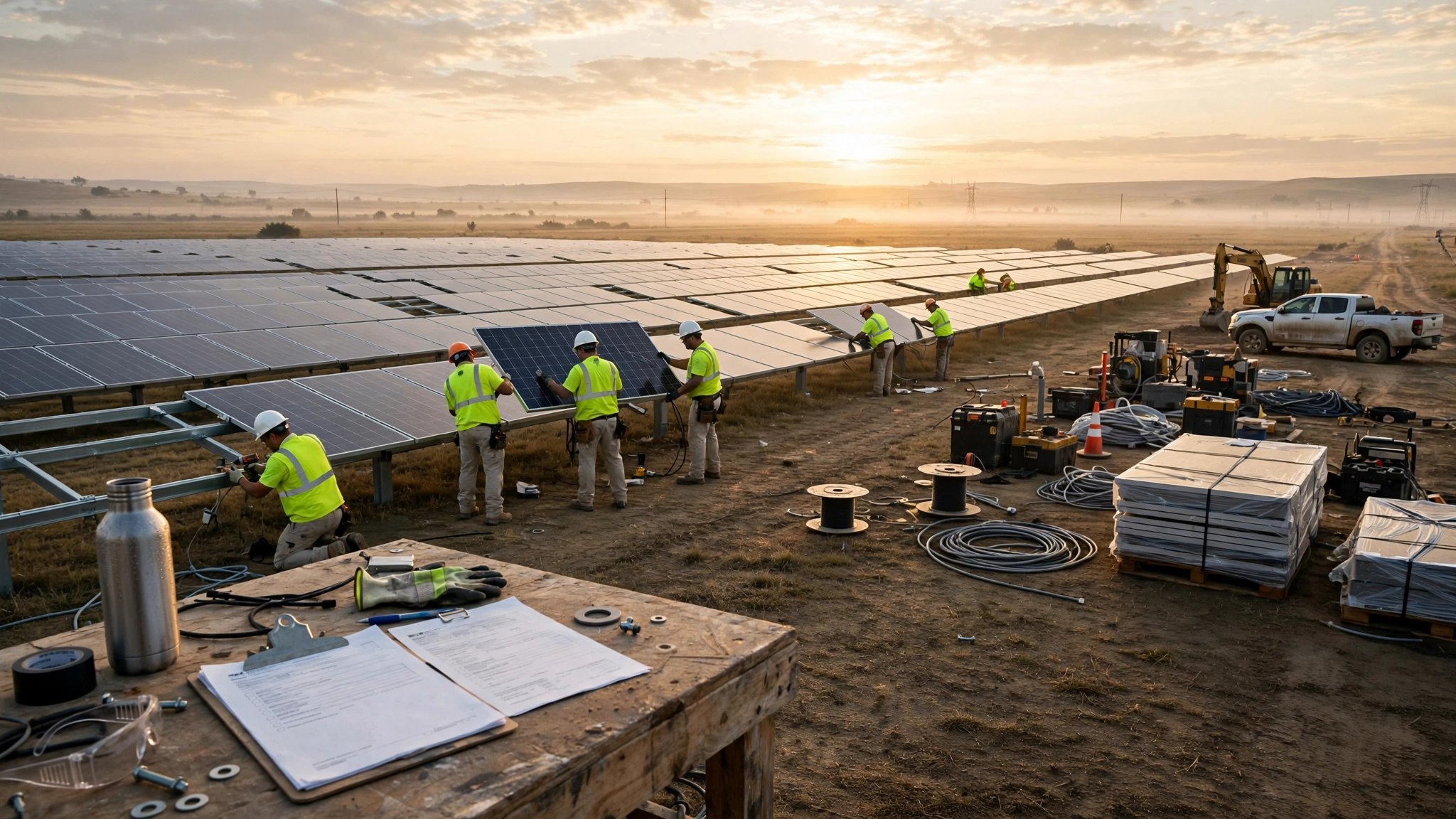
The Inflation Reduction Act gives clean energy projects a 5x tax credit multiplier for meeting prevailing wage and apprenticeship requirements: 30% instead of 6% for solar investment credits, a $24 million swing on a $100 million project. Every facility above one megawatt that broke ground after January 29, 2023, must comply or leave 80% of its credit on the table. Baker Tilly launched the only dedicated compliance platform in 2024, pairing a Big Four-caliber CPA engagement with LCPtracker's legacy payroll software at enterprise pricing. The 3,000-plus mid-market solar and wind contractors building the other 211 gigawatts in the six-year pipeline track apprentice labor hours in spreadsheets and prevailing wage rates in PDFs downloaded from a DOL website that frequently lacks the classification they need.
The Problem
The Inflation Reduction Act of 2022 is the largest energy incentive effort in U.S. history, directing more than $369 billion in clean energy tax credits through a two-tier rate structure that Congress designed to promote good-paying construction jobs. For projects with a nameplate capacity of one megawatt or more, the base investment tax credit (ITC) is just 6% of project cost. Meet the labor requirements and the credit jumps to 30%. The base production tax credit (PTC) is 0.55 cents per kilowatt-hour; meet the labor requirements and it becomes 2.75 cents. That is a 5x multiplier, and for a typical 100 MW utility-scale solar project costing $80-120 million, the difference between 6% and 30% is $19 to $29 million in federal tax credits.
The labor requirements have two pillars. First, prevailing wages: every laborer and mechanic on the project must be paid at or above the Davis-Bacon prevailing wage rate for their craft classification and county. These rates are published by the Department of Labor's Wage and Hour Division, but the database is incomplete. As Keith Martin, co-head of projects at Norton Rose Fulbright, told Bloomberg Law: "There are lots of instances we've run into already where there just aren't prevailing wages posted on the website." Clients have asked about rates for drill rig operations, offshore wind farms miles from shore, and projects on Guam. Each missing determination requires a formal request to the DOL, with no guaranteed response timeline.
Second, registered apprenticeships: a specified percentage of total labor hours on the project must be performed by apprentices from DOL-registered programs. The threshold started at 10% in 2023, increased to 12.5% in 2024, and reached 15% from 2025 onward. Contractors employing four or more workers must have at least one apprentice. If qualified apprentices aren't available, the contractor can document a "good-faith effort" exception by requesting apprentices from relevant programs and getting turned down, but the documentation requirements are specific and the burden of proof falls on the taxpayer.
Failure to comply isn't just an audit risk. The IRS has published a penalty cure mechanism: taxpayers can make correction payments (back wages plus interest plus a penalty amount per worker) to preserve the enhanced credit. But this requires knowing you have a problem before filing, calculating the underpayment by worker and pay period, and documenting the cure. Most mid-market contractors discover compliance gaps after the fact, when the numbers are already locked and the correction math becomes a forensic exercise.
Market Size
Original TAM calculation: According to SEIA's Q2 2026 Solar Market Insight Report, 211 GW of utility-scale solar will be added in the U.S. between 2026 and 2031, with 36.1 GW expected in 2026 alone. The EIA projects 43.4 GW of total new solar capacity in 2026 across all segments. Add battery storage (24 GW expected in 2026), onshore and offshore wind, EV charging infrastructure, hydrogen production, geothermal, and carbon capture, and the universe of IRA-eligible projects breaking ground each year exceeds 4,000 facilities above the 1 MW threshold.
The addressable market for a self-service compliance SaaS is the mid-market segment: EPC contractors, independent developers, and regional utilities managing 2 to 50 projects per year, who lack in-house tax compliance teams but manage projects large enough that losing the 5x multiplier would crater their economics. Based on SEIA member data and contractor registry counts from state apprenticeship agencies, we estimate 2,500 to 3,500 firms fit this profile. At a blended ARPU of $649/month (a $399/month platform subscription plus a $250/month per-active-project add-on for firms averaging 2.3 active projects), the base TAM is $27.2 million in annual recurring revenue.
A second revenue layer comes from compliance verification services for tax equity investors and transferability buyers. Since the IRA allows credit transferability, buyers of transferred credits need independent compliance verification before closing. A per-project verification report at $2,500 to $5,000, applied to the estimated 800 to 1,200 credit transfer transactions per year, adds a SAM of $2 to $6 million. Total realistic SAM: $33 million. Year 3 target: 400 contractor subscribers at blended $649/month plus 150 verification reports at $3,500 average = $4.7 million ARR.
The Product
A compliance management platform built specifically for the IRA's prevailing wage and apprenticeship requirements, covering the full lifecycle from project registration through tax filing substantiation. Core modules:
- Prevailing wage determination engine: Automatically maps each project site to the correct DOL wage determination by county, construction type, and craft classification. Monitors the DOL's wage determination database for updates and alerts contractors when rates change mid-project. Flags missing classifications and generates pre-formatted requests to the DOL Wage and Hour Division. Calculates blended rates for projects spanning multiple counties
- Apprentice hour tracker: Tracks total construction labor hours and registered apprentice hours in real time across all contractors and subcontractors on a project. Displays the running apprenticeship percentage against the 15% threshold with daily, weekly, and cumulative views. Alerts project managers when the ratio drops below target with enough lead time to request additional apprentices. Integrates with state apprenticeship agency databases to verify each apprentice's active registration status
- Good-faith exception documentation: When qualified apprentices are unavailable, generates the specific documentation the IRS requires: dated requests to each relevant registered apprenticeship program, responses (or documented lack of response after 5 business days), and a narrative justifying the exception. Maintains a database of registered programs by trade and geography so contractors know whom to contact
- Penalty cure calculator: When a prevailing wage or apprenticeship violation is discovered, calculates the exact correction payment by worker, pay period, and craft classification: the wage underpayment, interest at the underpayment rate, and the per-worker penalty ($5,000 for first-time, $10,000 for repeat). Generates the documentation package the IRS requires to accept the cure and preserve the enhanced credit
- Filing substantiation package: Produces the audit-ready documentation set that tax preparers need when claiming enhanced credits: certified payroll records, apprenticeship compliance reports, wage determination applicability memos, exception documentation, and cure records. Formatted for attachment to Form 8933 (carbon sequestration), Form 3468 (ITC), or Schedule 45-series PTC returns
Unit Economics
| Metric | Value |
|---|---|
| Monthly subscription (platform access per company) | $399 |
| Monthly per-project add-on (active projects) | $250 |
| Blended ARPU (avg 2.3 active projects) | $649/month |
| Per-project credit transfer verification report | $3,500 |
| Infrastructure cost per subscriber/month | $32 |
| DOL data integration cost per subscriber/month | $14 |
| Customer acquisition cost | $4,800 |
| Expected LTV (28-month avg retention, 93% gross margin) | $16,913 |
| LTV:CAC ratio | 3.5:1 |
| Gross margin | 93% |
| Startup cost (18-month runway) | $3.4M |
| Break-even | 22 months |
Methodology note: The 28-month average retention assumption reflects the multi-year construction timelines of utility-scale solar and wind projects (18 to 36 months from notice to proceed through commercial operation date). Once a contractor integrates compliance tracking into their project management workflow, switching costs are high because migrating mid-project risks data continuity and audit exposure. The CAC of $4,800 reflects B2B SaaS sales in a specialized vertical where SEIA conferences, regional solar trade associations, and Interconnection Queue user groups are the primary distribution channels. The LTV calculation: $649 x 28 months x 93% gross margin = $16,913. Payback period: 7.4 months. Gross margin of 93% reflects the software-plus-data model where the primary ongoing costs are DOL wage determination monitoring, state apprenticeship database integrations, and cloud infrastructure.
Go-to-Market
Phase 1 (months 1-8): Build the prevailing wage determination engine by ingesting and normalizing the DOL's publicly available wage determination database (sam.gov/wage-determinations) across all 3,143 U.S. counties and 200+ construction craft classifications. Launch with the prevailing wage lookup and apprentice hour tracking modules as a free tool for solar contractors, requiring only project registration and location data. Distribute through SEIA's state chapter networks and at the Solar Power International conference. Target 500 free-tier registrations in three states with the highest utility-scale solar pipeline: Texas, Florida, and California.
Phase 2 (months 9-16): Monetize with the $399/month platform subscription. Add the good-faith exception documentation module and penalty cure calculator. Integrate with popular construction payroll systems (Contractor Foreman, Gusto, ADP) to auto-import certified payroll data. Expand to wind, battery storage, and EV charging project types. Begin partnerships with regional tax equity investors who need compliance verification for credit transfers. Target: 150 paying subscribers.
Phase 3 (months 17-24): Launch the filing substantiation package generator and credit transfer verification service. Build integrations with LCPtracker and Lumber for firms already using those systems for general Davis-Bacon compliance (the IRA layer sits on top). Approach the top 20 tax equity investors (JP Morgan, Bank of America, US Bancorp) with an API for automated compliance verification on credit transfer transactions. Enterprise tier at $1,999/month for portfolio-level compliance dashboards. Target: 400 subscribers plus 150 verification reports.
Competitive Landscape
| Company | What It Does | IRA PW&A Compliance? | Pricing |
|---|---|---|---|
| Baker Tilly + LCPtracker | CPA-led compliance portal with legacy payroll tracking | Yes: the only dedicated IRA PW&A solution, but requires CPA engagement | Custom enterprise (est. $50K-200K/engagement) |
| LCPtracker Pro | Cloud-based prevailing wage certified payroll management | Partial: tracks prevailing wage payrolls, but not IRA-specific apprentice ratios or penalty cures | Custom pricing |
| Contractor Foreman | Construction project management with time tracking | No: tracks hours and basic Davis-Bacon, not IRA apprenticeship percentages or good-faith exceptions | $49/month |
| Lumber | AI-powered construction workforce management | No: handles general prevailing wage payroll and compliance, not IRA-specific credit protection | Free tier + custom |
| Miter Payroll | Construction payroll with prevailing wage automation | No: payroll processing only, no apprenticeship tracking or IRA compliance substantiation | $50/month + $6.50/employee |
| This startup | IRA-specific PW&A compliance lifecycle management | Core product: end-to-end IRA labor compliance from wage determination through tax filing substantiation | $399-649/month |
Baker Tilly's product is the instructive comparison. Their March 2024 launch announcement explicitly states: "It is widely misunderstood that these new requirements are similar to other federal rules such as Davis-Bacon and related acts. IRA requirements have specific features that are not incorporated into Davis-Bacon prevailing wage projects." They're right. The IRA's apprenticeship percentage threshold, good-faith exception pathway, penalty cure mechanism, and interaction with credit transferability are all novel regulatory constructs that existing construction payroll tools don't address. Baker Tilly solved this by wrapping a CPA practice around the technology. But their model prices out the mid-market contractor managing 3 to 10 projects: a $100,000 engagement makes sense when you're protecting $24 million in credits on a single 100 MW project, but not when you're a 40-person EPC managing a portfolio of 5 MW commercial rooftop installs where the per-project credit at stake is $400,000.
Why Now
Five forces are converging. First, the apprenticeship requirement just reached its maximum statutory threshold. The percentage of labor hours that must be performed by registered apprentices increased to 15% in 2025 and stays there indefinitely. At 10% in 2023, many contractors could meet the requirement by accident. At 15%, it requires active management, tracking, and documentation.
Second, the Trump administration is increasing compliance scrutiny while simultaneously promoting apprenticeship expansion. The DOL's March 2026 guidance aims to reach 1 million active apprentices (up from roughly 700,000 today), with Labor Secretary Chavez-DeRemer targeting 1.2 million by 2029. More apprentices in the system means more documentation to track. Meanwhile, the EPA's reform of clean energy programs signals stricter oversight of how federal clean energy dollars are spent, making compliance documentation more valuable, not less.
Third, credit transferability is creating a new compliance stakeholder. Since 2024, clean energy tax credits can be sold to unrelated taxpayers. Buyers of transferred credits have no direct visibility into the project's labor compliance and are buying the credit at a discount specifically because of compliance risk. Every transferred credit needs an independent compliance attestation, and the buyer's due diligence team needs structured data, not a box of timecards and a letter from the contractor's accountant.
Fourth, the solar installation pipeline is enormous and accelerating despite policy uncertainty. SEIA's Q2 2026 report projects 211 GW of utility-scale solar from 2026 to 2031, with Q1 2026 contracting activity up 15% year-over-year. Safe-harboring strategies mean many of these projects are locking in IRA-era credits even as future policy evolves. The projects in the pipeline today need compliance tracking for the next 2 to 4 years regardless of future legislation.
Fifth, EPC and labor availability constraints are forcing contractors to work with unfamiliar subcontractors and temporary workforce pools, making labor compliance harder to manage at the project level. SEIA's Q4 2025 report identified "limited EPC and labor availability as major impediments to further installation growth." When a general contractor brings on a sub they've never worked with to meet a construction deadline, they're inheriting that sub's prevailing wage and apprenticeship compliance posture without visibility into whether it meets IRA requirements.
Original Contribution: The Compliance Tax on Mid-Market Solar
A calculation nobody has published: Baker Tilly charges enterprise rates for IRA PW&A compliance. Based on comparable CPA advisory engagements for Davis-Bacon compliance on federal construction projects, the estimated cost of a full IRA PW&A compliance engagement ranges from $50,000 for a simple single-site project to $200,000+ for a multi-phase utility-scale facility with 20+ subcontractors. For a 100 MW project claiming $24 million in enhanced credits, that's 0.2-0.8% of the credit value, which is a sensible cost of compliance.
But apply the same cost structure to the mid-market: a 5 MW commercial rooftop solar project with a $5 million cost basis has an enhanced ITC of $1.5 million (30% of $5M) versus a base credit of $300,000 (6% of $5M). The enhanced credit at stake is $1.2 million. If the compliance engagement costs $50,000, that's 4.2% of the credit value. For a 2 MW community solar project with a $2.4 million cost basis, the enhanced credit at stake is $576,000 and a $50,000 compliance engagement eats 8.7% of the value. At some point, the cost of proving compliance exceeds the contractor's willingness to pay, and the rational decision is to claim the base credit and forfeit 80% of the incentive.
We estimate that mid-market projects (1-20 MW) represent roughly 40% of total IRA-eligible solar capacity but only 15% of current IRA PW&A compliance spending, based on Baker Tilly's enterprise focus and the absence of mid-market alternatives. If we assume 1,500 mid-market projects per year at an average forfeited credit enhancement of $800,000, the aggregate annual credit leakage from the mid-market segment is approximately $1.2 billion. A $399-649/month SaaS that reduces compliance costs by 80-90% versus a CPA engagement makes the math work for projects as small as 2 MW, potentially recovering hundreds of millions in credits that mid-market contractors currently leave on the table.
Limitations
Several weaknesses in this analysis need acknowledgment. First, the $50,000-$200,000 range for CPA-led compliance engagements is estimated from comparable Davis-Bacon advisory work, not from Baker Tilly's disclosed IRA pricing (which they don't publish). If Baker Tilly's actual pricing is significantly lower, the mid-market gap narrows. Similarly, if large EPC firms begin offering IRA compliance as a bundled service to their subcontractors, the addressable market of independent mid-market firms shrinks.
Second, the 15% apprenticeship requirement has a significant escape valve: the good-faith exception. If a contractor documents that they requested apprentices from relevant registered programs and none were available, they can still claim the enhanced credit without meeting the 15% threshold. In regions with robust apprenticeship programs (unionized Northeast, Pacific Coast), the 15% requirement is binding. In regions with sparse apprenticeship infrastructure (rural Southeast, Mountain West), the good-faith exception may be routinely available. If the exception becomes the norm rather than the exception, the compliance burden, and the market for compliance software, diminishes.
Third, the IRA's future under the current administration remains uncertain. While the core tax credits have survived due to bipartisan support (many clean energy investments are in Republican districts), the prevailing wage and apprenticeship requirements specifically have faced pushback from industry groups who argue they add cost and complexity. If Congress modifies or eliminates the labor requirements in future legislation, the entire compliance market disappears. The safe-harbor provisions protect existing projects, but the pipeline of new projects subject to PW&A requirements could shrink.
Fourth, the DOL's wage determination database is a government system with no public API. Scraping and normalizing it is technically feasible but creates a brittle dependency on a data source the startup doesn't control. If the DOL changes the database format, restricts access, or moves to a new system, the startup's core data pipeline breaks.
Strongest Counterargument
The most compelling case against this startup is that the general-purpose construction compliance tools will add IRA-specific features before a vertical startup can reach scale. LCPtracker already partners with Baker Tilly and has the prevailing wage data infrastructure. Lumber has an AI-powered platform with free entry pricing and deep integration into construction workflows. Contractor Foreman serves thousands of small contractors at $49/month. Any of these incumbents could add an "IRA compliance" module, import apprenticeship tracking logic, auto-calculate the 15% threshold, and ship it as a feature update rather than a standalone product.
This is the classic "feature vs. product" argument, and in construction software, features usually win. Construction contractors are notoriously resistant to adopting new software tools (the industry's technology adoption rate is among the lowest of any sector, according to McKinsey's construction productivity research). A contractor already using Contractor Foreman for time tracking, Gusto for payroll, and LCPtracker for certified payroll reporting will not welcome a fourth system for IRA compliance, no matter how specialized. They want one more column in their existing dashboard, not a new login.
The counterpoint is that the IRA's requirements are genuinely novel regulatory constructs. Baker Tilly's own partners acknowledge that IRA PW&A is "widely misunderstood" as equivalent to standard Davis-Bacon compliance. The apprenticeship percentage tracking, good-faith exception documentation, penalty cure calculations, and tax filing substantiation package are all IRA-specific workflows that don't exist in any general construction tool. An "IRA compliance module" bolted onto a payroll system is like bolting a tax return onto an accounting ledger: technically possible, but the regulatory complexity demands purpose-built logic. The question is whether the mid-market's pain is acute enough to justify a standalone tool, and whether the $24 million credit swing on large projects (scaling down proportionally for smaller ones) creates enough urgency to overcome construction's endemic resistance to new software.
The Bottom Line
The IRA created a $369 billion incentive structure where 80% of the credit value for every clean energy project above 1 MW depends on meeting labor compliance requirements that most of the industry's mid-market contractors track manually or don't track at all. The only purpose-built compliance solution is an enterprise CPA engagement that prices out the segment building most of the country's commercial solar, community solar, and small utility-scale projects. The compliance gap is not hypothetical: with the apprenticeship threshold now at 15% and credit transferability creating third-party verification demand, contractors who can't produce structured compliance documentation are either forfeiting millions in credits or accepting audit risk they can't quantify.
What You Can Do
If you're an EPC contractor or developer working on IRA-eligible projects above 1 MW: pull your certified payroll records from your last three projects and calculate the actual apprentice labor hour percentage. If you can't produce that number in under 30 minutes, you have a compliance documentation gap that puts your enhanced credits at risk. Next, check whether your prevailing wage determinations match the DOL's current published rates for your project county and craft classifications, not the rate from when the project started, but the rate published within the last 90 days (rates are updated periodically and mid-project changes require adjustment). If you're a construction payroll software company: the IRA compliance layer is a revenue expansion opportunity sitting on top of your existing data. The apprenticeship percentage calculation, good-faith exception workflow, and penalty cure math are three features you can build today that no competitor offers as a cohesive product. If you're a tax equity investor buying transferred IRA credits: demand structured compliance documentation, not a letter. The transferability market needs a standard format for PW&A attestation, and whoever defines that standard captures the verification fee on every transaction.
Related
📰 Construction Stormwater Compliance SaaS — another regulatory compliance gap in the construction industry where manual tracking creates project-level financial risk
📰 Heat Illness Compliance SaaS — OSHA's expanded outdoor worker protection rules creating a parallel compliance SaaS opportunity for the same mid-market construction contractors
📰 Workers' Comp Mod Rate Optimization SaaS — insurance cost intelligence for the same mid-market contractor buyer, demonstrating the depth of the vertical compliance SaaS opportunity in construction