A Federal Judge Ruled the Farmworker Pay Cut Illegal. The Replacement Is Due December 30, and 15,400 Employers May Owe Back Pay.
A federal judge ruled the Labor Department's 2025 wage cut unlawful and ordered a replacement by December 30, 2026. Employers who paid the lower rates may owe back pay, and no platform advertises software that tracks what anyone owes.
Washington cut the farm wage bill by $2.46 billion a year, a judge called it illegal, and 15,400 employers now face a December 30 deadline with a spreadsheet problem.
The Problem
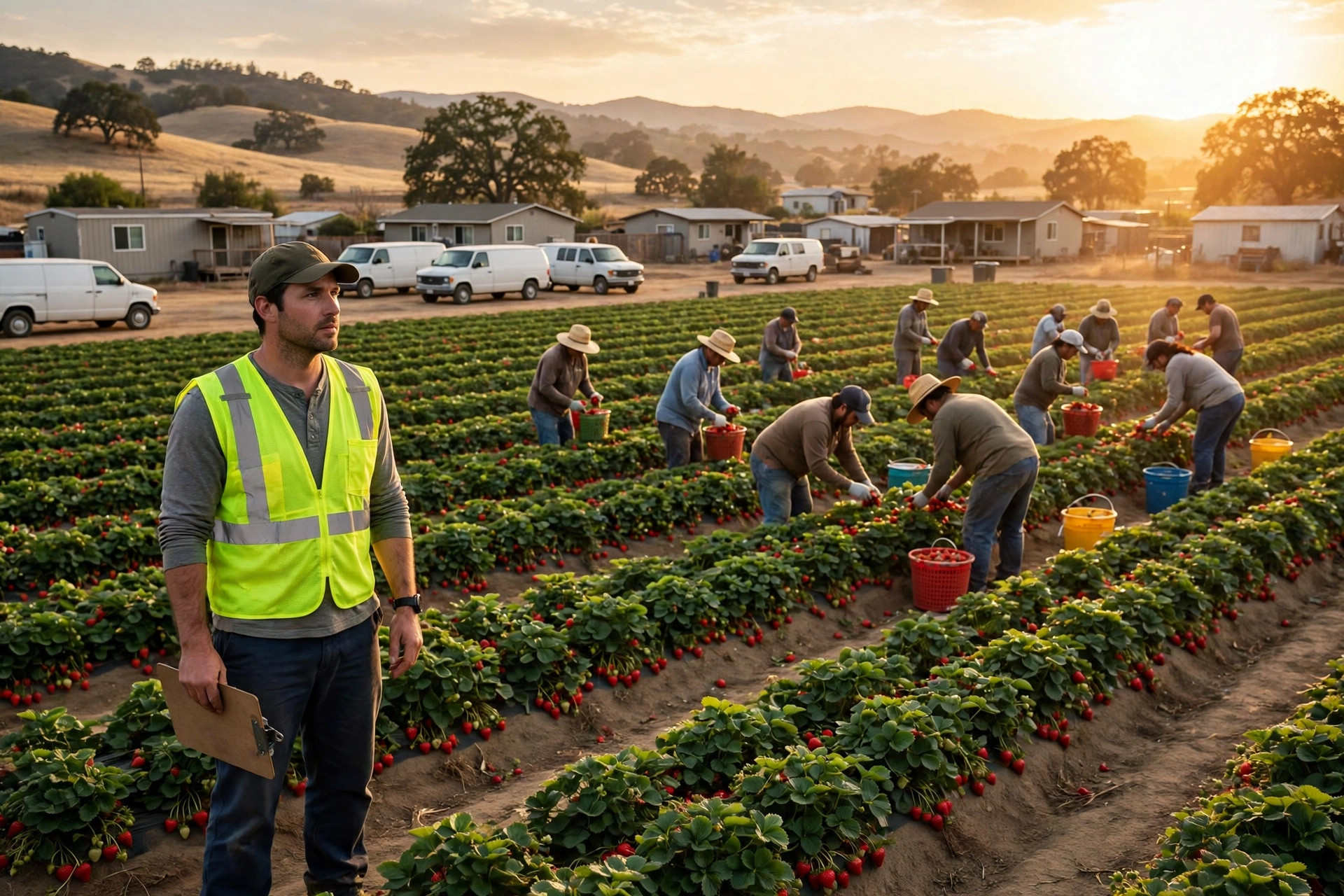
Every bag of strawberries, every crate of sweet potatoes, and every flat of nursery stock in an American supermarket depends on a workforce that barely exists on paper. Domestic farm labor has been shrinking for years, and growers fill the gap with the H-2A guest worker program, which lets employers bring in foreign nationals for temporary agricultural jobs after proving they tried and failed to recruit American workers. In fiscal 2025, the Labor Department certified 398,258 positions, 13,358 more than the year before, out of 415,496 requested, and the program has grown 185 percent in a decade. The department processed 24,526 applications from about 15,400 unique employers, with the typical employer filing one or two applications a year. Only 182 of the 415,000 advertised positions drew a domestic applicant, less than 0.04 percent. Nearly half the certifications sit in five states, Florida, Georgia, California, Washington, and North Carolina, and Florida alone accounts for 56,934 positions, 14.3 percent of the national total.
Getting those workers into a field is a paperwork marathon with hard deadlines. A grower files a job order 75 to 60 days before the workers are needed, then a labor certification application 45 days out, proves the housing has been inspected, recruits domestic workers first, and guarantees each worker at least three-fourths of the hours promised in the contract, a rule known as the three-fourths guarantee. Employers must also provide housing at no cost, reimburse inbound transportation once a worker completes half the contract, and pay at least the Adverse Effect Wage Rate, the wage floor meant to keep guest-worker pay from dragging down domestic wages. Getting it wrong carries back wages, civil penalties, and debarment from the program for up to three years, which for a grower with no other labor source is close to a death sentence. A 2024 Government Accountability Office report found violations in 84 percent of the Labor Department's H-2A employer investigations between fiscal 2018 and 2023, most commonly involving pay.
Most of the roughly 15,400 employers run this gauntlet with tools that would embarrass a 2015 bookkeeping firm. Job orders live in email threads with an agent. Housing inspections live as photos in a text message thread. Hours offered each day, the number the three-fourths guarantee turns on, live on paper timecards or a whiteboard in the packing shed. Payroll runs in a general-purpose system that has never heard of a guarantee, a piece rate, or a housing deduction. When the Wage and Hour Division shows up, and it does, the employer has days to reconstruct a season from binders.
The $2.46 Billion Pay Cut
On October 2, 2025, the Labor Department rewrote the wage floor in a single interim final rule, issued without the usual public comment period. It replaced the Farm Labor Survey, the twice-yearly survey whose results had set the Adverse Effect Wage Rate since 1987 and which the Agriculture Department terminated in August 2025, with the Bureau of Labor Statistics' Occupational Employment and Wage Statistics data. It split the rate into two skill levels, entry level at the 17th percentile of the wage distribution, a tier the department expected more than 90 percent of jobs to fall into, and experienced at the mean wage. And it added a housing deduction, the Adverse Compensation Adjustment, worth $0.71 to $3.18 an hour depending on the state in 2025, capped at 30 percent of the wage rate, on the theory that employer-provided housing has a cash value that can come out of pay.
For the workers, the rule was a pay cut dressed as a methodology update. The department's own filing priced the transfer at $2.46 billion a year from workers to employers, $17.29 billion over ten years, and projected about 119,000 additional H-2A hires because the labor got cheaper. The Economic Policy Institute estimated the cut at $2 billion or more, between 26 and 32 percent of affected workers' wages. In California, the minimum H-2A wage fell from $19.97 an hour to the $16.90 state minimum. In Florida, the experienced field rate came out around $12.77 to $13.41, down from $16.23. A worker on a six-month contract at the new rates takes home thousands of dollars less for the same harvest, money that would have gone to rent back home and remittances to family, and the housing deduction means the roof over their head is now itemized as a wage reduction. Because the visa ties the worker to the employer who sponsored them, complaining about the cut carries the risk of not being invited back next season, which is why the lawsuit that followed was brought by a union and 18 named workers rather than by the workforce at large.
On August 26, 2026, U.S. District Judge Kirk Sherriff of the Eastern District of California ruled in United Farm Workers v. U.S. Department of Labor that the rule was arbitrary and capricious and procedurally defective under the Administrative Procedure Act, because the department failed to show the new methodology would satisfy its legal duty to ensure H-2A employment does not adversely affect the wages of American workers. Rather than vacating the rule immediately and leaving the program without wage rates, he left it in place and ordered a replacement. His October 2, 2026 order requires a new interim final rule by December 30, 2026, and vacates the current rule effective that day whether or not a replacement is ready. On September 2, the department warned employers they may owe workers the difference between the current rates and the new ones once a revised formula is in place. California is not waiting: Governor Newsom signed AB 2646, setting a $19.75 hourly minimum for H-2A workers and the local employees working alongside them, starting January 1, 2027.
Here is the repricing math, with the labels kept honest. The department's earlier projection put the H-2A wage bill falling from about $7 billion a year to about $5 billion under the new methodology. Spread across the fiscal 2025 certification base, that works out as follows. Certified positions are seasonal jobs averaging about six months, not full-year employment, so read these as per-position-season figures:
| Wage bill | Total | Per certified position |
|---|---|---|
| Old methodology | ~$7.0 billion | ~$17,576 |
| New methodology | ~$5.0 billion | ~$12,555 |
| Difference | ~$2.0 billion | ~$5,022 |
Two caveats belong on that table. First, the $2.0 billion difference is the department's rounded projection; its own priced transfer in the rule filing was $2.46 billion a year, and independent estimates run higher, so treat $2 billion as the floor of the range, not the settled number. Second, filing at the wrong skill level misprices each worker by up to about $5,000 a season, which is the cost of the classification decision the software has to get right.
The Guarantee Math
Separate from the wage cut, there is a second way employers lose money, and it is the one the software catches first. A 12-week contract promising 40 hours a week is 480 hours, and the three-fourths guarantee means the employer must offer at least 360 hours or pay the shortfall. Suppose rain cuts a crew to 20 offered hours in each of three weeks. Offered hours land at 300, sixty short of the guarantee, and at a $15 wage the employer owes $900 per worker. Across a 50-worker crew that is $45,000, discovered at the end of the contract when the money is already spent.
Track hours offered, not just hours worked. The guarantee turns on offered hours, and a timecard that only records worked hours will not save you in an audit.
Software that tracks offered hours against the guarantee in week six, while the employer can still add shifts, is worth more than software that calculates the damage in week twelve. The same logic applies to the wage cut: software that accrues the gap between the rate paid and the rate a replacement rule might set, starting now, is worth more than a lawyer's letter in January explaining that the reserve should have existed.
The Gap in the Market
This is not an empty market, and any pitch that pretends it is will fail its first diligence call. Two real companies already serve it, and both shipped AI features in 2026.
Seso is the largest H-2A agency in the United States by Labor Department data, serves 45 of the 100 largest agricultural employers, and relaunched its platform on November 3, 2026 with Rootly, an AI assistant that answers questions about workers, contracts, and compliance status and can update records after approval. It bundles agency filing, onboarding, payroll, and compliance, and it is a technical assistance provider for the Agriculture Department's $50 million Farm Labor Stabilization and Protection Pilot Program.
Croft, born out of Purdue's agriculture college, calls itself the most-used H-2A platform in the country, claims to cut administrative time by more than half, and shipped a connector in June 2026 that lets employers query their own records through ChatGPT or Claude. Its Connect Plus tier covers housing assignments and inspections, timekeeping, and three-fourths guarantee pacing. Time Portal covers the narrower slice of agricultural time tracking, piece work, and hours offered.
What none of them serve is the long tail, and the long tail is most of the market by employer count. The typical employer files one or two applications a year through an agent, not a 5,000-worker operation with a back office. Farm labor contractors, who bring workers to farms they do not own, were certified to fill 44 percent of H-2A jobs in fiscal 2025, up from about 10,000 jobs in fiscal 2007 to more than 160,000 in fiscal 2023, a 16-fold increase. Contractors are also where enforcement concentrates: the biggest recent judgments all name contractors, not growers.
Three gaps follow. No platform advertises a wage engine built for a rule that changes by court order: two skill levels per occupation per state, a housing adjustment, state minimum-wage floors that override the federal rate in many states, a July 1 reset that reprices contracts mid-season, and now a replacement rule due December 30 that could restore higher rates and trigger back pay. Nobody owns the contractor workflow specifically: registration under the Migrant and Seasonal Agricultural Worker Protection Act, 29 U.S.C. § 1811 et seq., surety bonds, vehicle and driver compliance, multi-grower job orders, and housing spread across sites. And the field side is still English-first office software, while the people recording hours and housing conditions are Spanish-speaking crew leaders working offline in fields with no signal.
One distinction matters for how this company should talk about its customers. Some violations are inadvertent, a missed deadline, a misread wage table, a rain week nobody logged, and software genuinely prevents those. Others are deliberate: false statements under penalty of perjury, workers housed in moldy motel rooms, wages withheld. Software does not prevent deliberate underpayment, and a pitch that implies it does is selling absolution. The honest pitch is narrower: eliminate the inadvertent errors, make the deliberate ones visible faster, and give workers a confidential channel to report the second kind.
The Solution
A compliance platform built for the long tail of H-2A: small growers and farm labor contractors, sold through the agents who already file their paperwork, priced per worker-season instead of per seat.
Picture the field scene it has to survive. It is 6 a.m. in Salinas, fog still on the lettuce, and a crew leader with a cracked phone screen is marking who showed up, who was offered hours, and which housing unit has a broken heater. That phone has no signal until the crew gets back to the road. Every module below has to work in that scene first and in the office second.
Rule-versioned wage engine. Enter a job order's occupation, state, and skill requirements, and the engine returns the correct rate under each rule version that could apply: the October 2025 interim final rule while it remains in effect, the replacement rule when it lands on December 30, the pre-2025 methodology if the replacement restores it, and state floors like California's $19.75 AB 2646 minimum from January 1, 2027. Before filing, it simulates the wage bill at each skill level so the employer sees the cost of classifying a job as experienced rather than entry level. When new rates publish each July 1, it reprices every in-flight contract and flags the ones whose wage bill moved.
Back-pay reserve ledger. For every worker paid under the interim final rule, the ledger accrues the gap between the rate paid and the rate the worker would have earned under the prior methodology, updated as the replacement rule takes shape. The employer sees a reserve number in dollars, per worker and per contract, instead of discovering the exposure in a demand letter. This is the module that only exists because a judge set a deadline.
Three-fourths guarantee pacing. Crew leaders record hours offered each day from a phone, offline, in Spanish, with piece-rate entries where the job pays by the bin or the flat. A dashboard shows guarantee pacing per worker per contract, green while the employer is ahead, red the week a rain-shortened schedule puts the guarantee at risk, with a suggested number of extra shifts to close the gap. Payroll exports carry the guarantee calculation alongside gross pay, so the paystub an auditor asks for already contains the answer.
Housing and transportation ledger. Every housing unit gets a photo log with inspection dates, capacity, and assigned workers, plus a reminder to re-inspect before the next season rather than after a complaint. Transportation reimbursement is tracked per worker against the contract milestones, inbound after half the contract is complete and outbound at the end, with receipts attached. Vehicle assignments record driver licenses and inspection dates, because unsafe transport is one of the most common violations in the enforcement record.
Worker channel. A confidential, Spanish-first channel where workers can report housing problems, missed hours, or pay discrepancies without going through the crew leader, with reports routed to the employer and, at the worker's choice, to an advocate. This is both a product feature and a credibility test: a compliance platform that only serves the employer is a paperwork tool, and the market already has those.
Audit defense file. One click exports the entire season as the file a Wage and Hour investigator actually asks for: job orders, wage determinations under each rule version, daily hours offered, pay records, housing inspection photos, transportation reimbursements, and recruitment records, each timestamped and tied to the worker and contract it belongs to. For contractors, the export adds registration, bond, and multi-grower allocation records.
Agent back office. Agents file for dozens of small growers. Give them a multi-client view where each grower's filings, deadlines, and guarantee pacing sit in one queue, with the 75-day, 60-day, and 45-day filing deadlines counted down automatically. Agents become the distribution channel: they bring the growers, and the platform becomes the reason growers stay with the agent.
Revenue Model
Per-worker-season pricing, because a grower with 17 workers will not pay a $500 monthly seat fee for a tool used intensely for ten weeks a year:
| Tier | Who | Annual Price | Includes |
|---|---|---|---|
| Grower | 1 job order, up to 25 workers | $1,800 | Wage engine, guarantee pacing, housing log |
| Grower Plus | Up to 3 job orders, 100 workers | $4,800 | Plus audit file, back-pay ledger, transportation ledger, agent sharing |
| Contractor | Unlimited, multi-grower | $18,000 | Plus MSPA registration, bond tracking, fleet compliance, worker channel |
Add-on revenue includes filing assistance at $600 per application, which agents can white-label, and an audit-defense review at $2,500 per season for employers facing an active investigation. At $600, filing assistance undercuts the cost of a single hour of a missed deadline, which can mean losing the entire season's workforce.
Market Size
Build the market from the employer count, then cross-check it against the wage bill. The tier mix below is an assumption, not a published distribution, and it is shown so the arithmetic can be checked:
| Segment | Share of employers | Employers | Price | Contribution |
|---|---|---|---|---|
| Small growers | 60% | 9,240 | $1,800 | $16.6M |
| Mid-size growers | 30% | 4,620 | $4,800 | $22.2M |
| Contractors / large | 10% | 1,540 | $18,000 | $27.7M |
| Total | 100% | 15,400 | $4,320 blended | ~$66.5M |
That gives a TAM of about $66.5 million across roughly 15,400 employers at a blended $4,320 a year. Cross-check: one percent of the roughly $7 billion H-2A wage bill under the old methodology is $70 million, and one percent of the roughly $5 billion bill under the new methodology is $50 million, so $67 million sits inside the plausible range rather than outside it.
Restricting to the five states that account for about half of all certifications, Florida, Georgia, California, Washington, and North Carolina, gives about 7,700 employers and a SAM of about $33 million. Certification share is a proxy for employer share here, since the Labor Department does not publish an employer count by state, and the true state distribution will differ somewhat.
Year-three realistic capture at 3 percent of SAM is about $1.0 million in subscription ARR from roughly 230 accounts, with filing assistance adding several hundred thousand more if 5 percent of the 24,526 annual applications attach at $600. That is a modest venture outcome on subscriptions alone, and the honest read is that this is a $10 to $20 million ARR business at maturity, not a $100 million one, unless the program expands to year-round jobs in dairy and livestock, which the October 2025 rule explicitly did not do, or the same rule-versioned engine extends to other guest-worker programs with the same wage-floor mechanics.
A note on the program numbers, because three different figures describe the same year and they do not match. In fiscal 2024, the department certified 384,900 positions, the State Department issued 315,328 visas, and the Economic Policy Institute estimated 352,682 workers. Positions are job slots approved, visas are admissions, and the worker estimate counts people, including those continuing with the same employer or changing employers, so the three numbers describe different things and should not be expected to agree.
Why Now
Five forces converge, and the first one has a date on it: December 30, 2026, fifty days from now.
A judge set a deadline, and the wage floor is unknowable until it passes. The interim final rule stays in effect until December 30, then it is vacated whether or not a replacement is ready. Employers who paid the lower rates for a full season may owe the difference, and the department has already warned them so. Every grower filing for the 2027 season needs software that prices three rule versions at once and accrues a back-pay reserve. No platform advertises that yet, because until August 26 the rule looked permanent.
The program keeps growing into the gap. Certifications reached a record 398,258 in fiscal 2025, and early fiscal 2026 filings are running ahead of the year before, putting the program on track for another record, while domestic farm labor keeps shrinking and the Farm Labor Survey that anchored the old system no longer exists. Growth plus a rule change is the classic window for a new vendor.
Enforcement makes the audit file a sales pitch. A Santa Maria contractor was ordered to pay $558,298 in back wages to 649 workers plus $475,211 in penalties after three investigations found underpayment, missed guarantees, and false statements under penalty of perjury. In North Carolina sweet potatoes, investigators found violations in 92 percent of 14 investigations in fiscal 2022 and 2023. An employer who has watched a competitor get debarred does not need to be sold on documentation.
States are moving alone, which multiplies the rules. California's AB 2646 sets a $19.75 floor from January 1, 2027, on top of whatever the federal replacement rule says. Every state that follows adds another wage version the software must track, and multi-state employers are the ones who feel it first.
The incumbents just proved the category and priced themselves at the top. Seso and Croft both shipped AI assistants in 2026, which validates that growers will pay for software that reads regulations. Both sell top-down to large employers. Neither is built for a 17-worker grower in Georgia who files through an agent, and neither advertises a rule-versioned repricing engine or a back-pay ledger. That is the opening, and it closes the moment one of them ships the module or buys a startup that did.
Startup Costs
Estimated seed-stage capital requirement: $1.9 million, broken across engineering for the wage engine, mobile field app, and filing workflow over 12 months ($1.05 million), the rule-versioned wage engine and Labor Department filing integration ($250,000), immigration counsel to keep the rules engine accurate ($200,000), go-to-market through agents in Florida and Georgia ($250,000), and operations and overhead ($150,000).
First-year target: 120 paying accounts, mostly small growers in Florida and Georgia, generating about $520,000 in ARR at the blended contract value, with break-even at approximately 440 accounts, achievable in 24 months if the agent channel works. If the agent channel does not work, the direct sales cost to reach 15,400 scattered small growers will eat the company, which is the single biggest execution risk.
Risks and Limitations
This analysis relies on fiscal 2025 program data, the most recent full year the Labor Department has published, and on the department's own estimates of the wage cut rather than published replacement rates. Several assumptions deserve scrutiny:
The replacement rule is unknown, and the ruling already happened. The central risk in the first draft of this idea, that a court might strike down the 2025 rule, has already materialized. What the replacement says, when it lands, and whether it restores the old survey-based rates is unknowable until December 30. If the replacement restores a single rate, the repricing moat shrinks, and if the department misses the deadline, the wage floor is uncertain until a court or Congress resolves it. A product built on rule versioning survives either outcome; a product built on the 2025 rule alone does not.
Back pay may never be ordered. The department has warned employers they may owe the difference, but back pay has not been ordered. Treat the reserve ledger as insurance against a real but uncertain liability, not as a certain receivable for workers.
Pricing is assumed, not observed. Neither Seso nor Croft publishes pricing, so the $1,800 to $18,000 tiers are estimates based on comparable vertical compliance software. If the incumbents charge far less, or bundle the software free with agency services, the blended $4,320 contract value is too high and the TAM falls with it.
The long tail may not buy software at all. Small growers file through agents precisely because they do not want to manage compliance themselves. A tool sold to the grower competes with the agent's service; a tool sold to the agent competes with the agent's existing workflow. Either way the buyer is not the person with the problem, and that is a harder sale than it looks on a spreadsheet.
Seasonality creates churn. H-2A filing is intensely seasonal, with about 40 percent of certifications landing in the January to March quarter. A subscription priced annually needs off-season value, audit preparation, housing maintenance logs, rehire lists for next season, or it will churn every winter like a beach-town gym membership.
The filing system has no public API advertised. The Labor Department's FLAG system is a web portal, and no public API is advertised for it, so integration means form automation against a government website that changes without notice. That is a permanent maintenance tax and a single point of failure for the filing workflow.
The Strongest Case Against
Seso and Croft already won this market, and a new entrant's wedge is a feature, not a company. Seso is the largest H-2A agency in the country, serves 45 of the 100 largest agricultural employers, and just relaunched with an AI assistant that can update records. Croft is the most-used platform, cuts administrative time by more than half, and already connects to the AI assistants employers use. Both have the agent relationships, the employer data, and the engineering teams to ship a rule-versioned wage module in a quarter. When they do, the startup's entire pitch becomes a checkbox on an incumbent's pricing page, and the long-tail growers the startup wanted will buy the module from the vendor their agent already uses.
This is the classic vertical SaaS question, and the honest answer is that the startup's survival depends on a bet about distribution, not product. The bet is that small growers buy through agents, agents want a multi-client back office rather than a single-employer platform, and neither incumbent will build agent tooling before the startup becomes the default back office for a hundred agents in Florida and Georgia. If Seso decides its agency business is the distribution channel and starts licensing its platform to independent agents, or if Croft ships a multi-client agent tier first, the window closes. There is a second way the window closes: if the December 30 replacement rule restores a single, stable wage rate, the rule-versioning moat evaporates and the product is back to competing on guarantee pacing and housing logs alone. A founder entering this space should assume 12 months, not 24, before the incumbents respond, and should measure success by agents signed, not growers, because agents are the moat.
What You Can Do
If you are building this: start with the repricing engine, not the full platform. A free calculator that takes a job order and returns the correct wage under the current rule, the prior methodology, and the state floor side by side is the lead magnet every agent will link to during the 2027 filing season. Build the agent back office second, because one agent with 40 growers is worth forty direct sales calls. Hire the immigration counsel before the second engineer, because a wrong wage rate is a liability, not a bug.
If you are a small grower using H-2A workers: ask your agent to show you the Skill Level I and Skill Level II rates for your job order side by side before you file, and ask what the December 30 replacement could do to your contract. Track hours offered, not just hours worked, every single day, because the three-fourths guarantee turns on offered hours and a paper timecard that only records worked hours will not save you in an audit. Photograph every housing unit before workers arrive and keep the photos with the inspection date. And set aside the difference between what you paid under the 2025 rule and what the prior methodology would have required, as a reserve against possible back pay, rather than spending it as savings.
If you work at the Labor Department: the FLAG portal is the bottleneck for 15,400 employers and every agent who files for them. A read-only API for wage determinations and filing status would do more for compliance than any enforcement action, because the employers who make inadvertent errors are the ones who cannot see the rules clearly in the first place. That is not a substitute for enforcement against deliberate violations, which the record shows are common, but it is the cheapest way to shrink the inadvertent kind.
The Bottom Line
America's fruit and vegetable harvest now runs on 398,258 certified guest-worker jobs, and the wage math underneath them changed twice in thirteen months: once by rulemaking, once by court order. The cut was worth $2.46 billion a year to employers and the same amount out of workers' pay. A judge ruled it unlawful, the replacement is due December 30, back pay may follow, and California has already set its own $19.75 floor for January. A compliance platform that prices every rule version correctly, paces the three-fourths guarantee in the field, accrues a back-pay reserve, and exports an audit-ready file is a $66.5 million market with a window measured in weeks, not years. After that, the incumbents will have shipped the same module, and the window will be a case study instead of a company.
Related
📰 Heat Illness Compliance SaaS: the same regulatory wave for outdoor worker safety, applied to temperature instead of air quality
📰 Farmland Lease Rate Intelligence: the land side of the same farm economics, where the regulated number is the rent instead of the wage
📰 Pollination Contract Intelligence SaaS: another seasonal, deadline-driven farm contract where the paperwork is the product