Stored Grain Monitoring SaaS for Independent Farms
American farms hold 13.63 billion bushels of on-farm grain storage capacity worth over $60 billion at current prices. As of December 2025, capacity utilization hit 80%, the highest level in recent USDA records. Yet the majority of those bins are monitored the same way they were in 1975: a farmer climbs a ladder, sticks a thermometer in the grain, and hopes nothing went wrong since last time. A single undetected hotspot in a 30,000-bushel corn bin destroys $124,500 worth of grain. A wireless sensor subscription costs $300/year.
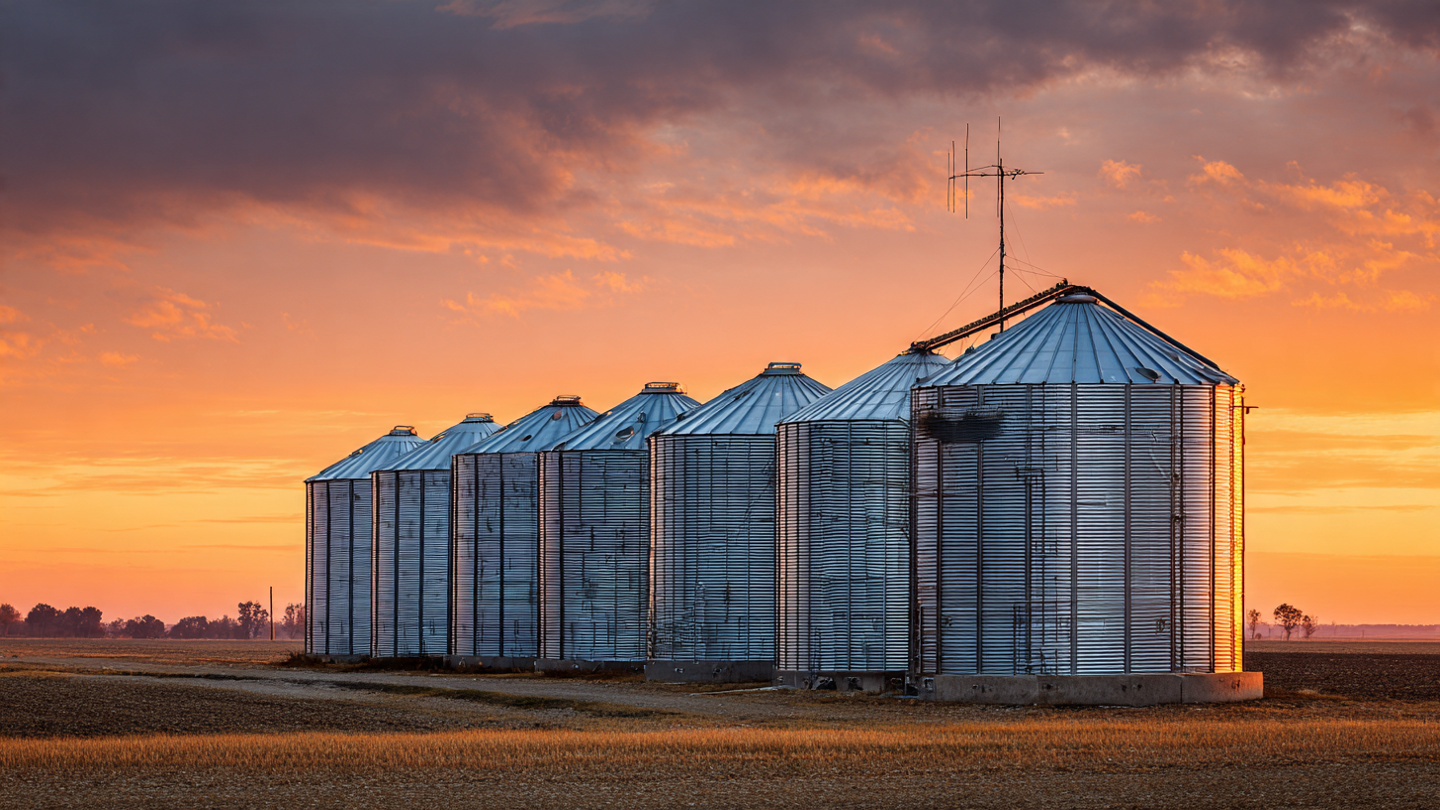
The Problem
The United States stores more grain on farms than any other country. According to USDA NASS data cited by the National Corn Growers Association, on-farm storage capacity stood at 13.63 billion bushels as of December 1, 2024, with an additional 11.85 billion bushels in off-farm commercial facilities. Total: 25.48 billion bushels of storage infrastructure across the country.
That infrastructure is under pressure. A February 2026 analysis from the University of Illinois farmdoc program documented a troubling divergence: between 2000 and 2019, US grain storage capacity grew by an average of 349 million bushels per year, roughly tracking production increases. Since 2020, capacity growth has effectively stopped, adding only 337 million bushels in six years total. Meanwhile, the 2025 US corn crop hit a record 17.02 billion bushels. On-farm capacity utilization reached 80% as of December 1, 2025, meaning bins are fuller than they've been in years.
Fuller bins stored longer create more spoilage risk. Grain is a biological material. Stored corn above 15% moisture at temperatures above 60°F develops mold within weeks. Insect infestations can start from a single hotspot and spread through an entire bin. The standard defense is aeration: running fans to push cool, dry air through the grain mass. But aeration only works when the operator knows conditions are deteriorating. By the time grain smells musty or clumps visibly, the damage is already extensive.
The monitoring methods most independent farms use have barely changed in decades. Temperature cables, if installed at all, were strung during original bin construction and read manually. Many operators simply don't monitor at all. They check bins when they have time, which during planting and harvest seasons means rarely. Purdue University's Agricultural Safety and Health Program documented 27 grain entrapments in 2023 alone, with 29 total fatalities from agricultural confined space incidents that year. Climbing into bins to check grain isn't just inconvenient. It kills people.
The Gap in the Market
Grain monitoring technology exists. But the current market splits into two camps, and neither serves the independent farmer with 5-20 bins well.
| Company | What They Do | What's Missing |
|---|---|---|
| OPI Systems (BinSense) | Canadian company, established 1990s. Wired temperature cables installed inside bins during construction, connected to cloud dashboard. Industry standard for new commercial installations. | Retrofit nightmare. Cables must be installed when the bin is empty and require professional wiring. Cost: $1,500-5,000+ per bin. Not practical for a farmer adding monitoring to existing, full bins. |
| TeleSense | VC-backed startup ($16.7M raised through 2020 Series B). Wireless sensors with spoilage prediction algorithms. Has commercial elevator customers. | Focused on commercial elevators and large operations, not independent farms. Hardware still runs $800-2,000+ per bin at retail. No self-serve onboarding for a farmer who wants to order sensors for five bins and start tomorrow. |
| GSI / AGCO | Major grain equipment manufacturer. Sells monitoring as add-on hardware bundled with their bin systems and dryers. | Locked to GSI equipment ecosystem. If your bins are Brock, Sukup, or Westeel, you're out of luck. Monitoring is a hardware upsell, not a standalone service. |
| Amber Agriculture | Startup that developed GrainTruth wireless sensor for on-farm bins. Won awards at CES. Focused on farmer-friendly design. | Limited commercial traction. Small team, narrow distribution. No integrated grain marketing or aeration control features. Proved the concept but hasn't scaled. |
The pattern: established players sell expensive hardware through dealer networks, and startups chase the commercial elevator market where deal sizes are larger. The independent farmer with $300,000 of corn sitting in five bins has no turnkey option to buy wireless sensors online, install them without an electrician, and get a phone alert when bin #3 starts heating up.
The Solution
A vertically integrated hardware + SaaS platform for on-farm grain monitoring, built for self-service and priced for individual operations:
1. Wireless retrofit sensors ($149-249 per bin): Battery-powered units that drop into existing bins through roof hatches. Temperature and relative humidity sensors on a cable, CO2 sensor at the headspace (CO2 is the earliest indicator of biological activity in stored grain, detectable before temperature rises). No wiring, no electrician, no emptying the bin. Install in 20 minutes per bin. University of Arkansas research has demonstrated CO2 monitoring as an effective early spoilage indicator that outperforms temperature-only systems.
2. Cellular gateway ($199, one per farm): A weatherproof base station that collects sensor data via low-power radio (LoRa) and transmits to the cloud over LTE-M. Range: 1+ mile, covering even spread-out farmsteads. No Wi-Fi dependency, which matters because most grain bins are 200+ yards from the farmhouse.
3. Monitoring dashboard + mobile app ($25/bin/month during storage season): Real-time temperature, humidity, and CO2 readings for every bin. Configurable alerts when any reading crosses thresholds. Grain condition scoring that translates raw data into plain language: "Bin 3 corn is stable" or "Bin 5 soybeans showing early moisture migration, run aeration fans." Storage season billing: farmers pay only for months when bins contain grain (typically September through May in the Corn Belt).
4. Aeration control integration ($99/bin add-on hardware): Smart relay that connects to existing aeration fans. The system triggers fans automatically when ambient conditions are optimal for cooling or drying, and shuts them off when humidity would add moisture. Saves electricity (farmers often run fans 24/7 "just in case") and optimizes grain conditioning without manual intervention.
5. Grain marketing intelligence layer (included in subscription): This is where the platform moves beyond monitoring into decision support. The system knows the condition and quantity of grain in each bin. It cross-references local basis data, futures prices, and storage cost calculations to show the farmer: "Your bin 2 corn is in good condition. At current basis of -$0.35 and December futures of $4.45, holding until January has historically improved net price by $0.12-0.18/bushel on this quantity. Estimated gain from waiting: $1,800-2,700." No farmer has this calculation automated today. They check the local elevator price, check CME on their phone, and guess.
The Math: What a Hotspot Actually Costs
Take a typical central Iowa corn operation. Five bins, each holding 30,000 bushels. Total stored: 150,000 bushels at $4.15/bushel (USDA WASDE, April 2026 farm gate price). Total value in bins: $622,500.
Scenario A: No monitoring (status quo)
Farmer checks bins monthly during winter. A moisture migration hotspot develops in bin 3 during a February warm spell. By the time the farmer checks in March, 4,000 bushels (13% of the bin) have caked and developed visible mold. Damaged grain is docked $0.50-1.00/bushel at the elevator, or rejected entirely. Loss at midpoint dock: 4,000 × $0.75 = $3,000. If rejected entirely: 4,000 × $4.15 = $16,600. This scenario plays out on thousands of farms every year. Industry sources estimate 2-5% average post-harvest storage losses in developed countries, though USDA does not publish a definitive US figure.
Scenario B: Wireless monitoring with auto-aeration
System detects CO2 spike in bin 3 headspace on February 8, three weeks before temperature cables would register the change. Sends push notification to farmer's phone. Aeration controller kicks on automatically, drawing cold February air through the hotspot. Grain temperature drops 12°F in 48 hours. Hotspot neutralized. Zero bushels lost.
Annual cost of monitoring 5 bins:
Sensors: 5 × $199 = $995 (one-time, amortized over 5 years = $199/year). Gateway: $199 (one-time, amortized = $40/year). Subscription: 5 bins × $25/month × 9 months = $1,125/year. Aeration relays: 5 × $99 = $495 (one-time, amortized = $99/year). Total annual cost: $1,463.
One prevented hotspot saves $3,000-16,600. ROI: 2-11x in year one. Over the five-year hardware lifecycle, preventing even one moderate spoilage event per year returns $15,000-83,000 on a $7,315 total investment.
But spoilage prevention is only half the value. The aeration optimization alone saves money. Farmers running fans continuously during storage spend $0.02-0.04 per bushel per month on electricity (Colorado State Extension). Smart aeration, running fans only when conditions are right, cuts energy use by 40-60% based on university extension research. On 150,000 bushels stored 9 months: baseline electricity cost of $27,000-54,000. Savings at 50% reduction: $13,500-27,000/year. The monitoring subscription more than pays for itself on electricity savings alone, before counting a single prevented bushel of spoilage.
Revenue Model
| Revenue Stream | Amount | Notes |
|---|---|---|
| Sensor hardware (per bin) | $149-249 | 65% gross margin at scale. Drop-in wireless, battery lasts 3+ years. |
| Gateway (per farm) | $199 | One per farm. LTE-M cellular with prepaid data. |
| Monthly monitoring SaaS | $25/bin/month | Storage season billing (typically 9 months). Includes dashboard, alerts, grain marketing data. |
| Aeration control add-on | $99 hardware + $10/bin/month | Smart relay + automated fan control. High-margin software layer. |
| Grain marketing premium tier | $49/month (farm-level) | Basis tracking, sell signal alerts, storage ROI calculator. Phase 2 product. |
Unit economics on a 5-bin farm: Hardware revenue at initial sale: 5 × $199 + $199 gateway + 5 × $99 aeration = $1,689 at ~60% gross margin. Annual recurring SaaS: 5 × $25 × 9 months + 5 × $10 × 9 months = $1,575/year at 85%+ margin. Customer acquisition cost via farm shows, dealer partnerships, and extension service referrals: ~$600. LTV at 5-year average hardware lifecycle with subscription retention: $7,875 SaaS + $1,013 hardware margin = $8,888. LTV:CAC ratio: 14.8x.
Market Size
TAM: USDA reports 13.63 billion bushels of on-farm storage capacity. Assuming an average bin size of 20,000 bushels, that implies approximately 680,000 on-farm bins across the US. At $25/bin/month × 9 months = $225/bin/year in SaaS alone: $153M/year recurring. Adding hardware sales and premium tiers: ~$250M total addressable.
SAM: Focus on the Corn Belt (Iowa, Illinois, Indiana, Minnesota, Nebraska, Ohio), which holds 59% of on-farm capacity. Approximately 400,000 bins on operations large enough to justify the investment (over 50,000 bushels total storage). At $225/bin/year: $90M/year.
SOM (year 3): 8,000 bins across 1,600 farms at blended $225/bin/year = $1.8M ARR, plus ~$1.2M in cumulative hardware sales. 2% penetration of SAM.
Why Now
The storage crunch is real and getting worse. Farmdoc's analysis shows that if storage capacity had continued its pre-2020 growth rate, the US would have 27.5 billion bushels of capacity today instead of 25.5 billion. That 2-billion-bushel gap, combined with record 2025 corn production, means farmers are filling bins higher and storing longer than planned. Higher utilization = higher risk = greater willingness to pay for monitoring.
Low crop prices make every bushel matter more. Corn at $4.15/bushel is near 5-year lows. When prices were $6-7/bushel in 2022, losing 2% of stored grain was painful but survivable. At $4.15, that same 2% loss cuts deeper into already thin margins. Farm income pressure makes the ROI argument sharper.
Cellular IoT infrastructure finally covers rural America. LTE-M and NB-IoT networks from AT&T, T-Mobile, and Verizon now cover over 90% of US agricultural land. Five years ago, getting reliable cellular data from a grain bin two miles from town was unreliable. Today, low-power wide-area networks make $5/month cellular per device economically viable.
The average farmer is 58 years old. The 2022 USDA Census of Agriculture reports the average age of US farm operators at 58.1 years. Climbing grain bins is physically demanding and dangerous. Older operators will pay a premium for a phone-based alternative to a 40-foot ladder and a confined space.
Startup Costs
| Category | Cost | Notes |
|---|---|---|
| Hardware engineering (sensor + gateway, 8 months) | $280K | 2 embedded engineers + 1 RF/antenna specialist. LoRa radio, CO2/temp/RH sensors, weatherproof enclosure, FCC certification. |
| Software platform (dashboard + mobile app, 6 months) | $180K | 1 backend + 1 frontend + 1 mobile developer. Cloud infrastructure, alerting, grain condition algorithms. |
| Initial hardware manufacturing run (500 sensor units + 100 gateways) | $75K | Contract manufacturing. First production run for pilot program. |
| Pilot program (50 farms, subsidized hardware) | $30K | Free sensors for first 50 farms in exchange for feedback and case study rights. |
| Farm show presence (year 1) | $25K | Farm Progress Show, Commodity Classic, state corn grower meetings. Booth, travel, demo units. |
| Regulatory / certifications | $20K | FCC Part 15 for sensor radio, UL listing for aeration relay. Required for commercial sale. |
| Operating buffer (12 months) | $40K | Cloud hosting, cellular data plans, support staffing. |
| Total | $650K |
Limitations
The 680,000-bin TAM estimate is derived from dividing 13.63 billion bushels of on-farm capacity by an assumed average of 20,000 bushels per bin. USDA reports total capacity but not bin count. Actual bins range from 5,000-bushel units on small operations to 100,000+ bushel commercial-scale structures. If average bin size is 30,000 bushels, the addressable bin count drops to ~450,000 and the TAM shrinks proportionally.
The 2-5% spoilage loss figure is widely cited in extension literature but not tracked systematically by USDA for US on-farm storage. Actual losses vary enormously by region, crop, and management practice. A well-managed operation in cool, dry North Dakota may experience near-zero storage losses in most years. A poorly ventilated bin in humid Missouri could lose 10%. The average masks significant variance, and many well-managed farms may not see enough spoilage to justify the subscription.
The electricity savings calculation ($13,500-27,000) applies to a large 150,000-bushel operation running aeration continuously. Smaller farms with 30,000-50,000 bushels of total storage would see savings of $2,700-9,000, which still exceeds the monitoring cost but is a less dramatic number. The math works best for operations above 50,000 bushels of total storage.
CO2 monitoring as a spoilage predictor is supported by university research but is not yet standard practice. The technology works in controlled studies; field reliability across varied grain types, moisture levels, and environmental conditions needs larger-scale validation.
Strongest Counterargument
John Deere could do this as a rounding error. Deere already owns the farmer relationship through equipment, precision ag software (the Operations Center platform), and dealer networks covering every county in the Corn Belt. They acquired Harvest Profit in 2022 for grain marketing tools. They have more data on farm operations than any startup will accumulate in a decade. If stored grain monitoring becomes a meaningful market, Deere can add a sensor SKU to their dealer catalog, integrate it into Operations Center, and reach 100,000 farms through existing relationships. Their cost of customer acquisition for an add-on product is effectively zero.
The counterpoint: Deere has been aware of on-farm grain monitoring for years and hasn't built or acquired a product. Their business model is equipment sales and precision ag subscriptions tied to field operations (planting, spraying, harvesting). Post-harvest grain storage is adjacent but outside their core workflow. Deere's Operations Center is about maximizing yield in the field, not managing grain in the bin. Building reliable IoT hardware for a harsh environment (metal bins, grain dust, extreme temperatures, lightning exposure) is a different engineering challenge than building GPS-guided tractors. And Deere's dealer network, while massive, is optimized for selling $400,000 combines, not $200 sensors. The channel incentives don't align well for a low-ASP hardware product. That said, if a startup proves the market, Deere's acquisition interest is virtually guaranteed, which is either a risk or an exit strategy depending on your perspective.
What You Can Do
If you're a farmer storing grain this fall: Before harvest, climb each bin (safely, with a harness and spotter) and check the condition of any existing temperature cables. If cables are broken or absent, the minimum viable investment is a wireless temperature probe like the Bin-Sense Plus ($600-900 per bin). If that's too much, buy a 36-inch grain probe thermometer ($40) and check every bin weekly from October through April. The goal is to catch hotspots before they spread. Set a phone reminder. "Check bins" is the most profitable 30 minutes you'll spend all winter.
If you're an ag-tech builder: Start with 10 pilot farms in central Iowa during the 2026 harvest season. The hardware MVP is a wireless temperature/humidity sensor ($30 in BOM at prototype volumes), a LoRa gateway, and a web dashboard. Skip CO2 and aeration control for v1. Get the data flowing and the alert system reliable. University extension agronomists are your best early distribution channel: they are trusted advisors who visit farms regularly and would welcome a tool that reduces the "go check your bins" conversations they repeat every winter.
If you're an investor evaluating ag-IoT: The stored grain management space is pre-category. No startup has achieved meaningful market share among independent farm operators. TeleSense raised $16.7M and focused on commercial elevators. The independent farm market (400,000+ bins, $90M SAM) remains essentially unaddressed. The unit economics are strong (14.8x LTV:CAC), the regulatory tailwind is real (higher capacity utilization, lower prices), and the exit market is favorable (Deere, CNH, AGCO all acquiring ag-tech assets at 5-8x revenue multiples).
The Bottom Line
American farmers store over $60 billion worth of grain on their own land every year, and the monitoring infrastructure protecting that asset hasn't fundamentally changed since the 1970s. Capacity utilization is at record levels. Storage construction has stalled. Crop prices are low enough that every lost bushel hurts. The existing monitoring vendors either sell expensive hardware designed for new construction or chase the commercial elevator market. Nobody has built the Ring doorbell for grain bins: cheap to buy, easy to install, monthly subscription, works on your phone. The hardware exists. The cellular networks exist. The farmer willingness-to-pay exists. What's missing is a company that packages it all into a product a 58-year-old corn grower in Story County, Iowa can order from his phone, install on a Saturday, and trust to watch his bins all winter.