The $29 Service Call Is a Lie. A Fixed-Price Marketplace Could Clean Up America's $2.6B Garage Door Repair Trade.
Garage door repair is a $6.5 billion global services market growing 5% a year. In the US, 90% of it sits with more than 15,000 independent shops. The customer acquisition model that dominates the trade is a $29 or $39 service-call ad that converts, on site, into a $500 to $1,000 invoice for parts the homeowner cannot price-check. In May 2026 the FTC and Illinois sued a company that ran thousands of fake local listings for "garage door repair" with fabricated reviews, routing calls to the Philippines and dispatching unqualified techs. In September 2026, KKR agreed to buy A1 Garage Door Service for around $2 billion, about 20 times its EBITDA, months after Oak Hill Capital agreed to acquire Guild Garage Group for more than $800 million. The money in this trade is real. The trust is not. A marketplace that publishes fixed prices, verifies every tech, and backs the work with a platform warranty would sell the one thing 15,000 independents cannot: certainty.
The Problem
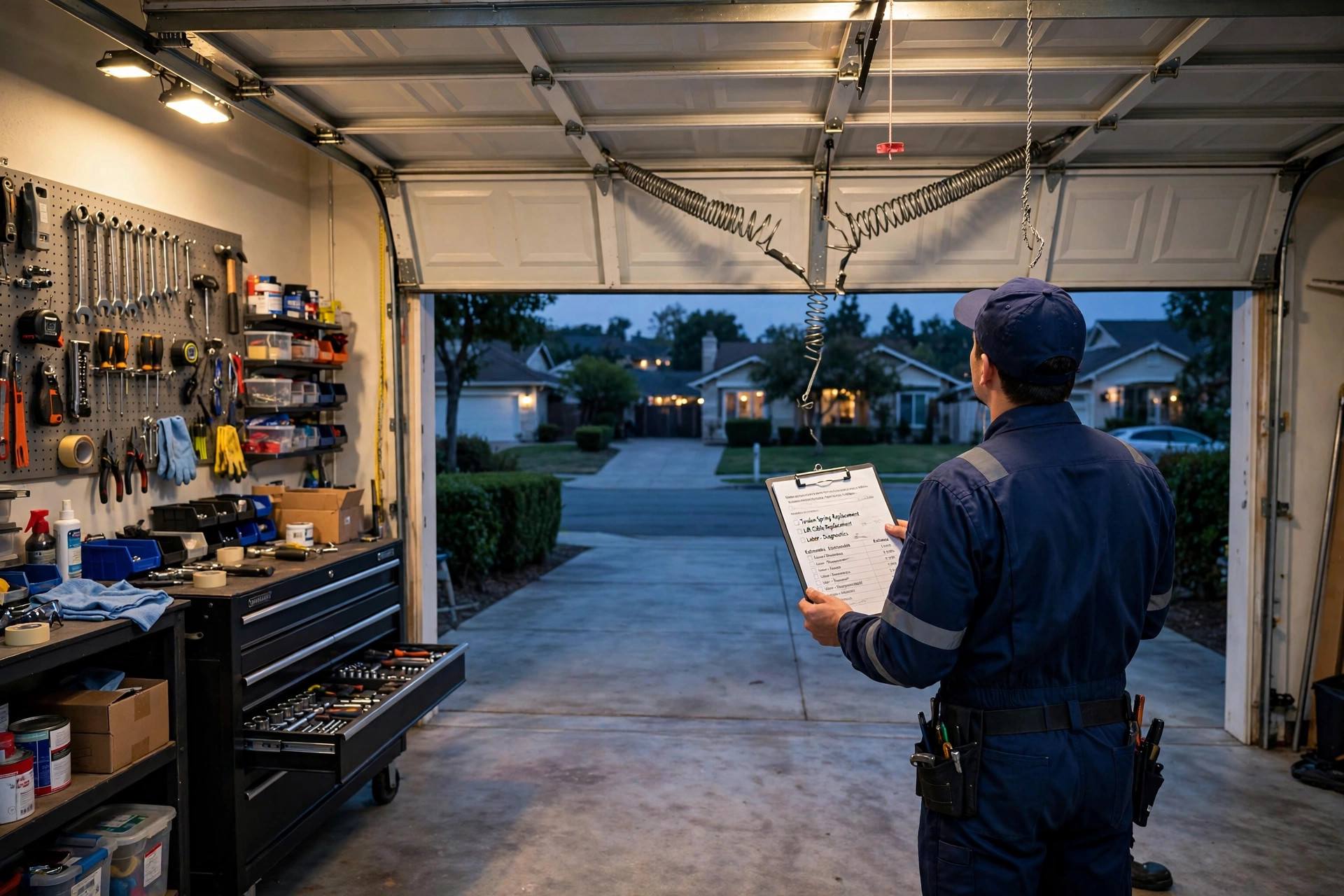
Your garage door spring snaps at 7 a.m. The door weighs 150 to 250 pounds and now it will not move. You search "garage door repair near me" and the top results all promise the same thing: a $29 or $39 service call, same-day dispatch, a 4.9-star rating with 800 reviews. You book one. The technician arrives, looks at the door, and tells you the springs, cables, drums, rollers, and probably the opener all need replacing. The $39 visit is now a $900 invoice. You cannot verify any of it. You do not know what a torsion spring costs, you do not know whether your cables were actually frayed, and you cannot get a second quote because your car is trapped inside.
This is not an anecdote. It is the industry's dominant acquisition funnel. A Dallas homeowner guide documents the exact pattern: bait-and-switch pricing where a $29 to $39 advertised fee becomes a $500 to $1,000 job once the tech is on site. In August 2026, St. Croix Garage Doors in Wisconsin issued a public warning about scammers impersonating legitimate local companies with similar names and logos, running the same low-advertised-price, high-pressure on-site playbook. And in May 2026, the FTC and the Illinois attorney general sued a lead-generation operator that had created thousands of fake local business profiles for "garage door repair," fabricated five-star reviews, and routed calls to representatives in the Philippines who dispatched technicians who were, in many cases, not licensed or qualified, according to the FTC's complaint. The fake-listing economy and the bait-and-switch economy are two faces of the same market failure: the homeowner cannot price the job before authorizing it.
The information asymmetry is structural. Garage doors fail rarely (springs are rated for 10,000 to 20,000 cycles, roughly a decade of normal use), the failure is urgent (car trapped, house unsecured), and the parts are opaque (a pair of torsion springs costs a contractor $15 to $80, per Houzz's cost data, but invoices routinely show $400+ for the springs alone). Angi's own data puts the average repair at $260 with a range of $80 to $675. ConsumerAffairs, which surveyed 18 garage door companies, found spring replacement runs $160 to $350. That is the honest band. The scam band is 2 to 3 times that, and the homeowner has no way to tell which band they are in.
The Gap in the Market
Nobody sells trust as the product. Angi, Thumbtack, and HomeAdvisor sell leads to contractors. The contractor pays per lead, the homeowner gets matched, and the price is negotiated on the driveway with all the leverage on one side. Google and Yelp sell discovery; reviews are the trust mechanism, and the FTC action shows exactly how thoroughly review fraud has compromised that mechanism in this trade.
On the operator side, the market is consolidating fast, which proves the unit economics but does nothing for pricing transparency. The roll-up wave is the strongest data point in this piece: Precision Garage Door Service, the Neighborly-owned franchise system, runs 132 US territories averaging $6.07 million to $7.43 million in gross sales each, per its franchise disclosure documents. Guild Garage Group assembled nearly 30 local businesses after 2024 and Oak Hill Capital agreed to acquire it for more than $800 million, reportedly around 18 times EBITDA, per PitchBook. Then in September 2026, KKR agreed to buy A1 Garage Door Service of Phoenix for around $2 billion, about 20 times its EBITDA, which PitchBook reports grew from $27 million in 2022 to roughly $100 million, with Reuters first to report the deal, per PitchBook. KKR already owns Neighborly, which puts the Precision franchise system and the A1 corporate roll-up under one roof. PitchBook counted 21 private-equity-backed garage door acquisitions through September 28, 2026, worth $4.2 billion, the highest nine-month total in a decade outside of 2021. Private equity sees the margins and is paying software-adjacent multiples for them. What private equity cannot sell is a price the customer sees before the tech arrives.
OEM dealer networks (Overhead Door, Clopay, Wayne Dalton) are built to sell doors, not to service them, and their dealer coverage is thin outside major metros. So the 15,000 independents that hold 90% of the US market, per PitchBook data reported in 2026, compete the only way the current discovery layer rewards: cheapest advertised service call, highest on-site conversion. Nobody has a structural reason to publish prices. That is the gap.
The Solution
A fixed-price garage door repair marketplace. The product is a published price book, not a quote tool. The homeowner photographs the door and describes the symptom. A decision tree plus photo identification matches the job to a fixed price from the book: one torsion spring $X, a pair $Y, cables $Z, opener replacement $W, parts and labor itemized, the diagnostic fee credited against the repair. The price is locked before dispatch, and the tech cannot re-price on site. If the photo diagnosis was wrong, the platform absorbs the difference up to a per-job cap and re-quotes with photo evidence; repeated misquotes get a contractor flagged, not the homeowner billed. Version one is the price book, a phone number, and the discipline to turn away contractors who will not honor the quote. Computer vision that prices a door from photos without human review is the scaling mechanism for version two, not the wedge.
The tech who arrives is licensed, insured, background-checked, and rated on post-job audits. The platform backs every certified job with a warranty funded by a $20 per-job pool: 3 years on springs, 1 year on labor for full jobs. The actuarial math is shown on the contractor page, not hidden: at a 4% callback rate and $180 average callback cost, expected cost is $7.20 per job against $20 collected, with the surplus compounding into the reserve.
The price book is the moat. It starts from published cost data and contractor surveys, then tightens with every completed job: actual parts invoices, actual labor hours, actual zip codes. Within 18 months the platform knows the true cost of a torsion spring pair in every major metro better than anyone in the industry, and that data is what makes the fixed quote credible. Contractors join because the platform hands them pre-diagnosed, price-accepted jobs with zero customer acquisition cost. Homeowners join because the price is the price.
The maintenance layer is the second act. Springs die on cycle counts, and a $99-a-year plan buys an annual tune-up, lubrication, safety checks, and a cycle-count-based alert when the springs are near end of life. That converts a once-a-decade emergency into a recurring relationship, and it is the honest version of what the industry already knows: preventive maintenance extends door life and is the cheapest job to deliver.
The Math: What a Job Actually Costs
Take the most common job in the trade. Spring replacement is roughly 35.7% of all garage door repair revenue, per industry segmentation data, and opener repair and installation is the second-largest service line at 24.7%. A typical fixed price for a torsion spring pair: $280, in the ConsumerAffairs $160 to $350 band and near the Angi $260 average. Contractor cost, built explicitly: a quality spring pair at $50 wholesale, 1.25 hours of tech time at a $40 loaded hourly rate ($50), plus $50 for the truck roll and dispatch allocation. Total: $150 all-in. The $40 loaded rate is above the Bureau of Labor Statistics mean wage of $51,640 a year (about $24.83 an hour) for mechanical door repairers, which is intentional: it prices in benefits, turnover, and non-billable hours. Gross margin per job: $130, or 46%.
Now the platform cut, and here is where the first draft of this idea failed its own review. Stacking a $299 monthly subscription, a 10% transaction fee, and a $25 warranty contribution on a $280 job at 50 jobs a year extracts $124.76 per job and leaves the contractor about $5 in profit. No honest shop joins that. So the fee structure has to be rebuilt so the subscription replaces the transaction fee instead of stacking on it. The corrected model: $299 a month for certified-partner status, which includes the first 20 platform jobs each month at zero transaction fee; jobs beyond 20 carry a 5% fee; and $20 per job goes into the warranty pool.
Contractor P&L on a $280 job against $150 in cost, at three volume tiers:
| Platform jobs/year | Platform cost/job | Total cost | Contractor profit | Margin |
|---|---|---|---|---|
| 50 (one a week) | $71.76 (amortized sub) + $20 warranty | $241.76 | $38.24 | 13.7% |
| 150 | $23.92 + $20 | $193.92 | $86.08 | 30.7% |
| 300 | $11.96 (amortized sub) + $20 warranty + $2.80 overage | $184.76 | $95.24 | 34.0% |
Thin at 50 jobs a year, healthy at 150, and the pitch to the contractor is the customer acquisition cost they already pay. An illustrative example, not a survey: a $35 shared lead on a lead-gen platform that closes one time in three costs $105 per booked job. The platform's blended $91.76 at the lowest tier is already cheaper, and it falls to $34.76 at 300 jobs. The subscription is not an extra tax on the job; it is a cheaper replacement for the ad spend and lead fees the shop is already incurring. That is the sentence that has to close the contractor sale.
Path to roughly $45 million in year-five revenue: 5,000 certified shops at $299 a month ($17.9M), overage fees on jobs beyond the included 20 a month ($4.2M), 150,000 homeowner maintenance plans at $99 a year ($14.9M), and wholesale margin on fixed-price opener and door replacements sold through the platform ($8M). Five thousand shops is a third of the roughly 15,000 US independents, which is aggressive but plausible for a company that becomes the category's trust mark, and the maintenance plans convert at roughly one plan per shop every two weeks.
Revenue Model
| Stream | Price | Notes |
|---|---|---|
| Certified partner subscription | $299/mo per shop | Includes license/insurance verification, price-book access, dispatch priority, warranty badge, and the first 20 platform jobs each month at 0% transaction fee. Replaces the contractor's lead-gen spend rather than stacking on it. |
| Overage transaction fee | 5% of job value | Only on jobs beyond the 20 included each month. At 25 jobs a month the overage is $70 total, small by design. |
| Warranty pool | $20/job from contractor | Funds the platform warranty (3 years on springs, 1 year on full-job labor). Expected cost at 4% callbacks and $180 average callback is $7.20 per job; the surplus compounds into the reserve. Pass-through, not platform revenue. |
| Homeowner maintenance plan | $99/yr | Annual tune-up, lubrication, safety inspection, cycle-count spring-life alerts. The tune-up visit is a loss-leader that feeds replacements. |
| Opener and door wholesale margin | Varies | Fixed-price opener replacement ($350 to $950 installed) and full door replacement ($900 to $3,500+) sourced through distributor partnerships. |
Market Size
Start with the global services market: $6.5 billion in 2025, growing to $10.08 billion by 2034 at a 5.0% CAGR, per Dataintelo. (Coherent Market Insights sizes it differently at $5.10 billion in 2026 growing at 6.1%; the research firms disagree on scope, so treat the global total as a $5 to $7 billion range and anchor on Dataintelo as primary.) North America is roughly 44% of global revenue, per industry segmentation data. Apply 90% of that to the US, and the US service TAM lands around $2.6 billion, a range rather than a point.
The SAM narrows to residential work in the top 30 US metros, roughly 55% of US households: about $1.4 billion in annual service revenue. The SOM at year five: roughly $45 million in platform revenue against that SAM. That is 3.2% of the SAM captured as revenue, which for a marketplace that does not swing a wrench is a reasonable target.
Why Now
Five things converged. First, the installed base is aging into its replacement wave. The suburban building boom of the 2000s put up millions of sectional doors whose springs, rated for 10,000 to 20,000 cycles, are dying right now. Second, enforcement raised consumer awareness: the May 2026 FTC action put "fake garage door repair listings" in the news, and every enforcement wave is a marketing subsidy for a trust-first brand. Third, consolidation proved the money: KKR agreed to pay around $2 billion for A1 at roughly 20 times EBITDA, and Oak Hill agreed to pay more than $800 million for Guild Garage Group at roughly 18 times. Independent operators cannot out-spend those roll-ups on ads, but they can out-trust them on price, and a platform that hands them pre-diagnosed, price-accepted jobs is how they fight scale with transparency. Fourth, AI vision quoting is finally good enough to price a door from photos plus a symptom checklist, which collapses the cost of the "free estimate" that scammers use as their funnel. Fifth, the smart-opener installed base (Chamberlain/LiftMaster myQ and competitors) is hitting its own refresh cycle, and opener replacement at $350 to $950 installed is the second-most-common ticket in the trade.
What to watch: whether the KKR-A1 deal closes and at what final multiple, whether the FTC's 2026 fake-listings case produces an injunction that clears the search results the scammers feed on, and whether Guild Garage Group's integration under Oak Hill starts publishing prices, which would tell you whether the roll-ups see transparency as a threat or a tactic.
Startup Costs
| Category | Cost | Notes |
|---|---|---|
| Vision quote engine + platform (9 months) | $220K | 2 ML/vision engineers + 1 full-stack. Photo-based door identification, symptom decision tree, published price book, booking and dispatch. The quote does not need to be perfect on day one; it needs to be fixed. |
| Contractor verification and ops (year 1) | $120K | License and insurance verification across launch states, background checks, onboarding audits. 1 ops lead + verification vendor costs. |
| Price-book research | $60K | Contractor cost surveys in 5 launch metros, wholesale parts pricing from distributors, labor rate mapping. The data that makes fixed quotes defensible. |
| Warranty reserve | $150K | Seed capital for the platform-backed 3-year warranty pool until per-job contributions make it self-funding. Actuarial support for failure-rate modeling. |
| Launch marketing (3 metros) | $120K | Phoenix, Dallas, Atlanta: high door counts, high scam complaint volume, contractor-dense. Local SEO, Nextdoor, and direct comparison ads against $29 service-call operators. |
| Operating buffer (12 months) | $80K | Cloud, insurance, legal review of the warranty terms and contractor agreements, customer support. |
| Total | $750K |
Limitations
No published study quantifies what share of garage door invoices are inflated or what the average overcharge is. The bait-and-switch pattern is documented by consumer protection guides, company warnings, and the FTC's 2026 complaint, but the honest band (Angi's $260 average, ConsumerAffairs' $160 to $350 for springs) and the scam band ($500 to $1,000 for the same job) are stitched together from different sources with different methodologies. The $299 subscription, 5% overage fee, $20 warranty contribution, and $99 maintenance plan are modeled, not observed; actual willingness to pay from independent shops is untested, and shops that currently profit from on-site upselling are precisely the ones least likely to join a fixed-price platform. The $35-lead, one-in-three-close customer acquisition comparison is an illustrative example, not a surveyed average. The warranty math assumes a 4% callback rate at $180 average cost; if callbacks run hotter or a metro cluster of bad jobs hits early, the $20 per-job pool depletes faster than the reserve replenishes it. And the year-five target of 5,000 certified shops is roughly a third of the country's independents, which is an aggressive penetration assumption for a five-year-old trust brand.
The TAM math chains assumptions: Dataintelo's global total, a 44% North America share from a different firm's segmentation, and a 90% US share of North America. If any link is off by a third, the $2.6 billion US figure moves with it. The SAM's "55% of households in the top 30 metros" is an approximation. The Guild Garage Group acquisition price and the A1 revenue and EBITDA figures are reported by PitchBook, and the Precision figures by its franchise disclosure documents, not confirmed in primary filings. Treat every number in the market-size section as directionally right and precisely wrong.
Strongest Counterargument
The strongest objection does not come from Angi at all. It comes from the article's own first draft, where the platform stacked a $299 monthly subscription, a 10% transaction fee, and a $25 warranty contribution on a $280 job and left the contractor about $5 in profit at 50 jobs a year. No honest shop joins a marketplace that leaves $5 on a $280 ticket. The restructured fee model in the Revenue Model section exists specifically because of that objection: the subscription replaces the transaction fee instead of stacking on it, the first 20 jobs a month carry no fee, and the contractor P&L is shown at three volume tiers. If you cannot make the contractor's math work on paper, nothing else in the piece matters.
Next: fixed pricing against heterogeneous doors. Wood, insulated, 8-foot, low-headroom, and commercial doors break any price book, and every edge case becomes a scope dispute where the platform either eats the difference or the tech re-prices on site, recreating the exact problem. The honest answer is that the platform does not price what it cannot see: the photo diagnosis gates exotic configurations into a "custom quote" lane with a bounded range instead of a fixed price, the platform absorbs misquotes up to a per-job cap, and the tech's misquote rate is a tracked, published metric. A contractor with a 15% misquote rate is not a pricing problem; it is a quality signal.
Next: the 3-year platform warranty is an insurance product wearing a marketplace costume. One bad metro, a callback cluster, a contractor who churns mid-warranty, and the $20 per-job pool blows up, while multi-state warranty programs invite insurance-regulator scrutiny. The mitigations are a cap (3 years on springs, 1 year on full-job labor, not blanket coverage), a reserve seeded with real capital, and published actuarial assumptions a regulator can read. None of that makes the warranty cheap to run. It is the most expensive line in the operation, and the piece should not pretend otherwise.
Angi or Thumbtack could add fixed-price booking and crush this before it scales. They have the homeowner traffic, the contractor supply, and the brand recognition. A "fixed price" toggle on Angi would reach 10x the audience of a new marketplace in its first year.
They will not do it, and the reason is their own revenue model. Angi and Thumbtack make money selling leads to contractors, often selling the same lead to multiple pros. Fixed-price booking with a platform warranty converts them from an advertising business into a services business, with all the liability that implies. Every fixed quote is a promise the platform must keep, which means dispute resolution, warranty claims, and contractor policing. That is operationally expensive and, worse, it cannibalizes the lead business: a contractor paying per lead does not want the platform setting the price. The incumbents' incentives point away from transparency, which is the same structural reason nobody in the trade publishes prices today. A startup with no lead revenue to protect is the only actor whose incentives align with the homeowner. The risk is not that Angi copies the feature; it is that the marketplace never reaches the contractor density in any one metro that makes dispatch fast, because density is the whole game and the first 18 months are a grind in every zip code. And the demand side is worse than the supply side: a homeowner with a snapped spring at 7 a.m. clicks the top ad, not the new trust brand. The platform's answer has to be the non-emergency entry point. The $99 maintenance plan is sold through Nextdoor, local SEO, and the honest shops' own customer lists when nothing is broken, and the emergency job arrives later to a homeowner who already trusts the brand. If the platform only intercepts emergencies, it loses the click auction every time.
What You Can Do
If your garage door just broke: Get the symptom in writing before anyone dispatches. Ask for the price of a spring pair replacement, parts and labor, over the phone, and ask whether the diagnostic fee is credited against the repair. If the company cannot name a price before the visit, it is telling you how the visit will go. Angi's published band is $80 to $675 with a $260 average; ConsumerAffairs puts spring replacement at $160 to $350. Anything quoted at 2 to 3 times that for springs alone deserves a second quote, even with the car trapped.
If you run an honest garage door shop: Publish your prices. The bait-and-switch operators have poisoned the well you drink from, and every $29 ad that converts to a $900 invoice makes the next homeowner distrust you before you arrive. A shop with a public price book and a real warranty is already 80% of this startup's value proposition. The platform just gives you distribution.
If you are building this: Start in Phoenix. A1 built a roughly $400-million business there before KKR agreed to buy it, which proves the market is deep, the housing stock is young enough to be in the failure wave, and the scam density is high enough that "the price is the price" is a differentiating message. Your first 50 contractors should be the shops already publishing prices on their own websites; they are pre-sold on the thesis. Arm yourself with the one sentence that closes the contractor sale: the $299 monthly subscription replaces their lead-gen spend instead of stacking on it, and at 150 platform jobs a year the contractor keeps a 30.7% margin on a $280 ticket, better than what the lead platforms leave them. The vision quote engine can wait for version two. Version one is a price book, a phone number, and the discipline to turn away contractors who will not honor the quote.
The Bottom Line
The garage door repair trade is a $2.6 billion American market where the customer cannot know the price before the work starts, which means the market clears on deception rather than competition. Fifteen thousand independents hold 90% of it. Private equity is paying software-adjacent multiples for it, about 20 times EBITDA on the A1 deal, per PitchBook. The FTC sued the fake-listing operators. Everything about this market says the money is real and the trust is broken. The company that publishes the price book, verifies the techs, and warranties the work does not need to invent demand. It needs to show up with a fixed quote in the three metros where the $29 service call is currently a business model, and let the honest shops do what they have always wanted to do: charge a fair price and get the job.