3.5 Million Fire Alarm Systems Need an Annual Inspection. The Technician's Tablet and the Fire Marshal's Database Have Never Spoken.
The U.S. fire alarm inspection market runs about $2.3 billion a year across roughly 3.5 million systems, and every inspection ends the same way: the contractor re-keys the report into the fire marshal's portal by hand and pays a filing fee for the privilege. One 10-technician shop burns $427,500 a year on that handoff. That handoff is a business.
The Problem
Every commercial building you walk into has silent failures humming in its walls. A Michigan safety conference presentation of 24 months of test results from a national fire protection contractor found that 11% of smoke detectors in large systems failed testing, 12% failed in residential and dorm systems, and heat detectors failed at a staggering 30% rate. These are devices that passed their last inspection and then sat dead in ceilings for a year. The deck publishes the rates but not the device counts behind them, so read the 30% as direction, not precision. The entire point of the mandated annual inspection is to find the ones that stopped working, and the inspection finds plenty of them.
The mandate comes from NFPA 72, the National Fire Alarm and Signaling Code: the consensus standard adopted by reference into virtually every US jurisdiction's fire code (via IFC §907.8 and local amendments), which makes it the legal inspection schedule in practice. It requires every component of a fire alarm system to be inspected, tested, and maintained on a fixed cadence: control panels and power supplies weekly, batteries monthly, waterflow devices semi-annually, battery load-voltage tests semi-annually, and a comprehensive functional test of every smoke detector, heat detector, pull station, and notification appliance annually (Canby Fire District's published NFPA 72 schedule lays out the full cadence). Smoke detectors on zoned systems get sensitivity-tested every five years. The weekly and monthly items are visual checks typically performed by building staff; the annual functional test is the one that must be performed by qualified technicians. (Quarterly waterflow testing, which shows up in some schedules, is an NFPA 25 sprinkler-system requirement, not NFPA 72.) The building owner is legally responsible for all of it (NFPA 72, 14.2.3), and written records of every inspection must be kept for the authority having jurisdiction.
That annual visit is also a transaction. A mid-size commercial building in New York City pays $400 to $1,200 per fire alarm inspection, small retail spaces run $300 to $500, and high-rises and healthcare facilities are custom-quoted. Multiply by roughly 3.5 million installed systems across the country and the inspection, testing, and maintenance (ITM) market for fire alarm systems alone runs about $2.3 billion per year in service revenue, before counting the deficiency repairs that each inspection generates.
Where the Paper Trail Breaks Down
Follow one inspection from the ceiling tile to the fire marshal's desk and watch how many times the data gets retyped.
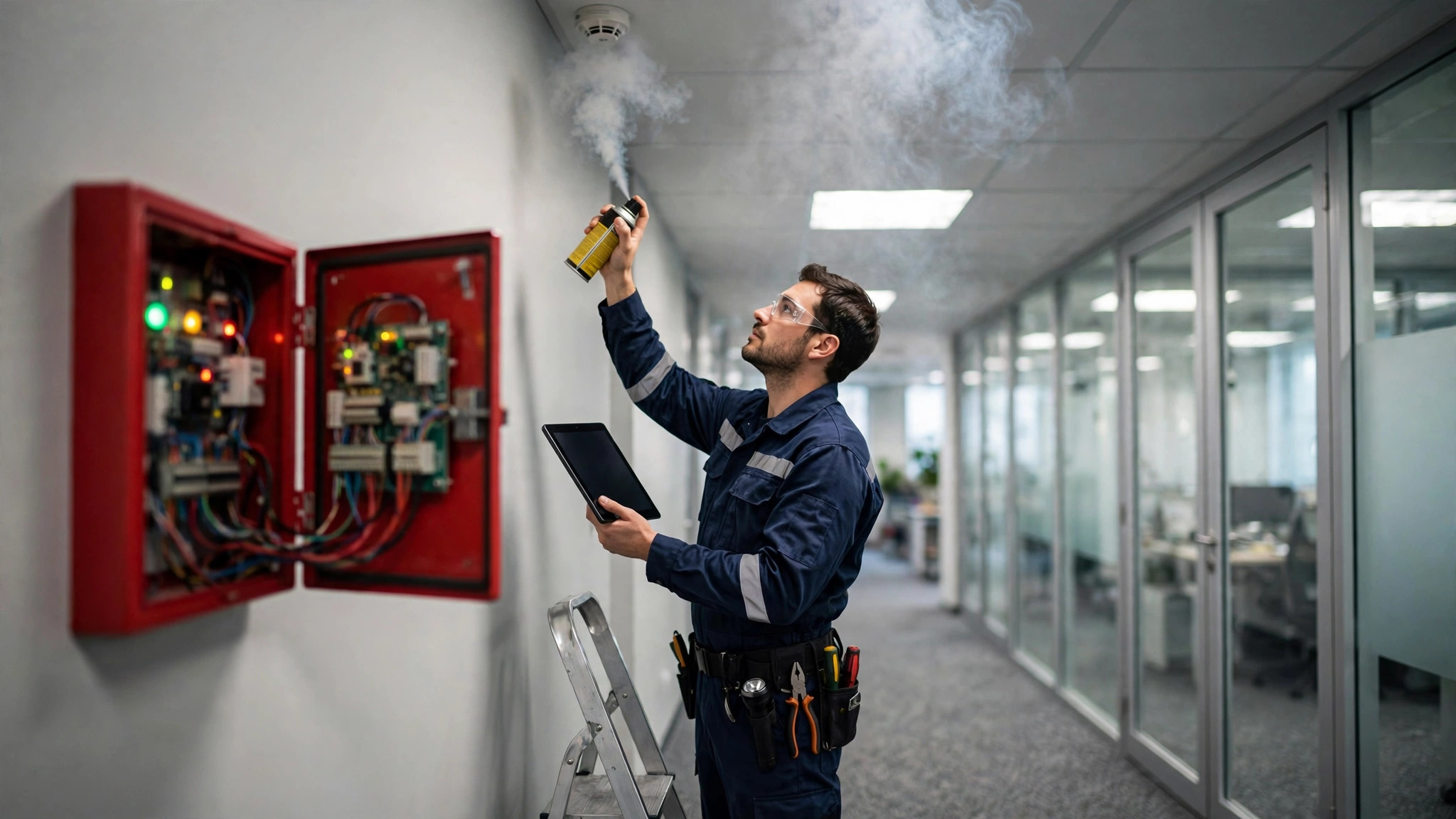
The technician arrives, tablet in hand, and walks the building testing devices: canned smoke on each detector, a magnet or heat source on heat detectors, pull station pulls, strobe and horn checks, panel function tests, battery load-voltage readings. On a 200-device system this takes most of a day. The field software (for contractors who have it) captures the findings per device. Then the technician returns to the truck or the office and the report has to go to three different audiences, each in a different format.
First, the building owner gets a compliance report with the contractor's letterhead, deficiency list, photos, and a proposal for the repairs. Second, the central monitoring station needs to know the system was taken on and off test. Third, the fire marshal's office increasingly requires the report to be filed through its own designated system. In a growing number of jurisdictions, that system is Brycer's The Compliance Engine: fire departments mandate that all service providers register and submit every test, inspection, and service report through TCE, paying what the Manhattan Fire Protection District calls "a nominal filing fee" per submittal. Harris County's Fire Marshal, the Township of Spring in Pennsylvania, and hundreds of other jurisdictions run the same playbook (Harris County's TCE page, Spring Township's program notice).
So the contractor that already did the work in its own field software now logs into a separate portal, re-keys the inspection results into TCE's templates (short form with a PDF attachment, or long form with every question answered), types out each deficiency again, and pays a filing fee for the privilege of delivering the fire marshal data the law already required it to produce. Contractors working across a dozen jurisdictions repeat this for every AHJ portal, each with its own templates and fees. InspectNTrack, a competitor in the space, estimates that paper-based and disconnected workflows cost field technicians 4.8 to 14+ hours per week, and the re-keying described above is exactly the kind of work that fills those hours.
On the fire marshal's side, the situation is the mirror image. TCE gives the AHJ a dashboard of filed reports and outstanding deficiencies, but it knows nothing about the contractor's schedule, the technician's route, or whether a flagged deficiency was actually repaired. The repair verification arrives as another manually-entered update, if it arrives at all. What the AHJ sees is filings, not the workflow behind them.
The Gap in the Market
Software for this problem exists, but it is split down the middle, and each side has significant blind spots.
| Company | What They Do | What's Missing |
|---|---|---|
| Inspect Point | Contractor-facing business management for fire inspection companies: NFPA checklists, mobile field entry, deficiency tracking, proposal generation, scheduling, customer portals. Founded 2014, $28M from Mainsail Partners in January 2022, acquired FireCAD in April 2025 and FormLink earlier, building toward a full contractor software suite. | No native AHJ submission layer: getting the report into the fire marshal's system (Brycer TCE, IROL, Tegris, or a municipal portal) is the contractor's manual problem. Its own leadership has said it wants to "merge its data into 3rd party reporting" (NFSA interview), an admission the bridge still doesn't exist: a roadmap item from years ago, not a priority. |
| Brycer / The Compliance Engine | AHJ-facing compliance platform. Fire departments get it free; contractors pay a per-report filing fee. Aggregates third-party inspection data into one cloud system, standardizes deficiency classification, tracks corrective actions. Brycer's own Building Safety Month release describes jurisdictions moving "from reactive enforcement to proactive compliance management" (Chester County release). | No contractor field product whatsoever. Technicians cannot run an inspection in TCE; they can only file into it after the fact. The per-filing fee makes contractors resent the platform they are mandated to use. TCE is a tollbooth on a road someone else paved. |
| InspectNTrack | Facility- and contractor-facing inspection software with an ROI calculator aimed at converting paper shops; plans start at $2,900 per year. | Focused on the inspection workflow itself, not the AHJ submission seam. Same structural gap as Inspect Point: the report still has to be re-keyed into whatever the fire marshal requires. |
| BuildOps / ServiceTrade | General commercial field-service management (HVAC, electrical, fire). ServiceTrade has been acquiring fire-industry point tools (Asurio, NorthBoundary). Strong on scheduling, dispatch, and invoicing. | Horizontal tools, not fire-code-native. No per-device NFPA 72 inspection logic at the depth a fire alarm contractor needs, and no AHJ filing integration. |
The structural pattern is two incumbents and zero middleware: the contractor's vendor serves only the contractor, the AHJ's vendor serves only the AHJ, and the inspection report flowing from the technician's tablet to the fire marshal's enforcement database has no software of its own. Inspect Point owns the contractor's day. Brycer owns the fire marshal's inbox. Nobody owns the delivery between them.
The Solution
A two-sided platform where the inspection and the filing are the same action:
1. Contractor field app (per-tech subscription): NFPA 72-native inspection workflows: per-device test capture with barcode/QR scan, canned-smoke and heat-test result logging, battery load-voltage readings, photo-backed deficiency classification by severity, offline-first for parking garages and basements, customer signature in the field. Scheduling, dispatch, and deficiency-to-proposal conversion so the repair quote leaves the building the same day. This is Inspect Point's territory, and the product has to be at least as good in the field to win technicians.
2. Universal AHJ filing layer (the moat): When the technician taps submit, the platform files the inspection report to every jurisdiction's required system automatically: Brycer TCE where mandated, IROL and Tegris where used, direct municipal portals and email where not. The filing fee the contractor currently pays Brycer per report gets absorbed into the platform's subscription or passed through at cost, and the re-keying disappears entirely. This is the feature neither incumbent can easily replicate: Inspect Point would have to build and maintain filing integrations for thousands of AHJ variants; Brycer would have to build a field product contractors actually want to use.
3. Owner compliance dashboard (included): Building owners and facility managers see every system's inspection status, upcoming due dates, open deficiencies with repair quotes, and a document vault of filed reports for the AHJ, the insurer, or a sale. Portfolio owners see all buildings across jurisdictions in one view. This kills the "when is my inspection due?" phone calls and gives the owner the compliance story that today lives in the contractor's filing cabinet.
4. AHJ deficiency closure loop (jurisdiction tier): Fire marshals get what TCE gives them today (filed reports, deficiency tracking) plus the missing piece: verified repair completion flowing back from the contractor's work orders, not manually re-entered. Red-tag deadlines (often 1 to 5 business days for critical deficiencies) get automatic escalation. The AHJ finally sees the workflow, not just the filing.
The Original Calculation: What the Seam Costs a Contractor
Take a 10-technician fire alarm contractor doing NFPA 72 inspections full time. Start with the paperwork tax. InspectNTrack's published estimate puts disconnected workflows at 4.8 to 14+ hours per technician per week; take the midpoint of 9 hours as a working figure for a shop that has field software but still re-keys reports into AHJ portals and chases deficiency paperwork by email.
9 hours × 10 techs × $45/hour loaded cost × 50 weeks = $202,500 per year in labor spent on work that creates zero revenue: re-entering findings into TCE and municipal portals, reformatting reports per jurisdiction, and the phone tag of deficiency follow-up.
Then the repair leakage. Industry benchmark holds that every $1 of inspection revenue should pull through roughly $1 of deficiency repair revenue, and inspections reliably find failures (recall the 11-30% device failure rates). A 10-tech shop billing $1.5M in inspection revenue should generate ~$1.5M in repair work. But deficiencies tracked in spreadsheets and email threads leak: quotes that never get sent, approvals that stall, repairs scheduled late. If 15% of repair pull-through leaks away, that is $225,000 per year in lost high-margin service revenue.
Total annual cost of the seam: roughly $427,500 on a $3M-revenue shop, or about 14% of revenue burned on friction. The platform's contractor tier at $150 per tech per month costs $18,000 per year for the same shop. The payback math is not close, which is exactly why the wedge is the contractor, not the fire marshal.
The two load-bearing inputs are working assumptions, not measured benchmarks: the $45-per-hour loaded tech cost and the 15% repair-leakage figure. Run the same math at the range ends and the seam runs roughly $260,000 to $580,000 a year: the paperwork tax falls to $108,000 at the 4.8-hour low end of the InspectNTrack range (itself a competitor's ROI calculator, midpointed at 9 hours here), while leakage runs $150,000 at 10% and $375,000 at 25%. Even the low end clears the $18,000 subscription ten times over.
Revenue Model
| Revenue Stream | Amount | Notes |
|---|---|---|
| Contractor field app (per tech/month) | $150 | Inspection workflows, scheduling, deficiency-to-proposal, offline mode. Annual contract. |
| AHJ filing pass-through (per report) | $8-12 | Filed to TCE, IROL, Tegris, or municipal portals. Absorbed into subscription up to a volume tier, then per-report. Undercuts the contractor's current filing-fee-plus-labor cost. |
| Owner portfolio dashboard (per building/year) | $120 | For portfolio owners and facility managers. Free single-building view; paid above 3 buildings. |
| AHJ jurisdiction tier (per jurisdiction/year) | $5,000-15,000 | Deficiency closure loop, escalation workflows, verified repair data. Priced by system count in the jurisdiction. |
| Repair proposal conversion (take rate) | 2% | Optional payments layer on deficiency-to-invoice. High-margin, scales with repair pull-through. |
Unit economics on a 10-tech contractor: Field app revenue: 10 × $150 × 12 = $18,000/year. Filing: ~2,000 inspections/year × $10 = $20,000. Repair proposal payments: $1.275M in converted repair revenue × 2% = $25,500. Total: $63,500/year from one mid-size contractor, against a customer acquisition cost (trade show presence, pilot, inside sales) of roughly $6,000-9,000. The filing and payments layers mean revenue per contractor grows with the contractor's own volume, not just seat count.
Market Size
TAM: The U.S. commercial building stock is 5.9 million buildings (EIA's Commercial Buildings Energy Consumption Survey). Estimating that roughly 60% carry installed fire alarm systems subject to NFPA 72 inspection (the International Fire Code requires alarms across most non-residential occupancies above size and occupant thresholds) gives ~3.5 million systems. At an average $650 per system per year in inspection spend (blending the $300-500 small-retail and $400-1,200 mid-size NYC figures with custom-quoted high-rises), annual fire alarm ITM service revenue is roughly $2.3 billion. The $650 is an inferred national average, not a measured one: at $500 the TAM is $1.8B, at $800 it is $2.8B, and NYC quotes are a known high outlier. The global fire alarm and detection hardware market was $51.63 billion in 2025 with North America the dominant region (Straits Research), which sanity-checks the installed base: the service tail on that hardware is enormous.
SAM: The software-serviceable slice has three parts:
| SAM Component | Calculation | Notes |
|---|---|---|
| Contractor field software | 20,000-25,000 techs × $150/month × 12 = $36-45M/yr | Technician count is an estimate; no national census of practicing fire alarm techs exists. Many AHJs require NICET credentials, per Kimble & Company's California licensing guide. |
| AHJ filing fees | ~3.5M systems × 1 mandated filing/yr × ~$10 avg fee = ~$35M/yr | Assumes one electronic filing per system per year. Semi-annual schedules and re-inspections would raise it; systems in jurisdictions with no e-filing mandate lower it. |
| AHJ jurisdiction tiers | ~500 adopting jurisdictions × ~$10K avg = ~$5M/yr | Rough: priced by system count per jurisdiction; adoption is the binding unknown. |
Combined SAM: approximately $75-90M/year.
SOM (year 3): 300 contractors averaging 6 techs on the field app: 1,800 × $150 × 12 = $3.24M. Filing: those shops run roughly 360,000 inspections a year (6 techs × 200 each), but only about 40% land in jurisdictions with a mandated electronic filing portal by year 3, so ~144,000 × $10 = ~$1.4M. 40 jurisdictions on the AHJ tier at ~$10K average: $400K. Repair payments: the unit-economics math works out to ~$15K per 6-tech shop at full adoption, but only about 5% of contractors adopt the payments layer in year 3, so 300 × $15K × 5% ≈ $230K. Total: approximately $5.3M ARR, about 6-7% of the SAM. The 40% mandate-penetration and 5% payments-adoption figures are stated assumptions, not forecasts: they are the explicit discount factors that keep the SOM honest against the unit economics above. The contractor count is the binding constraint, and 300 shops is reachable through NFSA/AFSA chapter relationships alone.
Why Now
The AHJ filing mandate wave is the forcing function. Every fire department that adopts a Brycer-style mandate (contractor registers, files every report, pays per filing) increases the pain of the handoff for contractors while proving that AHJs will standardize on a single submission endpoint. Each new mandate is a sales event for a platform that files automatically: the contractor's alternative is another portal login and another fee.
The consolidation window is narrowing. Inspect Point took $28M from Mainsail in 2022 and has since bought FormLink and FireCAD; ServiceTrade has been rolling up fire-industry point tools. The independent, code-native, two-sided window exists because the consolidators are buying contractor workflow, not the AHJ seam, but that window closes the moment one of them decides the filing layer is worth building. Speed matters more than feature completeness in year one.
Technician scarcity raises the value of every hour. NICET certification and state licensing constrain the supply of qualified fire alarm technicians, and AHJs increasingly demand credentialed staff. When you cannot hire more techs, the 9 hours per week each one spends on paperwork is the capacity you already own. Software that converts paperwork hours into billable inspection hours pays for itself out of labor the contractor is already paying for.
Code churn keeps the form library valuable. NFPA 72 is revised on a three-year cycle, and AHJs adopt editions and local amendments on their own timelines, which is why a single national inspection form does not exist. The per-jurisdiction filing template library is tedious regulatory scut work that compounds as a moat: every template built for one contractor's territory is reusable for the next.
Startup Costs
| Category | Cost | Notes |
|---|---|---|
| Platform engineering (12 months) | $320K | 2 backend + 1 frontend + 1 mobile. Offline-first field app, NFPA 72 device-level data model, filing integration framework for TCE/IROL/Tegris/municipal portals. |
| AHJ filing template library | $35K | Contract regulatory researcher. TCE short/long forms, IROL, Tegris, and direct-portal requirements across the first 200 jurisdictions. One-time moat. |
| Pilot program (10 contractors, 6 months) | $30K | Free platform access. Goal: validate that auto-filing is accepted by AHJs without contractor re-keying and that techs prefer the field app to their current tool. |
| Sales and conference presence (year 1) | $35K | NFSA and AFSA chapter meetings, NFPA conference. Booth, travel, demo accounts. |
| Security and compliance (SOC 2 Type 1) | $25K | Fire marshal IT departments and enterprise facility managers require security review. Type 1 year 1, Type 2 by year 2. |
| Filing-fee float and integration | $15K | Pre-funded filing fee accounts with TCE and equivalents; API and screen-scrape integration work for portals without APIs. |
| Operating buffer (12 months) | $40K | Cloud hosting, customer support, legal (state licensing research). |
| Total | $500K |
Limitations
The 3.5 million system estimate is derived, not counted: 60% of the 5.9M CBECS commercial buildings is an assumption about IFC alarm requirements, not a census. No public source enumerates installed fire alarm systems in the U.S. NFPA publishes fire incident data, not system census data. The true count could be meaningfully higher (multi-system campuses, residential high-rises under state codes) or lower (small occupancies exempt from alarm requirements).
The technician count (20,000-25,000) is an estimate. NICET publishes certification counts by program but the number of actively practicing fire alarm technicians, as opposed to certificate holders, is not public. The SAM's contractor-software half scales directly with this number.
The $1-of-repair-per-$1-of-inspection pull-through benchmark is industry lore repeated in contractor benchmarks, not a published study. Real pull-through varies by contractor sales discipline; a shop with no deficiency follow-up process pulls through far less, which is both the opportunity and a go-to-market risk (selling repair-recovery software to a contractor that doesn't sell repairs requires behavior change, not just tooling).
The working assumptions behind the headline math are asserted, not measured: the $45-per-hour loaded technician cost, the 15% repair-leakage rate, the $650-per-system blended inspection spend, and the 9-hour midpoint of InspectNTrack's 4.8-to-14-hour range (a competitor's ROI calculator figure). The SAM's one-filing-per-year assumption and the SOM's 40% mandate-penetration and 5% payments-adoption figures are stated guesses about a market that publishes almost no adoption data. If any of these are wrong by half, the SOM moves by millions.
There is an honest tension in the business model that deserves naming: this article criticizes Brycer for taxing contractors through a legally mandated filing, then proposes a platform that also charges a per-report fee on a legally compelled transaction. The defense is that this toll replaces labor cost rather than adding pure rent: the $8-12 pass-through substitutes for the hours a tech spends re-keying, and third-party fees are passed through at cost rather than marked up. But the defense only holds if pricing stays anchored to the labor it removes. The moment the fee exceeds the friction, this is just the prettier tollbooth.
Brycer's per-filing fee structure is set by Brycer and its AHJ contracts, and nothing stops Brycer from raising fees, changing terms, or restricting automated filing. Building a business on top of a tollbooth operator's API is platform risk, mitigated only by also filing direct to the thousands of jurisdictions that don't use TCE.
Strongest Counterargument
Inspect Point has $28M in growth equity, a decade of contractor relationships, and has publicly said it wants to merge its data into third-party reporting. Brycer owns the AHJ endpoint in a growing list of jurisdictions and gets paid every time a report is filed. Between them, they own both ends of the transaction this article describes. Either could close the gap: Inspect Point could build the filing layer, Brycer could build (or buy) a field app.
The counterpoint has three parts. First, Inspect Point's incentives point the other way. Its revenue comes from contractor seats, and every engineering sprint spent on AHJ filing integrations, thousands of jurisdiction-specific templates with no seat revenue attached, is a sprint not spent on features its paying customers request. The NFSA interview quote about "looking to expand services to merge data into 3rd party reporting" is from years ago, and the bridge still doesn't exist, which suggests it is a roadmap item, not a priority.
Second, Brycer's business model is structurally opposed to a contractor-loved field product. Brycer monetizes contractors through per-filing fees that contractors resent paying; its customer is the fire department, which pays nothing. Building a field app that contractors choose voluntarily requires treating contractors as customers, and Brycer's entire pricing architecture treats them as a revenue source. Companies rarely build beloved products for the constituency they tax.
Third, the filing layer is genuinely hard in a way that favors a dedicated entrant. It is not one integration; it is hundreds of AHJ-specific templates, short forms with PDF attachments, long forms with per-question validation, portals with no API, and fee schedules that change by jurisdiction. That is unglamorous integration scut work, and the company that does it first for contractors owns the workflow the incumbents would have to replicate jurisdiction by jurisdiction. That said, if Inspect Point ships credible auto-filing within 18 months of this article, the independent window is over.
What You Can Do
If you run a fire alarm contracting shop: Measure your handoff. For one month, have your techs log every minute spent re-entering inspection results into AHJ portals, reformatting reports per jurisdiction, and chasing deficiency paperwork. Multiply by your loaded hourly rate. Then pull your last twelve months of deficiency findings and count how many never became repair quotes. If the combined number exceeds $150 per tech per month, you are already paying for this software; you are just paying it in labor and lost repairs instead of a subscription. And if you know a contractor who curses the portal on filing day, send them this page.
If you manage facilities or a building portfolio: Ask your fire alarm contractor for a machine-readable record of your last inspection, not a PDF. Ask which AHJ systems your reports were filed into and when. If the contractor cannot answer both questions in one business day, your compliance documentation is one lost laptop or one departed office manager away from a fire marshal citation you cannot defend. Require digital filing in your next ITM contract renewal.
If you're a builder evaluating this space: Start contractor-first in Brycer-mandate jurisdictions. The filing mandate is your free demand generation: contractors in those territories feel the seam every single week, and a field app that files automatically sells itself at the NFSA chapter meeting. Build the filing template library before you build the pretty dashboard; the templates are the moat and they take longer than the app. Price the field app to undercut the contractor's current filing-fee-plus-labor cost, not to match Inspect Point's seat price, because you are selling hours back, not software. And build the audit trail before the filing speed: never let filing velocity exceed field verification. Deficiency closures should be evidenced (photos, test readings, timestamps), not merely asserted, and the report the AHJ receives should be traceable to the test data the technician captured. The AHJ's trust is the actual moat, and one audit failure ends the business.
The Bottom Line
Fire alarm inspection is a $2.3 billion annual service market created by a code mandate, and the report each inspection produces is a legal document with three audiences: the owner who pays, the technician who generates it, and the fire marshal who enforces it. The two software incumbents each serve one audience and ignore the others: Inspect Point runs the contractor's day but cannot file to the AHJ, Brycer runs the fire marshal's inbox but has no field product and taxes the contractors it serves. The company that makes the inspection and the filing the same action, where the technician's submit button simultaneously updates the owner's dashboard, pays the filing fee, and lands a structured report in the fire marshal's system, captures the handoff that both incumbents created and neither can easily close. Not glamorous, not trendy, just the boring transaction at the center of a life-safety code, waiting for someone to finally connect the tablet to the database.