2,700 Buildings Never Filed: Facade Inspection Orchestration for America's Five-Year Deadlines
About 2,700 New York buildings never filed their Cycle 9 facade inspection report, and Cycle 10 is already ticking with $5,000-a-year non-filing penalties. The licensed inspectors who write the reports also profit from the repair work they uncover. That is the whole conflict. Nobody sells the buying side of facade compliance as software, even though one missed deadline costs roughly five times the price of the inspection itself.
The Problem
Every five years, the owner of every New York City building taller than six stories must hire a Qualified Exterior Wall Inspector. Not optional, and the schedule is non-negotiable: an Unsafe finding starts a 90-day repair clock, public protection goes up immediately, and there is no grace period for falling masonry. A state-licensed engineer or architect with a city QEWI designation examines every exterior wall and appurtenance, then files a critical-examination report with the Department of Buildings through its DOB NOW: Safety portal, where the building is classified as Safe, Safe With a Repair and Maintenance Program (SWARMP), or Unsafe, and where one bad finding can convert a routine filing into a six-figure repair program overnight. Find an Unsafe condition and the clock starts immediately. The program is FISP, the direct descendant of Local Law 11 of 1998. Cycle 10 began on February 21, 2025, and the current five-year clock is already more than eighteen months old.
What hits you first is the scale. The DOB's own FISP analysis puts the Cycle 10 universe at approximately 17,000 covered buildings, split into three sub-cycles by the last digit of the tax block number: sub-cycle A, blocks ending in 4, 5, 6, or 9, files between February 21, 2025 and February 21, 2027; sub-cycle B, blocks ending in 0, 7, or 8, from February 21, 2026 to February 21, 2028; and sub-cycle C, blocks ending in 1, 2, or 3, from February 21, 2027 to February 21, 2029. Do the rough division: sub-cycle A covers four of the ten block-number digits, roughly 40 percent of the city's tall buildings, on the order of 6,800 of them, and each needs a filed report by February 21, 2027 unless it already filed early in the window.
And the previous cycle's paperwork is still on fire. In Cycle 9, about 16,000 buildings were eligible and only about 13,300 filed one of the three accepted reports. The DOB's own Cycle 10 analysis counted 3,246 "No Report Filed" buildings in October 2024, falling to 2,922 by June 2025 as late filers trickled in; at that pace we estimate roughly 2,700 remain today. Those owners are accruing penalties while Cycle 10 runs. Inspection firms cite $5,000 per year plus $1,000 per month for late filing. The DOB's own filing fees stack on top: $425 for the initial report, $425 for an amended report, $305 for a repair time extension. Miss the deadline and the fines dwarf the filing fees within a quarter.
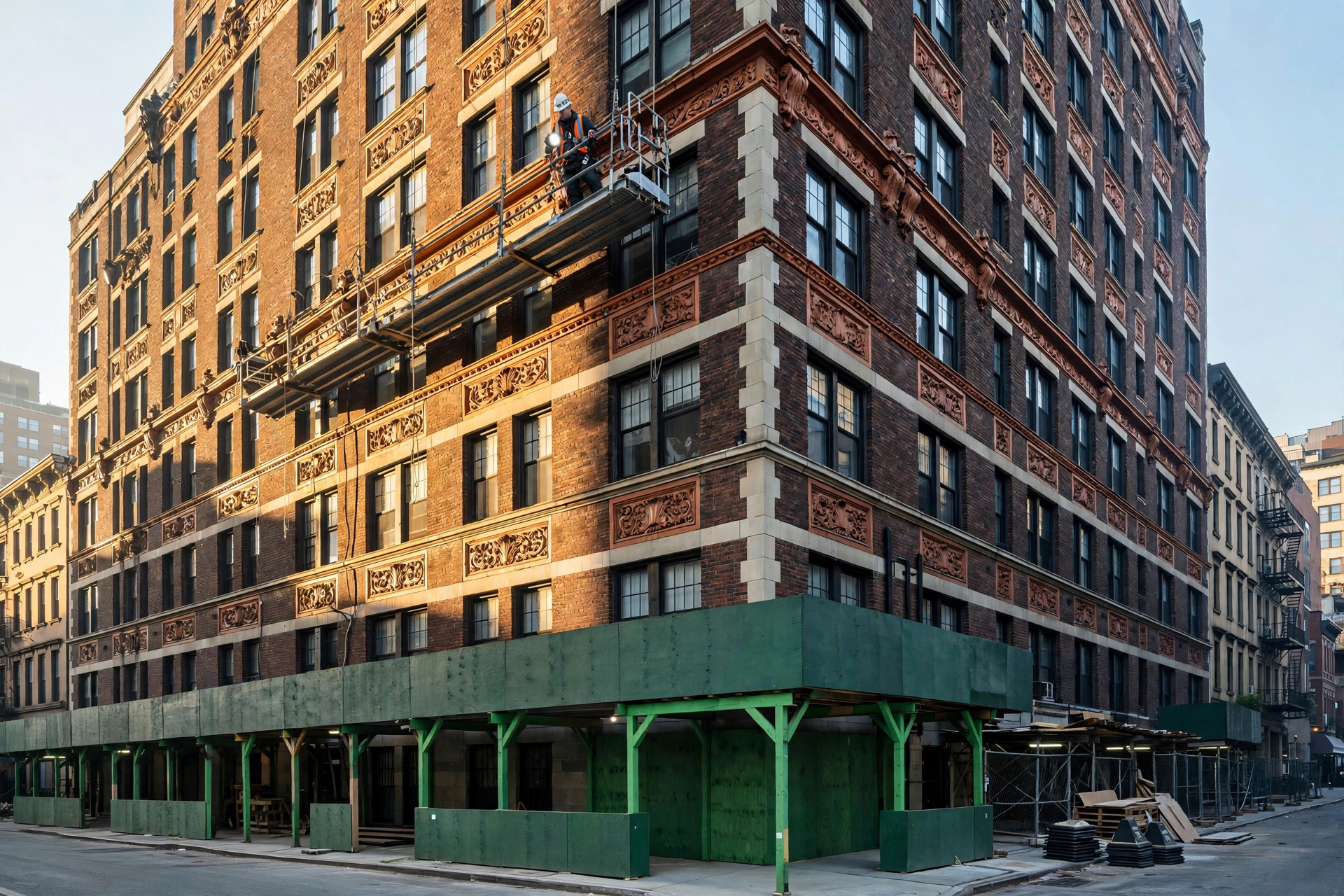
An inspection is an industrial operation, not a clipboard walk. Code requires close-up, hands-on examinations from scaffolding or another observation platform at intervals of no more than 60 feet along every facade elevation fronting a public right-of-way, which on a wide prewar building means a dozen or more drops, each one rigged, staffed, insured, and billed separately, and each one a negotiation with the sidewalk, the tenants, and the weather. Drones and high-resolution photography can supplement the close-ups. They cannot replace them. Each scaffold drop costs from $1,500 and up by our planning estimate (trade-press figures run higher). The QEWI's fee starts around $1,500 for a small building by our estimate and climbs steeply from there, because the license is scarce and the liability is real. A single full FISP compliance cycle, inspection through repair, can run $250,000 to more than $1,000,000 on a larger building by our estimate, often billed to condo and co-op owners as a lump-sum special assessment that arrives with 60 days' notice. An Unsafe finding that needs a sidewalk shed adds installation costs on the order of $100 to $150 per linear foot, plus monthly rent in the single digits per linear foot until the work is done.
New York is the biggest program, though not the only one. Chicago requires critical examinations of high-rise exterior walls 80 feet and taller on 4-, 8-, or 12-year cycles, with ongoing short-form reporting in between, which makes it the most administratively tangled program of the lot. Philadelphia requires buildings of 6 or more stories, or with any appurtenance over 60 feet, to be inspected by a licensed engineer or architect every 5 years. San Francisco's Building Facade Inspection and Maintenance Program, established by Ordinance 67-16 and updated twice since, alternates comprehensive and supplemental inspections on a five-year rhythm. Detroit, Pittsburgh, Milwaukee, and Columbus all have their own versions, each with its own triggers, intervals, and filing systems, which means a national portfolio is really a collection of local compliance regimes wearing a trench coat. A property manager with buildings in three cities is tracking three different codes, three different deadlines, and three different portals, usually in a spreadsheet.
The deeper problem is who sells the service. The market is dominated by engineering and contracting firms that bundle the inspection with the repair design and the construction work, which means the firm paid to find the damage is also paid to fix it, and the owner has no independent read on whether either price is fair. An op-ed by a contractor CEO in the retrofit trade press warned owners directly: facade engineers tend to lowball their initial inspection fees, then team up with contractors later in the process, and the project scope keeps expanding with unanticipated expenses. The person paid to find damage is economically aligned with finding it, and with being hired to fix it. Meanwhile FirstService Residential notes that more than 16,000 buildings are chasing a small pool of qualified inspectors, and warns that waiting until the deadline invites rushed repairs, price gouging, and emergency interventions, the textbook dynamics of a seller's market. The buyer is outgunned on both sides: by the inspector's information advantage, and by the calendar.
The Gap in the Market
Software touches this market, but always from the seller's side, and nothing neutral exists for the owner.
| Company | What They Do | What's Missing |
|---|---|---|
| Thornton Tomasetti | Full FISP services: critical examinations, repair contract documents, bidding assistance, construction-phase services. Holds a strategic partnership with T2D2, an AI platform that detects and classifies visible facade damage. | The firm is itself the inspector: the AI tool is built for engineers, not owners, and when the firm that finds the SWARMP conditions also designs the repair contract, the owner has no independent check on scope. |
| Hoffmann Architects + Engineers | Facade specialty firm working under New York's rules and similar inspection laws in Philadelphia, Boston, and Pittsburgh. Has helped hundreds of owners meet inspection, repair, and reporting requirements. | A service firm billing professional hours, with no software product, no portfolio-level deadline tracking, and no competitive procurement of its own work. |
| Insparisk (Versentia) | Inspection company advertising an in-house software suite covering boilers, elevators, facades, HVAC, and electrical. 5,000+ inspections completed, 24-hour quotes, a price-beat guarantee on its own quotes. | The software comes from the vendor the owner is supposed to be policing: inspection and platform from one throat, and that throat is not the owner's. |
| Vertical Access | Rope-access facade ordinance inspections, holds NYC special rigger licenses, partners with a QEWI. | An access method and an inspection vendor: it sells the examination, not compliance management across a portfolio. |
| ZickLin and single-source contractors | Contractors offering inspection, FISP reporting, and repair under one roof. | This is the exact arrangement the retrofit trade press warns against: one company inspects, finds the work, and performs the work. |
| Generic CMMS (Facilio, UpKeep, etc.) | Work orders, asset tracking, maintenance scheduling for facilities teams. | Nothing ordinance-specific: no sub-cycle windows, no DOB NOW filing states, no SWARMP repair clocks, no penalty-exposure math. |
The Solution
A compliance orchestration platform that works for the owner, not the inspector. It earns a published, capped percentage of the inspection and repair contracts it brokers — disclosed before the first bid, not buried in terms:
Deadline intelligence per building: The platform ingests each building's facade status from DOB NOW and BIS records, computes its sub-cycle window from the tax block number, and runs a penalty-exposure clock that prices every month of delay in dollars, because a deadline nobody can see is a deadline nobody meets. Alerts go out at 18, 12, and 6 months before the filing deadline, with the projected penalty figure right in the subject line, because a dollar number beats a calendar date.
Reverse-auction QEWI procurement: Instead of calling the engineer they used last time, the owner publishes a standardized scope: facade elevations, required close-up intervals under the 60-foot rule, photo documentation set, report format, and filing in DOB NOW: Safety. Three or more licensed QEWIs submit sealed bids. The platform verifies the inspector's license and QEWI designation and publishes bid histories, so the lowball-then-expand tactic becomes visible across the whole market instead of working quietly on one owner at a time.
Drone pre-screen before the close-up: A $750 drone survey maps every elevation in a day and flags the cracked terra cotta, spalled brick, and suspect parapets before the scaffold rigging is scheduled. It does not replace the code-mandated close-up inspection. The survey tells the owner which elevations actually need drops and gives the QEWI a target map, cutting the most expensive part of the inspection, the rigging, down to what is genuinely needed. It ends the era of the owner learning about an Unsafe condition for the first time from the filed report. No more surprises.
Findings and repair workflow: Safe, SWARMP, and Unsafe findings become tracked work items with repair deadline clocks, extension-request filing ($305, cheap insurance against $1,000-a-month failure-to-correct penalties), amended-report tracking, and shed-permit management for Unsafe buildings. Nothing falls into the "No Report Filed" bucket because a person forgot, which is the entire product thesis in one sentence.
Competitive repair bidding: SWARMP and Unsafe repair scopes get bid to vetted masonry and restoration contractors with the same sealed-bid mechanics, milestone photo documentation, and lien-waiver collection, which turns the most opaque transaction in building maintenance into something closer to a commodity purchase, and the inspector who found the damage is welcome to bid on fixing it. May the best bid win. They just have to beat two other firms.
Lender and insurer reporting pack: One export that answers the two questions capital asks about facades, what the filing status of every building is and what the booked repair exposure comes to, whether at refinance, at sale, or when the insurer starts asking about deferred maintenance.
The Math: What a Missed Deadline Actually Costs
Here is what a late filing actually costs: Insparisk, a New York inspection firm, publishes the Cycle 10 penalty schedule as $5,000 per year plus $1,000 per month of non-compliance. Year one of a missed filing runs $17,000, and a two-year lapse runs $34,000, because the annual penalty restacks with another twelve months of monthly penalties. Now run the citywide version: if the same 2,700 buildings that never filed Cycle 9 also sit out Cycle 10 for two years, the aggregate penalty exposure is roughly $92 million. Real money.
In annual run-rate terms, the $5,000-a-year component alone is $13.5 million per year accruing across the delinquent pool, before a single month of $1,000 late fees, which means the city is effectively running a thirteen-million-dollar-a-year subscription business on other people's forgetfulness. That number is our calculation from the DOB's filing counts and the published penalty schedule, and it assumes the non-filers have not since filed. It is also the total addressable urgency for a rescue product: Cycle 10 gave these owners a new early-filing path to stop the bleeding, which leaves the market's most motivated buyers exactly where a startup can find them: identifiable, countable, and already losing money every month.
Then the portfolio model: consider a mid-size New York manager with 30 covered buildings spread across the three sub-cycles, where inspections at an average $6,500 per building come to $195,000 per five-year cycle. Repairs are the heavy line, and they always are. If 30 percent of the buildings draw SWARMP or Unsafe findings needing an average $120,000 of masonry and restoration work, that is 9 buildings times $120,000, or $1.08 million, the number that turns a maintenance budget into a capital event. Two chronically lapsed buildings at $34,000 in penalties each add $68,000. Total cycle spend: roughly $1.34 million per five years, or about $269,000 per year of ongoing facade compliance spend for a 30-building portfolio. Almost none of it is currently procured competitively, tracked in one system, or benchmarked against anything.
Now put the platform's pricing against that spend. At $199 per building per month, the 30-building portfolio pays $71,640 per year in SaaS. Booking inspections 12 months ahead of the deadline through the reverse auction, instead of in the rush that FirstService warns about, avoids the 25 to 50 percent deadline premium on a $6,500 inspection. That saves $1,600 to $3,250 per building, or roughly $10,000 to $20,000 per year across the six buildings due annually, and one avoided late filing saves $34,000 on top. Competitive repair bidding at 10 to 15 percent below single-source pricing saves $108,000 to $162,000 per cycle on the repair line alone. The software pays for itself several times over before counting the value of never again discovering a deadline from a violation notice.
This is our original calculation, and the inputs are labeled: penalty schedules and the non-filer counts come from the sources cited in this article. The $6,500 inspection figure, the 30 percent SWARMP-or-worse rate, the $120,000 average repair figure, and the 25 to 50 percent rush premium are our planning estimates for a mid-size portfolio of prewar buildings, not DOB-published statistics; the premium is based on industry warnings about deadline-period price gouging. Actual results will vary with building age, facade material, and how early the owner starts, so read them as planning figures, not quotes.
Revenue Model
| Revenue Stream | Amount | Notes |
|---|---|---|
| Portfolio SaaS (per building/month) | $199/building/month | Deadline intelligence, DOB NOW status tracking, findings workflow, penalty-exposure clocks, billed as annual contracts. |
| QEWI reverse-auction fee | 8% of brokered inspection contract | Paid by the winning inspector as a marketplace fee: the average $6,500 inspection yields $520. |
| Repair bid orchestration | 3% of brokered repair contract | Charged on the winning masonry/restoration bid, so a $120,000 repair yields $3,600. |
| Drone pre-screen survey | $750/building | One-time per cycle, fulfilled by partner drone operators, at roughly 60% gross margin. |
| Lender/insurer reporting pack | $499/report | Portfolio compliance export for refinance, sale, or insurance renewal, at high margin. |
| Implementation + data onboarding | $1,500/portfolio | One-time fee covering BIN/BBL mapping, historical report ingestion, and sub-cycle computation. |
Unit economics on a 30-building portfolio: SaaS revenue is 30 times $199 times 12, or $71,640 per year. In a typical year, 6 buildings come due: drone pre-screens add $4,500, QEWI auction fees add about $3,100, and with roughly 2 of the 6 needing repair work, repair orchestration adds about $7,200. First-year revenue from one portfolio: approximately $86,000. Acquisition through property-manager associations and the public No Report Filed list costs an estimated $6,000 per portfolio. Five-year retention gives an LTV around $430,000, an LTV-to-CAC ratio above 70. The ratio looks absurd. Until you see the acquisition motion: a spreadsheet mail-merge against public delinquency data. Any outreach built on it has to stay informational, never imply DOB authority, and honor opt-outs.
Market Size
TAM: New York's 17,000 covered buildings at $199 per month produce a SaaS TAM of $40.6 million per year. Beyond the SaaS line, the attach revenue starts with annual inspection volume: 17,000 buildings divided by the 5-year cycle is 3,400 inspections per year, at an average $6,500, which is $22.1 million in annual inspection spend. An 8 percent marketplace fee on half of that volume is another $0.9 million. Drone pre-screens on half the annual inspections add $1.3 million. Repair orchestration: if 30 percent of annual inspections lead to $120,000 repairs, that is $122.4 million in annual repair spend, and a 3 percent fee on a tenth of it is $0.4 million. Total New York TAM: roughly $43 million per year. Nationally, at least ten major cities run facade inspection ordinances, and Chicago's program alone covers thousands of high-rises. We estimate the other cities combined at about 1.5 times New York's building count, which puts the national TAM near $110 million per year. The non-New York portion is our estimate, since no national registry of covered buildings exists.
SAM: The beachhead is mid-size owners and managers with 5 to 50 buildings: too big for spreadsheets, too small for an in-house compliance department. We estimate about 5,000 New York buildings sit in such portfolios, so at $199 per month, SAM is $11.9 million per year in SaaS, plus attach revenue.
SOM (year 3): 350 buildings on the platform at $199 per month is $836,000 in ARR, plus roughly $200,000 in annual attach revenue from auctions, drone surveys, and repair orchestration. Total: about $1.0 million ARR, or roughly 9 percent of SAM. Small enough to be credible, large enough to matter.
Why Now
Sub-cycle A closes in five months. Roughly 6,800 buildings must inspect, scaffold, and file by February 21, 2027, which means the QEWI capacity crunch FirstService warned about is not a future event but the current market, and owners who have not started are already in the price-gouging zone.
The 2,700 non-filers are a countable, motivated beachhead. Cycle 10 created a new early-filing path. Owners stuck in "No Report Filed" status can finally stop the penalties from compounding. The on-ramp builds itself: file the overdue report, clear the violation, and the rescued owner becomes a deadline-tracked subscriber.
The close-up rules keep tightening while drone and AI triage get cheap. The 60-foot close-up interval, the expanded parapet scrutiny that followed the late-2010s falling-debris fatalities, and the scaffold-or-nothing examination standard all push inspection costs up and make the rigging the dominant cost, which is exactly the cost center a platform that minimizes drops through drone triage and competitive bidding would attack. Thornton Tomasetti's T2D2 partnership proves the AI damage-detection layer works; the missing piece is putting it in owners' hands before the inspection, not in engineers' hands after. A $750 drone survey targets a $6,500 close-up inspection. That is a 10-to-1 information arbitrage.
Capital is asking questions. Lenders and insurers are scrutinizing deferred maintenance on older buildings more aggressively than at any point in the last decade, and a portfolio compliance export that proves every facade deadline is tracked and every repair is booked is becoming a financing input, not a nice-to-have.
Startup Costs
| Category | Cost | Notes |
|---|---|---|
| Engineering (12 months) | $300K | 2 backend, 1 frontend. DOB NOW/BIS data ingestion, deadline engine, sealed-bid marketplace, findings workflow, owner dashboard. |
| Drone operator partnerships | $40K | Contracted Part 107 operators in NYC metro, standardized survey spec, insurance certificates. |
| QEWI network + pilot program | $60K | Recruit 25+ QEWIs onto the auction side, subsidize first 10 owner pilots, travel for on-site support. |
| Sales to property managers (year 1) | $70K | Realty manager associations, trade shows, No Report Filed rescue direct mail, content marketing on penalty math. |
| Legal, E&O insurance | $50K | Marketplace terms, inspector agreements, errors-and-omissions coverage for a compliance intermediary that must never miss a deadline itself. |
| Cloud infrastructure (year 1) | $30K | Hosting, document storage for photo sets and reports, notification pipeline. |
| Total | $550K |
Limitations
The $5,000-per-year plus $1,000-per-month penalty schedule matches the DOB's post-2019 rule amendments (older DOB guidance listed lower figures), and inspection firms cite the same numbers for Cycle 10. Penalty exposure varies. Owners should confirm the current schedule with counsel, and our penalty math uses the higher, currently cited figures.
Inspection costs vary enormously: a six-story walkup with simple brick facades and a 40-story tower with setbacks, terraces, and terra cotta ornament are different products at different prices, so our $6,500 average is a planning figure for mid-size prewar buildings, not a quote.
The 30 percent SWARMP-or-worse rate is our estimate. So is the $120,000 average repair cost. The DOB does not publish the distribution of Safe, SWARMP, and Unsafe outcomes in a form we could use, so if the true repair rate is half our estimate, the repair-orchestration revenue line halves with it, though the SaaS line is unaffected.
Drones cannot replace the close-up inspection under current code, so any marketing that implies otherwise would be false, and the pre-screen is triage and documentation only: the value case must be made on rigging reduction and surprise elimination, not inspection replacement.
There is no public DOB API for facade filing status. The deadline engine depends on scraping DOB NOW and BIS records or on owners connecting their accounts, which is fragile and must be maintained against site changes. A DOB site redesign is a standing operational risk, so plan for it.
Strongest Counterargument
Bundled incumbents own the relationships, and they will not surrender them to a marketplace. A building owner who has used the same facade engineer for three cycles trusts that engineer. The QEWI, not the platform, files the report and holds the license, which makes the platform a paid layer on top of the professional the owner already pays. The largest landlords, the Relateds and the Dursts, run in-house compliance departments and will never buy this. And Thornton Tomasetti already has the AI damage-detection partnership, so the technology moat is thin: any engineering firm with a developer can build a deadline tracker, which is to say the moat was never the code. It was always the data.
Honestly, the beachhead is not the giants. And not the single-building owner. It is the 5-to-50-building manager who currently tracks all of this in a spreadsheet, buys from whoever the super recommends, and feels the inspector's information advantage as a personal monthly problem. As for the incentive critique, it is real and should shape the product from day one: cap the take rate, publish it in the terms of service, and offer a flat-fee brokerage tier so the platform's revenue never scales with the size of the repair bill. The alternative to a flawed neutral intermediary is not a perfect one. It is the current market, where the inspector's incentive is uncapped, undisclosed, and structural.
What You Can Do
If you own or manage a covered building: look up your facade status in DOB NOW today. Today. Compute your sub-cycle from your tax block number, and if your window closes in the next 18 months with no QEWI engaged, understand that you are already in the expensive zone where every month of delay has a price tag. Solicit three bids with an identical written scope. Commission a drone survey before anyone rigs a scaffold, because the $750 flight tells you which elevations actually need the $1,500-a-drop rigging. Never let the firm that finds the damage design the repair. Get a competing bid.
If you're building this: start with the 2,700 "No Report Filed" buildings. Nowhere else has buyers this motivated. DOB filing records are public and the penalties are compounding, which makes Cycle 10's new filing path the highest-intent on-ramp in the market: a rescue SKU that files the overdue report, clears the violation, and converts the owner into a deadline-tracked subscriber. Build the deadline engine first. Then the auction. Then the drone network through Part 107 partners rather than an in-house fleet. Sell to mid-size managers, not mega-landlords. Get E&O insurance before you track your first deadline.
If you're an investor evaluating this space: the diligence questions are supply-side. How many QEWIs will actually bid in the auction when the established firms make their margin on the repair work the auction commoditizes? How durable is the DOB NOW data ingestion against the next site redesign? Does the take-rate model survive the neutrality critique, or does it need to be flat-fee to be credible? The demand side is proven. The open question is whether the supply side shows up.
The Bottom Line
Facade compliance is a nine-figure annual spend in New York alone, procured the way it was procured in 1998: by phone, from the engineer you know, on a deadline you half remember, with penalties compounding in the background. The 2,700 buildings that never filed their Cycle 9 report are the visible symptom of a market where the buyer has no tools. The engineering firms built software for themselves and the drone companies sell to the engineers, but nobody built the buying side. The company that standardizes the scope, auctions the inspection, triages with a drone first, and never lets a deadline slip will own the most boring and most profitable seat in the room. The one between the owner and everyone the owner pays.