A Dead EV Does Not Need a Tow Truck. It Needs 25 Miles of Charge and a Crew That Knows High Voltage.
The US Department of Energy counts about 5.69 million battery-electric vehicles and 1.77 million plug-in hybrids on American roads, about 7.45 million plug-ins in total. When one of them stops, the default answer in most of the country is still a flatbed tow to the nearest charger, at $75 to $125 for the hookup plus $3 to $5 per mile. In one AAA club, a basic member who runs out of charge can instead buy range at $7.50 per mile delivered. In another AAA club, the published answer is that the club does not provide EV charging at all and will tow the car. Same country, same breakdown, opposite answers. That gap is the business: a specialist EV roadside network that delivers enough charge to reach a working charger, handles the small failures that actually strand EVs, and treats a tow as the last resort rather than the first dispatch.
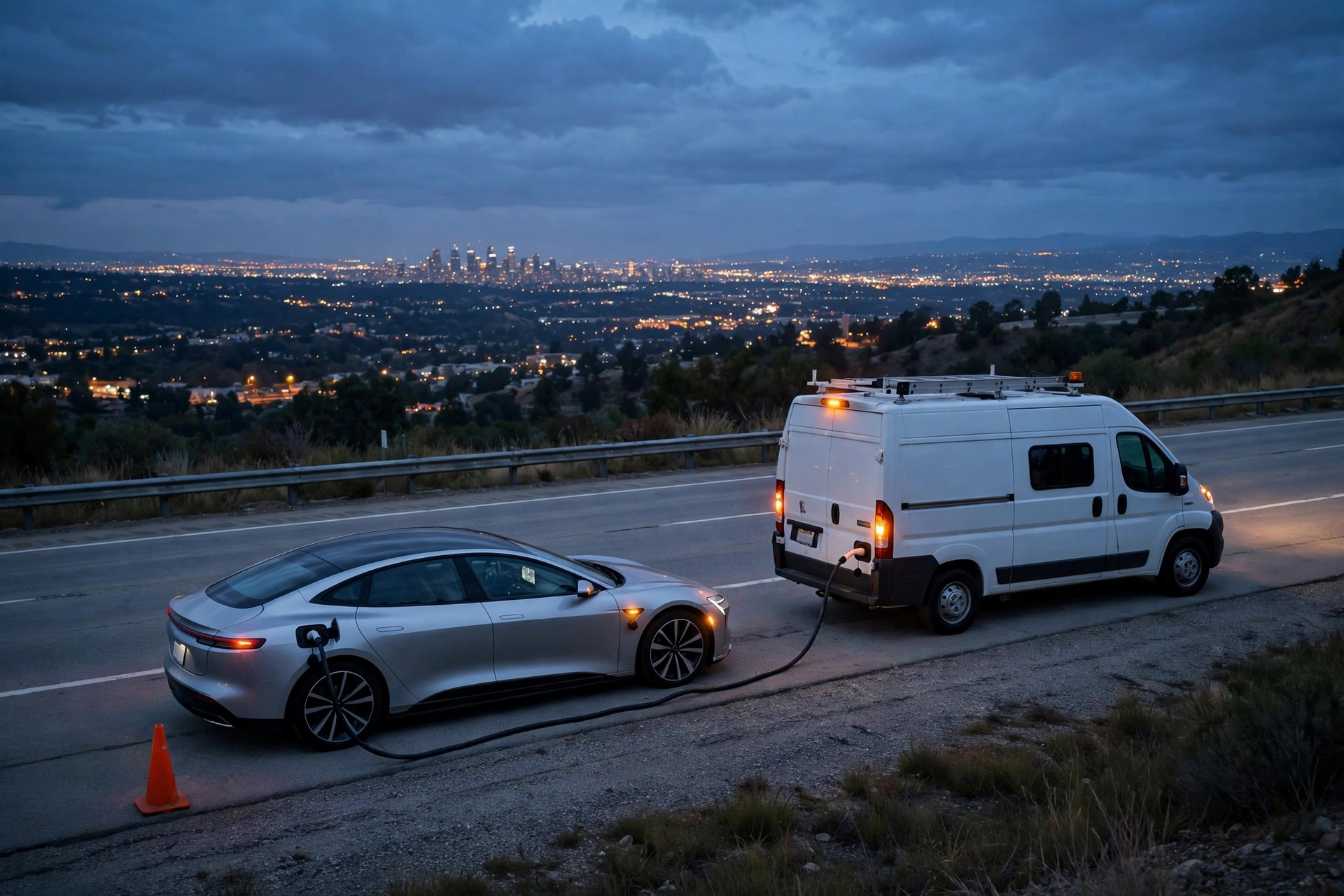
The Problem
An electric car fails differently from a gas car, and the roadside system was built for gas cars. A gas car that runs out of fuel gets a gallon delivered and drives away. A gas car that breaks down can be hooked by a wheel-lift truck and dragged to a shop. Neither move works the same way for an EV. An EV with a dead traction battery cannot be refueled from a jerry can. An EV generally cannot be towed with its driven wheels on the road, because turning those wheels spins the motor and generates current with nowhere safe to go, which can damage the motor, the inverter, or the pack. The safe move is a flatbed, and flatbeds cost more, take longer to arrive, and are scarcer at 2 a.m. on a rural highway than a standard wrecker.
The result is a mismatch between what the driver needs and what gets dispatched. A driver who misjudged range by ten miles, arrived at a public charger that was broken or occupied, or watched cold weather eat a quarter of the predicted range does not need a truck that carries the car. The driver needs ten to fifteen kilowatt-hours, delivered where the car sits, which at typical efficiency is roughly 30 to 50 miles of range. A driver with a dead 12-volt battery, the small battery that runs the lights, locks, and computers in every EV, needs a jump and a replacement, not a tow. A driver with a flat tire needs a tire, since most EVs carry no spare. The UK's AA reported attending more than 190,000 EV breakdowns in 2025 and resolving 88.4% of EV callouts at the roadside in the second quarter of 2026, slightly better than the 84.6% rate for petrol and diesel cars, as reported by Breakdown Cover's summary of AA data. The lesson is not that EVs break down more. It is that most EV breakdowns can be fixed where the car sits, if the crew that arrives is trained for high voltage, carries the right adapters and tires, and is not paid by the tow.
Coverage is fragmented in a way that makes the problem worse. AAA is not one company for this purpose. It is a federation of clubs with different terms. AAA Northeast's membership terms state that if an EV runs out of charge, the club will attempt to deliver enough charge to reach the nearest charging station, with basic members charged $7.50 per mile of range provided and Plus and Premier members covered, according to the club's published terms. AAA's Midwestern club, by contrast, states plainly on its EV roadside page that it does not provide EV charging and that a member whose EV runs out of charge will be towed to a charging station within the plan's towing distance, as shown on its EV assistance page. A driver crossing state lines can cross from a charge-delivery policy into a tow-only policy without ever being told. Insurers and automakers each run their own programs on top of this, with different phone numbers, different tow limits, and different rules about who pays when the nearest charger is 40 miles away.
Meanwhile the fleet keeps growing into the gap. The Department of Energy's 2025 registration estimates, derived from Experian data, put about 7.45 million plug-ins on the road, as reported by FinChannel's summary of the DOE figures. Public charging has not kept pace in the places that matter most to a stranded driver: the charger at the end of the trip. The US has about 82,595 charging stations with 259,687 chargers, according to Motley Fool's state-by-state charger count, and the National Renewable Energy Laboratory estimated in 2023 that more than one million additional public chargers would be needed by 2030 to support 33 million EVs on the road, as cited in the Alliance for Automotive Innovation's quarterly report, available at autosinnovate.org. A driver does not need the national average. The driver needs one working charger, tonight, within range. When that charger is broken, occupied, or behind a payment system that will not accept the driver's card, the roadside call is the backup plan, and today the backup plan is a flatbed.
Market Size
TAM calculation: Start with the whole roadside market, then take the EV share, rather than starting with dead batteries. Custom Market Insights puts the US vehicle roadside assistance market at $2.31 billion in 2024 and $2.40 billion in 2025, as published at Custom Market Insights. Divide that $2.40 billion by a blended average job value of $165, between a $75 to $125 local tow and longer flatbed jobs, and the market represents roughly 14.5 million roadside events per year across about 296 million light vehicles, or about 4.9% of vehicles needing help in a given year. Apply that same 4.9% incidence to 7.45 million plug-ins and the EV roadside market today is about 365,000 events per year, worth about $60 million in job revenue at $165 per event.
That $60 million is the honest size of EV roadside response today, and it is small. The growth case is the fleet. Under the NREL scenario of 33 million EVs on the road by 2030, the same 4.9% incidence and a $175 average job value produce about 1.62 million EV roadside events worth about $283 million per year. Add scheduled and adjacent work that the same vans and dispatch system can serve, including rental-fleet EV returns, fleet vehicles that come back to a depot below their next route's range, and event and construction-site charging, estimated here at $120 million, and the total addressable market at 2030 fleet scale is about $400 million per year. The TAM is a bet on fleet growth, stated as such, not a claim that the market is already large.
The realistic SAM is the three states where plug-ins concentrate today. California alone holds about 1.84 million battery-electric vehicles in the 2025 registration data, with Florida at about 450,400 and Texas at about 387,400, per the DOE figures cited above. Those three states hold about 2.68 million battery-electric vehicles, and scaling by the national ratio of plug-ins to battery electrics (7.45 divided by 5.69) gives about 3.5 million plug-ins in the three states. At 4.9% incidence and $185 per job, reflecting higher flatbed use for EVs, the three-state EV roadside service market is about $32 million per year today. A Year 3 revenue target of $8 million, about a quarter of that three-state service market, plus membership and fleet contract revenue, is the operating goal, not the SAM itself.
The Product
An EV-only roadside response network, sold business-to-business to insurers, automakers, rental fleets, and motor clubs, with a direct consumer option for drivers without coverage. The network owns or contracts a fleet of response vans in launch metros, staffed by high-voltage-trained technicians, and runs one dispatch system that decides the cheapest safe fix before it dispatches a truck. Core modules:
- Mobile charge delivery: Vans carry a 100 to 150 kWh battery pack and a 50 to 75 kW DC output, with CCS, NACS, and CHAdeMO adapters. The standard rescue delivers 8 to 12 kWh, enough for roughly 25 to 40 miles, in about 15 to 25 minutes. The pitch to the driver is not a full charge. It is enough range to reach a charger the driver chooses, with the dispatch system confirming that charger is working before the van leaves.
- Fix-first triage: Before dispatch, the system checks the vehicle's reported symptoms against the fixes that resolve most EV callouts: 12-volt battery test and replacement, tire repair or replacement from a van-stocked set of common EV tire sizes, software reset procedures by make and model, and charge-port and adapter faults. The UK AA roadside fix rate cited above is the reason this module exists. A network that only delivers charge will sit idle between rare dead-battery calls. A network that fixes the common failures earns its keep every day.
- Flatbed-light recovery: When a tow is truly needed, the network dispatches flatbeds from partner tow operators under EV-specific terms: all wheels off the ground, no wheel-lift towing, photo documentation before loading, and a destination chosen by charger availability rather than by which tow yard is nearest. The network charges for the recovery, not for the tow miles, which removes the incentive to tow a car that could have been charged.
- Dead-charger rescue: A distinct job type, and a growing one. The driver did everything right, arrived at a public charger with range to spare, and found it broken, full, or unable to take payment. The van delivers range to the next working charger and the system logs the dead charger, building a reliability record that insurers and fleets will pay attention to because it predicts where their next claims will come from.
- Fleet and rental contracts: The same vans serve contracted work in off-peak hours: topping up rental EVs returned below the required charge level, rescuing fleet vehicles that missed depot charging, and covering event sites. Contracted work fills the utilization gap that kills pure consumer roadside businesses, and it is sold per vehicle per month rather than per panic call.
Unit Economics
| Metric | Value |
|---|---|
| Consumer rescue price (up to 25 miles of range) | $149 |
| B2B price per completed job (insurer, OEM, motor club) | $165 |
| Blended revenue per job | $155 |
| Energy and battery-cycle cost per job | $8 |
| Driver, dispatch, and van cost per job | $57 |
| Gross margin per job | about 58% |
| Jobs per van per day at maturity | 6 |
| Annual EV roadside membership | $79 |
| Fleet contract price per vehicle per month | $6 to $12 |
| All-in cost per response van | $120,000 |
| Startup cost (18-month runway, 10 vans) | $2.9M |
| Break-even | 20 months |
Methodology note: The $120,000 per van is an estimate built from parts: about $48,000 for the van, about $52,000 for the battery pack, DC output hardware, adapters, and safety equipment, and about $20,000 for upfitting, tools, tires, and initial insurance. The $8 energy cost per job covers about 12 kWh delivered, including depot charging and battery-cycle wear on the van's pack. The $57 operating cost per job covers driver time, dispatch, van depreciation, maintenance, and insurance, spread over six jobs per van per day. Six jobs per day is a maturity figure, not a launch figure. Launch months will run closer to two or three jobs per van per day, which is why contracted fleet work is in the plan from the start rather than added later. The $2.9 million startup cost covers ten vans at $120,000, dispatch software and integrations, high-voltage training and certification, insurance deposits, and 18 months of operating losses while insurer contracts are signed.
Go-to-Market
Phase 1 (months 1–8): Launch in one metro with dense EV ownership and long charger gaps on its highway corridors, such as the Los Angeles basin and the routes east toward Palm Springs and north toward the Central Valley. Put ten vans on the road, sign one regional insurer and one rental fleet as anchor contracts, and sell the consumer rescue at $149 as a direct option in the dispatch app. The anchor contracts matter more than the app. Insurers already pay for tows. The sale is a simple comparison: a $165 specialist job that ends with the driver driving away, against a $125 to $275 flatbed tow that ends with the driver still needing a charge, plus the damage-claim risk that comes with loading an EV.
Phase 2 (months 9–16): Expand to the other two SAM states, Florida and Texas, using the same playbook: one metro each, one insurer anchor each, and a shared dispatch system. Add the dead-charger rescue job type as a distinct product, marketed to fleets whose drivers file the most dead-charger complaints. Publish the network's own response-time and fix-at-roadside rates by metro, since insurers buy measured performance and the incumbents publish almost none of it for EVs specifically.
Phase 3 (months 17–24): Sell to automakers as a white-label roadside option for vehicles out of their factory roadside period, and to motor clubs as a subcontractor for EV calls in states where the club's own policy is tow-only. The club pitch is the most direct: the club keeps the member relationship, the network takes the EV calls the club currently loses money on, and the member gets charge instead of a flatbed. Target 30 vans across six metros and $8 million in annual revenue by the end of Year 3.
Competitive Landscape
| Company | What It Does | EV Roadside Gap | Pricing |
|---|---|---|---|
| SparkCharge | Mobile off-grid charging as a service for fleets, after starting with consumer portable charging | Pivoted to fleets. Raised more than $100 million, including a $30.5 million round in May 2025, and now signs fleet charging deals with Hertz, Amazon, Lyft, and AAA Northeast, per AINvest's coverage of the raise and a Pulse 2 interview with its founder. No consumer roadside dispatch network for stranded drivers | 35 to 60 cents per kWh for fleet charging |
| AAA clubs | 63 million members across a federation of clubs, per Market Research Future's market report at marketresearchfuture.com | Policy differs by club. Northeast attempts charge delivery. The Midwestern club states it does not provide EV charging. Tow is the default in most of the country | Membership, varies by club and tier |
| Agero | White-label dispatch platform for insurers and automakers | Dispatches the nearest available provider, which for an EV is usually a tow operator, not an EV specialist. Software without a specialist fleet | B2B contract pricing |
| Urgently | Digital-first roadside platform with OEM telematics integration, $85 million Series D in September 2024 | Asset-light dispatch, same limitation as Agero: the network is only as EV-capable as the tow operators on it | B2B contract pricing |
| Automaker roadside programs | Factory roadside help during the warranty period, by brand | Ends with the warranty, covers only that brand, and usually dispatches a tow. A five-year-old EV from a brand the driver no longer follows is on its own | Included with new vehicle, then expires |
| Traditional tow operators | Local tow and recovery, mostly independent | Paid by the tow, equipped for gas cars, often without high-voltage training or charging hardware. The incentive points toward towing, not fixing | $75 to $125 hookup plus $3 to $5 per mile |
| This startup | EV-only roadside response: mobile charging, fix-first triage, flatbed-light recovery | The product is the dispatch decision itself: charge or fix before tow | $149 consumer, $165 B2B per job, $79 per year membership |
The gap in the competitive landscape is structural. The companies with the members, AAA and the insurers, do not own EV-specialist fleets. The companies with the dispatch software, Agero and Urgently, do not own fleets at all. The company with the best mobile charging hardware, SparkCharge, left the consumer roadside market to serve fleets, where the contracts are larger and the utilization is predictable. Nobody owns the last mile for a stranded EV driver who is not a fleet customer. That is the opening, and it stays open only until one of the dispatch platforms buys or builds a specialist fleet of its own.
Why Now
Four forces make the timing right. First, the fleet has crossed the size where a specialist network can fill its vans. At 7.45 million plug-ins, the 4.9% incidence used above already implies about 365,000 EV roadside events per year, and the fleet is still adding more than a million vehicles a year on the Alliance for Automotive Innovation's trajectory. A specialist network launched five years ago would have starved. One launched now starts with a real, if small, market and grows with the fleet.
Second, the vehicles leaving factory roadside coverage are the ones that need help most. New EVs carry several years of manufacturer roadside help. The cars aging out of that coverage are older, higher-mileage, and more likely to need a 12-volt battery, a tire, or a charge. The second and third owners of those cars have no dealer relationship and no roadside plan, which makes them the best direct customers for a $79 annual membership.
Third, public charger reliability is now a roadside problem, not just an inconvenience. When a driver arrives at a broken charger with 8% remaining, the next charger may be out of range, and the only options are a charge delivery or a tow. The NREL gap cited above, more than one million additional public chargers needed by 2030, means dead-charger rescues will grow faster than dead-battery rescues, because the driver did nothing wrong and the infrastructure failed instead.
Fourth, insurers are motivated buyers. A flatbed tow for an EV costs more than a standard tow, carries damage-claim risk from improper loading, and still leaves the driver needing a charge at the destination. An insurer that replaces a $200 tow plus a damage claim with a $165 job that ends with the car driving away saves money on the claim and keeps a customer who would otherwise spend the evening angry at the insurer's vendor. The pitch is arithmetic, not environmentalism, and arithmetic closes insurer contracts.
Original Contribution: The Dead-Battery Fallacy
A calculation nobody selling mobile EV charging wants to publish: the market for rescuing drivers who simply ran out of charge is tiny, and any business sized on it alone will fail. AAA learned this a decade ago. When it first deployed EV recharging trucks, its director of automotive engineering told reporters that out-of-charge service calls numbered in the thousands, but not tens of thousands, because EV drivers watch their remaining range far more closely than gas drivers watch a fuel gauge, as reported by CleanTechnica. Take the generous end of that historical range and update it for a fleet roughly three times larger: 20,000 dead-battery events per year in the US. At $149 per rescue, that is $2.98 million in annual revenue for the entire country. A venture-scale business cannot be built on $3 million of demand, and a network of vans sized for it would sit idle 360 days a year.
That is the fallacy in most mobile charging pitches: they size the market by dead batteries. The real market is everything else that strands an EV, priced above. At 365,000 EV roadside events per year and $165 per event, full EV roadside response is about $60 million today, twenty times the dead-battery slice. The UK AA data points the same way: 190,000 EV breakdowns in one country in one year, with nearly nine in ten fixed at the roadside, and almost none of them about an empty traction battery. Mobile charging is the headline product and the reason drivers remember the brand. Fix-first triage, 12-volt batteries, tires, and flatbed-light recovery are the revenue. Any pitch deck that leads with dead batteries and hides the triage revenue has the business backwards.
Limitations
This analysis has five acknowledged weaknesses. First, the 4.9% roadside incidence rate is derived by dividing a market-size estimate by an average job value, both of which are estimates. The true EV incidence could be lower, because EV drivers are more careful about range, or higher, because EV tires wear faster under vehicle weight and EV owners are more likely to call for help than to change a tire themselves. A one-point error in incidence moves the $60 million figure by about $12 million.
Second, the $165 average job value blends consumer rescues, insurer jobs, and fleet work that may price very differently. Insurers negotiate hard and pay slowly. If B2B jobs settle at $130 rather than $165, gross margin falls from about 58% to about 47% at the same cost per job, and break-even slips past 24 months.
Third, van utilization is the operating risk that the unit economics hide. Six jobs per van per day is a maturity figure that assumes dense metro coverage and contracted fleet work filling the gaps. Roadside demand peaks in cold snaps, holiday travel, and evening rush hours, and vanishes at 3 a.m. on a Tuesday. A network that staffs for peaks loses money in troughs, and a network that staffs for averages misses the peaks that build its reputation.
Fourth, high-voltage work carries liability that a standard roadside business does not. A technician who mishandles a damaged pack, or charges a vehicle with a known battery fault, can cause a fire that destroys the car and endangers the crew. Training, certification, insurance, and strict rules about which vehicles the network will charge rather than tow are not overhead. They are the business, and they cost more than the plan allows if claims arrive early.
Fifth, this analysis does not account for the response of the dispatch platforms. Agero or Urgently could add an EV-specialist tier to their existing networks faster than a startup can build ten vans, by certifying and equipping existing tow operators. The startup's defense is that certified tow operators paid by the tow still face the wrong incentive, but a platform that pays a flat specialist fee per EV job would close much of the gap without owning a single van.
Strongest Counterargument
The most compelling case against this startup is that it solves a problem drivers have already learned to avoid, in a market where the incumbent response, a tow, already works. EV drivers do watch their range. AAA's own experience, cited above, is that out-of-charge calls stayed in the thousands even as the fleet grew, because drivers leave a reserve and plan around chargers. Public charging keeps improving, home charging covers most daily driving, and the cars themselves now route to chargers, warn about range, and slow down to preserve it. The stranded EV is a rare event, and rare events do not support a dedicated fleet. The rational response for an insurer is to keep paying for flatbeds a few thousand times a year, not to fund a specialist network that spends most of its time waiting.
The counterpoint is that the business does not depend on stranded drivers being common. It depends on stranded drivers being expensive when they do occur, and on the network earning its keep on the common failures in between. A flatbed tow at $200, plus a damage claim, plus a lost evening for the customer, is an expensive rare event, and insurers pay for thousands of expensive rare events every year. The UK data shows the common failures are already there: tires, 12-volt batteries, and minor faults, at a volume that fills vans. The network is not a bet that drivers will run out of charge more often. It is a bet that the roadside system built for gas cars charges too much and fixes too little for the cars now on the road, and that the fix-first crew will win the contract even if the dead-battery calls never arrive.
The Bottom Line
The US roadside market is worth $2.40 billion a year, the EV share of it is about $60 million today and about $283 million at 2030 fleet scale, and the current answer for a stranded EV in most of the country is a flatbed tow that costs $125 to $275 and still leaves the driver needing a charge. The companies with the members do not own specialist fleets, the companies with the software do not own fleets at all, and the company with the best charging hardware left the consumer market for fleet contracts. A network that delivers 25 miles of range, fixes the small failures first, and tows only when it must can undercut the tow on price, beat it on driver experience, and sell the savings to the insurers who currently pay for both. The dead-battery market alone is worth about $3 million and would never justify the vans. The full EV roadside market is twenty times larger, and that is the market worth building for.
What You Can Do
If you drive an EV, check your roadside coverage before you need it, and check it by club and by state, not by brand. Ask two questions: does the plan deliver charge at the roadside, or does it only tow, and who pays per mile of range delivered. If the answer is tow-only, a $79 annual specialist membership or a pay-per-rescue option is cheaper than one flatbed tow. If you run an insurer or a fleet, pull your last 12 months of EV roadside claims and split them into tows, 12-volt jobs, tire jobs, and dead-battery jobs. If more than half were tows, you are paying tow prices for fixable failures, and a fix-first pilot in one metro will show the savings in a quarter. If you are a tow operator, high-voltage training and a charging unit on one truck is the cheapest hedge against a market where the tow is no longer the default answer.
Related
📰 EV Charger Uptime Compliance SaaS for NEVI-Funded Station Operators - the station operators whose broken chargers create dead-charger rescues
📰 The $20 Heist: Cable-Theft Defense for EV Charging Networks - another reason the charger at the end of the trip may not work
📰 Tow Rotation Compliance & Non-Consensual Fee Intelligence SaaS - the tow market this network competes with, and its fee practices