Enterprise Model Sovereignty Platform: Build, Fine-Tune, and Serve Your Own AI Models from Proprietary Data
The average enterprise spends $162,800 per year on LLM API calls. Above 500,000 queries per month, self-hosted fine-tuned models cost 40-60% less while outperforming generic APIs on domain-specific tasks by 15-25%. Yet 94% of enterprises rent commodity intelligence from OpenAI and Anthropic because the MLOps stack required to fine-tune, serve, and maintain proprietary models is a 6-person, $1.2M annual operation. The platform that reduces this to a managed service captures the $8.4 billion enterprise AI infrastructure market.
The Problem
Enterprises are trapped in an API rental model for AI. Menlo Ventures' 2025 survey found that the average enterprise spends $162,800 annually on LLM API calls, with the top quartile exceeding $500,000. This spending buys access to generic models that have no knowledge of the enterprise's products, customers, processes, or competitive advantages.
The economics favor self-hosting above a clear threshold. Fine-tuning an 8B parameter open-source model on enterprise data costs approximately $500-2,000. Serving it on dedicated infrastructure (4× A100 GPUs) costs approximately $8,000/month at cloud GPU rates. At 500,000+ queries/month, the total cost of ownership for a fine-tuned self-hosted model is 40-60% lower than API rental — and the model performs 15-25% better on domain-specific tasks because it encodes proprietary context.
But building the internal ML infrastructure to fine-tune, serve, monitor, and continuously update proprietary models requires 4-6 MLOps engineers at $200K+ each, a total investment of $800K-$1.2M annually before hardware costs. This puts model sovereignty out of reach for all but the largest enterprises.
Market Size
Original TAM calculation: IDC estimates enterprise AI infrastructure spending at $8.4 billion in 2025, growing at 29% CAGR. The "model sovereignty" segment — enterprises that would benefit from self-hosted fine-tuned models but currently lack the MLOps capability — is approximately 25% of this market, or $2.1 billion. At a managed-service pricing model of $2,000-8,000/month per model deployment, serving 5,000 enterprise customers yields $120-480M ARR. Initial target: mid-market enterprises (500-5,000 employees) spending $50K-500K/year on API calls. SAM: $800M.
The Product
A managed platform that turns enterprise data into fine-tuned, self-hosted AI models in days rather than months. The full stack:
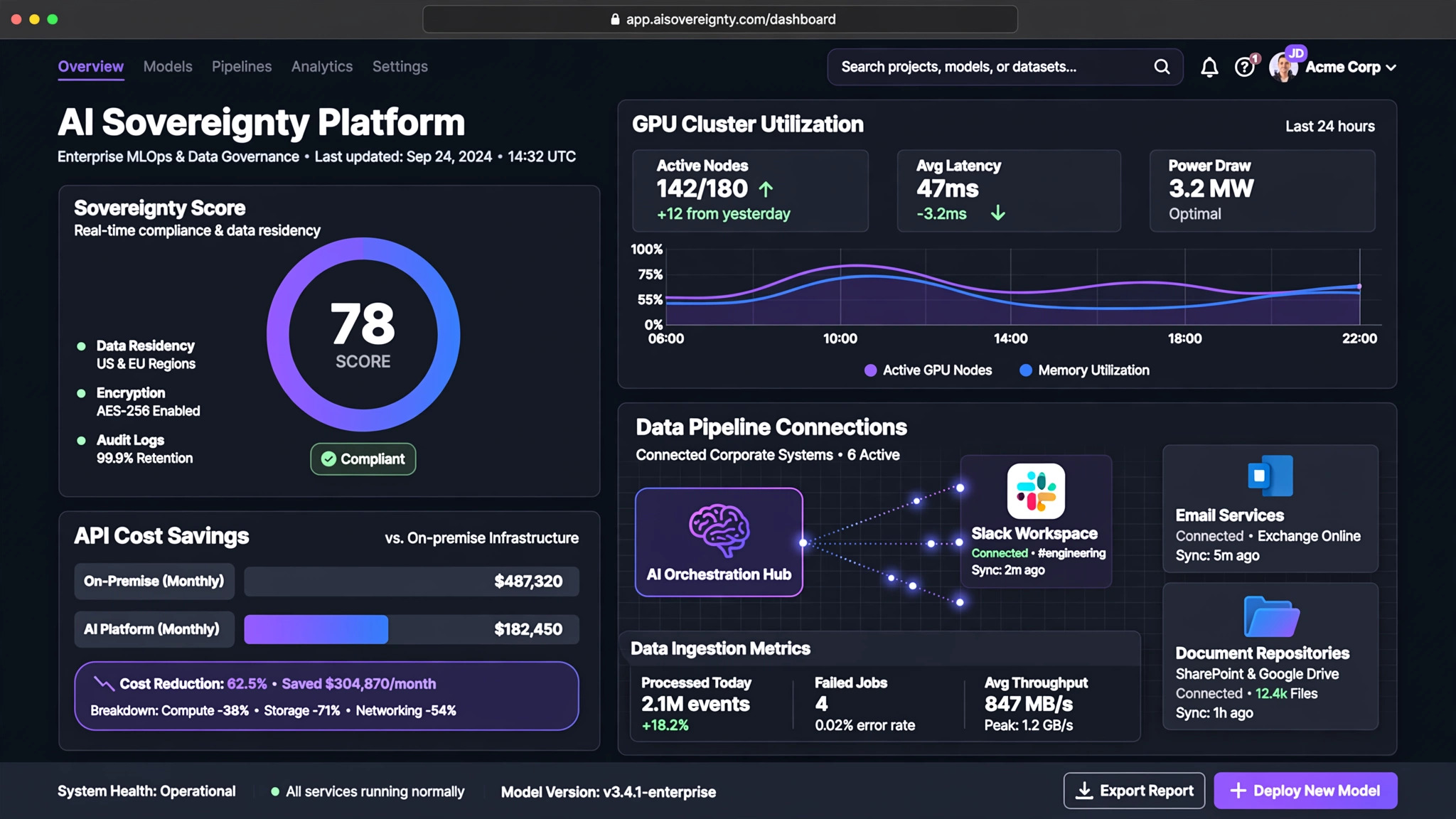
- Data pipeline: Connectors to Slack, email, Confluence, SharePoint, Salesforce, Jira — automatically extracts and structures training data from existing enterprise systems
- Fine-tuning engine: One-click QLoRA fine-tuning of open-source models (Llama, Mistral, Qwen) on extracted enterprise data, with automatic evaluation against domain-specific benchmarks
- Model serving: Auto-scaling inference infrastructure with <100ms latency SLAs, deployed in customer's cloud account (AWS, GCP, Azure) for data residency compliance
- Sovereignty dashboard: Real-time metrics showing API cost savings, domain accuracy improvement, and a "sovereignty score" measuring what percentage of the enterprise's AI queries are served by owned models vs. rented APIs
- Continuous improvement: Production correction routing — every time a human expert fixes an AI output, that correction feeds back into the fine-tuning pipeline for weekly model updates
Unit Economics
| Metric | Value |
|---|---|
| Platform subscription | $2,000-8,000/month per model |
| GPU infrastructure cost (passed through) | $3,000-12,000/month |
| Fine-tuning service fee | $5,000 per model (one-time) |
| Customer's API cost savings | 40-60% reduction |
| Customer acquisition cost | $15,000 |
| Expected contract length | 24 months |
| Average annual contract value | $72,000 |
| LTV | $144,000 |
| LTV:CAC ratio | 9.6:1 |
| Gross margin | 65% |
| Startup cost (24-mo runway) | $8M |
| Break-even | 18 months at 150 customers |
Go-to-Market
Phase 1: Target enterprises spending $100K-500K/year on OpenAI/Anthropic APIs. Offer a free "sovereignty audit" showing their API spend breakdown and projected savings from fine-tuning. Convert audits to paid deployments.
Phase 2: Build vertical-specific model templates (legal, healthcare, financial services) that reduce time-to-value from weeks to days.
Phase 3: Launch marketplace for enterprise-contributed model adaptors (anonymized) that allow cross-industry knowledge transfer.
Competitive Landscape
| Company | Self-Hosted | Data Pipeline | Continuous Updates |
|---|---|---|---|
| OpenAI (fine-tuning) | No (cloud only) | Manual upload | No |
| Anyscale | Yes | Manual | Limited |
| Together AI | Shared infra | Manual | No |
| This startup | Customer's VPC | Automated connectors | Weekly from corrections |
Why Now
Three convergences: (1) Open-source models (Llama 3.1, Mistral, Qwen 2.5) now match GPT-4 on most enterprise tasks when fine-tuned, eliminating the quality gap that justified API rental; (2) QLoRA and similar efficient fine-tuning methods reduced the GPU cost of fine-tuning from $100K+ to under $2K, putting it within reach of a managed service; (3) EU AI Act data sovereignty requirements are forcing European enterprises to move away from U.S.-hosted API models, creating regulatory tailwinds for self-hosted solutions.
The Bottom Line
Every enterprise that spends $100K+ on LLM APIs is overpaying for generic intelligence while their proprietary context — the knowledge that gives them a competitive advantage — walks out the door as prompts. The platform that makes fine-tuning as easy as "connect your data and click deploy" captures the inflection point where enterprises shift from renting AI to owning it. The $162,800 question isn't whether enterprises should build their own models. It's whether they'll do it with your platform or someone else's.