73% of Nursing Homes Have Inadequate Emergency Power, Per a 2026 Federal Audit. The Monthly Generator Test Is Still Logged on Paper.
NFPA 110 requires weekly inspections, monthly 30-minute loaded test runs, annual load-bank tests for diesels that never reach operating temperature, and a 4-hour loaded run every 36 months for Level 1 systems, with every event documented to a specific record standard. The federal government just published an audit finding that nearly three-quarters of nursing homes cannot keep the lights on. The compliance record for all of this testing is a clipboard, a contractor's PDF, or a spreadsheet with missing months. No vendor-neutral platform turns generator testing into survey-ready evidence.
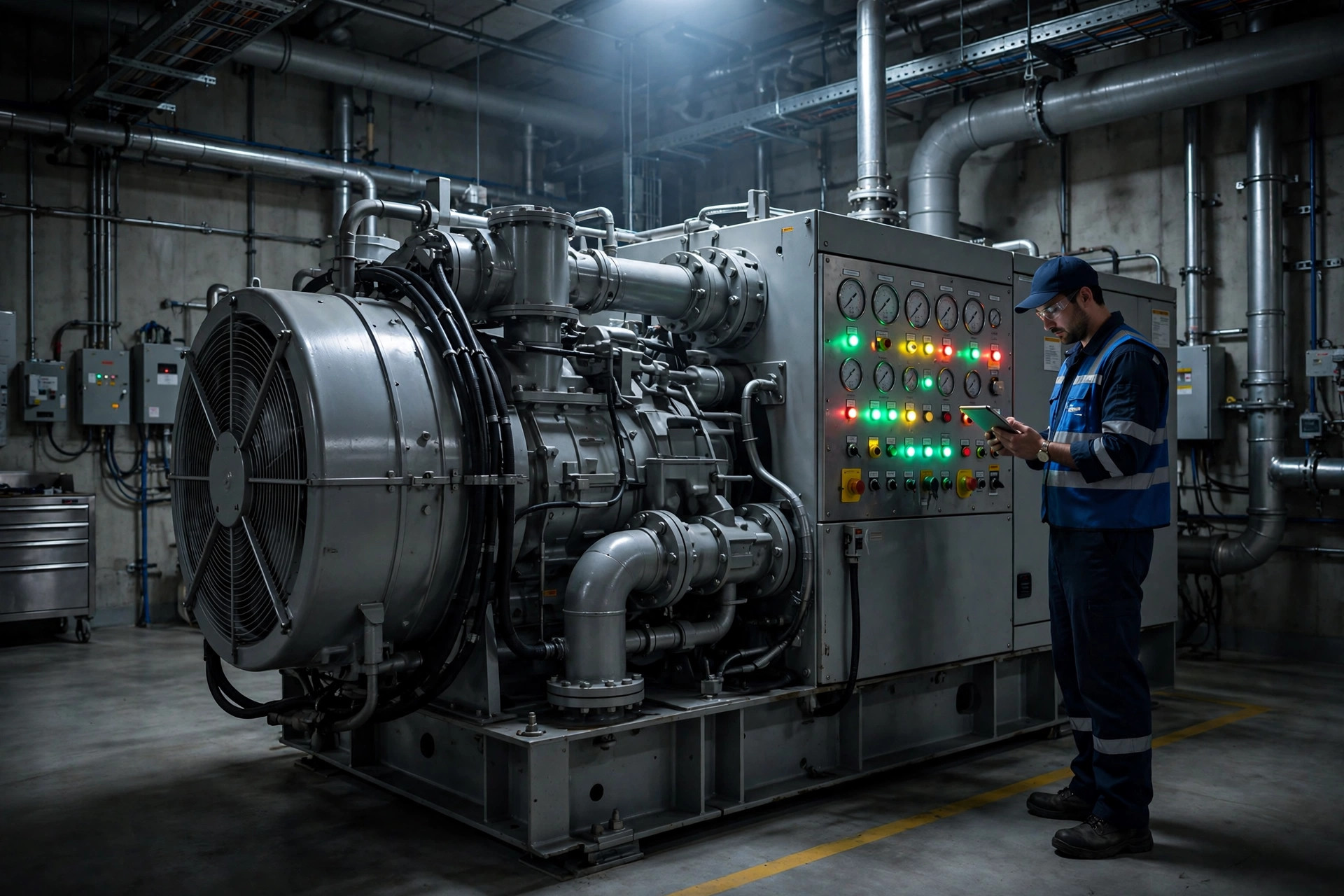
The Problem
In 2026, the Department of Health and Human Services Office of Inspector General published a national audit of nursing home emergency power, and the numbers are grim. Of 100 sampled facilities, 72 had emergency-power deficiencies, 119 in total. Extrapolated nationally: an estimated 10,983 of 15,115 US nursing homes, 73 percent, have inadequate or unreliable emergency power, with more than half showing inadequate generator maintenance and nearly four in ten showing inadequate circuit coverage, meaning the generator could not actually power what the emergency plan assumed it would. One in ten generators was over 40 years old. The audit report is OIG A-02-23-01022, and its highlights summary reads like an indictment of an entire maintenance culture.
The testing standard behind all of this is NFPA 110, the Standard for Emergency and Standby Power Systems, and it is not a vague best-practice document but a specific, enforceable cadence. Every emergency power supply system gets a weekly inspection including transfer switches. Every system gets exercised at least monthly for a minimum of 30 minutes at 30 percent of nameplate or enough load to reach manufacturer exhaust temperatures, and diesel units that cannot meet that monthly minimum get an annual load-bank test instead: 30 continuous minutes at 50 percent of nameplate, then a full hour at 75 percent. Level 1 systems, the category covering hospitals and nursing homes, must run under load for up to four hours at least once every 36 months, with the final hour at 75 percent of nameplate or greater.
Then there is the recordkeeping standard, which is where the business lives. NFPA 110 requires written records for all inspections, operational tests, exercising, repairs, and modifications, and each record must include the date, the servicing personnel, notation of any unsatisfactory conditions with the corrective action taken including parts replaced, and testing of any repair per manufacturer recommendation, a standard most facilities meet only when a surveyor is already in the building. The records must be available to the authority having jurisdiction on request. Federal law layers on top: long-term care facilities fall under 42 CFR 483.73(e) and hospitals under 42 CFR 482.15(e), both requiring implementation of the NFPA 110 inspection, testing, and maintenance requirements. The Joint Commission surveys hospitals against EC.02.05.03 and EC.02.07, and its own engineering data shows utility-system standards among the most cited in the country: 56 percent noncompliance on EC.02.05.01 in 2016, and a 52.6 percent RFI rate on the utility testing element EC.02.05.05 EP 6 as recently as 2023. Roughly two-thirds of Joint Commission clarifications come down to one phrase: lack of documentation.
The stakes are not theoretical. In August 2021, seven Louisiana nursing home residents died after Hurricane Ida knocked out power and they were evacuated into an overcrowded warehouse; in February 2021, Winter Storm Uri knocked out power to 118 Texas nursing homes. In August 2023, Adventist Health White Memorial in Los Angeles lost emergency power and evacuated 28 critical-condition patients to other hospitals while moving 213 more to another building. Generators fail for boring reasons: fuel contamination, weak batteries, clogged filters, controls nobody exercised. The monthly test exists precisely to surface those boring failures before the storm does.
And the monthly test is documented the way it was documented in 1985. A service contractor visits, runs the unit, fills out a paper form or a PDF, and hands it to the facilities director, who files it, while in-house techs log runs in CMMS work orders typed from memory at the end of the shift, or in a spreadsheet nobody audits. Come survey time, the facilities team discovers that March and July have no records, that the load readings were never captured, that the deficiency noted in October has no documented corrective action, and that nobody can prove the 36-month Level 1 test happened within its window. The Joint Commission does not cite missing generators; it cites missing proof.
The Gap in the Market
The generator industry sells iron and monitoring, but nobody sells the compliance record. Every incumbent product was built for a different job: watching equipment, not proving to a surveyor that a testing program meets NFPA 110.
| Company | What They Do | What's Missing |
|---|---|---|
| Cummins PowerCommand Cloud | Cloud monitoring built on Azure IoT: real-time visibility, remote start/stop, fault acknowledgment, predictive insights. Works with some third-party equipment. | Vendor-centric by design. It logs telemetry events, not NFPA 110 §8.5.3-compliant test records with servicing personnel, unsatisfactory conditions, and corrective actions. It does not flag the annual load-bank trigger when monthly runs never reach 30 percent load, and it does not track the 36-month Level 1 deadline. A hospital basement with Cummins, Kohler, and MTU units side by side needs one compliance system, not three OEM portals. |
| Kohler OnCue Plus | Remote monitoring and control via web app: event history, exercise scheduling, voltage, frequency, battery status. | Explicitly scoped to residential and light-commercial controllers. Not a healthcare compliance tool, not survey documentation, not NFPA 110 records. |
| Generic CMMS (UpKeep, MaintainX, Fiix, Limble) | Work orders, preventive maintenance scheduling, asset hierarchies. The default digital step up from paper. | No code intelligence. A CMMS cannot distinguish a monthly exercise from the annual load-bank trigger, cannot compute whether logged runs met the 30 percent loading threshold, cannot count down the 36-month Level 1 window, and cannot assemble a survey packet mapped to Joint Commission elements of performance. Every NFPA 110 rule must be hand-configured, and none of it is validated. |
| SafetyCulture / iAuditor checklists | Generic digital checklists, including community-built NFPA 110 monthly test forms. | A checklist is not a compliance program. No scheduling engine, no deadline tracking, no deficiency-to-corrective-action workflow, no survey evidence assembly. The checklist proves someone tapped boxes, not that the testing program is code-compliant. |
| Service contractor paper and PDF forms | The current default. The dealer who maintains the generator hands over a filled form each visit. | Not searchable, not auditable, not aggregated. Months go missing. Deficiencies noted on the form have no tracked remediation. When the surveyor asks for 36 months of records, the facilities director gets a manila folder. |
| Fieldproxy and similar field-service tools | Field-service automation vendors market generator test reminder templates with NFPA 110 references. | Marketing pages for generic field-service software, not an established compliance product. Reminders are the shallowest layer of the problem; the record standard, the loading thresholds, and the survey mapping are the product. |
The structural gap is the direction of the data. Every OEM tool starts with the equipment and reports upward to whoever bought that brand. Compliance starts with the regulation and demands evidence downward across every genset in the building regardless of brand. Hospitals run mixed fleets and nursing homes run whatever the previous owner installed in 1987, which is why the compliance layer has to be vendor-neutral by construction, and why no OEM will ever build it.
The Solution
A vertical SaaS platform that turns NFPA 110 testing from a paper ritual into survey-ready evidence, sold to facilities directors and the independent service contractors who already do the monthly visits. Seven modules. One record standard.
1. NFPA 110 rules engine: Every genset in the fleet gets a code-driven schedule: weekly inspections, monthly 30-minute loaded exercises, the annual load-bank trigger, and the 36-month Level 1 countdown. The engine watches logged run data and fires the §8.4.2.3 load-bank requirement automatically when monthly exercises never reach 30 percent of nameplate, counts down the triennial 4-hour test window per unit, and escalates overdue items to the facilities director before they become survey findings, which is the difference between a calendar reminder and a compliance program. This is the moat: a jurisdiction- and code-aware scheduling core that a generic CMMS cannot replicate without becoming this product.
2. Mobile test capture for the generator room: An offline-first app for the tech standing next to the unit. Start the exercise, capture hour-meter photos, log load readings in kilowatts, record transfer-switch test results, note deficiencies with photos. Timestamps are automatic. The app works in basements with no signal and syncs later. The tech never retypes anything at the end of the shift, which is where records currently go to die.
3. §8.5.3-compliant records vault: Every inspection, test, exercise, repair, and modification stored with the four required elements: date, servicing personnel, unsatisfactory conditions with corrective action including parts replaced, and re-testing of repairs, in an immutable log exportable on demand for the authority having jurisdiction, which retires the manila folder for good.
4. Controller integrations: Direct data feeds from the dominant genset controller brands, Deep Sea Electronics, ComAp, and Woodward, pull run hours, load profiles, alarms, and start counts automatically, so exercises get logged without human transcription and the 30-percent loading threshold math runs against real kilowatt data instead of the tech's memory of the analog gauge, which is where the current numbers come from.
5. Deficiency remediation loop: An unsatisfactory condition noted during a test becomes a tracked item with an owner, a due date, a documented corrective action, and a required re-test. The loop closes in the system instead of living as a scribble in a margin. This is the exact failure mode the OIG audit documented at scale: 53 percent of nursing homes with inadequate generator maintenance.
6. Survey-prep packet generator: One click assembles 36 months of records mapped to Joint Commission elements of performance and CMS tags, with a gap report flagging missing months, undocumented deficiencies, and overdue triennial tests before the surveyors arrive. The packet is the retention wedge: once a facility has three clean survey cycles in the system, leaving means rebuilding the evidence trail from scratch, which no facilities director volunteers for in the six months before a survey.
7. Contractor white-label channel: Independent generator service dealers, the companies that maintain most nursing home and small-hospital fleets, get a branded version. They log every customer visit in the app while their customers get the compliance portal, so the dealer differentiates on documentation instead of competing on hourly rate and the startup acquires facilities without ever making a direct sales call, which is the only economical way to reach 15,000 price-sensitive nursing homes.
The Math: What the Monthly Test Costs a 200-Bed Hospital by Hand
This analysis builds an original cost model for a representative 200-bed hospital with three emergency generators, comparing manual NFPA 110 compliance against the platform. Inputs are stated explicitly; the model should be re-run with a facility's real labor rates.
Monthly exercise labor runs one hour of technician time per genset to reach the unit, run the 30-minute loaded test, and verify transfer, which at three gensets and a fully loaded $45 per hour comes to $135 per month, or $1,620 per year. Weekly inspections at 15 minutes per genset: 39 hours per year at $45, or $1,755 per year. Documentation overhead, the filing, the chasing of missing forms, the spreadsheet updates: 30 minutes per genset per month, 18 hours per year, $810 per year.
Joint Commission survey preparation, every three years, consumes roughly 60 hours of the facilities director's and two techs' time assembling 36 months of test records, reconciling contractor PDFs with internal logs, and writing explanations for the gaps the surveyor will ask about first, which at a blended $55 per hour is $3,300 per survey, or $1,100 per year amortized, and every hour of it is waste created by the filing system.
Then there is the deficiency risk, and the 2023 Joint Commission data quantifies it: a 52.6 percent RFI rate on the utility-system testing element. A finding triggers a corrective action plan, consultant support, and follow-up survey risk; remediation costs for a serious Environment of Care finding run $15,000 to $50,000. Take the midpoint, $25,000, times the 52.6 percent citation rate, amortized over the three-year survey cycle: expected cost of $4,383 per year.
Total manual burden: $1,620 + $1,755 + $810 + $1,100 + $4,383 = $9,668 per year. The platform, at the $399-per-month hospital tier, costs $4,788 per year. Honesty requires noting what the software does not eliminate: someone still has to walk to the generator and run the test, so the $1,620 in exercise labor and $1,755 in inspection labor largely remain. The addressable portion is documentation ($810), survey prep ($1,100), and deficiency risk ($4,383): $6,293 per year of overhead and expected loss against a $4,788 subscription. The software pays for itself on labor alone, and the actual pitch is the survey outcome: arriving at a Joint Commission visit with a gap-free, code-mapped, 36-month evidence packet instead of a manila folder.
Revenue Model
| Revenue Stream | Amount | Notes |
|---|---|---|
| Nursing home tier (1-2 gensets) | $149/month | Rules engine, mobile capture, records vault, gap reports. The OIG-audit wedge: 15,000 facilities under fresh federal scrutiny, most on paper today. |
| Hospital tier (3-8 gensets) | $399/month | Adds controller integrations, deficiency remediation loop, survey-prep packet mapped to Joint Commission EPs and CMS tags. |
| Campus / data center tier (9+ gensets) | $899/month | Multi-building fleet view, API access, custom AHJ export formats. Data centers run dozens of multi-megawatt units per site. |
| Onboarding and historical import | $2,500 one-time | Fleet inventory, controller provisioning, backfill of paper records into the vault. Typically 2-3 weeks. |
| Contractor white-label seats | $99/month per tech seat | Independent service dealers brand the mobile app and portal. The acquisition channel: each dealer brings its customer list. |
Unit economics on a hospital-tier facility: $4,788 ARR plus $2,500 onboarding. Cost to serve runs roughly $600 per year in infrastructure, controller API fees, and support, leaving gross margin near 87 percent. The sales motion targets facilities directors at 100-to-400-bed hospitals and regional nursing home chains on 60-to-90-day cycles, with the contractor white-label channel carrying the long tail of sub-100-bed facilities that no direct sales team could profitably reach, which is exactly where the OIG audit hit hardest. Estimated CAC of $8,000 blended across direct and channel. Five-year retention anchored by the survey cycle and the accumulated evidence vault: LTV near $24,000, LTV-to-CAC around 3x, improving as the contractor channel scales.
Market Size
TAM: Start with the counted facilities. US hospitals: 6,100 per the AHA 2024 survey, at $4,788 per year: $29.2 million. CMS-certified nursing homes: roughly 15,000, at $1,788 per year: $27.0 million. US data centers: 3,000-plus per Pew Research, at $10,788 per year for multi-genset campuses: $32.4 million. Adjacent commercial facilities with emergency power obligations under building and fire codes, including high-rise residential, municipal water and wastewater plants, airports, and universities, add a conservative 40,000 facilities at the nursing-home tier price of $1,788 per year, or $71.5 million, which brings the total addressable market to roughly $160 million per year before any international expansion. Combined TAM: approximately $160 million per year.
SAM: The near-term addressable market is hospitals, nursing homes, and data centers, where the regulatory obligation is explicit and the buyer is identifiable: $88.6 million per year.
SOM (year 3): 350 facilities at a blended $5,400 average contract: $1.9 million ARR, roughly 2 percent of SAM. Two percent. That is the whole plan. The wedge is 150 nursing homes through the contractor channel in year one, expanding to hospitals on the survey-prep story and data centers on fleet-scale testing.
Why Now
The OIG audit landed this year. A federal report estimating that 73 percent of nursing homes have inadequate or unreliable emergency power, with 53 percent showing inadequate generator maintenance, is the kind of document that moves CMS enforcement posture and plaintiffs' attorneys at the same time. Compliance software sells fastest in the eighteen months after the regulator publishes the embarrassing number, and that window is open right now. Eighteen months. Starting now.
The data center buildout is a greenfield wave. Cummins reported data-center orders up 28 percent year over year in Q3 2025, and every new facility comes online with multiple megawatt-scale gensets that need an NFPA 110 testing program from day one. Greenfield buyers have no paper process to defend and no incumbent vendor relationship for compliance, which makes them the easiest conversions in the market.
The fleet is aging into replacement. One in ten nursing home generators is over 40 years old, per the OIG, and the replacement wave now underway forces facilities to recommission, re-document, and in many cases redesign their emergency power programs, which means a facility already spending six figures on a new genset will spend $1,788 a year to document it properly.
Documentation is the deficiency. Joint Commission data consistently shows that the most common survey failure is not broken equipment but missing proof, with lack of documentation driving roughly two-thirds of clarifications. This product sells directly into the single most-cited failure mode in hospital accreditation, and there is no clearer product-market fit signal in healthcare facilities software than a regulator telling you exactly what it cites while a federal audit tells you exactly who is failing.
The incumbent gap is structural, not temporary. Cummins, Kohler, and Generac sell equipment and monitoring tied to their own brands. A hospital basement with three OEMs needs one compliance record, and no OEM will build a vendor-neutral system that ingests competitors' controllers and maps records to Joint Commission survey elements. The independent dealer channel, which services most nursing homes, will never standardize on one OEM's cloud, which is why the neutral layer has to come from outside.
Startup Costs
| Category | Cost | Notes |
|---|---|---|
| NFPA 110 rules engine and scheduling core (4 months) | $120K | 2 engineers. Code-driven schedules per genset, load-bank trigger logic, triennial countdown, AHJ variation handling. |
| Mobile test capture app, offline-first (5 months) | $130K | 1 mobile engineer + 1 backend engineer. Photo capture, timestamping, deficiency notes, basement-grade offline sync. |
| Controller integrations (DSE, ComAp, Woodward) | $80K | Run hours, load profiles, alarms, start counts. Automated logging against real kilowatt data. |
| Survey-prep packet generator | $60K | 36-month evidence assembly mapped to Joint Commission EPs and CMS tags, with pre-survey gap report. |
| Records vault and AHJ export | $50K | Immutable §8.5.3-compliant log, on-demand export for authorities having jurisdiction. |
| Contractor white-label channel | $50K | Branded dealer portals, tech seat management, customer provisioning flow. |
| Legal, SOC 2 Type I, healthcare counsel | $70K | Outside counsel on record-retention posture. SOC 2 because the vault holds operational records auditors rely on. |
| Pilot program (5 facilities, subsidized) | $40K | Real monthly test cycles with design partners: 3 nursing homes, 2 hospitals. Rules-engine validation data and testimonial evidence. |
| Operating buffer (12 months) | $50K | Cloud infrastructure, controller API fees, support tooling. |
| Total | $650K |
Break-even math: at a blended $5,400 average contract and 87 percent gross margin, each facility contributes about $4,700 per year. One hundred forty facilities cover the $650,000 build cost on an annualized basis; at a realistic ramp of 8 to 10 net new facilities per month through the contractor channel, contribution break-even lands around month 22.
Limitations
No citable count of installed commercial emergency generators exists in the US, so the TAM is built from facility counts multiplied by assumed per-facility pricing, not from measured compliance software spend. If facilities prove unwilling to pay $149 to $899 per month for documentation, the TAM compresses toward the service-contract labor it displaces rather than the penalty risk it mitigates. The honest version is that the first hundred sales calls will test willingness to pay for documentation as a standalone line item, something no facility has ever budgeted for, and the pricing may need to hide inside the service contract before it can stand alone.
The Joint Commission citation statistics are at the Environment of Care chapter level. No published figure isolates generator testing as a standalone deficiency category, so the 52.6 percent RFI rate describes the neighborhood of the problem, not the exact address. The deficiency expected-cost math inherits that imprecision.
The OIG audit covers nursing homes only. Extending its urgency to hospitals and data centers is inference: hospitals face Joint Commission rather than OIG pressure, and data centers face uptime economics rather than regulators. The buying motives differ by segment, and the messaging has to differ with them.
The software does not run the test. A human being still walks to the generator room once a month, and the $3,375 per year in exercise and inspection labor in the hospital model stays. The product captures the documentation, scheduling, and audit-readiness value around that labor. If a buyer's mental model is "software should eliminate the visit," the sale fails on expectations.
Controller integration coverage will be incomplete at launch. Deep Sea, ComAp, and Woodward cover the large majority of commercial gensets, but older units run proprietary or purely analog controls, and those facilities fall back to manual mobile capture. The rules engine still works; the automated kilowatt data does not.
Strongest Counterargument
Cummins or Generac could add NFPA 110-compliant test records to their monitoring clouds in a quarter and crush a startup on distribution. They own the equipment relationships, they already stream the telemetry, and their service networks touch every major hospital. A startup selling documentation into a market where the equipment vendor already has a cloud dashboard is selling a feature the incumbent can ship as an update.
This is the serious objection, and the answer has four parts.
First, mixed fleets are the norm, not the exception. A hospital basement with Cummins, Kohler, and MTU units side by side is unremarkable, and no OEM builds a compliance system that treats competitors' equipment as first-class. The vendor-neutral record is structurally unavailable from any single manufacturer.
Second, telemetry is not evidence. A cloud dashboard showing that a generator ran is not a §8.5.3 record naming the servicing personnel, the unsatisfactory conditions found, the corrective action taken, and the re-test results, and building the record standard into the product is regulatory work rather than a dashboard feature, done by people who think in survey outcomes while OEM product teams are organized around equipment.
Third, the survey packet is the product, and no OEM will map test records to Joint Commission elements of performance or CMS tags. That mapping is accreditation consulting encoded in software. It is a different company's job.
Fourth, the 2026 urgency is concentrated in nursing homes, which overwhelmingly run older mixed fleets serviced by independent dealers, the exact segment OEM clouds do not reach. The startup's wedge market and the incumbents' installed base barely overlap. By the time an OEM compliance module matters, the startup owns the dealer channel.
What You Can Do
If you run facilities at a hospital or nursing home: Pull your last 36 months of generator test records this week. Count the missing months. Check whether any logged monthly run actually documents the load in kilowatts against the 30 percent threshold, and whether any run below that threshold triggered a load-bank test. If you cannot answer those questions from your files in an hour, your next survey has a finding waiting in it.
If you own a generator service company: Your monthly visit already produces the raw material; the paper form you hand over is the least valuable form it could take. A white-label compliance portal turns your documentation from a cost center into the reason customers renew. The dealers who productize the log will take share from the dealers who still hand over PDFs.
If you're building this: Start with nursing homes through the contractor channel, because the OIG audit gives you the opening line, the facilities are price-sensitive enough for $149 a month to be an easy yes, and there are 15,000 of them waiting for the call. Nail the rules engine and the mobile capture experience before touching controller integrations; the record standard is the product, telemetry is the accelerant. Sell the survey-prep packet from day one even to customers years from their next survey, because the evidence vault only has value if it has been collecting since before the audit period.
If you're an investor: The US has 6,100 hospitals, roughly 15,000 nursing homes, and 3,000-plus data centers, nearly all of them legally obligated to test emergency generators on a code-prescribed schedule and document every event to a federal record standard. A 2026 federal audit found 73 percent of nursing homes inadequate on emergency power. No venture-funded company owns the compliance record layer, the OEMs are structurally unable to build it vendor-neutral, and the generic CMMS vendors lack the code intelligence. At $650,000 to build and contribution break-even around 140 facilities, this is a capital-efficient wedge into a $160 million TAM with a regulatory tailwind that just got a federal exclamation point.
The Bottom Line
The United States runs its hospitals, nursing homes, and data centers on emergency generators that fire and building codes require to be tested weekly, monthly, annually, and triennially, with every event documented to a specific record standard. A 2026 federal audit found that 73 percent of nursing homes cannot meet the underlying obligation, more than half maintain their generators inadequately, and one in ten units is over 40 years old. The testing still gets logged on paper forms, contractor PDFs, and spreadsheets with missing months, while Joint Commission surveyors cite the resulting documentation gaps at rates above 50 percent. The equipment vendors sell monitoring locked to their own brands, the generic maintenance platforms have no code intelligence, and no vendor-neutral company owns the survey-ready test log. The company that productizes NFPA 110, starting with the rules engine and the mobile capture experience that make the record standard automatic, is selling into a dated legal obligation with a counted buyer list, a federal audit supplying the urgency, a data center buildout supplying greenfield buyers, and an evidence vault that gets more retentive with every survey cycle. The generator still needs a human to run it. Everything around that human is software waiting to be built.