Craft Beverage Excise Tax Compliance SaaS for Small Producers
The United States has 22,621 craft beverage producers filing federal excise tax reports with the Alcohol and Tobacco Tax and Trade Bureau. The Craft Beverage Modernization Act introduced tiered tax rates, proof-gallon credits, and flavor-content deductions that most small producers calculate by hand in Excel. Penalties for filing errors start at $1,000 per occurrence, and TTB audit enforcement is accelerating. Nobody has built affordable, unified tax compliance software that spans beer, wine, and spirits across all 50 state regimes.
The Problem
Every craft beverage producer in the United States operates under a dual tax regime that was designed for industrial-scale manufacturers and never simplified for the 9,578 craft breweries (Brewers Association, 2025), 2,282 craft distilleries (ACSA, 2025), and 10,761 wineries (WineAmerica, 2025) that now populate the American alcohol landscape. At the federal level, these producers must file excise tax returns with TTB on Form 5000.24 (brewers), Form 5110.26 (distillers), or Form 5120.17 (wineries), either monthly or quarterly depending on their tax liability. At the state level, they face a second set of excise tax filings, privilege tax reports, and production reports that vary so dramatically from jurisdiction to jurisdiction that a Virginia distillery selling in 12 states may face 12 different filing calendars, 12 different rate structures, and 12 different penalty regimes.
The federal tax calculation itself is where most errors happen. Before the Craft Beverage Modernization Act provisions were made permanent in December 2020, every barrel of beer was taxed at a flat $18. Now a brewer producing under 2 million barrels annually pays $3.50 per barrel on the first 60,000 barrels, then $16 per barrel on production above that threshold but below 6 million barrels. A distiller pays $2.70 per proof gallon on the first 100,000 proof gallons, $13.34 on the next 22.13 million, and $13.50 on everything above. Wine credits work on a separate tiered system: $1.00 per gallon on the first 30,000 wine gallons, $0.90 on the next 100,000, and $0.535 on the next 620,000. These tiers reset annually. They interact with controlled-group rules that aggregate production across commonly owned entities. They require tracking by proof gallon, wine gallon, or barrel depending on the beverage type. And for distilled spirits containing eligible wine or flavors, producers must calculate 5010 credits and effective tax rates that can drop the rate to $2.36 per proof gallon under certain formulas.
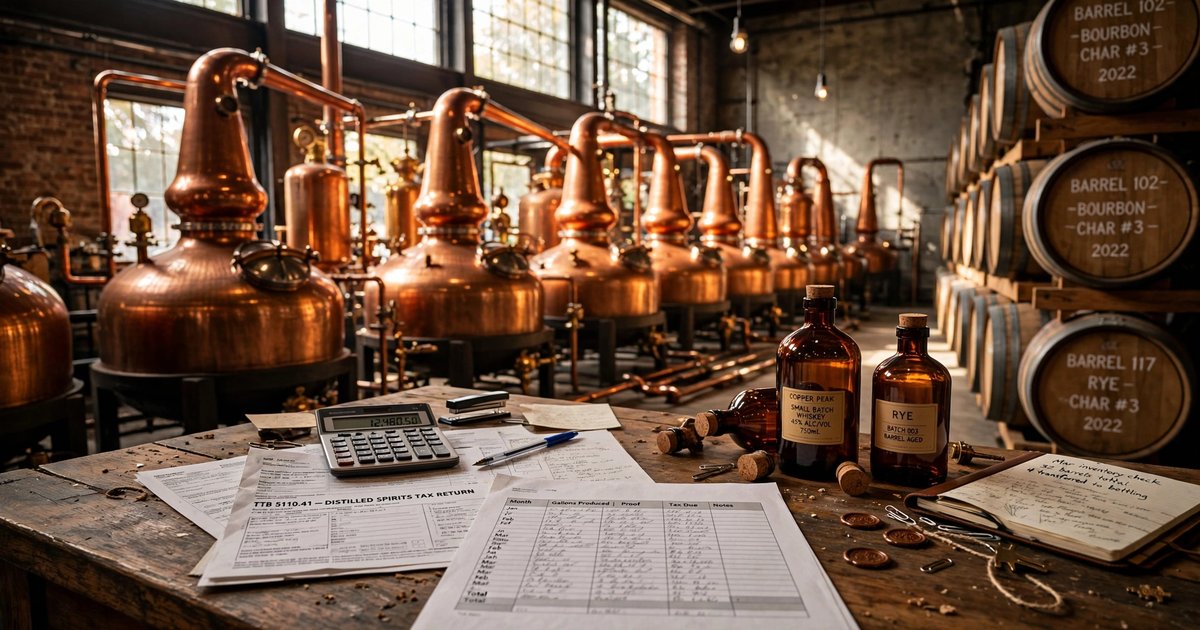
Most craft producers handle this with spreadsheets. A 2023 survey by the American Craft Spirits Association found that the median craft distillery has 7 full-time employees. The person doing tax compliance is also the person doing production, sales, or both. They pull data from their production logs, manually calculate tiered rates, fill in PDF forms, and submit them through the TTB's myTTB portal. A misplaced decimal in a proof-gallon calculation can cascade through the entire return. An arithmetic error on a controlled-group allocation can trigger an amended filing. A missed state deadline in New Hampshire generates different consequences than the same missed deadline in Oregon. The cognitive load is enormous for businesses whose founders went into the industry because they wanted to make whiskey, not because they wanted to become federal tax accountants.
Market Size
Bottom-up TAM calculation: The addressable market is defined by the 22,621 active craft beverage producers in the United States. Not all are equally addressable. Single-barrel hobby distilleries and nano-breweries producing under 100 barrels annually generate minimal tax liability and may not justify a subscription. The addressable segment is producers with sufficient production volume and multi-state distribution to face real compliance complexity. Based on Brewers Association data showing 6,084 breweries above nano-scale (microbreweries + taprooms + brewpubs + regional), ACSA data showing 1,800+ distilleries with meaningful production, and WineAmerica data showing roughly 7,500 wineries above 1,000 cases annually, the primary addressable market is approximately 15,400 producers.
At a $199/month base tier (federal TTB filing automation for a single beverage type in a single state) and a $499/month premium tier (multi-state, multi-beverage-type, full CBMA optimization with audit-ready documentation), with an estimated 65/35 split favoring the base tier, the blended average revenue per account is $304/month. At 15,400 addressable producers, the base TAM is $56.2 million in annual recurring revenue.
A secondary revenue stream targets the compliance service providers who currently do this work manually for clients: accounting firms specializing in beverage alcohol, compliance consultants, and law firms. A white-label or partner version at $1,200/month per firm, targeting the estimated 800 firms active in alcohol compliance (DISCUS directory + state CPA associations with beverage alcohol specialization), adds $11.5 million in potential ARR. Realistic SAM across both segments: $67.7 million. Year 3 target: 2,200 direct producer subscribers at blended $304/month plus 120 firm subscribers at $1,200/month = $9.8 million ARR.
The Product
A tax compliance automation platform built exclusively for craft beverage producers, connecting directly to production data sources (brewery/distillery/winery management systems, POS, inventory trackers) and generating filed-ready federal and state excise tax returns. Not an ERP. Not an inventory system. Not a recipe manager. A tax engine, purpose-built for the specific regulatory structure of beverage alcohol.
- Federal excise tax calculator with CBMA optimization: The core computation engine. Ingests production and removal data by beverage type and calculates tax liability across all applicable CBMA tiers, applying the optimal allocation strategy when controlled-group rules are in play. For distilled spirits, it handles 5010 credits for eligible wine and flavors, computes effective tax rates and standard effective tax rates (SETRs), and tracks the proof-gallon boundaries where rates change. For wine, it applies the tiered credit schedule and adjusts for the 16% ABV threshold that determines still wine tax classes. For beer, it tracks barrel counts against the 60,000 and 2,000,000 barrel breakpoints. All calculations carry an audit trail that maps each line item back to the source production record
- Multi-state excise tax filing: Each state has its own excise tax on beverage alcohol, its own filing forms, its own deadlines, and its own rate schedules. Texas charges $0.193 per gallon on malt beverages and $2.40 per gallon on distilled spirits, filed monthly by the 15th. Oregon charges privilege taxes on a tiered basis, reported monthly by the 20th. California has separate alcoholic beverage tax accounts for each license type. This module maintains a current database of state-by-state rates, filing deadlines, and form requirements, pre-populates state returns from the same production data used for federal filing, and generates filing-ready documents or electronic submissions where states accept them. One data entry, fifty tax jurisdictions
- DTC shipping compliance tracker: Direct-to-consumer shipping of wine (and, increasingly, spirits) is legal in most states but subject to state-specific permit requirements, volume limits, reporting obligations, and excise tax remittance rules. A winery shipping DTC to 30 states must track monthly or quarterly shipment volumes against state caps, file shipping reports with each state's alcohol control authority, and remit applicable state excise taxes on a schedule that varies by jurisdiction. Sovos ShipCompliant handles the permitting and label registration side but does not integrate with federal excise tax filing, creating a data reconciliation gap that this product fills
- Audit preparation and documentation vault: TTB audits have increased in frequency, and the agency's transition to the myTTB system includes enhanced data-matching capabilities. This module generates audit-ready documentation packages: production records reconciled against tax returns, inventory reconciliation reports (book-to-physical), and CBMA eligibility worksheets with controlled-group attestations. Every calculation is timestamped and versioned. When a TTB agent walks in, the producer hands them a PDF, not a box of spreadsheets
Unit Economics
| Metric | Value |
|---|---|
| Monthly subscription (Base: single-state federal + state filing) | $199/location |
| Monthly subscription (Premium: multi-state + CBMA optimization) | $499/location |
| Blended ARPU | $304/month |
| Infrastructure cost per subscriber/month | $22 |
| Regulatory data maintenance cost per subscriber/month | $14 |
| Customer acquisition cost | $2,400 |
| Expected LTV (36-month avg retention, 88% gross margin) | $9,625 |
| LTV:CAC ratio | 4.0:1 |
| Gross margin | 88% |
| Startup cost (18-month runway) | $2.1M |
| Break-even | 22 months |
Methodology note: The 36-month retention assumption reflects the high switching costs inherent in tax compliance software: once a producer's historical filing data, production records, and state registrations live in the system, migration to a competitor requires re-entering years of compliance history. The CAC of $2,400 reflects a conference-heavy sales motion targeting craft beverage trade shows (Craft Brewers Conference, ACSA Convention, WiVi Central Coast, WSWA Convention) and guild partnerships. Gross margin of 88% accounts for the ongoing cost of maintaining current state regulatory databases, which requires dedicated legal/regulatory staff monitoring rate changes across 50 jurisdictions plus TTB rule updates. LTV calculation: $304 × 36 months × 88% = $9,625. Payback period: 7.9 months.
Go-to-Market
Phase 1 (months 1-9): Build the federal excise tax calculator for a single beverage type, starting with craft distilled spirits. Why spirits first? Three reasons. The CBMA calculation for spirits is the most complex of the three beverage types, involving 5010 credits, effective tax rates, and proof-gallon conversions that even experienced bookkeepers get wrong. The craft distillery segment shed 25.6% of its active producers between August 2024 and August 2025 (ACSA, 2025), meaning the survivors are exactly the producers with enough volume and complexity to need this product. And the ACSA is an unusually well-organized trade association with direct communication channels to its membership. Recruit 200 beta users through ACSA partnerships and state distillers' guild chapters. Offer free access through the first TTB filing cycle in exchange for data on their current compliance workflow, error rates, and time spent.
Phase 2 (months 10-18): Expand to beer and wine federal tax calculations, adding the brewery and winery TTB filing workflows. Launch the $199/month base tier for single-state, single-beverage producers. Begin building the multi-state database, starting with the 12 states that account for 65% of craft beverage production: California, Colorado, Michigan, New York, Oregon, Pennsylvania, Texas, Virginia, Washington, North Carolina, Florida, and Ohio. Integrate with the three largest brewery management platforms (Ekos, Orchestrated, Ollie) and the leading winery POS/management system (VinNOW) to automate production data ingestion.
Phase 3 (months 19-24): Launch the $499/month premium tier with full multi-state support (all 50 states plus DC), DTC shipping compliance tracking, and audit documentation. Open the white-label partner program for accounting firms. Approach the state brewers' guilds, vintners' associations, and distillers' guilds (there are 55 state brewers' guilds alone) for endorsement partnerships that bundle the product into guild membership benefits at a negotiated group rate.
Competitive Landscape
| Company | What It Does | Tax Compliance? | Pricing |
|---|---|---|---|
| Ekos Brewmaster | Brewery operations: batch tracking, inventory, invoicing, scheduling | No: tracks production, not tax liability | From $159/mo |
| Orchestrated | Brewery ERP: production, sales, accounting, distribution | No: accounting module handles revenue, not excise tax | From $200/mo |
| Ollie | Brewery order management and CRM | No: demand side, not compliance side | From $299/mo |
| Sovos ShipCompliant | DTC wine shipping compliance: permits, labels, state registrations | Partial: DTC shipping taxes only, no federal excise | From $200/mo |
| VinNOW | Winery POS, club management, production tracking | No: operational, reports wine production but not tax calculations | From $100/mo |
| DRAMS (Five & 20) | Distillery ERP: barrel tracking, blending, bottling, TTB forms | Partial: generates some TTB reports but limited to spirits, no multi-state | From $150/mo |
| This startup | Excise tax compliance: federal CBMA calculation + multi-state filing | Core product: tax computation, filing, and audit documentation | $199-499/mo |
The competitive gap mirrors what existed in payroll before Gusto. Every small business had an accounting system. None of them calculated payroll taxes correctly, because payroll tax calculation is a distinct problem from general ledger accounting. The same structural gap exists in craft beverage: every producer has some kind of production management software. Zero of those platforms calculate federal excise tax liability using the full CBMA rate schedule, let alone extend that calculation across state jurisdictions. DRAMS comes closest for distilleries, but it handles only spirits, only at the federal level, and only generates forms rather than performing the underlying tax optimization. The tax compliance layer that sits between production data and government filing portals is a gap that 22,000 producers currently fill with spreadsheets and hope.
Why Now
Five forces are converging to make this moment optimal. First, the CBMA provisions are permanent but the implementation is still evolving. Congress made the reduced rates permanent in December 2020, but TTB has been issuing implementation guidance, industry circulars, and rule clarifications continuously since then. Industry Circular 2022-3 added new procedures for calculating effective tax rates on imported spirits. The refund-in-lieu-of-reduced-rates program for importers launched in January 2023. Each new piece of guidance changes how producers must calculate and report their tax liability, and small producers with no in-house regulatory staff have no systematic way to keep current.
Second, the industry is contracting and the survivors need efficiency. Craft breweries declined 2.9% in 2025 to 9,578 (Brewers Association). Craft distilleries dropped 25.6% to 2,282 (ACSA). Wineries fell 3% in 2025 to 11,107 (BMO Wine Market Report, 2026). The producers that survived are the ones with enough scale, quality, and business discipline to make it through a shakeout. These survivors are exactly the customers who will pay $199-499/month to eliminate the 10-15 hours per month they currently spend on manual tax calculations, because they understand that their time is worth more than $15 an hour.
Third, TTB is modernizing its filing infrastructure. The agency's myTTB system is replacing legacy paper and PDF filing workflows with electronic submission capabilities. This modernization creates a one-time window where producers are already changing their filing workflows and are receptive to new tools. It also creates a technical integration opportunity: a SaaS product that can submit filings directly through myTTB's electronic interfaces eliminates the last manual step in the compliance process.
Fourth, multi-state distribution is becoming the norm rather than the exception for craft producers. The ACSA reports that craft spirits sales are now split nearly 50/50 between home-state and out-of-state markets (48.5% vs. 51.5% in 2024). Wine DTC shipping continues to expand as more states legalize or simplify their permit processes. Every new state a producer enters is another filing deadline, another rate schedule, and another set of penalty rules. The compliance burden scales linearly with the number of states; the production volume does not.
Fifth, and most immediately, the 2025-2026 tariff environment has added a new variable. Proposed tariffs on imported beverages and the retaliatory tariffs already affecting U.S. spirits exports create additional CBMA calculation complexity for any producer using imported ingredients, custom-crushing arrangements, or alternating proprietorship structures. The producers least equipped to handle this complexity are the small ones.
Original Contribution: The Compliance Tax on Craft Scale
A calculation nobody has published: What does excise tax compliance actually cost a craft producer in labor hours, and how does that cost scale with production volume? We can estimate this from available data. The median craft distillery has 7 full-time employees (ACSA, 2024) and $831,000 in annual revenue (derived from total craft spirits revenue of $7.58 billion divided by 2,282 active distillers, adjusted for the log-normal distribution of revenue by production size). Federal excise tax filing requires monthly or quarterly returns. State filings add one report per active state per period. A distillery selling in 8 states files roughly 100 compliance reports per year across federal and state jurisdictions.
Industry interviews suggest that a compliance-aware owner-operator spends 8 to 15 hours per month on excise tax calculations, filing, and record-keeping, with the range depending on the number of active states and the complexity of the product portfolio (spirits with eligible flavors or wine content require additional 5010 credit calculations). At the median, call it 11 hours per month, or 132 hours per year. If the owner's imputed hourly cost is $75 (conservative for a business owner in a $831,000-revenue enterprise), the annual compliance labor cost is $9,900 per producer.
Scale that across the industry: 22,621 producers × $9,900 average compliance cost = $223.8 million in annual labor spent on excise tax compliance across the craft beverage sector. That figure does not include the cost of errors. TTB penalties for late or incorrect filing start at $1,000 per occurrence and can reach $10,000 for willful or repeated violations. State penalties vary but commonly include both financial penalties and license suspension risk. The total cost of compliance errors is unknowable at the industry level because most producers quietly amend and refile rather than publicize their mistakes. But the 19% violation rate that the FTC found in funeral home inspections offers a rough analog for a similarly fragmented, regulation-heavy industry of mostly small operators: nearly one in five is doing it wrong and may not know it.
The proposed product at $199-499/month ($2,388-5,988 annually) captures 24-60% of the $9,900 annual compliance labor cost, well within the range where the value proposition is self-evident. For a producer spending 132 hours per year on tax compliance, even a 50% time reduction pays for the premium tier in saved labor alone.
Limitations
Several weaknesses in this analysis deserve direct acknowledgment. The compliance labor estimate of 11 hours per month is derived from a small number of industry interviews and conversations with beverage alcohol CPAs, not from a rigorous time-use study. Actual hours vary enormously by producer type: a single-product brewery selling only in its home state might spend 2 hours per month on compliance, while a multi-spirit distillery with DTC shipping in 20 states might spend 30 hours. The $9,900 average masks this variance and likely overstates the labor cost for the simplest producers while understating it for the most complex ones.
The market sizing assumes that 15,400 of 22,621 producers have sufficient complexity to need this product. That threshold is judgmental. A substantial portion of craft breweries are taproom-only operations with minimal tax complexity (they sell on-premises, in one state, with a single tax rate). If the true addressable market is closer to 8,000 producers, the TAM drops to roughly $29 million, which is still a viable SaaS business but a less attractive venture-scale opportunity.
The multi-state regulatory database is the hardest part of this business to build and maintain. Fifty states, each with their own excise tax code, filing forms, and deadline calendars, some of which change annually during legislative sessions. This is not a one-time build; it is an ongoing operational cost that requires dedicated regulatory staff monitoring legislative and administrative changes across every jurisdiction. Avalara's sales tax compliance business employs hundreds of people to maintain its tax database. This product's regulatory database is narrower (beverage alcohol only) but equally complex per jurisdiction. Underestimating the maintenance cost of regulatory accuracy is the most likely way this startup fails.
Strongest Counterargument
The most compelling case against this startup is that the producers who most need it cannot afford it, and the producers who can afford it have already solved the problem. Consider the economics. The median craft distillery generates $831,000 in annual revenue. After COGS, rent, equipment depreciation, payroll for 7 employees, insurance, and marketing, the typical craft distillery is operating at slim margins or at a loss during its first several years. The ACSA reports that total industry investment declined for the first time in 2024, falling to $811 million from $885 million the year before, signaling capital constraints across the sector. A $199/month subscription is $2,388 per year. For a business struggling to make payroll, that is not obviously justified by saving 6 hours of the owner's time per month, because the owner's time, in the financial reality of a small craft operation, has an opportunity cost closer to $0 than $75.
Meanwhile, the larger craft producers who genuinely face multi-state complexity (regional breweries doing 10,000+ barrels, distilleries with national distribution) have typically hired a beverage alcohol CPA or outsourced compliance to a firm like GBQ or Marcum. These firms charge $3,000-8,000 per year for full compliance management, and the client gets a human who answers the phone when TTB sends a letter. A SaaS product that reduces but does not eliminate compliance labor may not clear the switching threshold for a producer who already has a CPA handling it.
The uncomfortable middle is the target market: producers large enough to face real complexity but too small to have outsourced it. That segment exists, but it may be narrower than the TAM calculation suggests. The craft beverage contraction is actively shrinking the pool of these middle-tier producers, with nano operations closing and surviving businesses either staying hyper-local (simple compliance) or scaling regionally (outsourced compliance). If the addressable band narrows faster than the product penetrates it, this becomes a viable lifestyle business rather than a venture-scale outcome.
The Bottom Line
Twenty-two thousand American craft beverage producers file federal excise tax returns using a rate structure that Congress rewrote in 2017, modified in 2019 and 2020, and is still issuing implementation guidance on in 2026. The calculation involves tiered rates by volume, proof-gallon conversions, flavor credits, controlled-group aggregation rules, and wine-content deductions that change based on alcohol content thresholds. On top of that, each state where the producer sells adds its own excise tax, its own filing calendar, and its own penalty regime. The entire compliance workflow runs on spreadsheets built by people who trained as distillers, brewers, and winemakers. That is the gap. The contraction in craft producers means the surviving market is better capitalized, more operationally sophisticated, and more aware of the cost of manual compliance than at any point in the past decade. The TTB's migration to electronic filing creates a rare window where filing workflows are already disrupted and producers are actively looking for new tools. And the regulatory complexity is only increasing, not decreasing, as CBMA implementation continues to evolve and state-level DTC shipping laws expand. The multi-state regulatory database is the hardest operational challenge, and the narrow mid-market segment between hobby-scale simplicity and outsourced-CPA sophistication is a real risk. But nobody else is building this. The operational software companies are building inventory tools. The shipping compliance companies are building permit trackers. The actual tax calculation, the part where a decimal point in the wrong column costs you $1,000 and an audit, belongs to a spreadsheet that the founder built at 2 AM.
What You Can Do
If you run a craft brewery, distillery, or winery: pull your TTB filings for the last three years and calculate your effective excise tax rate per unit produced (per barrel, per proof gallon, or per wine gallon). Compare it to the CBMA-optimized rate for your production tier. If you are not claiming the full reduced rate, or if you are filing at a flat rate instead of the tiered CBMA schedule, you are overpaying federal excise tax. Then count the number of state filings you submitted last year and the total hours spent. If that number is above 100 hours and you are not paying a CPA, you are the customer for this product. If you are a developer or founder interested in beverage alcohol compliance: start by reading TTB's CBMA FAQ page and Industry Circulars 2022-2 and 2022-3. Understand the 5010 credit calculation for spirits. Then talk to five distillery owners about their filing process. The pain will be self-evident within the first conversation.
Related
📰 Restaurant FOG Compliance SaaS — another fragmented food-and-beverage industry where thousands of small operators face jurisdiction-specific regulatory obligations with no purpose-built software
📰 Pesticide Application Compliance SaaS — the same multi-state regulatory database challenge applied to agricultural chemical compliance
📰 Workers' Comp Mod Rate Optimization — a comparable mid-market SaaS opportunity where small businesses overpay a regulatory obligation because they lack the analytical tools that large companies take for granted