Boiler and Pressure Vessel Inspection Compliance SaaS for Building Owners
The National Board of Boiler and Pressure Vessel Inspectors maintains a registry of 1.875 million items across the United States. Violation rates hit 17-18% for the low-pressure steam boilers that heat apartment buildings and schools. Building owners are legally liable for inspection compliance, but the inspections are performed by their insurance companies, filed by their insurance companies, and verified by nobody. There is no vendor-neutral platform that lets building owners track, verify, and manage boiler and pressure vessel compliance across properties and jurisdictions.
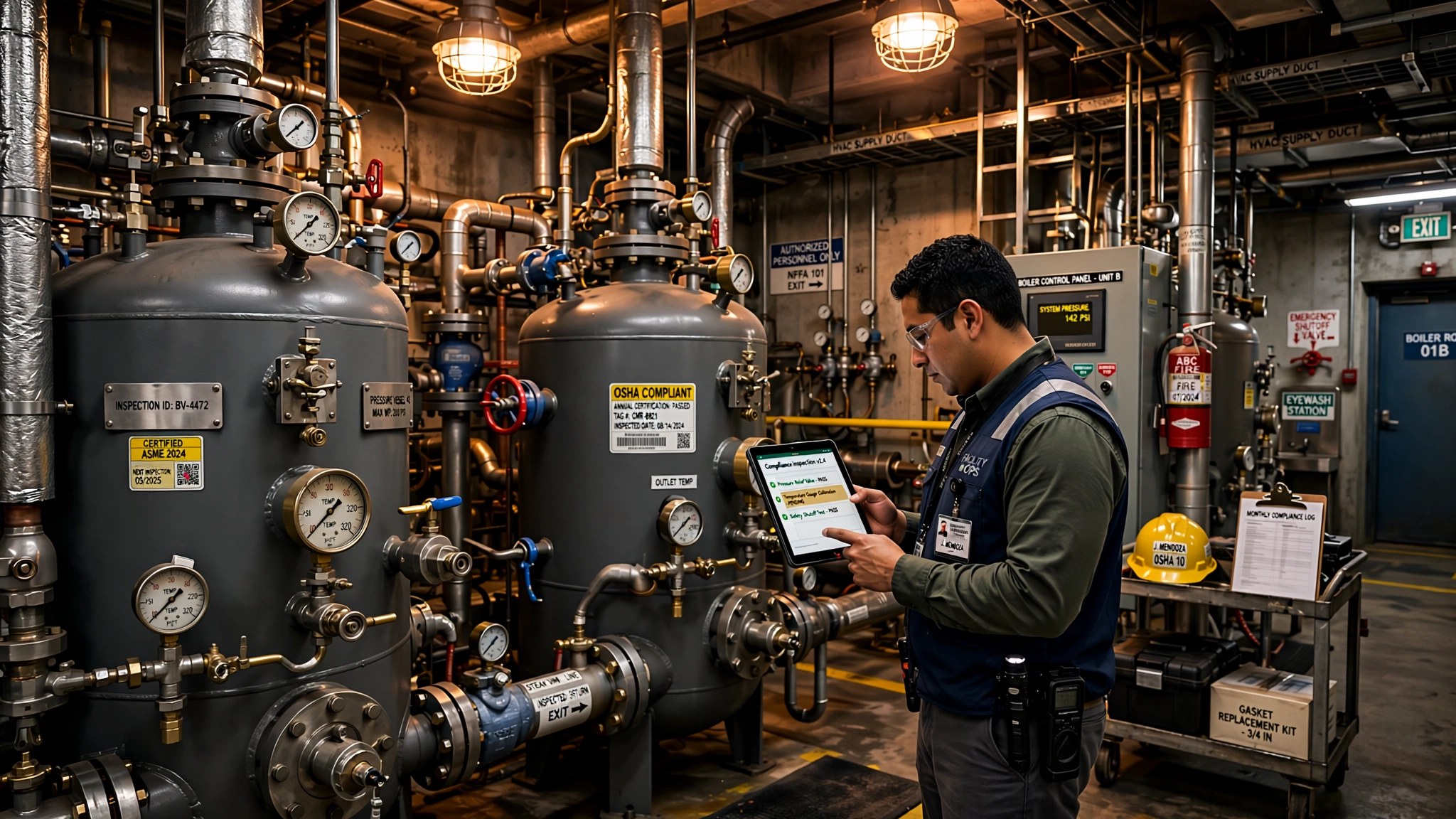
The Problem
Every commercial building with a heating system, a steam kitchen, or an autoclave almost certainly contains equipment regulated under the ASME Boiler and Pressure Vessel Code. Fire-tube boilers, water-tube boilers, hot water heaters above certain capacity thresholds, unfired pressure vessels, steam sterilizers in hospitals, compressed air receivers in workshops: the code covers all of them, and the National Board of Boiler and Pressure Vessel Inspectors (NBBI) reported 1.875 million items on its active registry in FY2021, drawn from 64 million cumulative registrations since the registry was established in 1921.
Every US state except Wyoming has adopted some version of the ASME code. Each requires periodic inspection by a commissioned inspector, with intervals varying from annual for most boilers to biennial for some pressure vessels, and certificates expiring on fixed dates that the building owner is responsible for tracking. Fail to comply in a lenient jurisdiction and the penalty is a few hundred dollars. Fail in California under Labor Code §7721 and the exposure is $25,000 per violation.
The NBBI publishes quarterly violation reports from its Violations Information System. Across all equipment types, the violation rate holds steady around 9%. But that number obscures sharply worse outcomes in specific categories: low-pressure steam boilers, the type heating apartment buildings, school campuses, and smaller hospitals, fail at 17-18% per quarter, while hot water boilers run 12-14%. These are not paperwork technicalities: NBBI's top violation categories include safety valve failures, waterside corrosion compromising pressure integrity, and non-functional low-water fuel cutoffs, which are the last mechanical barrier between a neglected boiler and a catastrophic overpressure event.
The consequences show up in OSHA's accident investigation database, which contains 303 boiler-related incidents with injuries and fatalities. In February 2023, a boiler explosion at a Birdsboro, Pennsylvania apartment complex killed a maintenance worker and displaced dozens of residents. In December 2022, a dry-fire incident at a Memphis commercial laundry caused third-degree burns to two operators. The Chemical Safety Board has investigated multiple catastrophic pressure vessel failures where inspection lapses were contributing factors. Boiler explosions are rare precisely because the inspection system catches most problems before they escalate. When that system fails, the results are violent and immediate.
Who Bears the Risk
The inspection ecosystem for boilers and pressure vessels is built around insurance, not regulation, and that single fact explains why the building owner's compliance problem has gone unsolved for over a century.
In most states, the primary inspection mechanism is the Authorized Inspection Agency, or AIA. These are NBBI-accredited organizations authorized to perform jurisdictional inspections, and the vast majority of them are insurance companies or their affiliated engineering subsidiaries. The workflow is straightforward: a building owner purchases boiler and machinery insurance, the insurer assigns a commissioned inspector who performs the required inspections as part of the coverage, the insurer files the report with the state, and the building owner receives a certificate in the mail.
Hartford Steam Boiler (HSB) dominates this market by a wide margin. A subsidiary of Munich Re since 2008, HSB employs over 1,200 engineers and inspectors worldwide, carries an A++ (Superior) financial strength rating from A.M. Best, and insures roughly 40% of the US commercial boiler fleet. Factory Mutual, Zurich, and Travelers fill out the rest of the market, each running their own inspection teams.
The structural parallel to elevator inspection is exact. The entity inspecting the equipment is financially entangled with the entity responsible for covering losses when that equipment fails. Finding a deficiency means requiring the owner to remediate, increasing the insurer's administrative burden and risking account attrition. Missing a deficiency means signing off on equipment that might blow up, creating a liability claim against the insurer's own book. Neither outcome is neutral, and the insurance company optimizes for its own risk model, which is not the same thing as optimizing for the building owner's regulatory compliance.
From the building owner's perspective, the entire process is invisible and passive. The insurer's inspector shows up, or doesn't. The inspector performs all required tests, or skips some. The insurer files the certificate with the state on time, or files it three months late. The building owner has no independent way to verify any of it, and may not learn about a gap until a state notice of violation arrives in a certified envelope.
States run their own boiler inspection programs, but staffing is thin everywhere. California's Division of Occupational Safety and Health oversees pressure vessel registration through its Pressure Vessel Unit, which maintains a public database of registered vessels and inspection dates. The database exists as a lookup tool that tells you whether a vessel is registered and when it was last inspected. It does not alert you when an inspection is overdue, does not track deficiency remediation, and cannot compare your compliance posture across a portfolio of forty buildings in three states.
The Gap in the Market
Software exists for boiler service companies and large industrial plant operators who manage thousands of pressure-bearing assets in refineries and power stations. It does not exist for the property management company that needs to track compliance for 200 boilers scattered across 40 commercial buildings in three jurisdictions, each with different inspection intervals, filing deadlines, and penalty structures.
| Company | What They Do | What's Missing |
|---|---|---|
| IBM Maximo | Enterprise asset management for utilities, refineries, and heavy industrial operators. Inspection scheduling, work orders, asset hierarchies, and regulatory workflows for thousands of assets. | Priced and scoped for organizations with full-time reliability engineering teams and six-figure implementation budgets. A property management company with 200 boilers is not IBM's customer. |
| eMaint (Fluke) | Cloud CMMS with configurable compliance modules. Inspection scheduling, mobile work orders, parts inventory. Mid-tier pricing around $85/user/month. | Generic maintenance scheduling with no boiler-specific compliance intelligence. The system cannot distinguish a California hot water heater requiring biennial inspection from a New York City low-pressure steam boiler on an annual cycle. Every jurisdiction rule must be configured manually by the building owner. |
| Oxmaint | Cloud CMMS for small and mid-size facilities. Work order management, preventive maintenance scheduling, basic compliance checklists. Free tier available. | Compliance checklists are blank templates the user populates. No pre-built regulatory knowledge. A property manager would need to research every state's boiler code and build their own inspection schedule matrix, which is the problem, not the solution. |
| HSB Connected Solutions | IoT monitoring from Hartford Steam Boiler. Sensors track boiler temperature, pressure, and operating parameters. Anomaly alerts. Integration with HSB insurance inspection data. | Exclusive to HSB insurance customers. Monitors equipment health, not regulatory compliance. Cannot track certificate expiration, jurisdiction filing deadlines, or deficiency remediation across multiple insurers. Switch carriers from HSB to Factory Mutual and your entire monitoring history stays behind. |
| Yardi / RealPage / AppFolio | Property management platforms with general maintenance and compliance tracking modules. Vendor management, work orders, document storage. | Boiler compliance occupies one row in a spreadsheet-style tracker alongside fire extinguishers, elevator inspections, and pest control schedules. No awareness of ASME code categories, NB registration numbers, inspector commission credentials, or the distinction between an internal inspection and an external inspection. |
The pattern mirrors what we documented in elevator inspection compliance almost perfectly. Sophisticated software serves the service side of the market, while the asset owner side runs on paper, email reminders, and insurance certificate PDFs stored in a shared drive folder nobody audits. The critical difference is the nature of the insurance entanglement: in elevators, the OEM inspects its own maintenance work. In boilers, the insurer inspects the equipment it underwrites. The building owner pays for oversight that is structurally incapable of being independent.
The Solution
A compliance management platform built for building owners and property managers who carry boiler and pressure vessel obligations across multiple properties and jurisdictions.
Jurisdiction Rules Engine. Every state's boiler code, inspection interval, filing requirement, and penalty structure, encoded into a queryable database and maintained as legislatures amend their codes each session. This is the moat, and Pennsylvania's Title 34 regulations specify annual inspections for power boilers and low-pressure steam boilers but biennial for hot water boilers and unfired pressure vessels, while California requires separate registration with Cal/OSHA's Pressure Vessel Unit and levies penalties under Labor Code §7721 that are twelve times higher than Pennsylvania's, and New York City's Department of Buildings requires independent filings from the building owner even when the insurance company handles the inspection itself. That jurisdictional fragmentation is precisely why no generic CMMS solves the problem, and it is why the database is defensible once built.
Equipment Registry. Every boiler and pressure vessel in the portfolio, tracked by its NB registration number (the globally unique identifier the National Board issues), classified by equipment type, and linked to its age, capacity, manufacturer, serial number, physical location, applicable jurisdiction, required inspection cycle, insurance policy, and assigned inspector. One source of truth across the entire portfolio.
Inspection Lifecycle Management. The platform calculates deadlines automatically from jurisdiction rules and the last inspection date, tracks each item through the full cycle from "due" to "scheduled" to "completed" to "certificate filed with the state," sends alerts at configurable intervals before deadlines arrive, and escalates when a deadline approaches with no inspection scheduled.
Inspector Credential Verification. National Board commissions are public record, and the platform cross-checks that the inspector who signed each certificate holds a valid NBBI commission for the relevant equipment type and jurisdiction, a verification step that nobody performs today. The building owner trusts whatever name appears on the certificate.
Deficiency Tracking. Given that nine percent of inspections find violations, without a structured tracking system, remediation responsibility falls into the gap between the inspector's report and the building manager's memory, where it often stays. The platform tracks each deficiency from discovery through remediation to closure: who is responsible, which code section was violated, what corrective action was taken, and who verified the fix.
Multi-Insurer Dashboard. A property portfolio with 500 boilers across 50 buildings might carry coverage from three different insurers, each running its own inspection team, using its own reporting format, and following its own filing process. The platform normalizes all of this into a single compliance view that no insurer will ever build, because building it would mean sharing performance data with their competitors.
TAM, SAM, and Revenue Model
The NBBI's 1.875 million registered items include boilers, pressure vessels, and nuclear components. Strip out nuclear, which operates under an entirely separate regulatory regime through the NRC, and the addressable commercial and institutional base is approximately 1.5 million items distributed across office buildings, apartment complexes, hospitals, schools, hotels, and retail properties.
The US boiler and machinery insurance market generates approximately $3.5 billion in annual premiums, with inspection serving as a cost center embedded in those premiums. Building owners also pay directly when they hire third-party inspection agencies for supplemental or independent assessments, which typically run $200-600 per unit per inspection depending on equipment type and jurisdiction.
SaaS pricing: $8-15 per registered item per month. A mid-size property management company with 300 boilers and pressure vessels spread across 20 buildings would pay $2,400-4,500 monthly, or $28,800-54,000 annually. That is a rounding error against their insurance premiums and a fraction of the penalty exposure from a single missed inspection in a state like California.
| Market Tier | Items | Annual Revenue at $10/item/month |
|---|---|---|
| TAM (all registered commercial/institutional items) | 1,500,000 | $180M |
| SAM (multi-property owners, 100+ items) | 450,000 | $54M |
| SOM (5% SAM penetration in 5 years) | 22,500 | $2.7M ARR |
Secondary revenue: jurisdiction rule update subscriptions sold to insurance companies at $50K-100K per carrier per year, API access for property management platforms integrating compliance data into their existing workflows, and premium analytics that benchmark violation rates by equipment type, age, manufacturer, and geography across the platform's installed base.
Startup Costs and Break-Even
| Category | Year 1 Estimate |
|---|---|
| Engineering (3 full-stack + 1 domain engineer) | $520K |
| Regulatory research and database build (49 states) | $80K |
| Infrastructure (cloud, CI/CD, monitoring) | $36K |
| Sales and marketing (1 sales hire, conferences, content) | $180K |
| Legal, accounting, insurance | $40K |
| Total Year 1 | $856K |
Break-even arrives at approximately 1,200 properties averaging 12 registered items each, which is roughly 14,400 items generating $1.73M ARR at $10/item/month. That is achievable in 18-24 months with concentrated sales in two or three high-penalty states where the product pays for itself on the first avoided violation.
Bootstrappable if the founding team includes someone who can personally build the jurisdiction database from primary sources. A modest seed round of $1-2M accelerates the regulatory research and enables simultaneous launch in multiple states rather than sequential expansion.
Why Now
State registries are digitizing. California's DIR Pressure Vessel database is publicly queryable online. Texas TDLR offers electronic license and inspection lookup. A growing number of states are modernizing their filing infrastructure in ways that create API-accessible inspection records for the first time, and five years ago the vast majority of these records still lived in filing cabinets in state capitols.
Insurance is hardening. Boiler and machinery premiums rose 8-12% in 2024-2025 according to Marsh's Global Insurance Market Index, and insurers are tightening underwriting scrutiny of compliance history at renewal time. A building owner who can demonstrate inspection currency through a structured compliance platform gains direct leverage in premium negotiations, which makes the compliance platform self-funding at renewal time.
Connected boilers are shipping. IoT-enabled controls from Cleaver-Brooks, Weil-McLain, and Lochinvar are becoming standard in new commercial installations, generating continuous operational telemetry (supply temperature, return temperature, firing rate, stack temperature) that a compliance platform can ingest to augment inspection records with real-time equipment health data and, eventually, predictive analytics that flag problems between inspection cycles.
Remote inspection is permanent. Multiple jurisdictions introduced remote or virtual inspection provisions during COVID-19 that have since been codified. The NBBI published guidelines for remote visual inspections in 2021, and remote inspections generate documentation types (video records, remote sensor readings, inspector attestation forms) that paper-based tracking systems were never designed to handle.
Energy reporting mandates are proliferating. Local Law 97 in New York City, BERDO 2.0 in Boston, and similar building performance standards in over 30 US cities now require detailed reporting on energy systems including boilers. These mandates require the same equipment-level data (age, type, capacity, fuel type, operating hours) that a boiler compliance platform already collects, making the marginal cost of bolting on energy reporting functionality close to zero.
Risks and Limitations
Insurance companies could fight it. If HSB, Factory Mutual, or Zurich perceive the platform as threatening their gatekeeper position in the inspection process, they could refuse to share inspection data with building owners who use it, pressure property managers not to adopt it, or fast-track development of competing offerings that bundle compliance tracking into their existing insurance products.
Small owners won't pay. A building owner with a single boiler in a 20-unit apartment building already pays roughly $1,500 per year in boiler insurance, and asking for another $120 annually in compliance software is a harder sell than the same pitch to a portfolio owner managing 500 units across a dozen states. The economics pull the product toward mid-to-large property management companies, which narrows the initial addressable market considerably.
Regulatory fragmentation cuts both ways. Building the jurisdiction rules engine for 49 states plus major cities with independent boiler programs (New York City, Chicago, Detroit, and others) requires sustained, expert-level regulatory research that never ends because every legislative session can change inspection intervals, penalty structures, and filing requirements. That permanent maintenance burden is what makes the database defensible, but it also means the cost of keeping it accurate never goes to zero.
Inspection data flows through insurer pipes. In many states, the inspection report moves from inspector to insurer to state, and the building owner receives a summary certificate but not the full report with itemized findings and deficiency classifications. Getting access to the granular data the platform needs to be truly useful may require contractual renegotiation with insurers or new regulatory mandates for inspection data portability that do not yet exist in most jurisdictions.
The Strongest Counterargument
HSB already has the data, the inspectors, and the customer relationships. They employ 1,200+ engineers and inspectors, insure roughly 40% of the commercial boiler market, operate an IoT platform in HSB Connected Solutions, and sit on 150 years of underwriting data documenting which boiler types fail, how often, and why. If anyone should build the building owner's compliance dashboard, it is the company that already touches every link in the compliance chain.
This counterargument carries genuine weight and is not easily dismissed. Munich Re, HSB's parent, generated €58.4 billion in revenue in 2024 and could fund a compliance platform out of petty cash. HSB already employs the regulatory domain experts a startup would need to hire. And they do not need to build insurer integrations, because they are the insurer.
The rebuttal is structural, not financial: HSB will never build a tool that lets building owners compare HSB's inspection quality against Factory Mutual's, or a dashboard showing which insurer's inspector found fewer violations, responded slower to scheduling, or filed certificates later. That vendor-neutral comparison layer is something no insurer will build because it would expose their own service quality to competitive benchmarking. HSB Connected Solutions already proves the point: it monitors only HSB-insured equipment, does not ingest inspection data from other carriers, and goes dark the moment a building owner switches to Zurich.
The harder version of this objection: Yardi or RealPage, which together dominate commercial property management software, add a boiler compliance module to their existing suite. They already have the customer relationships and the property data. But the same structural argument applies, because generic property management platforms treat boilers identically to fire extinguishers, HVAC filters, and pest control contracts, because they do not employ anyone who understands NB registration numbers, ASME code inspection categories, inspector commission credential requirements, or the thirty-seven different ways US jurisdictions define "low-pressure boiler." Building that regulatory depth requires a level of domain investment that a horizontal platform will not make until a vertical startup proves the category is worth owning.
What You Can Do
If you're a building owner or property manager: Pull your boiler and machinery insurance policies and identify every insured item by its NB registration number. For each one, verify that you have a current inspection certificate on file with a valid date. In California, check the DIR Pressure Vessel database to confirm registration and current inspection dates. In New York City, check your DOB filings separately. If you own equipment in multiple states, build a spreadsheet tracking equipment ID, jurisdiction, required inspection interval, last inspection date, next due date, insurer, and inspector name for every single item in your portfolio. If populating that spreadsheet takes more than an hour, you are the customer for this product.
If you're building this: Start in California or New York. California offers the largest commercial building stock in the country, a publicly queryable pressure vessel database, and penalties up to $25,000 per violation that make your compliance platform self-funding from the first avoided fine. New York City adds independent DOB filing requirements that create compliance burden beyond what the insurer handles. Target mid-size property management companies with 20-100 buildings and mixed equipment across multiple insurers. BOMA chapters in your launch city are the natural first sales channel. Get the jurisdiction rules engine right for one state, prove the value with 20 paying customers, then expand to Texas (TDLR electronic filing, growing commercial construction) and Pennsylvania (detailed Title 34 regulations with clear penalty schedules).
If you're an investor: The US boiler and machinery insurance market produces $3.5 billion in annual premiums, and the compliance layer connecting building owners to insurers to state regulators across that market does not exist as software. NBBI's own violation data shows a 9% failure rate on 160,000 inspections per quarter, with rates nearly doubling for the equipment types most common in residential and institutional buildings. No venture-funded startup currently addresses the building-owner side of boiler compliance. The regulatory database is a durable moat, because 49 state codes, hundreds of municipal variations, and continuous legislative updates create a data-compilation barrier that a fast-follower cannot replicate in less than two years. The comparable play is how BuildOps ($150M raised) captured the commercial contractor workflow for HVAC and fire protection. Boiler compliance is a narrower vertical with deeper regulatory complexity, higher per-unit penalty exposure, and a structural conflict of interest that guarantees sustained demand for vendor-neutral oversight tools.
The Bottom Line
The United States has 1.875 million registered boilers and pressure vessels. Each one requires periodic inspection under state law. The National Board's own data shows a 9% overall violation rate, spiking to 17-18% for the low-pressure steam boilers that heat apartment buildings, schools, and hospitals across the country. The inspection process is controlled by insurance companies whose inspectors examine equipment those same companies financially underwrite, creating a conflict of interest that is structural and permanent. Building owners receive certificates but cannot independently verify inspection quality, track deficiency remediation timelines, or manage compliance across properties in multiple jurisdictions from a single interface. Every software tool in the market today serves the service side: CMMS platforms for plant operators, IoT dashboards for insurance customers, ERP systems for industrial facilities. The building owner's compliance system is a filing cabinet. In a market with $3.5 billion in annual insurance premiums, up to $25,000 per violation in penalty exposure, and an inspection process that no participant has an incentive to make transparent, the owner-side compliance platform is overdue.