Balcony EEE Inspection Compliance SaaS: The $410M Mandate California Just Made Everyone Miss
On June 15, 2015, a fifth-floor wood-framed balcony collapsed at Library Gardens in Berkeley during a 21st birthday party, killing six students and injuring seven. California answered with two laws: Senate Bill 721, signed September 2018, requiring every apartment building with three or more units to inspect its exterior elevated elements by January 1, 2026, with re-inspections every six years; and Senate Bill 326, signed August 2019, requiring condominium HOAs to do the same by January 1, 2025, with re-inspections every nine years. Both deadlines have now passed. An estimated 75,000 apartment buildings fall under SB 721 in California alone, with inspection costs running $2,000 to $18,000 per building. Buyers, lenders, and insurers are starting to demand proof of inspection at sale and refinance. The compliance workflow that should connect owners, licensed inspectors, remediation contractors, buyers, and enforcement agencies runs on PDFs in email threads, paper reports in property management filing cabinets, and memory. The companies that perform the inspections sell labor, not software. The property management suites that hold the owner relationship treat a balcony inspection as a custom date field. Connecting all five sides of this workflow into a single system of record is a $150 million annual software opportunity hiding inside a water-damaged balcony rail.
The Problem
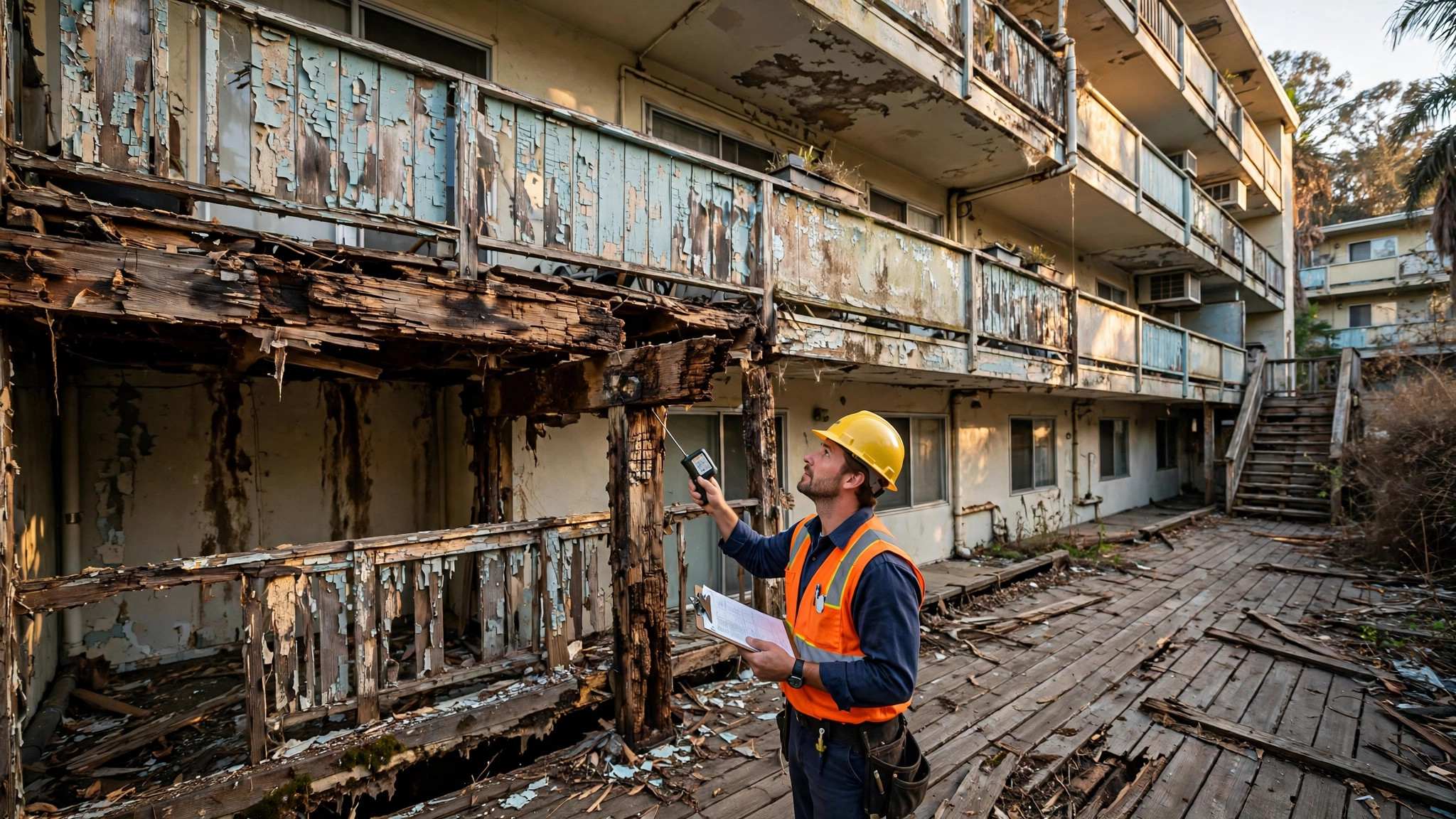
California's rental housing stock is, to an unusual degree, made of wood. The garden apartment boom of the 1960s through the 1980s produced hundreds of thousands of two- and three-story walk-ups: wood-framed balconies, wood-supported exterior walkways, wood staircases, all sitting outside the weather envelope. Wood rots. Waterproofing membranes fail. Flashing details that were wrong on day one stay wrong for forty years, silently funneling rain into the joist pockets where balcony cantilevers meet the building.
At Library Gardens, investigators found that the balcony that killed six people had rotted through from the inside. The wood framing that anchored it to the building was degraded by water intrusion that was invisible from the walking surface. The residents who celebrated a birthday on it that night had no way to know it was failing, and the building owner had no inspection regime that would have caught it.
The two statutes California passed in response are specific. SB 721 (Health and Safety Code §17973) applies to apartment buildings and other rental properties with three or more dwelling units. SB 326 (Civil Code §5551) applies to condominiums and other common interest developments. Both cover exterior elevated elements more than six feet above grade, balconies, decks, stairways, landings, and walkways, that rely in whole or substantial part on wood or wood-based supporting materials. Both require a minimum 15% sample of each EEE type per building, inspections performed by licensed architects, civil or structural engineers, or qualifying contractors, and record retention spanning at least two full inspection cycles, 12 years for apartments.
Complying is not a checkbox. It is a six-step workflow: inventory the building's EEEs, generate the sampling plan, hire and schedule a licensed inspector, receive the report, apply for permits and complete repairs within 120 days if defects are found, then file the certification and retain records for twelve years while starting the countdown to the next cycle. Every step involves a different party, and the handoffs between them are where compliance dies.
The Compliance Math: An Original Calculation
No public dataset counts how many buildings fall under SB 721. But we can build the number from Census data.
The Census American Community Survey puts California's renter-occupied housing units at roughly 5.8 million. About 53% of California renters live in structures with three or more units, yielding approximately 3.1 million rental units in covered building types. At an average of 14 units per apartment building, that is roughly 215,000 rental buildings with three or more units statewide.
Not all of them have qualifying EEEs. Subtract single-story garden apartments with no elevated elements, buildings of concrete and steel construction, and properties with no wood-supported walking surfaces above six feet. California's stock skews heavily toward 1960s-to-1980s wood-frame construction, so a conservative qualification rate of 35% is defensible. That gives roughly 75,000 apartment buildings subject to SB 721.
Now the spend. DrBalcony, a California inspection firm, publishes typical SB 721 cost ranges: $2,000 to $4,000 for 3 to 10 units, $4,000 to $7,000 for 11 to 30 units, $7,000 to $10,000 for 31 to 50 units, $10,000 to $18,000 for 50 to 100 units, and $18,000 plus for 100 units and above. Weighted by building-size distribution, the average lands near $5,500 per building.
75,000 buildings at $5,500 average: $412 million in first-cycle inspection spend in California alone, recurring every six years, or roughly $69 million per year in inspection services. That is the services market. The software layer sits underneath it: every inspection needs a sampling plan, a scheduling record, photo-verified field documentation, a 12-year record vault, a permit-and-repair workflow, and a transferable compliance certificate that buyers, lenders, and insurers can verify at transaction time.
Add the condo side. SB 326 covers common interest developments with three or more units, a separate pool of roughly 25,000 HOA-managed properties subject to the same math on a nine-year cycle. And the same regulatory pattern is already spreading: Florida's post-Surfside milestone inspection regime and similar balcony-safety proposals in Washington, New Jersey, and Illinois all point toward a national market where California is simply the first mover.
Where the Paper Trail Breaks Down
Consider a 120-unit garden apartment complex in the San Fernando Valley, owned by a family LLC that holds eleven such properties. SB 721 required its first inspection by January 1, 2026. The property manager got three bids from engineering firms in October 2025. The cheapest was $11,500. Scheduling took six weeks because every qualified inspector in the region was booked solid against the deadline.
The inspection found deteriorated waterproofing on 22 of 46 balconies. The report arrived as a 60-page PDF. The owner applied for permits within the 120-day window. Repairs took four months and cost $210,000, handled by a contractor who documented completion with phone photos emailed to the property manager's assistant, who saved them in a folder named "Balcony Stuff."
Now it is 2031 and the second inspection cycle is due. The original engineering firm has merged into a competitor. The property manager has changed twice. The folder named "Balcony Stuff" lives on a departed assistant's laptop. Nobody remembers which 22 balconies were repaired, whether the repaired waterproofing details match the original specification, or which balconies were in the 15% sample the first time around. The new inspector must re-inventory the entire property from scratch, at full price, and the owner pays again for knowledge that already existed.
This is not a hypothetical edge case. It is the default outcome whenever a six-year compliance cycle is managed with email, PDFs, and personnel turnover. The law requires records to be retained for 12 years, two full cycles. Almost no small owner can produce them.
The Gap in the Market
Software for this workflow exists in pieces, but every piece serves only one side of it.
| Company | What They Do | What's Missing |
|---|---|---|
| DrBalcony and regional inspection firms | Perform the actual SB 721/SB 326 inspections. Some publish cost calculators and compliance guides. | They sell labor, not software. The report they deliver is a PDF that enters the owner's filing cabinet. They have no portfolio dashboard for multi-property owners, no 12-year record vault, no multi-firm support for owners who bid inspections competitively. Their incentive is billable inspections, not durable compliance infrastructure. |
| AppFolio, Buildium, Vantaca | Property management suites holding the owner relationship. Can store documents and set calendar reminders. | A balcony inspection is a custom date field and a file attachment. No sampling-plan engine, no inspector scheduling workflow, no 15% sample logic per EEE type, no repair-permit tracking, no buyer-disclosure transfer. Compliance is not a module; it is a reminder. |
| Engineering firms (Apex, Optimum Seismic, et al.) | Licensed professionals qualified to perform EEE inspections. | Report formats are proprietary and inconsistent. No two firms' reports contain the same data in the same structure, which means owners cannot compare bids, buyers cannot verify completeness, and nobody can track a building's inspection history across firms over twelve years. |
| Excel, email, and filing cabinets | The actual current system of record for most small owners. | Personnel turnover destroys continuity. No enforcement agency accepts a spreadsheet as proof. No buyer accepts one either. |
The critical gap is the multi-sided one. The owner needs the inspector's report, the inspector needs the building's EEE inventory and prior-cycle data, the contractor needs the defect list, the buyer needs the certificate, and the city needs the filing. Each side currently talks to the others through ad hoc channels, and the data never survives a handoff.
The Proposed Solution
A vendor-neutral compliance platform built around the building, not the vendor. The core object is a digital EEE registry: every balcony, deck, stairway, landing, and walkway in the building, photographed, geotagged, and classified by type, with the inspection history of each individual element preserved across cycles and across inspector firms.
The platform generates the sampling plan automatically: given the registry, it selects the statistically valid 15% sample per EEE type that the statute requires, and it remembers which elements were sampled in cycle one so cycle two covers the remainder. Inspectors bid against the registry rather than against a vague description over the phone. Field documentation is photo-verified through a mobile app, with each photo bound to a specific EEE element rather than dumped into a folder.
When defects are found, the defect list converts directly into a permit-and-repair workflow: contractor bids, 120-day permit clock tracking, photo-verified completion. The completed cycle produces a transferable compliance certificate, a signed, inspectable record that the building was inspected, by whom, with what sample, and with what remediation. At sale or refinance, the certificate transfers to the buyer, who inherits the full 12-year record instead of starting from zero. Title companies, lenders, and insurers get a verification endpoint instead of a phone call to a retired property manager.
Revenue Model
Four revenue lines, each tied to a different side of the workflow.
Owner/HOA tier: $299 per building per year for the EEE registry, cycle countdown, record vault, and compliance certificate. At 15,000 buildings, roughly 20% of the estimated California qualifying stock, that is $4.5 million in annual recurring revenue. Pricing is anchored to the alternative: a $5,500 inspection every six years makes $299 per year for never losing the records a trivial line item.
Inspector tier: $149 per month per firm for the bidding marketplace, sampling-plan engine, mobile field app, and report generation in a standardized format. California likely has 400 to 600 firms competing for this work; 300 firms at $149 per month is $536,000 per year, with expansion as the platform becomes the place owners go to find inspectors.
Transaction fees: $49 per compliance certificate transfer at sale or refinance, paid by the buyer or split through the title company. Southern California alone sees tens of thousands of multifamily transactions per year. This is also the viral loop: every non-compliant listing that needs a certificate becomes a customer.
Remediation marketplace: 10 to 15% referral fee on contractor repair work sourced through the platform's defect workflow. With repair bills commonly running 10 to 30 times the inspection cost, even a small share of mediated work adds meaningful margin.
Combined five-year target: $8 to 12 million in annual recurring revenue at 20% California penetration plus early expansion into Florida and the states following California's regulatory pattern.
Why Now
The timing is the whole thesis. Both first-cycle deadlines have passed: SB 326's in January 2025, SB 721's in January 2026. Non-compliance is no longer a forecast; it is a fact about specific buildings with specific owners, and the consequences are arriving through the channels that move money: sale, refinance, and insurance.
California real estate brokers are already advising clients that uninspected buildings face disclosure risk and buyer discounts, because a buyer who discovers the seller never inspected inherits the liability and the cost. Lenders are beginning to ask for EEE certifications in multifamily loan underwriting. Insurance carriers, facing balcony-collapse liability claims, are the next to move.
The second cycle has also started ticking. SB 721 re-inspections come due starting in 2031, and the buildings inspected in the first wave need a system of record now if their second cycle is going to cost less than the first. The record vault only has value if the data enters it at cycle one, which means the window to become the default system of record is the next 24 months, while first-cycle reports still exist in recoverable form.
Finally, the regulatory pattern is exportable. Florida's condominium milestone inspection regime, enacted after the Surfside collapse, and balcony-safety proposals in other states mean the California product becomes the national product with localization rather than reinvention.
Risks and Challenges
Geographic concentration. Today this market is California plus a Florida tailwind. If other states fail to adopt balcony inspection mandates, the national TAM thesis stalls and the company is a regional compliance tool with a $35 million ceiling. The counterweight is that building-collapse liability is a powerful legislator motivator, and the California template is already being studied elsewhere, but "other states will follow" is a projection, not a fact.
The six-year sales problem. An inspection happens every six years, which makes annual SaaS a harder sell than it looks. Owners buy compliance software after a scare, then let it lapse in year three when nothing is happening. The product must justify itself between cycles: insurance premium documentation, buyer disclosure readiness, and the repair workflow all provide year-round value, but churn between cycles is the number-one product risk. Annual contracts with auto-renewal and lender-facing features are the mitigation.
Inspector supply bottleneck. The statutes restrict who may inspect: licensed architects, civil and structural engineers, and qualifying contractors. The pool is thin, it was booked solid through the 2026 deadline, and a platform that cannot staff its marketplace cannot deliver. The startup does not need to employ inspectors, but it needs enough firms on the platform that owners get competitive bids. Launch city by city, starting in Los Angeles and the Bay Area where firm density is highest.
Deadline extensions. AB 2579 already extended the SB 721 deadline once, from 2025 to 2026. Legislatures that extend once can extend again, and every extension deflates the urgency that drives adoption. The mitigation is that the transaction channel, buyers and lenders demanding proof, does not depend on the enforcement calendar.
The strongest counterargument: AppFolio or Buildium could build this. They own the owner relationship, they already store documents, and a "balcony compliance module" is a plausible roadmap item. The counterpoint has two parts. First, property management suites are horizontal platforms; EEE compliance is a vertical workflow with statutory sampling logic, licensed-inspector marketplaces, and buyer-disclosure certificates that do not generalize to their other modules. Building it well requires living inside the statute. Second, and more importantly, the platform's value compounds across owners: a buyer's lender wants to verify a certificate regardless of which property management software the seller used. The network effect lives at the transaction layer, which belongs to no single PM suite. A vertical entrant that owns the certificate standard has a moat that a feature inside AppFolio cannot easily replicate.
Startup Costs
Roughly $700,000 for a 12-month path to revenue. Two full-stack engineers ($320,000 fully loaded), one founder handling sales and partnerships ($180,000), legal review of the statutory workflow and insurance positioning ($60,000), design and mobile app polish ($80,000), and operating overhead including cloud infrastructure, which is modest for a document-and-workflow product ($60,000).
The go-to-market is cheap because the customer list is public. Every apartment building with three or more units is on a tax roll, and code enforcement departments in cities like Belmont, Gilroy, and Banning are already publishing EEE notices, which means the outreach list can be built from municipal records rather than bought. Break-even at roughly 14 months on 2,300 building subscriptions plus the inspector tier.
What You Can Do
If you own an apartment building in California: Check whether your building has balconies, decks, stairways, or walkways more than six feet above grade with wood-based supports. If it does and you have not completed an SB 721 inspection, you are out of compliance right now. Get three bids from licensed inspectors, keep the report, and retain it for twelve years. The inspection costs $2,000 to $18,000. The wrongful death lawsuit costs everything.
If you sit on a condo HOA board: Your SB 326 deadline passed in January 2025. Confirm your reserve study accounts for the nine-year re-inspection cycle and that your management company has the original inspection report filed somewhere retrievable. If the report is a PDF on a former board member's personal email, fix that this month.
If you are a licensed inspector: Standardize your report format. The firms whose reports are machine-readable, element-by-element, and photo-verified will win the marketplace when owners start comparing. The firms whose reports are bespoke PDFs will be competing on price alone.
If you're building this: Start with the certificate, not the marketplace. The transferable compliance certificate is the artifact that buyers, lenders, and insurers need, and it is the feature that creates the viral loop: every transaction pulls a new building onto the platform. The inspector marketplace and the sampling engine follow. Launch in Los Angeles, where the building count and inspector density are both highest, and partner with two or three inspection firms to seed the supply side before opening owner signups.
The Bottom Line
Six people died on a Berkeley balcony in 2015 because wood rots invisibly and nobody was required to look. California's answer, two statutes, two deadlines, 15% sampling, twelve years of records, was the right regulatory shape for the problem. But the compliance infrastructure was never built. The inspections happened, or didn't, and the records scattered into PDFs and filing cabinets while the second cycle started ticking. An estimated $412 million in inspection spend will cycle through California every six years, and the system of record for all of it is a folder named "Balcony Stuff" on a departed employee's laptop. Whoever builds the registry, the sampling engine, the record vault, and the transferable certificate owns the workflow that determines whether 75,000 buildings are actually safe or merely once-inspected. At $299 per building per year, the revenue model is modest. The buildings it keeps standing are not.