AI-First Primary Care Triage Using Consumer Biomarker Data and At-Home Diagnostics
AI matched or beat dermatologists in 30 of 38 diagnostic categories. It matched radiologists on chest X-rays, pathologists on tissue slides, and emergency physicians on triage decisions. But AI isn't replacing doctors — it's replacing the $171 average cost of a primary care visit for the 60% of visits that end with reassurance, a referral, or an OTC recommendation. 500 million wearable devices are generating continuous health data that nobody analyzes between doctor visits. The platform that turns that data into clinical-grade triage — routing simple cases to AI and complex cases to the right specialist — captures a $48 billion primary care market.
The Problem
The average American makes 3-4 physician visits per year, at an average cost of $171 per primary care visit (Kaiser Family Foundation). Of these visits, studies consistently show that 27-35% are for conditions that could be managed via telehealth or AI triage — skin rashes, upper respiratory infections, urinary tract infections, medication refills, and health anxiety.
Meanwhile, 500+ million health wearables are continuously measuring heart rate, heart rate variability, blood oxygen, skin temperature, sleep quality, and activity levels. An additional 30+ million Americans use at-home blood pressure monitors, 7+ million use continuous glucose monitors, and 10+ million use connected scales. All of this data sits in siloed apps, never integrated, never analyzed clinically, and never used for preventive care between doctor visits.
The clinical evidence supports AI triage. Liu et al. (Lancet Digital Health, 2019) meta-analyzed 82 studies and found deep learning matched specialists in 30 of 38 diagnostic imaging categories. Ayers et al. (JAMA Internal Medicine, 2023) found AI responses were rated higher quality and more empathetic than physician responses by a panel of licensed healthcare professionals.
Market Size
Original TAM calculation: U.S. primary care spending is approximately $320 billion annually (CMS). Virtual-first primary care (already $24B and growing 25% CAGR) targets the same addressable market. AI triage can address approximately 15% of current primary care volume — the straightforward cases that don't require physical examination — representing a $48 billion market. At a consumer subscription ($19.99/month) plus per-triage-episode fees covered by insurance ($35-50/episode), with 500,000 subscribers and 2 million annual triage episodes, initial revenue target is $190M ARR.
The Product
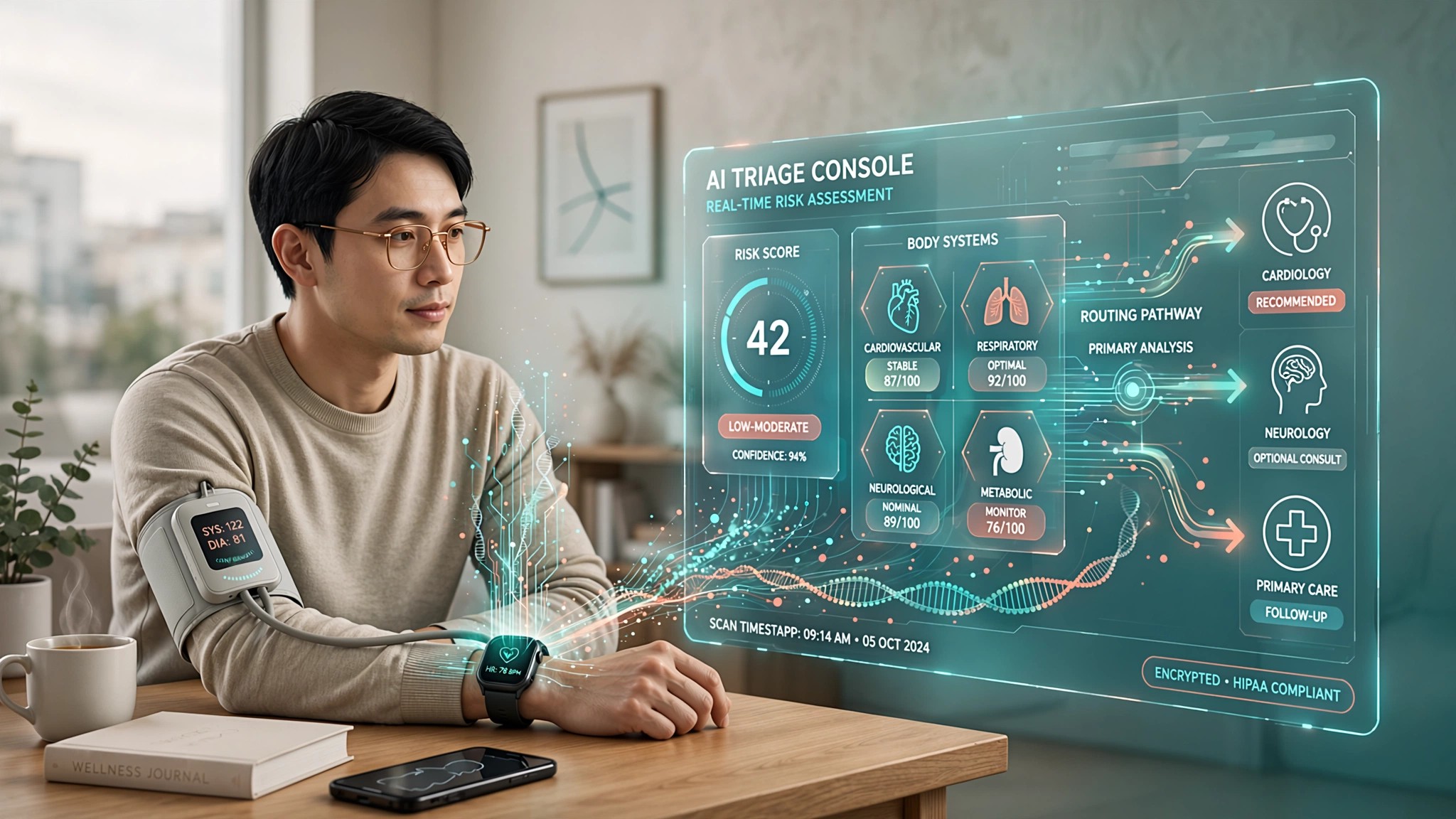
An AI health platform that sits between consumer wearables and the healthcare system. Core features:
- Continuous monitoring: Integrates data from Apple Watch, Fitbit, Garmin, CGMs, BP monitors, and smart scales into a unified health timeline
- AI risk assessment: Transformer model analyzes longitudinal biomarker data to flag concerning trends before they become emergencies — the "check engine light" for your body
- Smart triage: When a health concern arises, the AI performs clinical-grade triage: simple cases get AI-delivered guidance with OTC recommendations; complex cases get routed directly to the right specialist with a pre-assembled diagnostic package
- Specialist fast-track: When the AI identifies a likely specialist need, it assembles a "diagnostic briefing" — relevant biomarker trends, symptom timeline, preliminary differential — and sends the patient directly to the specialist, skipping the PCP referral step
- Clinician dashboard: Physicians who receive referrals see the AI's analysis with SHAP-based explanations of which biomarkers drove the referral
Unit Economics
| Metric | Value |
|---|---|
| Consumer subscription | $19.99/month |
| Insurance-covered triage episode | $35-50 (CPT 99421-99423) |
| AI inference cost per user/month | $1.80 |
| Clinical oversight cost per user/month | $2.50 |
| Customer acquisition cost | $55 |
| Expected retention | 14 months |
| LTV (subscription + episodes) | $380 |
| LTV:CAC ratio | 6.9:1 |
| Gross margin | 72% |
| Startup cost (24-mo runway) | $8.5M |
| Break-even | 22 months |
Go-to-Market
Phase 1: Launch with dermatology and common acute conditions (UTI, URI, allergies) — the categories with strongest AI evidence. Partner with 2-3 health systems for specialist referral network. Get through FDA De Novo pathway for clinical decision support.
Phase 2: Add chronic disease monitoring (diabetes management, hypertension). Integrate with pharmacy benefit managers for automated prescription coordination.
Phase 3: Launch employer-sponsored plans (positioned as "reduce unnecessary ER visits by 30%"). Integrate with HSA/FSA for consumer payments.
Competitive Landscape
| Company | Wearable Integration | AI Triage | Specialist Routing |
|---|---|---|---|
| Teladoc | Minimal | Symptom checker | General referral |
| Forward Health | In-clinic sensors | CarePods (AI) | In-network only |
| K Health | None | Symptom AI + doctor | In-app doctors |
| This startup | Full wearable fusion | Biomarker-based ML | Smart specialist routing |
Why Now
Three convergences: (1) Wearable sensors have achieved clinical-grade accuracy for core vitals (Apple Watch FDA-cleared for AFib, ECG; Abbott Lingo for continuous glucose); (2) AI diagnostic accuracy has crossed the specialist-equivalent threshold in dozens of categories, making AI triage clinically defensible; (3) The primary care physician shortage is worsening (projected 48,000 PCP shortfall by 2034, per AAMC), creating structural demand for AI-augmented alternatives.
The Bottom Line
The $171 primary care visit is the wrong price point for "your rash is nothing to worry about." AI can deliver that reassurance at $5. But AI alone isn't enough — you need the wearable data integration that makes the reassurance evidence-based, the clinical validation that makes it trustworthy, and the specialist routing that handles the cases where it isn't nothing. Build the bridge between consumer health data and clinical care, and you own the most important interface in healthcare's digital transformation.