AI Tutoring Platform That Makes Learning Deliberately Harder to Make It Actually Stick
Bloom's famous 2-sigma claim — that one-on-one tutoring produces two standard deviations of improvement — has been inflated by a factor of six for 40 years. The real effect is 0.3 sigma. Meanwhile, retrieval practice, spacing, and interleaving produce 0.5-0.7 sigma gains, with the critical ingredient being struggle, not smooth explanation. Every AI tutoring platform on the market — Khanmigo, Duolingo, Photomath — optimizes for engagement by minimizing friction. The cognitive science says friction is the active ingredient. The $7.8 billion EdTech market is building the wrong product.
The Problem
AI tutoring platforms optimize for the wrong metric. Khanmigo (Khan Academy, $44/year) measures session completion and problem-solving rates. Duolingo Max ($167.88/year) measures streak length and daily XP. Photomath ($59.88/year) measures problems solved. All three metrics reward smooth, friction-free interactions — and all three directly contradict what cognitive science says produces learning.
VanLehn's 2011 meta-analysis found that the actual effect of one-on-one tutoring — measured against broad standardized assessments rather than experimenter-designed tests — is 0.79 sigma, not Bloom's claimed 2.0 sigma. For AI tutoring specifically, the measured effect drops to 0.3 sigma. Meanwhile, Roediger and Karpicke's landmark 2006 study showed retrieval practice produces 80% retention at one week versus 36% for re-studying — more than double, at a measured effect size of 0.5-0.7 sigma.
The implication is clear: an AI tutor that makes students struggle productively (retrieval practice, spacing, interleaving) should outperform one that explains smoothly — but no commercial product implements this because productive struggle tanks engagement metrics. Students rate "easy" sessions higher, return more frequently to low-friction apps, and maintain longer streaks when learning feels effortless. Engagement-optimized AI tutoring produces the illusion of learning without the durable knowledge.
Market Size
Original TAM calculation: The K-12 EdTech market is $7.8 billion in the U.S. (HolonIQ, 2024). AI tutoring platforms represent approximately $1.2 billion of this. Our target segment — parents and school districts willing to pay premium prices for measurably better retention outcomes — is approximately $400 million. At a $29/month subscription ($348/year), 200,000 paying students within 3 years yields $70M ARR. School district licensing at $15/student/year across 2 million students adds $30M. SAM: $100M ARR target by year 3.
The Product
An AI tutoring platform that deliberately makes learning harder. Core features:
- Retrieval-first learning: Every session starts with a test on previous material, not a review. The AI asks before it explains.
- Spacing engine: Material reappears at scientifically calculated intervals based on individual forgetting curves — not when the student wants to review, but when they're about to forget.
- Interleaving: Problem sets mix topics instead of blocking them by chapter. Harder in the moment, but produces 40%+ better transfer to new problems.
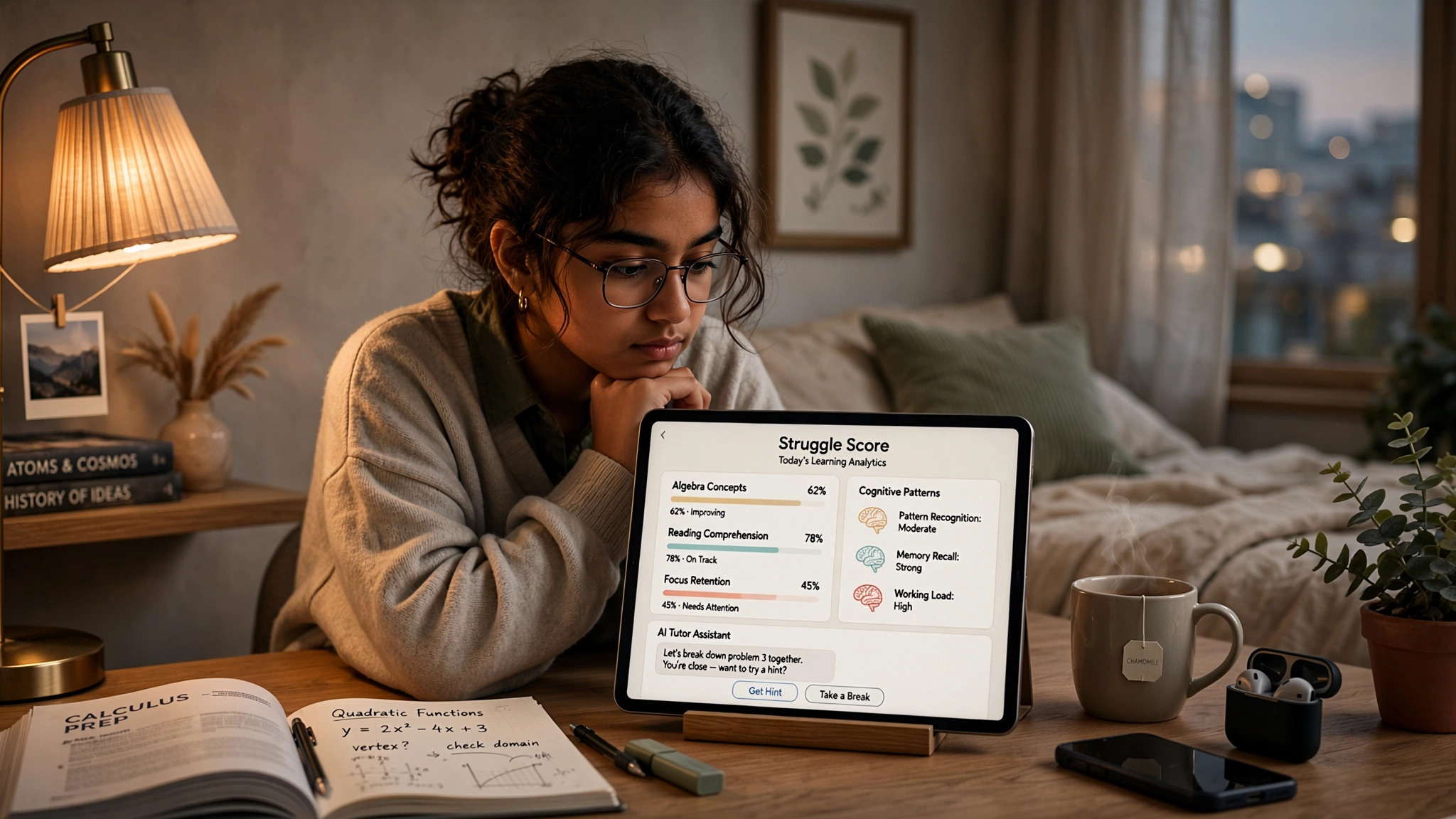
- Struggle Score dashboard: Parents and teachers see a "Struggle Score" showing productive difficulty alongside a "Retention Score" showing how much knowledge is actually retained at 7 and 30 days — replacing deceptive "mastery" badges.
- Anti-hint system: Hints are deliberately delayed by 60-90 seconds of productive struggle. The AI coaches the student through the stuck point rather than explaining the answer.
Unit Economics
| Metric | Value |
|---|---|
| Monthly subscription (B2C) | $29 |
| School district license/student/year | $15 |
| AI inference cost per student/month | $2.80 |
| Content development cost per subject | $120K |
| Customer acquisition cost (B2C) | $65 |
| Expected retention (B2C) | 10 months |
| LTV (B2C) | $290 |
| LTV:CAC ratio | 4.5:1 |
| Gross margin | 82% |
| Startup cost (18-mo runway) | $2.8M |
| Break-even | 20 months |
Go-to-Market
Phase 1: Launch with middle school math only (largest tutoring spend, most research evidence). Run a controlled study with 500 students comparing 30-day retention against Khanmigo. Publish results.
Phase 2: Add science and vocabulary. Use published retention data as sales tool for school districts. Target districts that adopted Khanmigo but saw disappointing standardized test improvements.
Phase 3: Add SAT/ACT prep (high willingness to pay, easily measurable outcomes). Launch family plans.
Competitive Landscape
| Company | Optimizes For | Retention Evidence | Price |
|---|---|---|---|
| Khanmigo | Engagement + mastery | None published | $44/yr |
| Duolingo | Streaks + XP | Limited | $168/yr |
| Photomath | Problem completion | None | $60/yr |
| This startup | 30-day retention | Core metric | $348/yr |
Why Now
Three convergences: (1) LLMs can now generate high-quality retrieval practice questions dynamically — previously this required expensive hand-authored question banks; (2) the first wave of AI tutoring disappointment is arriving as school districts that bought Khanmigo see no standardized test improvement, creating demand for evidence-based alternatives; (3) Bloom's 2-sigma myth is finally being debunked publicly, creating an opening for "the science says you're doing it wrong" positioning.
The Bottom Line
The cognitive science has been clear for two decades: productive struggle is the active ingredient in learning. Every AI tutoring platform minimizes struggle because it tanks engagement metrics. The startup that bets on retention over engagement — and proves it with published outcomes data — captures the premium end of a $7.8 billion market. The pitch to parents is simple: your kid's tutor shouldn't make homework feel easy. It should make the knowledge stick.